

"Dewy," I think, is the best word to describe Candy Christian, the heroine of Terry Southern and Mason Hoffenberg's "Candy." Implying freshness, virginality, naiveté. Candide recast as a teenage American girl, the disciple of both William Blake and Modess, Candy makes her way through a porno picaresque that, 45 years after it was first published, remains one of the wildest satires in American fiction.
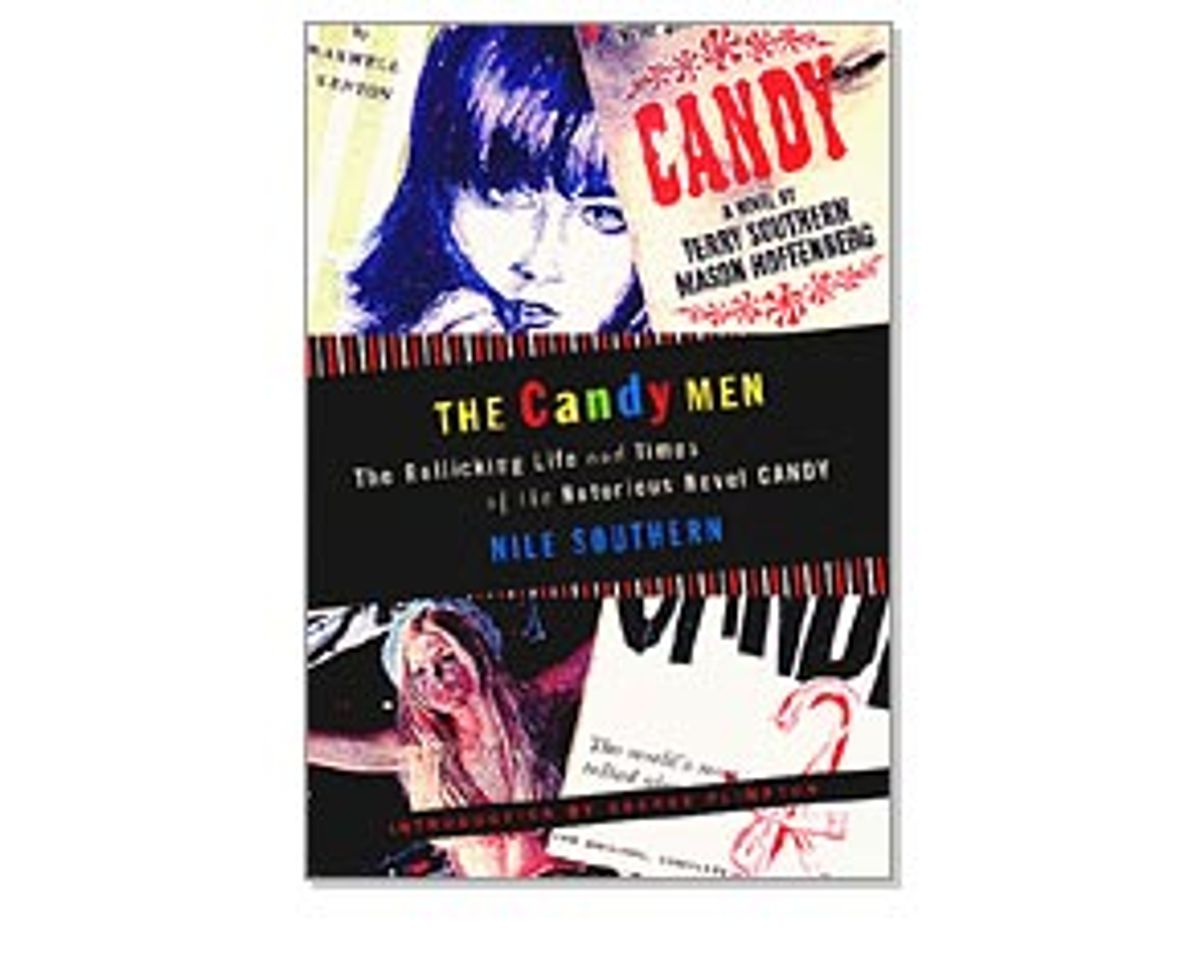
"Candy" also remains one of American publishing's most convoluted stories, with conflicting claims of copyright, piracy and royalties. This is the mess that Terry Southern's son, Nile, sets out to untangle in "The Candy Men: The Rollicking Life and Times of the Notorious Novel 'Candy.'" He doesn't entirely manage it. The labyrinth of documents, contracts, letters, warring agendas, suspicions and egos Nile Southern is navigating here is frequently dizzying, and the details finally seem like background to the main story of a friendship gone wrong, and two literary careers sputtering out.
The basic story goes like this: Terry Southern and Mason Hoffenberg, two expatriate American writers, met in Paris in the late '40s. They were part of a diverse group that included Mordecai Richler, James Baldwin, Alexander Trocchi and the set around his magazine Merlin, on one hand, and George Plimpton and the better-heeled set around the Paris Review on the other. Inevitably, one of the characters most struggling writers in Paris met at that time was the daring and wholly untrustworthy Maurice Girodias, founder of the notorious Olympia Press.
Girodias, often running from his creditors and from government censors, was the first to publish books like "Naked Lunch" and "Lolita." They appeared as part of his Traveler's Companion Series, a demure-looking series of baize-green paperbacks that encompassed not only those significant works of modern literature (along with Nabokov and Burroughs, French novelist Raymond Queneau was also represented) but pornography written for hire. Trocchi ("Cain's Book," "Young Adam") and the American Iris Owens ("After Claude") were among the writers who turned out porn for a quick buck. (Trocchi's "Helen and Desire" is, if you can find it, absolutely delightful smut.)
Over several years, Southern and Hoffenberg put together "Candy," whose authorship was attributed to one "Maxwell Kenton." When French authorities seized the book, Girodias merely republished it under the title "Lollipop." In the years following "Candy," Southern made a name for himself as a novelist ("The Magic Christian" and "Flash and Filigree"), journalist, and screenwriter ("Dr. Strangelove" and "Barbarella"), while Hoffenberg's flirtation with heroin became a lifelong love affair.
"Candy" was published in hardcover in America by Putnam in 1964. But due to the combination of the authors' carelessness and Girodias' underhandedness, the book, which was never properly copyrighted, was soon being pirated by a variety of other publishers. Southern and Hoffenberg lost thousands on the pirated editions. They also lost their friendship as Hoffenberg began to resent his partner's success and as Southern pulled away from Hoffenberg, who had become obsessed with settling the score with Girodias. It was Southern alone who was signed to write the screenplay for the -- unwatchable -- 1968 movie version of "Candy," one of the decade's most notorious bombs.
By then, Terry Southern's fiction career was almost over. A brilliant collection of short stories and journalism, "Red-Dirt Marijuana and Other Tastes," came out in 1967 (and included some stories that can stand with Faulkner). His penultimate, and best, novel, the wild "Blue Movie," would appear in 1970. But Southern devoted himself to writing screenplays that went unproduced, or doing polish jobs on other writers' screenplays, often just generating enough money to placate the IRS, with whom he had trouble for years. There was a one-season stint as a writer on "Saturday Night Live" in the early '80s (to borrow a phrase from Camille Paglia, Southern writing for "SNL" was like Caruso dueting with Tiny Tim), and also an increasing dependence on booze and speed.
Southern suffered a heart attack in 1995 on the steps of Columbia University, where he was teaching a writing course, and died four days later. Hoffenberg had preceded him in 1986, dying of lung cancer after years of using junk.
(It has been Hoffenberg's bad luck to have "Candy" spoken of as if it were the sole creation of Terry Southern, and what follows in this piece may be guilty of the same. "The Candy Men" reveals that most of Hoffenberg's contribution was in the novel's "Dr. Kranekit" section. Unlike Southern, Hoffenberg left behind almost no other public writings from which to discern a distinctive voice.)
Even if you get lost in the legal maneuverings and depressed by the downer arc of the tale, "The Candy Men" offers the pleasure of a generous selection of Southern and Hoffenberg's correspondence. We are in the realm of the hipster here, in the company of men who push a joke as far as it can go for the sheer pleasure of seeing what they can get away with. In a 1954 letter written from Greenwich Village to Hoffenberg in Paris, Southern alerts Hoffenberg to a pair of young women traveling to France:
"These are two nifties, Hoff, and will be calling for organ thick and fast. To get the best out of one of them ... you'll be wanting to don a beard and say, repeatedly during the act: 'I'm your old dad! I'm your old dad!' and the child will spasm like a veritable machine-gun."
It wasn't just to Hoffenberg that Southern wrote like this. After "Candy" appeared in the U.S., an excerpt of the novel was slated to appear in the porno mag Nugget (this was when skin mags actually had some literary content), then under the editorship of the writer Seymour Krim. But Krim, nervous about getting in trouble with the censors, changed a phrase uttered by Candy's nymphomaniac Aunt Livia, "hot greaser cock," to "hot greaser stuff." Southern responded:
"The word 'stuff' has vague and amorphous connotations, whereas it is well known that Livia required organ of stout and smart definition, and it does, I must say, reflect editorial shoddiness of a very shocking order. I'm not insisting on the word 'cock' ... 'Hot greaser joint' is acceptable, as is 'bit,' 'wood,' 'rod,' 'dip-stick,' 'shaft,' 'staff' and 'jelly-roll' (or 'jumbo,' or the very contemporary 'zoomba'!) ... You'll be hearing from my powerful solicitor who is charged to oversee these instructions."
You can detect in that seemingly frivolous letter Southern's insistence on getting the exact tone and rhythm (what Norman Mailer famously called Southern's "clean, mean, coolly deliberate, and murderous prose"). His friend George Plimpton once described Southern's style of speaking as combining the sound of his native Texas with mock English propriety and locutions and a hipster habit of abbreviation. Transferred to Southern's prose, that combination of hipness and propriety allowed nearly anything to be described in language suitable for a speaker addressing the Ladies Sewing Circle at the local Episcopalian church. Take this sentence from "Candy": "'Well,' said Candy, 'I've never met a ... gynecologist socially. How do you do?'"
Look at the nuances packed into that brief sentence: Candy's polite pause -- almost a demurral -- before speaking the word "gynecologist" in mixed company; the way the emphasis on the conditional "socially" rushes to assure her listeners that Candy has, in fact, been to a gynecologist; and finally the way she steers away from that revelation back to social decorum with the very proper, "How do you do?"
Southern could also parody Rotary Club boosterism. He delighted in taking American glad-handing for a drag through the gutter, as in this sentence from "Candy" describing a pair of preps boozing at a West Village bar: "Jack Katt and Tom Smart there, at a front table, lushing it up and keen for puss." The rhythm of that opening evokes nursery rhymes ("Jack Sprat could eat no fat"), but the overall effect is a succinct evocation of drunken, horny, loudmouth rich kids. Can't you see them now, Darien, Conn.'s finest in their Brooks Brothers casuals, slumming it for the evening in a boho bar?
Apart from the concern with tone and language, that letter to Seymour Krim reveals something of the era in which Southern and Hoffenberg worked. "Candy" was published during a period that saw some of America' censorship laws finally defeated, thanks to the efforts of publishers like Grove Press' Barney Rosset and lawyers like Edward de Grazia. But the danger of government prosecution was still potent enough to make writers feel as if they were operating under the Puritans.
Consider these particulars: John Cleland's "Memoirs of a Woman of Pleasure" (aka "Fanny Hill") was first published in 1748-49. It has only been legal to read it in America since 1963. D.H. Lawrence's "Lady Chatterley's Lover" has been legally available, both here and in the United Kingdom, only since the early '60s. Henry Miller's "Tropic of Cancer" and "Tropic of Capricorn" were cleared of obscenity in the U.S. just a few years later. In 1966 "Naked Lunch" was convicted of obscenity in Massachusetts and then cleared by that state's Supreme Court. "The Candy Men" reveals that the FBI, under the directorship of J. Edgar Hoover, investigated the possibility of bringing "Candy" up on obscenity charges, but concluded the book was obviously a satire. A bowdlerized version of "Candy" was published in England in 1968 (the critics ridiculed the timidity of the publisher) and the book didn't appear uncut there until 1970.
This is the atmosphere in which Southern and Hoffenberg brought forth "Candy." It's frightening to think that, had the book been written today, it might have faced the legal troubles it eluded in the '60s. Various bills like the Child Pornography Protection Act outlawed the portrayal of sex between minors, which meant, for instance, that the wedding-night scene in a production of "Romeo and Juliet" could have been legally classified as child porn. What might such an act have done to "Candy"?
In "Candy," dewiness meets defilement. The joke of the book isn't just that everyone Candy meets is ready to take advantage of her, just as they took advantage of her namesake Candide, it's that she participates willingly in her own abasement. "To give of oneself -- fully," Candy writes in her college thesis, "is not merely a duty prescribed by an outmoded superstition, it is a beautiful and thrilling privilege." Believing it, Candy goes on to meet a succession of men -- her literature professor, the Mexican gardener, a guru, a surgeon, her own uncle, and, in the book's most notorious sequence, a brain-damaged hunchback -- out to convince her that it will be a beautiful and thrilling privilege to give herself to them.
Candy Christian has often been classed with Lolita as one of literature's hotties. But Candy shares less with the knowing, wised-up Lolita than with Lolita's poor culture-mad mother, Charlotte Haze. Suckers who want to think of themselves as enlightened, they have a '50s American taste for "progressive" psychology, and for the accouterments of refinement. With her sherry and her copy of "Songs of Innocence and Experience," no less than the men she gives herself to, Candy believes she's asserting her independence over the stultifying taboos of her middle-class upbringing. To Southern and Hoffenberg, she represents another kind of American conformity.
Southern conceived Candy as the epitome of all the attractive girls he had seen in Paris and Greenwich Village who gave themselves to the worst creeps imaginable as long as said creeps were able to talk a compelling line of B.S. (The right comment about poetry or art or music and the next stop, as Southern once said, was "Poon City!") Which is why the most repulsive of Candy's lovers, the demented hunchback, provides the novel's most hilarious scene. Candy has -- understandably -- turned down his charming seduction gambit, "I want fuck-suck you," but just as quickly gives in after he points to his hump and asks, "Is because of this?" What follows is a wicked contrast of Candy's "selflessness" with the baseness of her paramour's intentions:
"It means so much to him, Candy kept thinking, so much, as he meanwhile got her jeans and panties down completely so that they dangled now from one slender ankle as he adjusted her legs and was at last on the floor himself in front of her, with her legs around his neck, and his mouth very deep inside the fabulous honeypot."
And what's going on in the hunchback's mind during this? "... the most freakish thoughts imaginable -- all about living and broken toys, every manner of excrement, scorpions, steelwool, pig-masks, odd metal harness, etc." And there you have it, a sexual Florence Nightingale meets the hell-spawn of de Sade and Quasimodo.
Candy's descendants were still around when I was in college in the late '70s and early '80s, still as curious as they were naive, still ready to dismiss as cynicism any suspicion of "new" ideas and experiences. The cuter they were, the more willing they seemed to throw themselves to the lions. But are the same type of girls around now? What does "Candy" mean in the age of Britney Spears or the Olsen twins -- or the Bush twins, for that matter?
You can imagine any of these young celebs setting all sorts of comic bells ringing in Southern's imagination. But the frankness of their affect and couture -- porno chic as marketed by Contempo Casuals -- is miles away from the sunny eagerness of Candy Christian. Something in them seems even to resist that favored adjective of dirty old men -- "nubile." You can't imagine any of them possessing innocence, let alone the cheerful naiveté of Candy. Or at least the same sort of naiveté.
Consider the thimble-deep knowingness exuded by Britney, that look of perpetual blahness on the Olsen twins' faces, as if they were always just barely putting up with everyone else, they're not going to be taken in by anything. It also tells you they are not going to be excited by anything. Seen through contemporary eyes, Candy's unsophisticated attempts at sophistication appear almost like the studiousness of the class grind. And though you could perhaps detect some echoes of Candy's emerging "social conscience" -- in Ralph Nader voters, for instance -- its earnestness seems of another time, too.
I don't mean to suggest that "Candy" is past its sell-by date. Any society whose government can fly into high dudgeon at the sight of Janet Jackson's breast is still wallowing in the sort of Puritanism that Southern dragged into the bushes and ravished. But I do mean to suggest that society has caught up with Terry Southern. In its crassness, its lust for celebrity, its pornographication, in the willed yahooism of its politics, America has seemed, for some time now, to be operating according to a Terry Southern scenario. For the last 30 years or so, he has been the Edgar Bergen of the American zeitgeist. I wish there had been more Terry Southern books, but his voice is a constant. For me there is no other writer whose voice is more present in American public life, whose distant cackle can be detected in the (often overlapping) lingo of showbiz and advertising and corporations and politics.
It's the spirit of Guy Grand, the prankster millionaire of "The Magic Christian" who believes that everyone has their price, that presides over reality TV. The people who dumpster-dove in that novel for the money Grand had hidden among the most foul offal now eat that offal on "Fear Factor." When, as New York magazine reported a few weeks back, Condoleezza Rice attends a Manhattan dinner party and says, "As I was saying last week to my husb -- ... As I was saying last week to the president," that's a prelude to some porno Terry Southern fantasy, the White House as setting for "Mandingo." When Ken Starr, with the epicene baby-face of a man who, in his 50s, still lives with his mother, succeeds in turning the national dialogue to blow jobs, cigar dildos, and semen stains, it's a Terry Southern fantasy come true. The only thing that could top it would be the pope having a Tourette's attack during Easter mass.
A few years back in Film Comment, the critic Howard Hampton suggested that the nympho little sister played by Martha Vickers in Howard Hawks' film of "The Big Sleep" is the prototype for every fame-hungry porn starlet making her way to the San Fernando Valley. Candy Christian, with her sherry and her LPs of Gregorian chants and her thesis on "Contemporary Human Love" doesn't seem like much of a prototype for contemporary American girlhood. The new naiveté is of a different sort.
"Candy" feels to me both eclipsed by and cannier than the present time. Teenage girls (and girls not yet in their teens) dressing like porn stars to emulate their idols might have been the product of a Southern fantasy, but they're a long way from Candy's applying a spritz of Tabu as she awaits a midnight visit from the Mexican gardener. Yet the Britney and Christina wannabes don't seem much more sophisticated; they've just learned a more hard-bitten way to be naive. No one has yet figured out how to satirize that. Or even whether you can.
Shares