Consciously or unconsciously, great storytellers have a way of tipping us off to their concerns right upfront. On the first page of "At Canaan's Edge," the concluding third volume of his magisterial "America in the King Years," Taylor Branch writes about J.T. Haynes, a high-school agriculture teacher in Alabama's Lowndes County, the region that in the '60s would see some of the worst Klan violence against the civil rights movement and would also give rise to the Black Panther Party. "Haynes," Branch writes, "a teacher of practical agriculture, tried to harmonize his scientific college methods with the survival lore of students three or four generations removed from Africa -- that hens would not lay eggs properly if their feet were cold, that corn grew only in the silence of night, when trained country ears could hear it crackling up from the magic soil of Black Belt Alabama."
You could argue that Haynes, being black himself, had a built-in kinship to the black sons and daughters of Lowndes County. But seen from the midst of our current national division, one that's less dramatic though perhaps just as poisonous as the divisions of the '60s, it's hard not to read Haynes' faith that he could reach his students -- not to overwhelm them or argue them down but, in Branch's exquisitely chosen word, "to harmonize" -- as a belief in the transformative power of discourse, a belief that America, both right and left, has largely abandoned.
And if that faith is abandoned, Branch would likely argue, then Martin Luther King Jr.'s vision is a dream that has no hope of being realized.
Every year, Dr. King's birthday brings editorials extolling how far we've come from the days of legal segregation (true) or lamenting how far we've fallen short of his example (also true). Writers complain that a day devoted to nothing more than shopping is no way to honor his legacy. The far more insidious debasement of King's legacy can be seen every day in what passes for political engagement in America right now. In 2003, in the left political journal Dissent, Queens College history professor Michael Wreszin inadvertently exemplified that debasement when, responding to co-editor Michael Walzer's assertion that the left needs to enter a dialogue with the people most set against it, he asked if King should have been expected "to communicate with the average white citizen in racist Mississippi and Cicero, Illinois." And, of course, the answer is yes. King knew that if he didn't communicate with those people, there was no hope of eroding racism. That doesn't mean that he took a gentle line with them, or hesitated to name ignorance and brutality when he encountered it. But King's approach depended on reaching reasonable people, people who may not have been ready to welcome black people into their homes but who, ashamed by the more repellent racism around them, were finally able to see the legal and moral arguments for admitting blacks to lunch counters and public facilities and, the toughest stretch of all, to their schools and neighborhoods.
That's a rapprochement Wreszin can't imagine. He writes from the blinkered depths of a culture war where the most notorious phrase of a despised president, "You're either with us or you're against us," fits the mind-set of both his fiercest adherents and his most vociferous opponents. Just as politics is not possible if you're not willing to say what people don't want to hear, it's not possible if you're willing to listen only to what you want to hear.
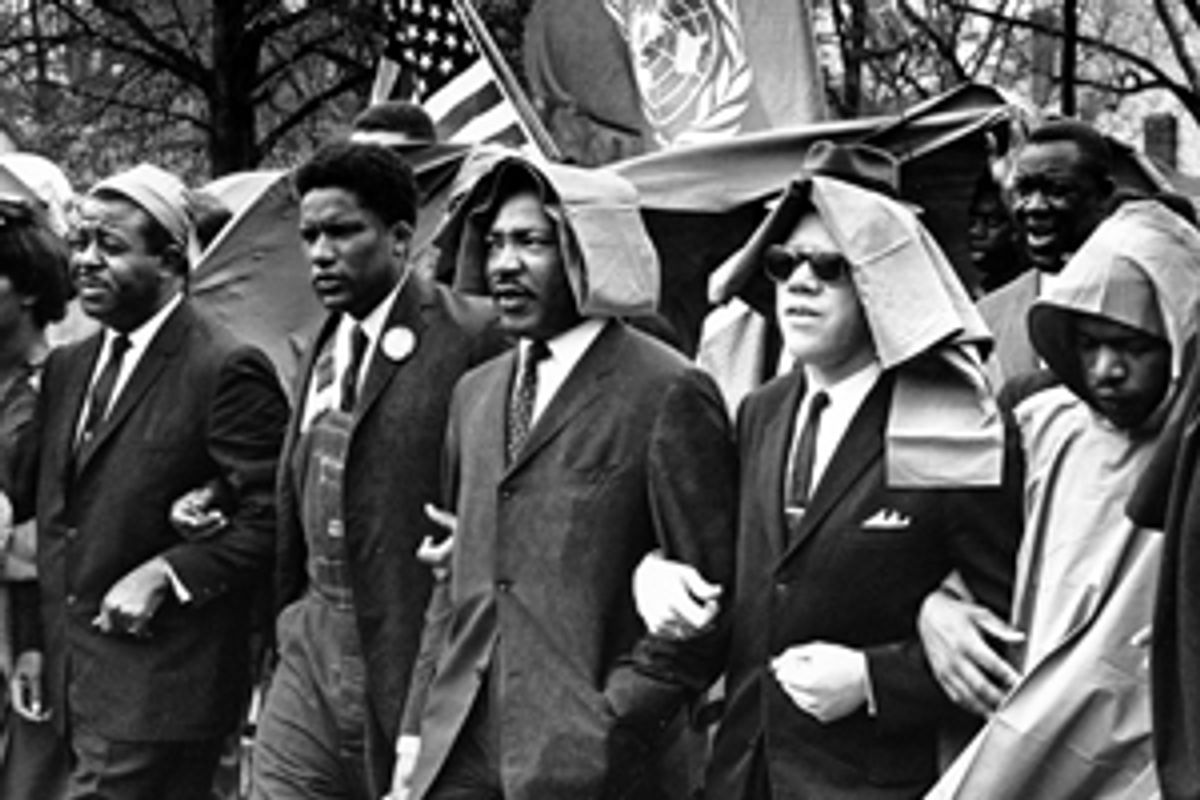
In "At Canaan's Edge," which deals with 1965-68 -- the years spanning the Selma to Montgomery march to King's assassination in Memphis -- Branch sticks to the facts, following the story (not just of King but of "America in the King Years") into Vietnam, tracking J. Edgar Hoover's campaign against King, charting the divide between the civil rights movement and the emerging black power movement, and almost never interpreting. There is a vision that comes through, though, a vision that is an implicit rebuke to the divisiveness of what currently passes for politics.
For Branch, nonviolence represents the highest form of political engagement because it must be employed at the moments when it's most tempting to abandon the idea that engagement is even possible. Branch wants to demonstrate the political viability of nonviolence as both moral stance and practical strategy -- even though he calls nonviolence "an orphan among democratic ideas" that "has nearly vanished from public discourse even though the most basic element of free government -- the vote -- has no other meaning." What's been orphaned, in Branch's view, is an expansive vision of what it means to be a citizen.
"America's founders centered political responsibility in the citizens themselves, but, nearly two centuries later, no one expected a largely invisible and dependent racial minority to ignite protests of steadfast courage -- boycotts, sit-ins, Freedom Rides, jail marches -- dramatized by stunning forbearance and equilibrium into the jaws of hatred." In other words, Branch is saying, people who were not even allowed the rights granted them by the Constitution acted, not simply for their own freedom, but as if the very fate of the republic depended on their actions. In order to do that, they had to have faith that the potential and the possibility of America far surpassed the worst of its governance and its people.
Branch does not need to underline the irony that some in the civil rights movement, like J.T. Haynes, were World War II vets, and returned from combat only to face a homegrown fascism. Haynes was in the congregation of Mt. Carmel Baptist Church in Lowndes County on the night of Feb. 28, 1965, when Klansmen surrounded the church with rifles. (The congregation was able to leave when the Klansmen inexplicably withdrew.) Incidents like this, and the earlier murder of a 26-year-old pulpwood worker named Jimmie Lee Jackson, shot twice in the stomach by police during a night march from Zion's Chapel Methodist Church, galvanized the response to Rev. James Bevel's proposal for a 54-mile march from Selma to the Alabama state capital in Montgomery. The march would take participants right through the heart of Lowndes County. The violence began before the marchers even made it out of Selma.
The first attempt at a march, on Sunday, March 7, 1965, resulted in the notorious scenes of Gov. George Wallace's Alabama state troopers and reserves on horseback ramming through marchers as they attempted to cross the Edmund Pettus Bridge. ABC showed footage of the carnage that night, interrupting its broadcast of "Judgment at Nuremberg." (At the point ABC cut into the film, a German couple was explaining they knew nothing about the treatment of Jews under Hitler.) A second attempt was made during which King turned back so as not to defy a court order barring the march. Hours later, the Rev. James Reeb, a Unitarian minister who had come from Boston to join the march, was clubbed outside a cafe and later died of his injuries. The third -- and finally successful -- march was begun on March 21. The marchers, their ranks victoriously swollen, reached Montgomery on March 24. That night, Viola Liuzzo, a white marcher from Detroit, was shot to death as she began the long drive home to Michigan. (It was later revealed that one of the passengers in the shooter's car, Gary Thomas Rowe, was an FBI informant who almost certainly had knowledge of what was going to happen.)
The Selma to Montgomery march takes up almost the first 200 pages of "At Canaan's Edge." It needs to, because it was the last great march of the civil rights movement. It was also the moment when the coalition formed between church groups like King's Southern Christian Leadership Conference and student groups like the Student Nonviolent Coordinating Committee, and others like the Congress of Racial Equality, began to fray. The deaths of Jackson, Reeb and Liuzzo, the 1964 murders of the Freedom Summer volunteers Andrew Goodman, James Chaney and Mickey Schwerner, and the constant threats and danger civil rights workers faced in the rural South were starting to grind down the commitment to nonviolent change. To people who had seen their co-workers beaten or had themselves suffered in jails, King's unwavering insistence on nonviolence came to seem almost suicidal.
Branch understands the almost inhuman effort required of people not to react violently when they live in constant fear for their lives. Reading "At Canaan's Edge," you understand exactly why Stokely Carmichael, arrested 27 times during his work with SNCC, finally came to the point where he yelled at a crowd of demonstrators about to be tear-gassed by state troopers, "You tell them white folks in Mississippi that all the scared niggers are dead!" You see why Carmichael and movement figures like SNCC's James Forman came to conclude that nonviolence would not help American blacks. More profoundly, you understand just how foolhardy a conclusion that was.
What is frequently branded radical politics in America is often just romantic fantasy, a childish impatience with anything that produces less than immediate results, mistakenly equating the compromises that politics entails with corruption. One of King's favorite quotations, often used in his speeches, was the abolitionist Theodore Parker's "the arc of the moral universe is long, but it bends towards justice." That was not a means of mollifying people who had given and suffered so much -- it was a way of honoring that suffering and sacrifice. It would be wrong to discount the sacrifices that the members of SNCC made. It's not exaggerating to say that attempting to register black voters in the South at that time was an invitation to being murdered. But as SNCC became increasingly radicalized, it, along with the Black Power movement and the Black Panthers -- who, with their uniform of leather and sunglasses and proudly displayed weapons, had made themselves the stars of the vigilante movie playing in their heads -- came to be certain that working toward equality through the mechanisms of representative democracy was the same thing as making yourself a whipping boy for the Man.
One of the few places in the book where Branch betrays his own impatience is when he writes of SNCC, "They were no longer students or nonviolent. They no longer coordinated sacrifice beyond the wisdom and courage of the nation's elders, nor operated by egalitarian grassroots committee. Instead, they competed for celebrity attention while reverting to youthful disputes as tawdry as snipes at their clothes." Having given them the respect they are due, Branch is, I think, saying that finally they did not have the moral courage to live up to the meaning of their sacrifice, and that their rhetoric was less articulate than the unspoken faith shown by others who were confident that the courage they had shown and the violence they had endured would pay off in profound change. Those people understood, as a friend of mine put it, no real revolutionary ever hated his own country.
Lost in the fantasy that the system was so rotten it could not be changed, SNCC ceded the moral high ground to, among others, the president it despised, Lyndon Johnson. In Johnson's March 1965 address to Congress on the moral necessity of passing the Voting Rights Act -- along with Lincoln's second inaugural address, it remains the greatest of all presidential oratory -- Johnson showed both verbal and moral eloquence: "It is not just Negroes, but really it's all of us, who must overcome the crippling legacy of bigotry and injustice. And we shall overcome." Mayor Joseph Smitherman of Selma said that hearing a white Southern president say those words was like "a dagger in your heart." James Forman's response: "That cracker was just talkin' shit."
One of the things Branch brings back so vividly is how unfashionable Martin Luther King became in the last years of his life. I choose the adjective deliberately. There were plenty of people willing to groove on the same fantasies of rebellion. Branch records a debate in New York City where Hannah Arendt, who was shortly after to formulate her own response to the revolutionary perfume in the air in "On Violence," argued that "violence always arises out of impotence." From the floor Arendt was challenged by Tom Hayden, who claimed democratic means had been exhausted for ending the war in Vietnam and racism at home (especially when you give up on the democratic process), and Susan Sontag, who said that arguments about the nature of violence dodged the question of action, "whether we in this room, and the people we know, are going to be engaged in violence."
By 1966, Andrew Kopkind, writing in the New York Review of Books, said haughtily of King, "Whites have ceased to believe him, or really to care; the blacks hardly listen." Shortly after, in the same pages, Kopkind was extolling as the true movement the National Conference for New Politics, at which H. Rap Brown had said, "We should take lessons in violence from the honkies. Lee Harvey Oswald is white. This honky [Richard Speck] who killed the eight nurses is white."
It's easy to dismiss Kopkind's effusions and Hayden's posturing and Brown's psychotic babble as the nuttiness that's in the air at any given time, and that eventually fades out of vogue. But the moment-to-moment style of Branch's prose suggests the harm that fuzzy thinking can do in its own time, draining energy and thought from the hard work of forging change, and offering escapist fantasy from the sometimes untenable choices of real politics.
Which is not to say that nonviolence doesn't present its own set of moral problems. When Arendt finally published "On Violence" in 1969 she acknowledged that nonviolent resistance can only be employed against a democratic country. Against a totalitarian country that used violence to force compliance, nonviolence is doomed. "Those who oppose violence with mere power," she wrote, "will soon find that they are confronted not by men but my men's artifacts, whose inhumanity and destructive effectiveness increase in proportion to the distance separating the opponents." And strict adherence to nonviolence can produce its own inhumanity. In his essay "Reflections on Gandhi," George Orwell noted that Gandhi said the correct pacifist response to the Nazi persecution of Jews was that the Jews should commit mass suicide and thus rouse the world to action.
But Arendt's arguments provide a hardheaded reply to the charge that King's nonviolence was merely fuzzy Christian humanism unsuited to the reality of his time. "Power springs up whenever people get together and act in concert, but it derives its legitimacy from the initial getting together rather than from any action that may then follow," she wrote. "Violence can always destroy power; out of the barrel of a gun grows the most effective command, resulting in the most instant and perfect obedience. What can never grow out of it is power."
And that, in large part, is why King's ideas truly deserve to be called radical when the fantasies of those who claimed he was out of touch remain such dangerous nonsense. When praising those who've been deemed moral leaders, people tend to overlook their pragmatism as if such common-sense concerns somehow invalidated their aura of saintliness. For King, nonviolence was clearly and primarily a moral principle. But it was also a practical one. He knew that many people who had not been convinced of the need for racial equality would be, understandably, turned off by violence. Which means that, for King, nonviolence was an act of faith that people were capable of change, and that the mechanisms of representative democracy were capable of enshrining those changing attitudes into the law of the land.
With this final volume, "America in the King Years" becomes unsurpassed in the last 50 years of American biography. Which is not to say that Branch has written a perfect book. His syntax is at times unnecessarily twisted, and he can be careless about identifying the figures in the story. The last section of this epic tale is fragmented in the telling, but that is perhaps unavoidable; the story itself is fragmented and thus, not as emotionally satisfying as the stories of the civil rights movement's earlier triumphs. As King moved his campaign into the Northern ghettos (notably, Chicago), he found problems not given to such clear-cut moral victories. And as he began to speak out against the war in Vietnam, the moral thrust of the civil rights movement began to seem blunted -- though with a disproportionate number of blacks fighting the war, and with funding for the war undermining the funding for LBJ's Great Society programs, protesting Vietnam was a logical step. (Branch is merciless in detailing how the establishment press, particularly the New York Times, said King had no standing to speak on Vietnam. Those Op-Eds were the polite Eastern version of telling King to step to the back of the bus.)
But these are minor reservations about a book that gradually reveals a large-scale vision of democracy as an act of hope thrown down like a gauntlet. If one of the marks of greatness is that a person's stature continues to grow after he is gone, then King is one of the titans of American history. Next to his example, what passes today for a politics of opposition seems puny, snobbish, a closed circle rather than one ready to expand to allow those willing to enter. It's heartening to pick up the paper and read of the Georgetown students who protested Attorney General Gonzales' speech justifying Bush's domestic spying. A dozen of them simply stood and turned their back to Gonzales while others unfurled a banner that quoted Benjamin Franklin: "Those who would sacrifice liberty for security deserve neither." As an act of protest it was simple, elegant and to the point, devoid of the grandstanding, the sheer thoughtlessness, that marks so much political speech.
What no one seems willing to say about the red state-blue state divide is that people on both sides like it because it allows them the dual pleasures of feeling superior and having someone to hate. I don't doubt that the Bush White House would love to stifle dissent. But there is something skin-deep about arguing for dissent in an atmosphere where the dissenters have adopted the same simplistic moral scheme of those in power. We have become so scared of appearing to be on the incorrect side of an issue, so scared of seeming to give credence to the other side, that we are willing to eliminate inconvenient facts from our rhetoric, ignore ugly echoes. (It's depressing to hear "sovereignty" cited as a reason against going into Iraq -- a war I oppose. It's the same argument used by segregationists of the '50s and '60s as a way of resisting integration. Arguing for the sovereignty of a tyranny is simply a means of legitimizing the oppression of its people.)
Against the current certainty on the right and the left that the other side is beneath contempt, not worth talking to -- an attitude that leaves no possibility for real change and reduces democracy to majority tyranny, no matter who is in power -- we have King's belief in the ability of people and their country to overcome the worst in themselves. In his vision empathy is not appeasement but the beginning of change. In his introduction, Branch quotes the last words of Mickey Schwerner, spoken to the Klansmen who held a gun to his head: "Sir, I know just how you feel." That's the challenge this story throws down to us. How can any less be expected of those of us who don't have a gun to our heads?
Shares