

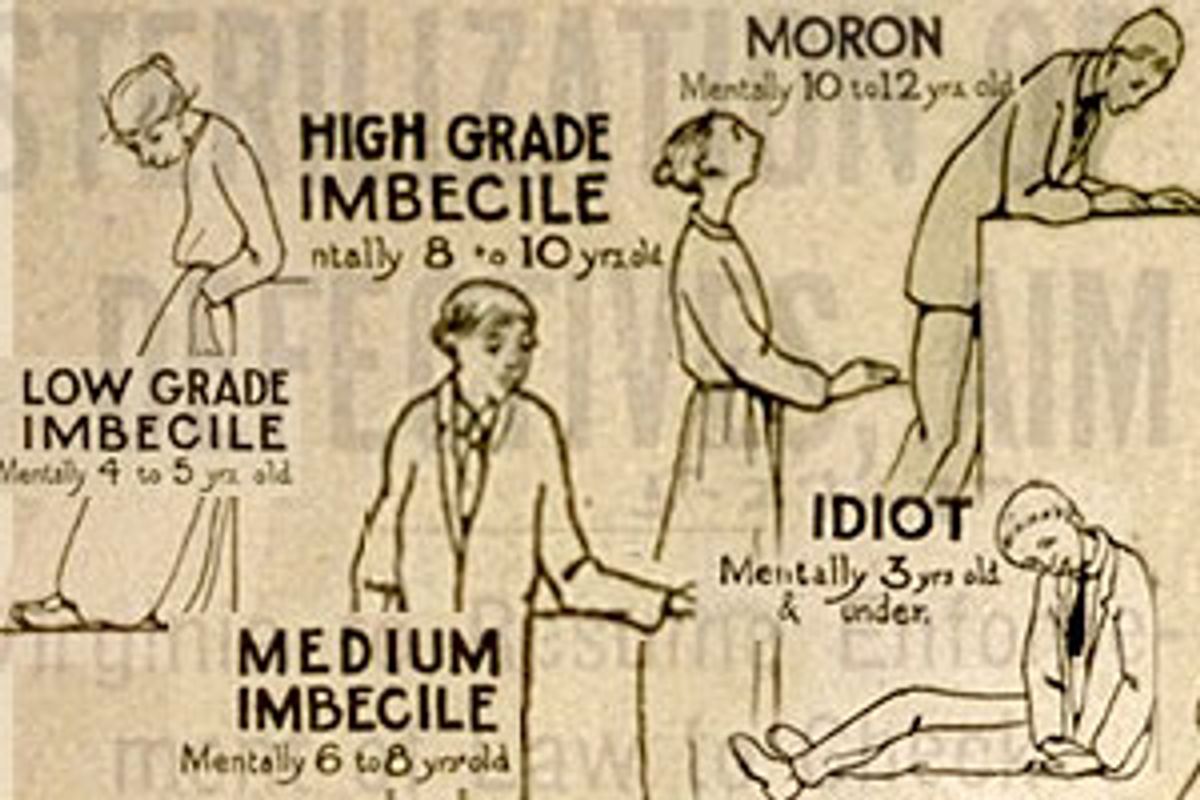
Among the many concerns that captivated the American educated class early in the last century, few were thought to be as urgent as the threat posed to the nation by sexually insatiable female morons. This may sound silly; today, our fear of morons is rather abstract, and on a national scale confined mostly to whomever is the current resident of the White House. But a hundred years ago, morons were public enemy No. 1, seen as a drain on the nation's resources and a grave danger to its stability. The situation was most keenly appreciated by progressives -- scientists, businessmen, feminists and liberal politicians -- who, as even the best of us sometimes do, feared that within a short time, the nation would be overrun by simpletons.
But how do you solve a problem like the moron? These poor people, for one, weren't easy to spot. "Feeblemindedness," the medical condition from which morons suffered, was chiefly manifested by subtle, difficult-to-diagnose symptoms, such as poor judgment and a susceptibility to deviance. The only way to tell if you were dealing with a certifiable moron -- an actual medical term -- was by administering an intelligence questionnaire (an early version of the IQ test), which scientists believed could accurately assess a patient's "mental age." Unlike idiots and imbeciles (who were characterized by significant, obvious mental defects), morons, who were grown-ups who showed mental ages that were far below their physical maturity, might do well in school, they might hold down jobs, and they might even manage to raise children -- but all this was to be thought of as a ruse, because sooner or later, they'd go astray.
As the journalist Harry Bruinius explains in "Better for All the World: The Secret History of Forced Sterilization and America's Quest for Racial Purity," his comprehensive new history of the American eugenics movement, the problem wasn't just that morons were given to crime and poverty; because feeblemindedness was a genetic condition passed on from one generation to the next, their children, and their children's children, and on and on, were similarly suspect as well. Of particular concern were the afflicted women, in whom scientists had found the symptoms of feeblemindedness more pronounced. Female morons gave in to their sexual urges more quickly than feebleminded men, and they sometimes deceived normal men into consorting with them; in addition, they were "hyper-fecund," as doctors termed their apparent tendency to become pregnant easily. Put this all together, as many smart Americans did, and you had a big problem on your hands: an extremely fertile, extremely needy, apparently permanent underclass.
It's lately become fashionable to reckon with growing ignorance among one's countrymen by threatening to emigrate to Canada; for American intellectuals of an earlier generation the more obvious solution was forced sterilization. At the dawn of the medical age, when scientists were just beginning to discover both the evolutionary basis to biology as well as painless, "humane" procedures to render humans infertile, it was the nation's rationalists who hit upon the idea of sterilization as a way to solve the problem of multiplying morons, Bruinius explains; the main opposition to the horrific idea came from religious fundamentalists.
Progressives saw sterilization as having natural advantages over traditional methods of helping the poor, such as charity. Sterilization was "scientific" -- its rationale could be found in the writings of Charles Darwin's cousin Francis Galton, the father of eugenics, who mused that superior people, like superior crops and farm animals, were the product of good breeding. The term "gene" had not yet been coined -- among the surprises in Bruinius' book is that the science and the word "genetics" were born of the pseudoscience eugenics, and not vice versa -- but any well-read person could understand that if you wanted to rid the world of inferior people, you ought to stop them from passing on their characteristics to future generations. Whereas charity only prolonged and deepened the problem of poverty by allowing the "unfit" among us to survive and procreate, sterilization presented what you might call a permanent, final solution. Give a man a fish and he eats for one day; cut his mother's fallopian tubes and you can be pretty certain not to need any fish, or fishing lessons, in the first place.
Much of the story of the American eugenics movement has been forgotten, and this is the main thing Bruinius' book has going for it. Though it's at times discursive and repetitive, tends toward the melodramatic, and is probably too long by half, "Better for All the World" tells a story few Americans know or have considered much. Bruinius says the history is "secret," but there isn't much deliberate obfuscation in the record -- indeed what's most surprising about our eugenics past is how public, proud and prominent its proponents were about their aims. There's perhaps a better explanation for why we've forgotten the story: Eugenics in America can be seen as something like a tragedy deferred, a terrible path that we veered toward, but, like the presidency of Charles Lindbergh, wisely averted at the last minute. To the extent that we remember the eugenicists now, we think of them as faddists; like phrenologists before them or, in a later generation, dot-com evangelizers, eugenicists caught some attention by peddling a simple and attractive solution to many of the world's ills, and while they may have caused a good deal of trouble in the process, they were eventually outwitted. Eugenics in America is a historical blemish, not an open wound, and it's the open wounds one tends to remember. Another way of saying this is, at least we're not Germany.
And yet in Bruinius' telling American eugenicists don't look nearly so inconsequential. Importantly, Bruinius points out, we were the first to pick up the eugenics bug. Galton, a Brit, provided the intellectual basis for eugenics, but Americans, who fancied themselves a chosen people and whose blood has always run hot on matters of utopia, actually implemented the plans. In 1907, Indiana passed "the first sterilization law in human history," Bruinius writes, and "in the next two decades, the United States became the pioneer in state-sanctioned programs to rid society of the 'unfit.'" At least 30 states enacted similar laws, and sterilization became routine. California, which ran the most aggressive program, sterilized more than 2,500 people in a 10-year period; in all, more than 65,000 Americans were rendered infertile.
More astonishing than the number of people sterilized is the long list of famous Americans who supported and sanctioned such programs. Bruinius takes his book's title from the 1927 Supreme Court majority opinion in Buck v. Bell, which ruled that the Constitution did not prohibit Virginia -- and, consequently, other states -- from sterilizing its citizens. The opinion, by Oliver Wendell Holmes Jr., is Bruinius' trump card, and he repeats bits of it often; if you have trouble believing that anyone with half a brain might have bought the arguments of eugenicists, the opinion settles the matter.
"We have seen more than once that the public welfare may call upon the best citizens for their lives," Holmes wrote. "It would be strange if it could not call upon those who already sap the strength of the State for these lesser sacrifices [ i.e., forced sterilization], often not felt to be such by those concerned, in order to prevent our being swamped with incompetence. It is better for all the world, if instead of waiting to execute degenerate offspring for crime, or to let them starve for their imbecility, society can prevent those who are manifestly unfit from continuing their kind." Referring to Carrie Buck, the plaintiff in the case whom the state intended to sterilize, and whose mother and daughter both had been suspected by doctors to be afflicted with feeblemindedness, Holmes added: "Three generations of imbeciles are enough." (As Bruinius points out, Holmes had this label wrong; Buck and her kin had been diagnosed as morons, not imbeciles.)
Others who supported eugenics included Victoria Woodhull, the suffragist and progressive activist who was the first woman to run for president; the inventor Alexander Graham Bell (who later moved away from the movement); foundations connected with the Carnegies, the Harrimans and the Rockefellers, which donated large sums toward eugenics research; professors at leading universities, including Harvard, Yale, Stanford and Johns Hopkins; and editorialists of the New York Times. Bruinius also fingers Margaret Sanger, the birth control advocate who founded the American Birth Control League, the predecessor to Planned Parenthood, as having sympathy for eugenics; though Sanger did say many suspect things, her closeness to the movement has been questioned and rejected by her supporters. Then there was Theodore Roosevelt, who, in a letter to the eugenicist Charles Davenport in 1913, hoped that "Someday we will realize that the prime duty, the inescapable duty, of the good citizen of the right type is to leave his or her blood behind him in the world; and that we have no business to permit the perpetuation of citizens of the wrong type."
It's not exactly clear what Roosevelt meant by "citizens of the wrong type," but it should be noted that as eugenics thinking matured, many supporters began to see the delineations between people of the right and wrong type as extending beyond just mental categories. Leading eugenicists argued that science proved that non-whites were genetically inferior to whites, that certain kinds of Europeans were better than other kinds, and that you should never trust a Jew. The eugenicists' claims were touted by opportunistic politicians, who used the scientific findings to pass restrictive immigration laws in the U.S.
The American enthusiasm for purifying the populace did not go unnoticed beyond our borders. After the Supreme Court approved the process, "the American technique of social engineering became the model for laws in Canada, Denmark, Finland, France, and Sweden," Bruinius writes. And one more: Hitler's Germany, where the sterilization laws were consciously modeled on and supported by the American efforts.
But why didn't we descend deeper into hell -- why, in the end, did sanity prevail in America, where it did not in Germany? To be sure, there's an obvious answer to this question: Adolf Hitler. Bruinius underlines the ways the Germans used American laws as support for their eugenics programs, but you can be sure that had America never approached eugenics, Hitler would not have been a sterling democrat; Hitler, being Hitler, didn't need an American Supreme Court decision to send him down the path toward madness. Yet aside from that clear difference, there may be a compelling reason why America didn't fully embrace the eugenicists' aims: After the sin of slavery, we could not stand for a state-sanctioned biological aristocracy.
The author suggests, probably correctly, that it was Americans' tendency to reach for perfection that swayed us toward eugenics in the first place; this is the land of manifest destiny, after all, and it certainly was not manifest that our destiny be that morons run about all over the land. Moreover, it's undeniable that eugenics did enjoy a certain logical appeal as a social tool. For people who were embracing science and technology in all corners of their lives -- this was the age of industrialization -- sterilization had the benefit of being both novel and efficient. You didn't have to be evil to support eugenics; you only had to have a fuzzy idea of how biological sciences worked (and a fuzzy idea is all scientists had at that time), as well as a general reformist spirit. That's why progressives, rather than religious fundamentalists, were so hip to eugenics. The whole thing seemed like a can't-miss idea.
Yet there would also seem to be something progressive about the reasons the United States moved away from eugenics. First, the science was weak, and the weaknesses eventually did in the eugenicists' ideas. In 1922, Walter Lippmann wrote a series of influential articles for the New Republic questioning the eugenicists' claim to accurately measure intelligence. Lippmann pointed out the obvious problem with calling people morons, imbeciles, idiots or whatever else: "Intelligence is not an abstraction like length and width; it is an exceedingly complicated notion which nobody has as yet succeeded in defining." By the 1930s, Bruinius writes, scientists were beginning to see this clearly; in an article in Psychological Review, Carl Campbell Brigham, a psychologist at Princeton who'd once supported the eugenicists' ideas, argued that intelligence could not, in fact, be measured easily. Eventually such ideas as categorizing people according to laughably flawed mental tests, and supposing that something so complex as one's future offspring's mental capacity could be deduced from such tests, were discredited by people who favored science over ideology (people who favored the study of genetics over eugenics, of actual evolution over social Darwinism).
More important than the science, though, was Americans' long-held opposition to an aristocracy. The sensibility that led toward the widespread adoption of sterilization is, unfortunately, recognizable; who among us hasn't ever suspected, however fleetingly, that the world would be better off if there were only people like us around? But we also recognize these feelings as fundamentally elitist -- and even though our history is pocked with elitism enshrined into law (slavery, segregation), the sort of aristocracy envisioned by the eugenicists, in which 10 percent or more of the population would be marked for sterilization, was too much for American democracy to abide.
Some of the most compelling passages in Bruinius' history involves the eugenicists' efforts to convince the nation that loads and loads of people should be sterilized. Yet instead of convincing people, the eugenicists ended up scaring folks. "We are ... building up an aristocracy of lunatics, idiots, paupers, and criminals," Dr. John Kellogg, the physician and cereal magnate, declared in a speech in San Francisco in 1915. Kellogg called for every American to undergo an annual health inspection, and for the results to be stored in a national registry that would be used to determine whether people could marry or should be sterilized. When the press reported Kellogg's speech and outlined the scope of the eugenicists' aims -- "14 Million to Be Sterilized," the Hearst papers screamed in headlines -- Americans were aghast. The eugenicists mounted an aggressive propaganda campaign -- which included outlandish "fitter family" contests at state fairs -- but the American public wouldn't buy it. Their "audacious rhetoric," Bruinius writes of the eugenicists, "may have been starting to hurt the eugenics cause with its very un-American call for a new aristocracy ... The leitmotif of statistics was starting to lose its rhetorical power in a democratic land, failing to engage ordinary folk and convince them of the need for better breeding."
Oliver Wendell Holmes overlooked individual rights in his decision, and the government eventually forced many thousands of people into sterilization. But we did not sterilize millions, and the programs proved unpopular and quickly withered away. One has to guess that this was because forced sterilization seemed anathema to the nation at large, especially at a time when the country was beginning to move toward granting rights to more of its citizens (women, blacks) rather than fewer.
That we sterilized thousands rather than millions may seem an academic distinction -- it's bad enough, isn't it, that the nation sterilized anyone? -- but the difference is important. Bruinius concludes his book by wondering whether modern scientific advances in genetics and bioengineering could usher in "a tipping point in which genocide -- cultural, ethnic, or genetic -- can seem a rational and desirable goal?" Anything can happen, of course, and it would be naive to say that the United States is immune to committing genocide, either at home or abroad. But genocide is a crime of numbers, a horror of multitudes -- of millions, not thousands. There is little to be proud of, and much to learn from, our nation's rendezvous with eugenic genocide. But one can take solace that it was only a rendezvous, and not a full embrace.
Shares