

There is a revelation lurking in Michael Baigent's "The Jesus Papers: Exposing the Greatest Cover-Up in History," but it's not the one the author and publisher promise. Baigent, one of the co-authors of the 1982 bestseller "Holy Blood, Holy Grail," a putative work of nonfiction on which Dan Brown's novel "The Da Vinci Code" is based, hints in this new book that he'll provide further evidence supporting the elaborate theories in "Grail" and "The Da Vinci Code." Those theories involve Jesus surviving the crucifixion and fleeing with his wife, Mary Magdalene, to the South of France where they allegedly founded the Merovingian Dynasty of Frankish kings. Proof of all this, Baigent claims, exists somewhere in the form of certain documents -- some protected by secret societies, others suppressed by an all-powerful and malevolent Vatican.
Of course, by now, with over 40 million copies of "The Da Vinci Code" in print and a big-budget movie version of the novel due to premiere in May, it's probably safe to say that the "coverup" -- if there ever was one -- has failed. Baigent himself can't rustle up any sufficiently sensational new allegations to fling before the public eye, and in "The Jesus Papers" has to resort to reheating leftovers from "Holy Blood, Holy Grail." In a way, the copyright infringement lawsuit Baigent and fellow "Grail" co-author Michael Leigh recently filed against Brown in a British court shows more creativity than anything printed on the pages of the new book. The publicity surrounding the trial has not only driven up sales of the 20-year-old book Baigent accuses Brown of ripping off, it seems to have given "The Jesus Papers" a healthy boost as well. Last week, Baigent's new book climbed to the sixth slot on Amazon's bestseller list.
Nevertheless, the most intriguing discovery to be found in "The Jesus Papers" will probably only interest those of us who pursue the odd and somewhat pitiful hobby of crank-watching; it's finally clear from reading this book that it was Baigent -- rather than co-authors Leigh and Henry Lincoln -- who actually wrote "Holy Blood, Holy Grail." The voice, which grows more and more authoritative in tone as the foundations of its arguments dissolve into piffle, is unmistakable. Baigent's co-authors may have supplied the research and quite possibly the underlying structure of "Grail"; this book offers little fresh information and is badly muddled. But the style of "The Jesus Papers," a masterly counterpoint of bluster, false humility and self-righteousness, matches that of "Holy Blood, Holy Grail" like a fingerprint.
And what a style it is; Baigent helped make "Holy Blood, Holy Grail" one of the masterworks of paranoid pseudohistory, along with, say, "Chariots of the Gods." In ambition and organization, "The Jesus Papers" can't hold a candle to "Grail," but because it's a less seamlessly constructed edifice of bunkum, it gives you a clearer picture of how Baigent et al. managed to hoodwink millions of readers. Since writing "Grail," Baigent has borrowed a few crowd-pleasing, thriller-style tricks from Brown, but he's not as gifted a panderer, and he never seems as comfortable when he's trying to entertain you as when he's doing what he does best: pretending -- magnificently -- that he actually knows what he's talking about.
You do get the impression that Baigent isn't as excited about the Magdalene-Grail-bloodline theory as he once was. The parts of "The Jesus Papers" that deal with the theory are relatively perfunctory and cover ground already dealt with in "Grail." In "The Jesus Papers," Baigent seems most enthused during a long, tedious and intellectually muddled section that extols the "secret knowledge" of a grab bag of mystical cults claiming roots in ancient Egypt. He seems to believe sincerely in such practices, implies that he has firsthand experience of them, and attempts to rope Jesus into the cults with the pretty sketchy argument that the messiah spent his youth beside the Nile studying similar rites.
However, the customers will be shelling out to read more on how Jesus faked his own death, not to be lectured on murky Hermetic mysticism, and Baigent knows that he better deliver. Much of the Grail bloodline theory centers around a small town in Southern France where the local priest is rumored to have discovered some incriminating documents and parlayed them into a financial windfall in the late 1800s. In reality, as even Baigent admits (in a footnote), the priest was engaging in the ecclesiastical crime of simony -- charging people to say masses in their names -- but his "unexplained wealth" still led to rumors that he'd discovered some sort of treasure.
Clues to the nature of this treasure are reputed to be hidden in the garish decorations inside the church built by the priest with his ill-gotten gains. One example of such a "clue" provides an excellent illustration of Baigent's ingeniously slippery rhetorical technique.
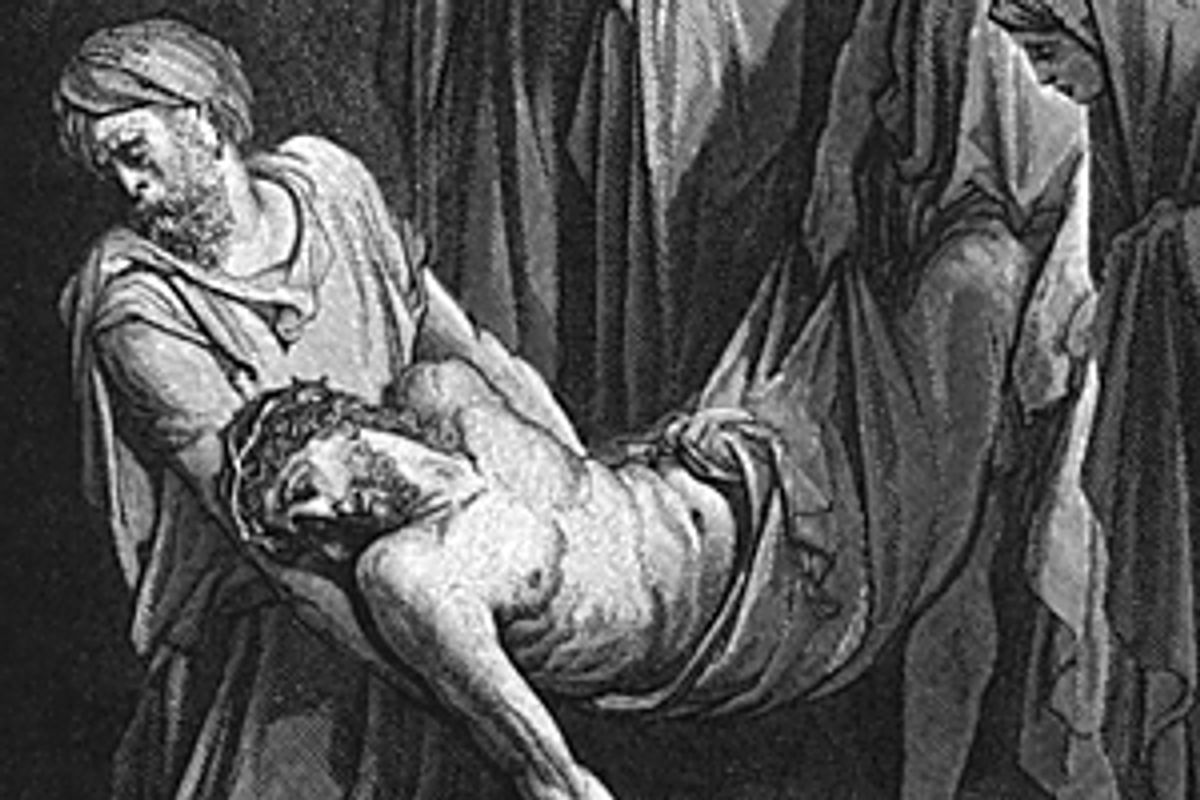
Plaster reliefs depicting the Stations of the Cross (a series of key events in the Passion) hang on the walls of the church. The reliefs appear to be mass-produced but they were painted, Baigent assures us, "under the direct supervision" of the priest. Station 14 traditionally shows the dead body of Jesus being taken to the tomb, and the painters of this particular relief have rendered it as a nighttime scene. But this is all wrong, Baigent insists, because the day following the crucifixion was Passover and no observant Jew would handle a corpse after the holy day had begun at sunset. "This variation of the 14th station," he goes on, "suggests two important points: that the body the figures are carrying is still alive, and that Jesus -- or his substitute on the cross -- has survived crucifixion."
From this "very curious" detail, Baigent extravagantly concludes that the priest "appears to be telling us that he knows -- or at least believes -- that Jesus survived the crucifixion." (Never does Baigent, or anyone else who indulges in this kind of speculation, explain why someone -- be it a provincial abbi or Leonardo da Vinci -- who is sworn to keep a controversial secret, would run around planting clues about it in paintings and architectural details.) Baigent then remembers talking with an elderly Englishman who recalls that a long-dead friend of his supposedly translated some documents in a Parisian church that might have proven Jesus' survival -- and the French priest once visited the same church. Sacre bleu! Could the two men have met? "If we accept the story as it has been relayed to us, then on the face of things the answer to both of these questions seems likely to be yes."
These are some pretty big ifs, but the mere process of running through a series of dubiously related conjectures makes each one seem as if it supports the others. Eventually, the whole haze of far-fetched guesses is transformed, as if tapped by a fairy godmother's wand, into something a bit more solid. The still-squishy mixture is then run through the processor of Baigent's rhetoric until it emerges as a shiny imitation of fact. One thing Baigent is particularly adept at is pretending to qualify his wacky assertions before moving in for the kill: "Whatever the answers -- and we are hardly in a position to come to any definite conclusions just yet -- Station 14 as it is depicted on the wall of this church serves as an eloquent testimony to a secret heretical knowledge that once lay in the hands of a priest in deepest rural France."
In other words, while we can't prove anything just yet, the night sky painted on this plaque obviously testifies to "secret heretical knowledge," and what else could that knowledge possibly be? This argument would hold more water if rural French Catholics (especially the parishioners who painted this hideous plaque) could be expected to know all about traditional Jewish taboos. On the other hand, maybe they just read their Bibles: Two gospels in the New Testament (Matthew and Mark) say that Joseph of Arimathea only went to Pontius Pilate to ask permission to remove Jesus' body from the cross after "evening had come," which makes the depiction of a nocturnal entombment perfectly logical.
Baigent might well counter that the biblical depiction of the entombment is one of many clues to Jesus' survival actually embedded in the New Testament itself -- though why the evangelical authors of the gospels would do this is, again, never really explained. Baigent pounces upon all sorts of biblical inconsistencies to demonstrate his point (or, rather, the point of Hugh Schoenfield, whose 1965 bestseller, "The Passover Plot," first floated the Jesus survival theory). This is congenial territory for Baigent, who's great at faking knowledge of ancient languages and cultures in order to wrap his speculation in an impressive aura of scholarship. He can count on most of his readers being unable to spot the occasions when he's wrong.
Take the "myrrh and aloes" that, according to the book of John, Nicodemus brought to Jesus' tomb the night after the crucifixion. According to Baigent, this is another "very curious" detail, since both substances have medicinal properties (i.e., to revive a drugged man) and "neither drug is known to have a role in embalming dead bodies." Before you gasp, though, know that both myrrh and aloes were frequently used in ancient Middle Eastern burial rites and that "embalming" practices are irrelevant in any case, since 1st century Jews didn't embalm their dead. Nor do today's Jews -- Jewish law prohibits the preservation of corpses. Instead, the Jews of Jesus' time left the body inside an alcove in the tomb to decompose to bones, and then returned to place the bones in an ossuary. Aromatic spices like myrrh and aloes were frequently used to mask the smell.
Likewise, Baigent finds the passage in Mark in which Joseph of Arimathea asks Pilate for Jesus' body to be very suggestive. In "the original Greek text," he reports, Joseph uses the term "soma" for the body, while Pilate refers to it as the "ptoma." Baigent claims that while "ptoma" always refers to a corpse, the word "soma" "denotes a living body," and thus, "Jesus' survival is revealed right there in the actual Gospel account." But this just isn't true. While "ptoma" does refer to a corpse, "soma," like the English word "body," can describe a person either living or dead. Why this difference is an issue is even more baffling, since according to passages elsewhere in his maddeningly inconsistent book, Baigent thinks that Pilate was in on the conspiracy to save Jesus!
Getting all "CSI" on the New Testament creates the impression of analytical rigor, and it distracts readers from a whopping contradiction in Baigent's own approach: If you believe that tiny details like Joseph's word choices and Nicodemus' spices are described accurately in the New Testament, then what about, say, the miracle of the loaves and the fishes or the resurrection itself? If you're going to claim that the gospels are fundamentally incorrect in their major points, you can hardly allow your arguments to depend on the scrupulous correctness of their minor ones.
All this leads, of course, to the problems of treating the Bible as a historical source. There are no contemporary accounts of Jesus' existence, although this isn't surprising, since he wouldn't have seemed sufficiently important to the people who wrote those accounts. Most modern scholars, including the secular ones, believe that someone more or less like Jesus did really exist and that there's a kernel of historical truth to the New Testament, but as with Homer's "Iliad," whatever originally happened has been encrusted with myth and legend, as well as fundamentally reshaped by those who passed on the story.
The New Testament gospels are based on oral traditions. Anyone who's ever played the child's game Telephone knows how easily words can be distorted as they're passed along from one person to another -- even when the people are all sitting in the same room on the same day, let alone when they're handed down over decades or more by individuals who are advocating religious agendas. Even in a thoroughly documented, highly literate era like our own, information gets distorted and distortions become conventional wisdom.
For example, depending on who you are, you might believe one or more of the following "facts": All the Jews employed at the World Trade Center were warned not to report to work on the morning of Sept. 11; the novelist Jonathan Franzen turned down an invitation to have his novel featured in Oprah Winfrey's book club; New Orleans residents stranded in the city after Hurricane Katrina fired guns at rescue helicopters; Saddam Hussein was in league with al-Qaida before the American invasion of Iraq. It's an easily verifiable matter of public record that none of the statements above are true, but many people believe them all the same. Now imagine how hard it is to find out what really happened in the Middle East 2,000 years ago when there are no official records and almost all of the participants were illiterate religious fanatics.
As James Tabor, the author of "The Jesus Dynasty: The Hidden History of Jesus, His Royal Family, and the Birth of Christianity," a much more plausible consideration of the historical Jesus, writes, "What we have to realize is that the gospels of Matthew, Luke, and John were written between forty to seventy years after the death of Jesus by authors who were not original witnesses and who were not living in Roman Palestine." Mark, the earliest of the gospels, was written 30 years after Jesus' death and like all the gospels was altered by scribes over the years to make it better conform to the emerging Christian orthodoxy.
The oldest manuscripts of Mark, for example, do not report any appearances of the resurrected Jesus at all; they end with the two Marys and Salome fleeing in astonishment from the empty tomb. "Pious scribes," Tabor writes, "who copied Mark made up an ending for him and added it to his text sometime in the 4th century A.D. -- over 300 years after the original text was composed." The ending printed in most Bibles -- "a clumsy composite of the sightings of Jesus reported by Matthew, Luke, and John" is clearly not by the same author. The Revised Standard Version of the Bible published in 1946, which printed the added ending as a footnote, caused such a "storm" that the nonoriginal ending had to be put back in later editions.
Readers who have only recently learned, via "The Da Vinci Code," of the complicated history of the New Testament, are much better served by books like Tabor's than by conspiracy-mongering like "The Jesus Papers." Tabor chairs the religious studies department at the University of North Carolina at Charlotte, has studied the Dead Sea Scrolls, worked on archaeological excavations in the Middle East and is the editor in chief of the Original Bible Project, "an effort to produce a historical-linguistic translation of the Bible with notes." Like Baigent, he doesn't believe in the literal truth of the resurrection, but unlike Baigent, he keeps his religious beliefs to himself.
Like all efforts to re-create historical events from the New Testament, "The Jesus Dynasty" is by necessity highly interpretive and contestable, but it's certainly more grounded than the fantasias of "The Jesus Papers." Tabor is primarily interested in recovering the history of Jesus' immediate family -- his mother, four brothers and two sisters -- who, he maintains, played a far more important role in the young religious movement than is generally known. The exact configuration of Jesus' extended family is pretty hazy; Tabor suspects that an elderly Joseph married the teenage Mary when she was already pregnant by another man and then died a few years later, leaving Jesus at the head of a large family.
Jesus' brothers -- sons of Joseph or perhaps of Joseph's brother, who according to tradition was likely to have married Mary after Joseph's death -- took over the church in succession after Jesus' death. The eldest, James, stood for the continuation of the original identity of Jesus' movement. It was a profoundly Jewish, messianic sect that believed Jesus to be divinely inspired but not divine, that foresaw a coming "Kingdom of God" that was earthly rather than heavenly, that sought the restoration of Jewish self-rule in the form of a king descended from David, that did not view the celebration of the Eucharist as the symbolic consumption of Jesus' flesh and blood and that considered Jesus himself to be well and truly dead.
"There are two completely separate and distinct 'Christianities' embedded in the New Testament," Tabor writes. The version that triumphed -- Jesus as God in human form, born of the eternally virgin Mary, whose death mystically atoned for the sins of humankind, who rose from the dead and inaugurated a new covenant with God that superceded the necessity of following Jewish law -- is largely the creation of Paul. Tabor's mission with "The Jesus Dynasty" is to recover what he can of the vein of Christianity led by James, the one that "lost" and that eventually withered away.
Although messiahs and messianic movements seem to have been a dime a dozen in the Jewish world before, during and after Jesus' lifetime, as the Jews fought their doomed battle against their Roman overlords, Tabor believes that John the Baptizer was among the most galvanizing. "The Jesus Dynasty" seeks to restore John to some of the status he enjoyed before Christian theologians reduced him to a mere precursor of the Christ. In actuality, Tabor argues, John's radical cause was fully in motion by the time Jesus, a kinsman of John's, turned up to be baptized in the Jordan River at age 30. "Jesus was a disciple of John and John was the rabbi or teacher of Jesus," not the other way around.
Eventually, Jesus and John became "full partners" in a movement that anticipated the overthrow of the corrupt civil and religious authorities in Israel and eventually the entire world. They heralded the establishment of a new age, in which the people would be ruled by two messiahs, a king descended from David (Jesus) and a high priest descended from Aaron (John), who would preside over the temple in Jerusalem. But John and Jesus didn't advocate armed revolution -- they believed, on the basis of their interpretation of passages in the Old Testament, that God would intervene and effect the change when the right moment arrived. Although Tabor describes their movement as "apocalyptic," he doesn't mean that they expected the end of the world, only its utter transformation.
Given this view, it's not surprising that Tabor considers John's execution by King Herod to be "the most disappointing and shocking event in Jesus' entire life." The loss seems to have inaugurated a new, darker vision of his own destiny in Jesus' mind. In the best section of "The Jesus Dynasty," Tabor imagines the last few days of Jesus' life. Although the story is familiar, as Tabor retells it, minus the supernatural elements and taking the very Jewish nature of Jesus himself into account, it becomes new and in its own way just as powerful.
Tabor's Jesus is a man who considers himself chosen by God and who reconciles himself to enduring terrible suffering before God's kingdom can be established. He deliberately provokes a Jewish religious establishment glutted on temple tributes, and the Roman authorities, known for their creatively sadistic execution methods. "He firmly believed that if he and his followers offered themselves up, placing their fate in God's hands," they could bring about the beginning of the new age, Tabor writes. Although, as Tabor admits, we can never know Jesus' inner thoughts, it's possible that even on the cross, "up until the last minutes, perhaps, Jesus believed that God would intervene and save his life, and openly manifest his Kingdom."
That hope was betrayed and eventually Jesus' own legacy was transformed into a religion that, Tabor argues, he would have scarcely recognized. The more faithful -- and more Jewish -- remnant of Jesus' following, led by James and possibly two other half-brothers, became utterly overshadowed by Paul's Christianity, a faith that swept through the Gentile world to become the biggest religion on the planet.
This is a remarkable enough story without a lot of folderol about Egyptian mystery cults, faked deaths and the Holy Grail, plus it has the added attraction of being rooted in some legitimate scholarship and it's better written. "The Jesus Dynasty" surely has enough in it to challenge the religious orthodoxies that many Americans were raised with, one of the qualities of "The Da Vinci Code" that seems to have made the deepest impression on the novel's fans. Of course, Tabor's never been in the position to sue Dan Brown, but if his book can't win at least a few readers away from "The Jesus Papers" this Easter, then, well, there is no God.
Shares