

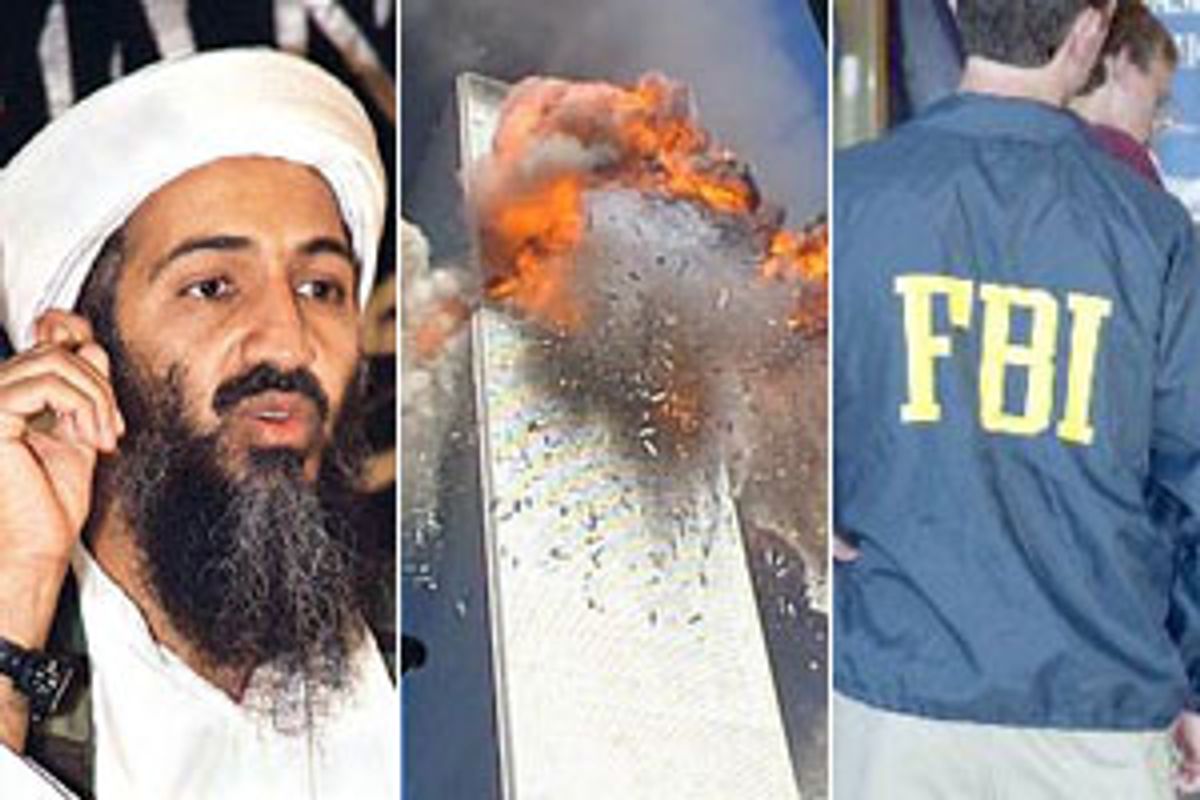
Five years later we are still sifting through the rubble. Newly released recordings of frantic phone calls from those trapped inside the Twin Towers remind us the wounds are still raw. The airline terror plot foiled in London reminds us we are still vulnerable. With national security again the central fault line for approaching elections, a familiar rhetoric of fear keeps us mired in the politics of a war with no apparent end. And the long discussion goes on -- not only about the origins and lessons of the Sept. 11 terrorist attacks, but about the U.S. military ventures and global spasms of violence that have followed.
Lawrence Wright's remarkable new book, "The Looming Tower: Al Qaeda and the Road to 9/11," illuminates that discussion like no volume before it. Wright synthesizes an array of figures and events into a riveting tableau. He traces al-Qaida's strategic conception and ideological evolution, born of smoldering dissident movements from Egypt to Pakistan. He casts aside the cartoonish mug shot of a madman who provoked a global war to reveal Osama bin Laden in his many achievements, failures and contradictions. And he uncovers an intricate and astonishing tale of how myopia and infighting among U.S. intelligence agencies almost certainly blinded them to the plot that would plunge hijacked planes into the Twin Towers, Pentagon and a field in Pennsylvania. The book is a feat of exhaustive reporting and research, yet reads like a novel, thanks to Wright's vivid prose and instinct for dramatic detail.
There is already a library's worth of books available on how the 9/11 attacks were conceived and carried out, and on the scattered attempts by U.S. officials to stop them. But Wright delves deeper, stitching together the key personalities of the epic event. Along with bin Laden, they include Ayman al-Zawahiri, an Egyptian medical doctor turned fanatic who would become a deeply influential and indispensable second-in-command to bin Laden; and John O'Neill, a conflicted FBI counterterrorism chief obsessed with the Islamic terrorist threat, who would leave the bureau in August 2001 only to perish in the attacks as the head of private security for the World Trade Center.
Wright, a longtime staff writer at the New Yorker, builds his tale of these men on hundreds of interviews with their family members, childhood friends and professional associates; extensive travel through the Middle East, Asia and Europe; and a library-sized bibliography of his own, including key primary source materials translated from the Arabic. In scrutinizing these figures, he humanizes them, showing us their quirks, strengths and flaws. We see how distant adversaries mirror each other, their respective organizations at times reeling from vicious infighting, at others galvanized by renegade leadership. The illumination of these men in their complexity clarifies our sense of the people and politics that detonated the seminal event of our time.
At the heart of Wright's wide-ranging narrative is America's arch nemesis. "One can ask whether 9/11 or some similar tragedy might have happened without bin Laden to steer it," he says. "The answer is certainly not." Wright argues that by the close of the millennium, after a string of al-Qaida attacks against U.S. and allied interests abroad, "the tectonic plates of history were certainly shifting, promoting a period of conflict between the West and the Arab Muslim world; however, the charisma and vision of a few individuals shaped the nature of this contest." While there were provincial militant Islamist movements blooming across the Middle East, Wright emphasizes that it was bin Laden's vision to create an internationalist jihadi corps.
It would be easy enough to look at the victories and defeats of bin Laden's career, and his evolving worldview, and see the specter of a madman behind 9/11. "But there was also artistry involved," Wright declares with a hint of admiration, "not only to achieve the spectacular effect but also to enlist the imagination of the men whose lives bin Laden required."
By exposing al-Qaida's clash with America, Wright also helps us see the road beyond it. His work reminds us that the consequences of the Iraq war, massive deficit spending on security and the military, and the degradation of America's moral standing fit bin Laden's goals. Indeed, when bin Laden's organization officially trained its mass-murderous sights on the United States in the early 1990s, Wright explains, "al-Qaeda's duty was to awaken the Islamic nation to the threat posed by the secular, modernizing West. In order to do that, bin Laden told his men, al-Qaeda would drag the United States into a war with Islam -- 'a large-scale front which it cannot control.'"
Five years after the attacks, the United States may still be unable to track down bin Laden, but Wright helps us continue to track down who he really is. His portrait of the elusive Kalashnikov-toting terrorist builds on an already well-documented background. As a young man, bin Laden held a post in his family's Saudi Arabian construction empire. He later enjoyed high-level contacts in the CIA and Saudi royal family as a jihadi leader in Afghanistan's war against the Soviets. By the early 1990s, living in exile in Sudan, he ran a sizable farming operation while cultivating followers for his nascent war on the West.
Though bin Laden had a piece of the family fortune, Wright explains that he was a lousy businessman. In his early years as a jihadi, "he was not politically sophisticated," but he was generous and tireless. Even so, "bin Laden did not make much of an impression as a charismatic leader," Wright says. "He was shy and serious, and he struck many as naive."
That would seem to belie the savvy and vision of a man who had long shaped aspects of his life after the prophet Mohammed's -- a man who, in Wright's view, would come to use political and religious mythmaking "brilliantly" in the service of his ominous cause.
Over the last several years, through captured al-Qaida documents, court proceedings and various news investigations, a clearer picture has emerged of the complex organization bin Laden and his top lieutenant, Zawahiri, nurtured in Pakistan and Afghanistan. Wright pulls the many fascinating details together. Al-Qaida lieutenants had advanced educational and professional backgrounds -- they were university graduates, teachers, engineers, soldiers. On arrival at the training camps, new recruits filled out forms in triplicate and signed an oath of loyalty. They received a monthly salary, vacation time and health benefits.
Al-Qaida also developed a constitution and bylaws, including a recommendation that its leader have "at least seven years of jihad experience and preferably a college degree." There was an advisory council and a budget plan. "One can appreciate the ambition of al-Qaeda by looking at the bureaucratic structure, which included committees devoted to military affairs, politics, information, administration, security and surveillance," Wright says. "The military committee had subsections devoted to training, operations, research, and nuclear weapons."
The organization arose from the rubble of the Afghan-Soviet war, where bin Laden had made his name among the fighting faithful. Wright traces al-Qaida's inception back to a 1988 meeting in Peshawar, Pakistan, attended by a consortium of jihad heavyweights who shared Afghanistan experience more than they did ideological views. Citing court documents and two men he communicated with who allegedly attended the meeting, Wright reports that "a vote was taken to form a new organization aimed at keeping jihad alive after the Soviets were gone."
Although bin Laden and Zawahiri had been rivals seeking control of a broader Islamist movement, they joined forces for good in Pakistan by the mid-1990s. Wright argues al-Qaida could not have emerged without their union. "Each man filled a need in the other," he says. "Zawahiri wanted money and contacts, which bin Laden had in abundance. Bin Laden, an idealist given to causes, sought direction; Zawahiri, a seasoned propagandist, supplied it." Zawahiri had wanted to ignite a revolution in Egypt, while bin Laden was focused on expelling foreign infidels from Muslim lands. "The dynamic of the two men's relationship made Zawahiri and bin Laden into people they would never have been individually," Wright argues. "Moreover, the organization they would create, al-Qaeda, would be a vector of these two forces, one Egyptian and one Saudi. Each would have to compromise in order to accommodate the goals of the other; as a result, al-Qaeda would take a unique path, that of global jihad."
While bin Laden had been banished from Saudi Arabia, kicked out of his sanctuary in Sudan, and had few places left to go, Wright suggests that his final migration to the caves of Afghanistan in 1996 was as much a stroke of propagandistic brilliance as a move of necessity. By then bin Laden was on the run and had been stripped of most of his wealth. The cave, Wright says, became the primary symbol of his hijira, or retreat, likening bin Laden's plight to that of the prophet Mohammed, who, centuries before, had been ostracized and expelled from Mecca. In the year 622, the prophet fled to Medina, where he took refuge in a cave. It was a historic turning point, Wright observes: Within a few years Islam "burst out of Medina and spread from Spain to China in a blinding flash of conversion and conquest."
Bin Laden's move, Wright says, was emblematic of his "public-relations genius." Only by retreating from modernity and the corruption of society could bin Laden presume to speak for "the true Islam" and those who longed to restore its purity and dominion. "Inside the chrysalis of myth that he had spun about himself," Wright says, "he was becoming a representative of all persecuted and humiliated Muslims."
Bin Laden forged that myth despite some stark contradictions. Never mind that the former construction magnate had built the Tora Bora cave complex with heavy modern machinery, or that he had outfitted it with computers, telecommunications gear and an archive of press clippings. His ascetic trappings and bitter diatribes were convincing enough to the world's subjugated and demoralized Muslims. As Wright says of bin Laden in his cave, "the mind that understood such symbolism and how it could be manipulated, was sophisticated and modern in the extreme."
Today, from Bush and Cheney speeches to the nation's Op-Ed pages, we continue to be bombarded with declarations about whether the al-Qaida faithful hate America for its freedoms or for its policies. Wright's work reveals that the answer, clearly, is both.
Bin Laden often emphasized his objection to the presence of U.S. troops on the Arabian peninsula, beginning with the Gulf War. He regularly demonized Israel and the United States as its prime benefactor. Nor were Arab allies of the United States exempt; he excoriated the corrupt Saudi regime, whose members continued their legendary indulgence in Western extravagance -- yachts, booze, women, gambling -- despite the acute inflation and unemployment ravaging the kingdom after the Gulf War. "How can you ask people to save power when everyone can see your enchanting palaces lit up night and day?" he demanded of King Fahd in August 1995. "Do we not have the right to ask you, O King, where has all the money gone? Never mind answering -- one knows how many bribes and commissions ended in your pocket."
Bin Laden knew how to further sow a crop of young, enraged jihadis in Saudi Arabia and other bankrupt societies of the Middle East. Increasingly, his fiery political dissent burned on a perversion of Islamic ideology, one obsessed with religious purification rather than any kind of governance.
Bin Laden had long harbored strict religious views of his own. But by the mid-1990s, Zawahiri -- who became both the operational and ideological mastermind of the organization, according to Wright -- was responsible for securing takfir, a doctrine of violent excommunication from Islam, at al-Qaida's visionary core. All those who did not adhere to their extremist conception of Sharia law were regarded as infidels punishable by death. Offenses included such Western behaviors as registering to vote. Despite some moral dissent in the ranks, Zawahiri apparently found bin Laden in agreement and successfully hard-wired the radical ideology into al-Qaida's strategy -- and with it the religious justification for a ghastly tactic: suicide bombing.
Wright describes the doctrine of takfir as a dark "mirror image of Islam, reversing its fundamental principles but maintaining the semblance of orthodoxy." Wiping out all offenders was no less than a religious obligation, and collateral damage, including women and children, was a non-issue. "The new takfiris believed that they were entitled to kill practically anyone and everyone who stood in their way," he says. "Indeed, they saw it as a divine duty."
Ultimately, that duty would lead to the indiscriminate slaughter of thousands in New York, who represented more than 60 nationalities and dozens of ethnicities and religions. "This battle is not between al-Qaeda and the U.S.," bin Laden declared in October 2001, lower Manhattan still smoldering. "This is a battle of Muslims against the global Crusaders." He also renewed his call for recruits: "These events have divided the whole world into two sides -- the side of believers and the side of infidels. Every Muslim has to rush to make his religion victorious."
This was indeed a theological war, Wright explains, and in bin Laden's eyes "the redemption of humanity was at stake."
The title of Wright's book conjures an obvious image for Americans, but it is drawn from the other side of the divide. In a taped speech by bin Laden found on one of the 9/11 hijacker's computers, the terrorist leader's call to martyrdom included a quotation from the fourth sura of the Koran: "Wherever you are, death will find you, even in the looming tower."
What enabled the terrorists to fulfill their twisted religious mission -- on the American side -- is the other groundbreaking focus of the book.
The full story of how America's intelligence agencies failed to stop 19 men from turning four commercial jetliners into precision missiles may never be known. But enough details have surfaced to prompt the largest overhaul of the intelligence business since the United States first made it an institution during World War II. The turf wars among the CIA, FBI and NSA, long legendary to insiders, increasingly have come into public view over the last few years. The documented examples of bureaucratic infighting and politicization that allowed the 9/11 attacks to barrel forward are multiple and gut-wrenching. Wright adds to what's known of the tragedy largely from the perspective of the FBI.
Despite the bombings of the American embassies in Kenya and Tanzania in 1998, and bin Laden's full-throated declarations of war on the United States, precious few FBI resources were devoted to the Islamic terror threat. Then, in October 2000, when suicide bombers killed 17 American sailors, wounded 39 others and nearly sank the U.S.S. Cole off the coast of Yemen, John O'Neill, head of the FBI's National Security Division, dispatched dozens of agents. Led by O'Neill's star protégé, a young Lebanese-American agent named Ali Soufan (whose story was first excerpted in the New Yorker in July), the FBI soon linked the bombing to al-Qaida.
Soufan, who Wright describes as "a highly caffeinated talker, with a hint of Lebanon," was one of only eight Arabic-speaking investigators working for the FBI in late 2000. He had earned a master's degree in international relations before signing up. As Wright tells it, Soufan's expert interrogation of suspects in Yemen -- using empathy, smarts and knowledge of the Koran, rather than any kind of harsh physical abuse -- is alone a powerful argument for targeting terrorists with the traditional tactics of American law enforcement. Not only did Soufan crack open the Cole case, but he was also closing in on at least two of the future 9/11 hijackers -- though he would come up excruciatingly short. It may have stood as America's best chance, Wright concludes, to stop the attacks on New York and Washington.
The failure was not for lack of effort by Soufan; he and other FBI investigators could sense they were on to an operation that reached beyond Yemen. Wright attributes the failure in part to the infamous "wall," the mandate that blocked the sharing of information between U.S. intelligence gatherers and criminal investigators, pinning the agencies in a state of dangerous disharmony.
In Wright's telling, the wall led to fatal duplicity on the part of the CIA, which jealously guarded its sources and methods from the by-the-book FBI. In Yemen, Soufan was on the trail of an al-Qaida figure closely connected with Nawaf al-Hamzi and Khaled al-Mihdhar, two Saudi-born al-Qaida operatives who would later help seize planes on 9/11. The CIA had surveillance photos of all three men together from an al-Qaida summit in Malaysia the previous January, but when Soufan came knocking for information, the CIA slammed the door shut. It was part of what Wright calls "a bizarre trend in the U.S. government to hide information from the people who most needed it."
The highly secretive National Security Agency, which was monitoring a pivotal al-Qaida phone number in Yemen that could have helped track Hamzi and Mihdhar, was as possessive of its information as the CIA, and equally unhelpful. Ironically, FBI agents investigating the 1998 embassy bombings had found the pivotal phone number in the first place. "This Yemeni telephone number would prove to be one of the most important pieces of information the FBI would ever discover," Wright says, "allowing investigators to map the links of the al-Qaeda network all across the globe."
Nevertheless, monitoring international calls was the NSA's turf. Even more bizarre than the lack of cooperation was the FBI's efforts to circumvent the NSA to get what it sensed was under its nose. Seeking signals intelligence of their own, the frustrated FBI agents constructed a satellite telephone booth in Kandahar, Afghanistan, hoping to lure in international jihadis looking to call home. In Madagascar, they erected an antenna to intercept the calls of Khaled Sheik Mohammed, who would serve as the tactical chief of the 9/11 plot. As Wright explains, "Millions of dollars and thousands of hours of labor were consumed in replicating information that the U.S. government already had but refused to share."
Still more astonishing, the CIA chose not to inform FBI investigators once they knew, by summer 2001, that Hamzi and Mihdhar had entered the United States. The FBI had an intelligence liaison with the CIA's "Alec Station" devoted to hunting bin Laden, but "the wall" still stood in the way. Even though another FBI analyst, Dina Corsi, was made aware of the information, she wasn't allowed to share it with the criminal investigators in her own agency.
By late August 2001, it did reach one of them, an FBI agent working with Soufan named Steve Bongardt -- when an urgent e-mail from Corsi was accidentally copied to him. Bongardt, one of several FBI sources Wright interviewed, called Corsi on the phone, incredulous. "Dina, you got to be kidding me! Mihdhar is in the country?" Following orders from on high, Corsi told him he had to delete the e-mail.
The next day, in a phone call with Corsi and a CIA supervisor from Alec Station, Bongardt was again told to "stand down" from any effort to track Mihdhar. Bongardt insisted that the intelligence should be shared, and that the wall was a misguided bureaucratic construction that was hurting the agents' mission. "If this guy's in the country, it's not because he's going to fucking Disneyland!" he said. In a follow-up e-mail to Corsi, he said, "someday somebody will die -- and wall or not, the public will not understand why we were not more effective."
Wright reports that several of his FBI sources strongly believed that the CIA shut them out because the CIA was interested in recruiting Mihdhar and Hamzi, having never been able to penetrate al-Qaida with an agent. If the FBI collared the two as terrorist suspects, the opportunity to recruit them as agents would have been lost to the more transparent criminal investigative process. The nearly 3,000 lives lost on 9/11, Wright suggests, was the net result of the CIA's strategy.
Perhaps. In his notes at the end of the book, Wright himself cautions that a story drawn from even the most exhaustive reporting in the realm of terrorism and espionage -- including opaque documents subject to translation, and interviews with spooks, ex-jihadis, politicians and international businessmen -- must be carefully digested. We know the FBI had other opportunities to thwart the plot, and surely there were other pivotal moments in the catacombs of U.S. agencies on which light may never shine.
The same must be true about the men and machinations of al-Qaida. A number of its key members are reportedly still being held in secret by the U.S. government. A complete history of al-Qaida and the global war it helped unleash, Wright proposes, cannot be told until they are allowed to talk. In the meantime, he has given us a touchstone for mapping the road to 9/11, and the one that continues beyond.
Shares