

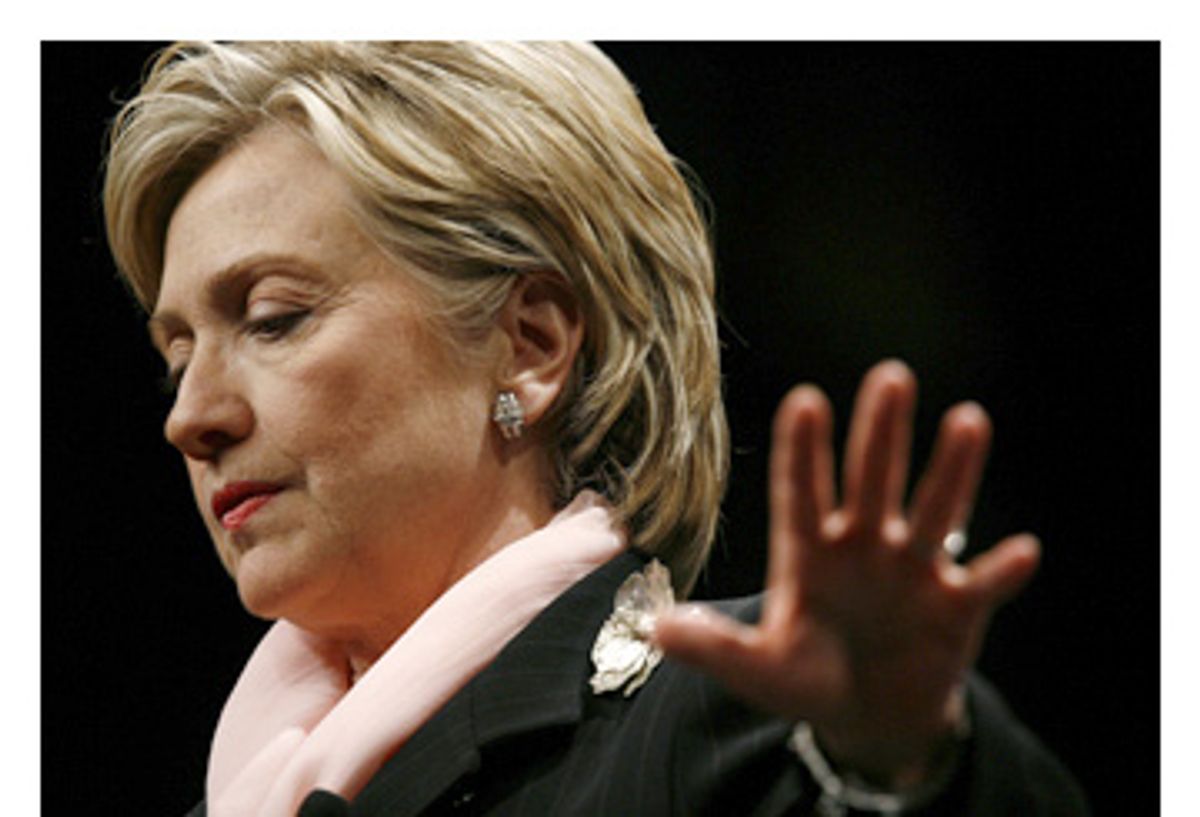
Any day now, some upstart college with a keen sense of public relations and the political zeitgeist will announce the creation of a new department called "Hillary studies." When that inevitable intellectual breakthrough occurs, this cutting-edge academic discipline will not lack for a reading list. The woman born and married as Hillary Rodham, transformed by the political realities of Arkansas into Hillary Rodham Clinton and now hailed in her campaign materials simply as "Hillary," does not yet match Abraham Lincoln in the bookshelf-space derby. But, hey, Honest Abe had a 140-year head start.
Just published are the two latest entries in the Hillary canon: "A Woman in Charge," by Carl Bernstein, and "Her Way," by Jeff Gerth and Don Van Natta Jr. In familiar fashion, they chart her now seemingly inevitable progress from child of the conservative Chicago suburbs to Wellesley antiwar commencement speaker to Arkansas political wife to first lady to New York senator to 2008 presidential candidate. It is a "Pilgrim's Progress" for our times -- and her route may soon double back to the White House.
Formerly in the hands of political journalists (David Maraniss and Michael Tomasky), psycho-biographers (Gail Sheehy) and right-wing attack artists (Barbara Olson and David Brock, until he repented), the torch has now been passed to the investigative reporters. Bernstein, of course, is the less prolific half of the legendary Watergate duo with Bob Woodward. Gerth (who wrote the original 1992 Whitewater story for the New York Times) and Van Natta (who still works at the paper) are both Pulitzer Prize winners. But despite the talents of these journalistic gumshoes, the haul from their collective labors would hardly pay the rent on Sam Spade's office, let alone justify their book advances.
Gerth and Van Natta, for example, breathlessly announce in their opening chapter, "More than three decades ago, in the earliest days of their romance, Bill and Hillary struck a plan ... to work together to revolutionize the Democratic Party and ultimately make the White House their home ... [W]ith Bill's victory in 1992, their plan became even more ambitious: eight years as president for him, then eight years for her. Their audacious pact has remained a secret until now." Talk about a scoop -- Bill and Hillary were ambitious! Get me rewrite! As for a long-planned his-and-then-hers presidency, Gerth and Van Natta offer no tangible evidence that Hillary was plotting to run for public office prior to the first post-impeachment rumblings of a New York Senate bid.
In his initial research, Bernstein won the trust of Diane Blair, Hillary's closest friend, who died in 2000. Blair, a political scientist at the University of Arkansas, had thought of writing an insider's account of the 1992 campaign and interviewed 126 members of the Clinton staff after the election. She shared her notebooks with Bernstein, but Blair's research does little to alter the long-standing impression of Hillary as a tough-minded campaign strategist. Bernstein writes, "The big story of the campaign, [Hillary] feared, was going to be Bill's private life and hers, and a grotesque record of the Arkansas years ... It's apparent in interview after interview in Diane's binders that the real guiding premise [of the Clintons] was: Keep them away from us and our private lives." Once again, there's no there there. After a brutal primary campaign that revolved around the Gennifer Flowers debacle and the candidate's Vietnam draft record, it was no secret to any political reporter on the planet that the Clinton high command wanted to plant Do Not Enter signs on the borders of Arkansas.
This is not to dismiss the books as entirely unrevealing, unfair or unnecessary. Bernstein's "A Woman in Charge" is sprightly written, often insightful in its judgments, and studded with factual nuggets that enhance the Hillary saga. "Her Way," which at times becomes bogged down in investigative minutiae, offers a valuable account of Clinton's slow migration away from her hawkish stance on Iraq. But after digesting 1,076 pages of chronology and footnotes (the books, incidentally, together weigh 3.8 pounds), I am weary of reading the same stories over and over with a few different factual flourishes. I am fatigued from going through the same small-bore Hillary "scandals," from commodities trading to Whitewater to the White House travel office dismissals. And most of all, I am tired -- so tired -- of theorizing about that mysterious entity known as the Clinton marriage. (After Bill Clinton left office, I vowed to myself that I would never again type those three fateful words, "the Clinton marriage." But, as I should have learned by now, good intentions rarely survive contact with a presidential campaign.)
What both books inadvertently illustrate is that Hillary Clinton may have been investigated out. If there are major secrets still buried about the current presidential candidate, they are unlikely to be unearthed in time for this campaign. Almost nothing that Bernstein, Gerth or Van Natta discovered is startling enough to launch a single attack commercial or oppo-research hit. What seems far more relevant at the moment are the lessons that the candidate draws from her life experience rather than new details about Bill Clinton's philandering ways in 1987.
Both biographies have yawning gaps, one in its research, the other in its chronology. "Her Way," the Gerth and Van Natta entry, is comprehensive in its timeline, carrying Hillary from girlhood in Park Ridge, Ill., to the announcement of her presidential campaign. But a close reading of the footnotes suggests that almost every anecdote about her life before her 1975 marriage has been borrowed from earlier books, especially her own 2003 autobiography, "Living History." Bernstein's "A Woman in Charge" is meticulously researched, but the author seemingly ran out of time and energy, truncating Hillary's entire life after the 1999 impeachment vote to a single 18-page chapter.
There was a time when I, too, thought of majoring in Hillary Studies. During the early 1990s, I hunted down some of her Wellesley classmates (and heard their stories before they had grown stale from constant retelling) and looked up her Arkansas friends. I first interviewed Hillary, nearly 15 years ago, in the governor's mansion in Little Rock, and several times after that. What stays with me is something that she said during a 1993 White House interview, back in the hopeful days when healthcare reform was slated to be her signature achievement and Monica Lewinsky was still off at college. "I am a Rorschach test," she declared, reflecting a shrewd awareness of how, even then, her public persona was in the eye of the beholder. Tomasky, in his 2001 book on her initial Senate race, "Hillary's Turn," captured the same reality when he wrote, "Hillary Clinton has existed primarily as a symbol, both to those who admire her and to those who detest her."
The rigors of the 1992 campaign -- probably augmented by her own bent toward overpreparation and caution -- made Hillary an oddly distant figure, easier to theorize about than understand. These days, anyone trying to write something fresh and original about her has to grapple with the problem of access: As Bernstein writes, "Both Hillary and Bill Clinton told me on several occasions that they would welcome being interviewed by me. In the end, both formally declined." (There is no textual evidence that the Clintons spoke with Gerth and Van Natta either.) Would-be chroniclers must also deal with the intense loyalty that has long been a feature of Hillaryland; almost no one close to her is willing to tell all (especially on the record), and virtually everyone in her orbit tends to be nervous about how even the most innocuous comments might look in print.
But the biggest obstacle to reporters is that this woman who has been probed and psychoanalyzed and hounded by special prosecutors understands the political virtues of repetition and boredom. As first lady, senator and now presidential candidate, she has rarely veered away in public from her self-scripted agenda.
If there was a turning point -- a moment when Hillary Clinton seemed to go robotic -- it probably came during the waning days of 1992 primary campaign. Attacked in a debate by Democratic presidential gadfly Jerry Brown over her legal work while her husband was governor, Hillary snapped, "I suppose I could have stayed home, baked cookies and had teas, but what I decided to do was to fulfill my profession." Bernstein points out that Hillary went on to talk about the difficult choices that women have to make, but notes that her words were attacked "as evidence of radical feminist disdain for traditional values." What neither biography picks up is the larger significance of the "cookies and tea" furor: Bill Clinton had to step in to help his wife mend her image. This moment marked a change in the couple's power dynamic, for up until then, it had always been Hillary who took on the Sisyphean task of cleaning up Bill's messes.
At this late date, the Bernstein-Gerth-Van Natta trio of investigative reporters finds it hard to become overexcited by Hillary's own messes from her days in Arkansas. Bernstein, who knows what a real scandal looks like, is scathing about the wasted journalistic energies that went into investigating the Clintons' involvement in an ill-starred real estate venture called Whitewater. "In truth, the 'Whitewater story' became overblown almost from the moment the New York Times first wrote about it," states Bernstein, an alumnus of the Washington Post, who adds, "The Clintons' response was not straightforward, and served only to arouse suspicion." Even Gerth, who was heavily involved in the Times' Whitewater coverage, now concludes that Hillary Clinton was probably guilty of nothing more heinous than padding her bills for legal work. The authors of "Her Way" state, without a hint of Times culpability, "Her likely indiscretions were altogether modest, but the scandal that would result from Hillary's attempt to cover up her sins in the past would be enormous."
It is strange that the one Clinton-era scandal that might resurface in the 2008 campaign is brushed off in a single paragraph in both biographies. Fred Thompson, poised to enter the Republican presidential race as one of the front-runners, presided over the 1997 Senate investigation into the flagrant fundraising abuses of the Clinton reelection campaign, from Lincoln Bedroom sleepovers to shady Asian influence peddlers wandering around the White House. As Bernstein all too briefly summarizes, "Johnny Chung, a Democratic fund-raiser who later pleaded guilty to funneling illegal contributions to the Clinton campaign, had shown up one day in Hillary's office with a check for $50,000 for the reelection committee. 'You take, you take,' he demanded of some startled Hillaryland aides."
The Gerth and Van Natta biography offers an intriguing theory about who Hillary's enabler was in framing her hawkish stance on the Iraq war -- Bill Clinton. The authors, citing interviews with unnamed Clinton associates, write, "Just as he has engaged in most aspects of her Senate career, Bill served as her main counsel on the Iraq war vote." They also note that Hillary outdid even Joe Lieberman in her speech justifying her vote in favor of the Iraq war resolution by claiming that Saddam Hussein was guilty of giving "aid, comfort and sanctuary to terrorists, including Al Qaeda members." (This is a belief, by the way, that only Dick Cheney still holds.) While Hillary's judgment on the war was execrable (as was that of John Edwards), it becomes tricky for Democratic primary voters to simultaneously revere the foreign policy of the Clinton administration and excoriate the New York senator for following the advice of Bill Clinton in casting her Iraq vote.
Even when "Her Way" and "A Woman in Charge" score with telling details, there remains a sense that their subject remains tantalizing close, yet also out of reach. Hillary Studies (or, at least, political reporting about her as president or senator) is likely to be a growth area over the next decade. But like so many other fledgling disciplines, it is still in search of its core textbook -- a nuanced biography that captures Hillary Rodham Clinton as both human being and political figure, instead of dissecting her like a laboratory slide through the lens of investigative reporting.
Shares