

Most contemporary books about the environment end up being jeremiads. They may sing the praises of the natural world, but mostly to draw attention to the ways we are destroying it. The goal is to inspire social change, but that does not always result in creative or compelling prose. How do you avoid putting readers to sleep with yet another alarming tale when you're dealing with a subject that truly is alarming? One of the many virtues of Alan Weisman's "The World Without Us" is that it finds a brilliantly creative solution to this problem.
Weisman embarks on an audacious intellectual adventure: He tries to imagine what the world would be like if humans suddenly disappeared. "How would the rest of nature respond if it were suddenly relieved of the relentless pressures we heap on it and our fellow organisms? How soon would, or could, the climate return to where it was before we fired up all our engines? How long would it take to recover lost ground and restore Eden to the way it must have gleamed and smelled the day before Adam, or homo habilis, appeared? Could nature ever obliterate all our traces?"
Weisman opens his study with a parable, a scene set in the Amazonian jungle. A few dozen Zapara Indians are getting drunk on chicha, a sour beer made of fermented cassava pulp, and eating monkey meat. Once, generations ago, the tribe numbered 200,000 and fed itself by hunting the game that the jungle teemed with. That all changed after Henry Ford started mass-producing automobiles. The demand for rubber led to a genocide of the Zapara and other native peoples, and savaged the forest they lived in. Today, only a few hundred Zapara survive, and their ancient way of life is gone. They cut and burn down the towering forest to grow cassava. And although they believe themselves to be descended from monkeys, they have resorted to eating them -- a formerly taboo act. Only one old woman, Ana Maria, protests. "When we're down to eating our ancestors," she asks, "what is left?"
Weisman uses this grim tale to set up his thought experiment. "[L]ately, we have had a creeping sense of what Ana Maria means," he writes. "Even if we're not driven to cannibalism, might we, too, face terrible choices as we skulk towards the future?" Weisman admits that we can't know -- but he believes we should engage with the question. And he offers his thought experiment as a kind of creative spur to such engagement, a way of opening and focusing our minds.
By approaching the end of humanity from this unique angle, as a given, Weisman succeeds in throwing the spotlight on the earth itself -- and invests us in her fate. His thought experiment is so intellectually fascinating, so oddly playful, that it escapes categorizing and clichés -- in particular that earnest moralizing that can make environmental screeds so predictable. Written as if by a compassionate and curious observer on another planet, his book restores a sense of wonder not just to one little piece of the cosmos, but to the human race whose amazing deeds have transformed it, and whose equally monumental folly now threatens it.
"The World Without Us" taps into one of our deepest, if only furtively acknowledged, pleasures: imagining destruction. Just as Tom Sawyer sneaked deliciously into his own funeral, we gobble up Weisman's anecdotes about the decay and dissolution of everything human. It also appeals to our love of looking in the cosmic rearview mirror: Like "A Christmas Carol" or "It's a Wonderful Life," it sucks us in with a vision of what is, what has been and what is yet to come. The book is addictive: Just a few pages into it and I was as enchanted as I was by the imaginative books I loved as a boy, like "Paddle-to-the-Sea," the beautiful fictional story of the odyssey of a tiny canoe carved by an Indian boy, and "Cosmic View: The Universe in 40 Jumps," which starts from a picture of a girl holding a cat and moves in exponential leaps both far out, to the end of the universe, and deep in, to the subatomic realm.
That Weisman's book stirs such innocent page-turning joy may be a larger achievement than it at first appears. For that joy is somehow connected with our innocent feeling for nature, one we are always in danger of forgetting. And without that feeling, all the jeremiads in the world will not inspire us to take the steps that are so urgently necessary.
Paradoxically, it's the fact that Weisman envisions the Earth enduring that becomes motivation for us to change our ways. The twist, of course, is that his imagined happy ending for the Earth only comes about because mankind is absent. Yet this isn't depressing, as one might think, but oddly inspiring. Weisman concludes that many of those happy endings are possible even if humanity doesn't disappear -- as long we curb our appetites and our population. And even if we end up causing our own extinction, it is profoundly reassuring to think that the Earth will not only survive, but flourish.
By restoring our sense of awe about the Earth, and our connectedness to it, Weisman takes us out of the merely political and into a deeper realm. His book is a kind of time bomb: Its surface cheeriness conceals a much deeper pessimism. But in the end that pessimism, too, is transformed by a force even stronger than geology: hope.
So what would happen to the Earth if we were gone? In search of answers, Weisman travels to the Bialowieza Puszcza, the last remaining primeval forest in Europe; to the ancient underground cities of Cappadocia in Turkey; to Korea, where North and South Korean troops face off over a DMZ that has become home to wildlife that might otherwise have vanished; to Houston and its vast petrochemical plants; under New York City, where engineers struggle daily to keep torrents of water from flooding into the subway tunnels; to abandoned hotels on the Green Line in divided Cyprus; to the Panama Canal, one of the most extraordinary engineering feats of all time.
One of the reasons "The World Without Us" is so compelling is that Weisman, a veteran journalist, has a keen eye for locations and stories that are at once crucial and offbeat: I had never heard of the Bialowieza Puszcza before, had no idea that endangered species were finding refuge in the Korean DMZ, and if I had not just visited the amazing underground cities of Cappadocia myself, would have been ignorant of them as well. Weisman's vivid, well-written accounts of the places he goes and the people he meets make his meandering narrative as colorful and exotic as a travelogue.
But it is his science reporting, at once lucid and full of wonder, that is the heart and soul of this book. Even when he is reporting on the grimmest, most dispiriting phenomena -- for me, it was the inconceivable amount of microscopic plastic bits that we are dumping into the oceans -- Weisman evinces a spirit of joy in scientific inquiry for its own sake. It's that playful objectivity, which feels Buddhistic rather than detached, that makes "The World Without Us" so original and refreshing.
That, and the scientific popcorn. Did you know that the entire population of the world could fit into the Grand Canyon? Or that the fertilizer-choked dead zone at the mouth of the Mississippi is larger than New Jersey? Or that much of the world's garbage landfill is made up of newspapers? Or that Norway is storing samples of the world's crop seed varieties on an Arctic island in case of a global catastrophe? Or that the reason tires don't degrade is that they're one enormous molecule? Or that north of the 60th parallel, Canada has more lakes than the rest of the world combined? Such tasty morsels are sprinkled on virtually every page of this book.
The most obvious question, of course, is: What would happen to our homes? Weisman walks us meticulously through the steps that lead inevitably to the complete destruction of almost every single part of our houses. The first and last enemy is water. Water sneaks in at the weak points of roofs, near the chimney, for example. It enters around the edges of nails. Mold begins to grow on wet wood; under the mold, "threadlike filaments called hyphae are secreting enzymes that break cellulose and lignin down into fungi food." The roof falls in. More water enters through the windows, some shattered when birds flew into them. The floor corrodes. Squirrels and lizards eat the drywall. Vinyl siding begins to crack as its plasticizers weaken. Even aluminum begins to break down, as salt eats it away. Steel gas pipes begin to rust away. PVC pipe yellows and thins. In 500 years, just about everything is gone, eaten away by the elements, the remaining scraps covered up by vegetation.
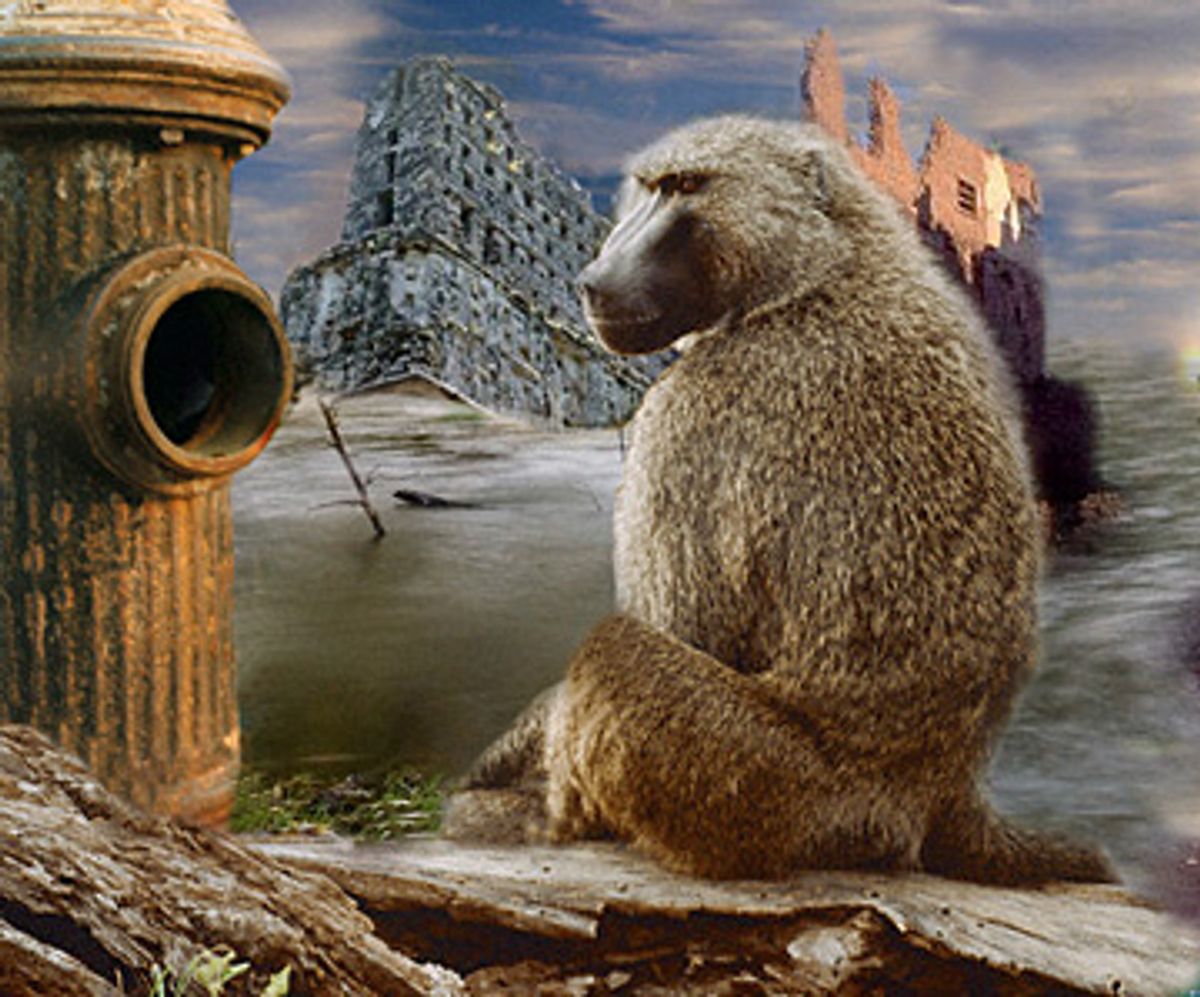
A few things remain longer. Bathroom tile, because "the chemical properties of its fired ceramic [is] not unlike that of fossils." Stainless steel pots, pans and knives, especially if they're buried out of the reach of destructive oxygen. Perhaps aluminum, although we'll never know -- the rate at which this new metal degrades is not yet known. Thick cast iron endures, as we know from Roman ruins, so fire hydrants may last for millennia.
Yet forces that mankind has set in motion may preserve things that would otherwise disappear. If oceans rise as a result of global warming, wood-framed houses "may be preserved like the timbers of Spanish galleons wherever rising seas pickle them in salt water."
As with houses, so with cities. Weisman describes how millions of gallons of water under New York City, unchecked by pumps, would flood the subways. "Within 20 years, the water-soaked steel columns that support the street above the East Side's 4,5 and 6 trains corrode and buckle. As Lexington Avenue caves in, it becomes a river." Meanwhile, pavements would be breaking apart as ice expands in cracks. Weeds and potent invaders like ailanthus, with no city maintenance crews to stop them, would wreak havoc. Lightning fires would start, and gas mains ignite. As skyscrapers' windows break, water would corrode even concrete floors. Subbasements would weaken. High winds from hurricanes, more powerful in the future, would topple giant buildings. Bridges, their unpainted joints cracking as they expand, would collapse. The strongest, like arch railroad bridges, could last 1,000 years, although earthquakes could bring them down. Even the gigantic garbage fills on Staten Island would finally disappear, when the next Glacier Age returned.
The plant and animal world would change dramatically as well. Colonizing trees would take over, and biodiversity increase. Many imported plant species would wither and die, or revert to more primitive ancestral forms. Some natives would lose out in the struggle as well. Coyotes, bears and wolves would return. Frogs would breed in Manhattan's rivers.
Weisman ends up wandering -- literally -- all over the map, alternating between future and past, chemistry and politics, the fate of imported apple trees and the outer reaches of the universe. This kaleidoscopic approach can at times feel scattershot, but his subject is so vast and multifaceted that the only way to do justice to it is to jump around. His digressions allow him to deal with the philosophical and foundational questions raised by his thought experiment. For his concern isn't just to figure out what the world would look like without us. It's also to put that question in context by assessing what we have done to the world, for better and worse. And what the world would have looked like if we never existed.
Having whetted our appetite with this vision of a dissolved New York, Weisman then characteristically pulls far back, to a geological perspective -- the only one that can make sense of "one of the human-crafted artifacts that will last the longest after we're gone ... our redesigned atmosphere." For more than a billion years, great sheets of ice have intermittently covered the Earth. The last glacier left New York only 11,000 years ago -- which would make us due for another Ice Age now, were it not for the fact that we've stuffed "our atmospheric quilt with extra insulation": CO2. As a result of human activity, "there's more CO2 floating around today than at any time in the past 650,000 years." This means that glaciers won't encroach for at least another 15,000 years.
What will the effects of this vast climate change be? Weisman notes that scientists posit three different scenarios. In the first, the world gets warmer. In the second, the cold water from melting ice caps stops the Gulf Stream, and precipitates another Ice Age. In the third, the two extremes balance each other and leave things more or less the same. But no matter what scenario transpires, Weisman notes, if we continue to pump carbon dioxide into the atmosphere, the great northern and southern ice caps will keep melting. And depending on how much they melt, many cities -- including New York --- could be covered by water.
In order to make sense of mankind's brief and potentially catastrophic sojourn on the Earth, Weisman turns to some foundational questions. Why did humans appear? Was it inevitable that they did? And if we vanished, could we reappear again? The crucial element here is ice: It was an ice age, Weisman argues, that led certain apes to leave the forest and venture onto the savannah, where eventually they became hominids. There was nothing inevitable about this, he implies, and nothing inevitable about it ever being repeated. If humans disappear, he writes, baboons stand as good a chance as any species of making the evolutionary leap -- and it'll take another ice age to drive them into the open.
Once humans did appear, they proceeded to change the world more than any other species -- in part by killing off a lot of other species. Weisman visits Arizona to talk to a paleoecologist named Paul Martin, who believes that when humans left Africa and Asia and came to North America, they exterminated three-quarters of the continent's late Pleistocene megafauna -- "a menagerie far richer than Africa's today." Huge animals like giant armadillos, giant short-faced bears twice as big as grizzlies, giant lions bigger and faster than African lions and, of course, woolly mammoths -- all were driven into extinction, Martin argues, because they did not suspect that the "runty biped" who confronted them was dangerous. Martin's theory, Weisman writes, remains "one of science's greatest flash points," the subject of endless debate.
Weisman concludes his discussion with a powerful scene in which Martin gives a speech in a museum filled with hundreds of stuffed heads shot by a world-famous big-game hunter. "My 50-year career has been absorbed by the extraordinary loss of huge animals whose heads don't appear on these walls," Martin says. "They were all exterminated, simply because it could be done." Martin's message, Weisman says, is that we are in danger of perpetrating an even worse mega-massacre -- one that might not even be driven by a killer instinct, but simply by acquisitive instincts "that also can't tell when to stop, until something we never intended to harm is fatally deprived of something it needs. We don't actually have to shoot songbirds to remove them from the sky. Take away enough of their home or sustenance, and they fall dead on their own."
In Africa, unlike the New World, the megafauna survived -- because they grew up with humans, and learned to fear them. If man disappeared from Africa, Weisman notes, the big mammals would flourish, with the elephant population, which now numbers half a million, returning to perhaps 10 million, where it stood before the ivory trade. But reality is less encouraging. Africa is the only place on Earth, except Antarctica, never to suffer a major wildlife extinction. As a result of overpopulation, poachers, cattle and changed habitats, however, the extraordinary African collection of megafauna is severely threatened. In what he calls an "insidious epitaph," Weisman notes that "Only one thing, too terrible to contemplate, might slow all this proliferating before all the animals go extinct": AIDS. Noting that the HIV virus probably spread to humans through bush meat, he asks rhetorically, "Could AIDS be the animals' final revenge?"
In some ways, one subject encapsulates this entire book: the fate of plastic. Ever since World War II, mankind has been creating staggering amounts of synthetic polymers -- one billion tons of the stuff. According to one expert, except for a small amount that has been incinerated, every bit of that plastic still exists, somewhere in the environment. Much of it is at sea: there is six times more plastic by weight on the sea's surface than there is plankton. All that plastic kills fish. Even if it ends up as powder, it will still be swallowed by jellyfish and other filter-feeders, with unknown consequences. None of it will biodegrade in any time frame that will matter; no organism has had time to learn to eat it yet.
It's a horrifying story, perhaps the most frightening one in Weisman's book. And yet the earth is strong enough to swallow even this vast, wretched McMeal. Weisman quotes a scientist who believes that in 100,000 years, some species of microbe will evolve that will eat plastic. And if not, there's always geologic time. "The upheavals and high pressure will change it into something else ... Change is the hallmark of nature. Nothing remains the same."
Rubber and petrochemicals are two of mankind's other contributions that will probably outlast Shakespeare, Mozart and the memory of humanity. Weisman explores Houston's vast "petro patch," the largest concentration of petrochemical refineries in the world. What would happen if humans stopped tending these plants? There might be a massive explosion. Or there might be endless fires in oil wells, like those started by Saddam Hussein in Iraq, that would bring on a chemical winter and release contaminated gases through the world. But in the end, this too would pass: Heavy metals would sink deep to the bottom of the ocean, buried by shells and compressed into limestone.
Weisman deals with just about every conceivable human artifact the earth would have to contend with after our departure, from farmed fields to PCBs to war zones to nuclear reactors. His discussions of the varied and unexpected ways our leavings would affect our planet are deeply researched, nuanced and fascinating. Not surprisingly, it's pretty clear that the Earth can take everything we throw at it. But there's a disquieting flip side: If we keep on going as we are now, the Earth may physically survive, but we won't. And even if we survive, the world as we know it will no longer exist. It is precisely because it approaches this issue obliquely, almost in passing, that "The World Without Us" is so memorable.
In his conclusion, Weisman changes his tone -- and reveals just how seriously he takes the problems he has been exploring. He calls for mankind to cut its birthrate dramatically by limiting every female to one child. By 2100, we would have reduced the human population to 1.6 billion, back where it was in the 19th century. The only alternative, he strongly implies, may be figuring out how to travel to other planets, either physically or by replicating ourselves remotely, cloning our bodies holographically and e-mailing our minds across the cosmos.
The consequences of mankind continuing on its more or less heedless path may indeed be this apocalyptic. But since Weisman has spent the entire book spinning a very different kind of tale, this dramatic choice comes as something of a shock. He hasn't laid out future scenarios of increasing destruction. And so this apparent either-or choice, posed at the very end of the book, is somewhat disconcerting.
But the dark note Weisman closes on inspires resolve rather than gloom. By appealing not just to our fear and guilt but to our love for our planetary home, "The World Without Us" makes saving the world as intimate an act as helping a child. It's a trumpet call that sounds from the other end of the universe, and from inside us all.
Shares