

The place is somewhere in Turkey, 5,200 years ago. Noah has just gotten word about an upcoming episode of abrupt climate change, and he and his family are hard at work building an ark. The plan is to take on board mating pairs of every living thing of all flesh, every creeping thing of the ground, in order, as God put it, to keep them alive.
Up walks a man who introduces himself as an adjunct professor at the Copenhagen Business School. He says, "Noah, you have to stop. We've run the numbers and they don't add up. I agree that there may be a few days of rain, but if you really want to help future generations, don't build the ark. Grow the economy!"
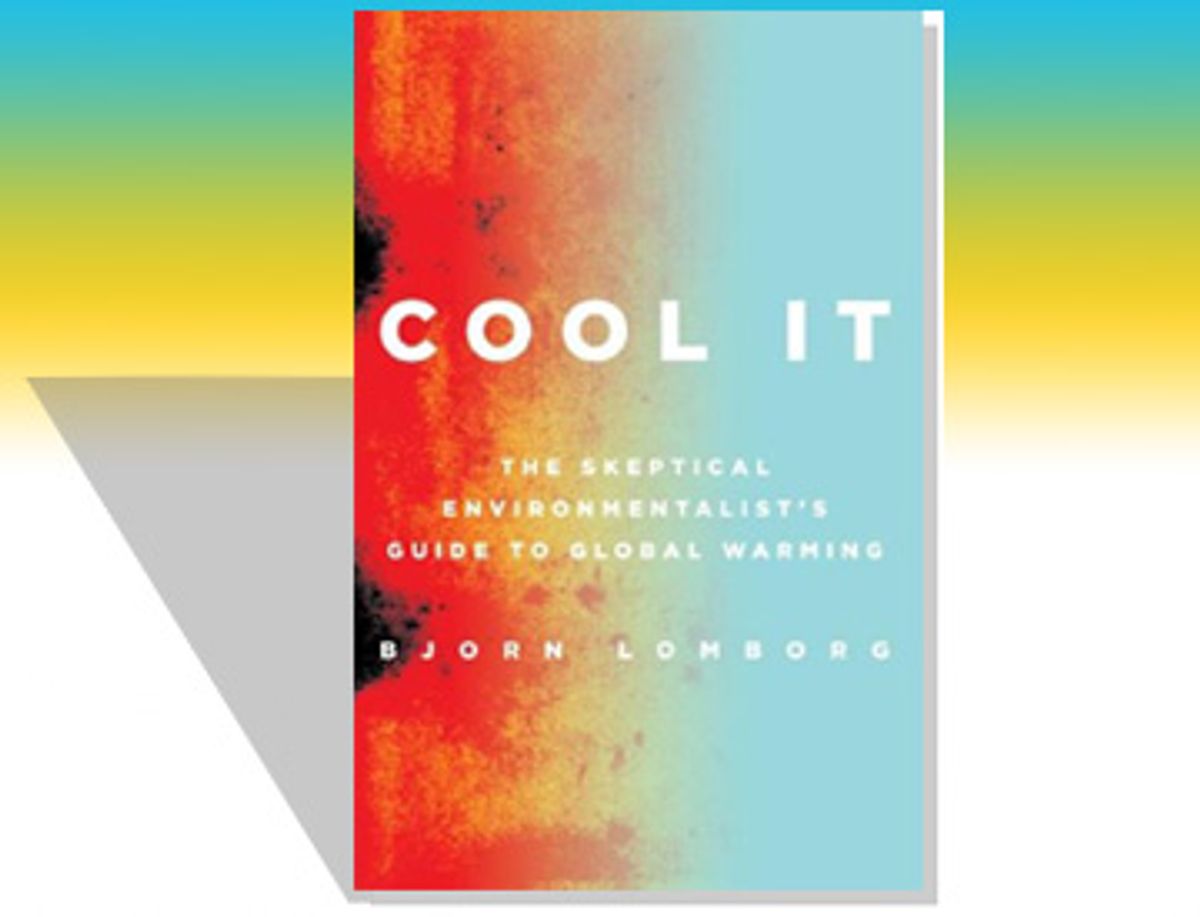
In "Cool It: The Skeptical Environmentalist's Guide to Global Warming," that Copenhagen Business School professor, Bjørn Lomborg, is at it again, preaching the gospel of benefit-cost analysis. His message: Don't take any serious action to stop global warming pollution because doing so will slow down economic growth that poor people need, and anyway, it's really not going to rain that hard.
Lomborg's first effort, "The Skeptical Environmentalist," made a splash in 2001 with a mixture of polemics targeted at scare-mongering environmentalists. With its voluminous footnotes, Lomborg appeared to have done his homework. But on closer examination, some of the facts were not so well supported and Lomborg was widely accused of cherry-picking to support his arguments. Eminent Harvard biologist E.O. Wilson called the work a "sordid mess."
In "Cool It," Lomborg has three messages. First, the planet will warm up no more than 4.7 degrees Fahrenheit this century, and on balance, this will be bad, but not too bad. Second, all benefit-cost models show that serious limits on global warming emissions are too costly, and therefore we should pollute with virtual impunity. And -- surprisingly -- we should invest a decent amount ($25 billion per year) in clean energy technologies now so that, starting in a few decades, we will have tools to slow down global warming just a little bit through 2100.
How much is a 4.7 degree warming? During the last ice age, a period of time during which much of North America was covered with hundreds of meters of ice, the world was only 9 degrees colder than it is today. Lomborg's world in 2100 -- what he calls the "standard" estimate from the U.N.'s Intergovernmental Panel on Climate Change -- is already halfway to a shift in temperatures of ice age magnitude, only hotter not colder, within our children's lifetimes.
To make his case that this "moderate" warming won't do too much harm, Lomborg puts much weight on the argument that as the world heats up, reductions in deaths from cold might significantly outweigh increased heat deaths. But as Frank Ackerman at Tufts has shown, such a conclusion holds only if one incorrectly assumes that people do not adapt to what Lomborg insists will be very gradual temperature changes. Here as elsewhere, Lomborg presents scientific and economic debates as much more settled than they are.
But this really is not the point. The glaring error in "Cool It," and the one that disqualifies the book from making a serious contribution, is that Lomborg ignores the main concern driving the debate. Incredibly, he never mentions even the possibility that the world might heat up more than 4.7 degrees. Although he claims IPCC science as gospel, in fact the scientific body gives no single "standard" estimate as its official forecast for this century's warming. Instead, the IPCC provides a range of up to 10.5 degrees -- more than double the number on which Lomborg bases his entire argument.
The global warming "alarmism" that Lomborg finds so distasteful is motivated by a serious, science-driven concern that hidden within our global climate system are powerful positive feedback loops. So that as we inch up from 3 to 4 and then 4 to 5 degrees of warming, we may very well cross some temperature threshold that would trigger a couple of degrees of further warming, causing a catastrophic upward spiral in global temperatures.
For example, if the Amazon heats up and dries out too much, much of it could burn down, flipping to savannah, and releasing tens of billions of tons of CO2 into the atmosphere. Similarly, as the permafrost in the Arctic melts, a huge pulse of methane may be released. The science is clear that, interacting, these and other biophysical and socioeconomic factors could drive planetary temperatures far beyond the range that Lomborg addresses. By ignoring the vast uncertainty underlying these forecasts, and every alternative outcome except his preferred "moderate" warming scenario, "Cool It" reduces to an uninteresting discussion of why folks alive today should choose 4.7 degrees of warming rather than 4.4 as the optimal outcome for our grandkids.
On sea level rise, Lomborg assures us, with serene confidence, that it will stop at a serious but manageable one foot by the end of the century. The book omits any reference to Dr. James Hansen, head of NASA Goddard's Space Research Institute at Columbia University. A growing body of research led Hansen to declare earlier this year that Lomborg's favored business-as-usual scenario "would guarantee future disintegration of West Antarctica and parts of Greenland." This in turn would guarantee a long-run, irreversible sea level rise of 20 feet or more, with the potential for a several-foot increase this century.
Given Hansen's recent work, Lomborg's insistence that "all models clearly show both Greenland and Antarctica making small contributions [to sea level rise] over the next century" is silly. Similarly quaint is his claim that Antarctica is a region where "little or no surface melting occurs." Earlier this year, NASA found that California-size lakes formed on the continent's surface in 2005.
Lomborg's focus on a single, midrange number for global temperature increase is paralleled by his insistence that Kyoto-level controls, with the U.S. participating, would have cost the world $180 billion per year. Kyoto mandated a 7 percent reduction in emissions by 2010, and the European countries that are complying with the treaty have done so by placing a cap on emissions from cars and power plants. To get under the cap, industries have to invest in new, cleaner technologies, and to the extent that this increases the cost of travel or power, these higher prices can generate a reduction in the rate of economic growth. This in turn might lead to a small percentage drop in the level of global GDP at the end of each year -- Lomborg's measured cost of Kyoto.
Yet here again he imagines a consensus that does not exist. Yale economist Robert Repetto's well-known review of 16 cost studies concluded that the estimated GDP impact of Kyoto-level controls ranged from the relatively small negative effects that concern Lomborg, to results that were also small, but positive. Reducing emissions might actually spur economic growth by, among other reasons, increasing global energy efficiency.
Lomborg manufactures yet another alleged consensus among economists regarding benefit-cost analyses of carbon controls: "all macroeconomic models show they are poor investments." This is wrong. Several benefit-cost analyses -- including those of William Cline and Frank Ackerman -- have supported serious near-term caps on carbon.
Lomborg is forced to acknowledge, and try to debunk, the most recent counterexample: the high-profile Stern report from the U.K. Lomborg refers frequently to four economic Nobel laureates who agree with his position that carbon controls are too expensive. But professional opinion is far from monolithic. Stern's analysis is part of an ongoing debate among economists -- particularly on the choice of discount rate, a critical parameter that drives the results of all the benefit-cost models. The discount rate determines how much weight the models give to benefits (whether higher GDP or lower global temperatures) that occur in the future.
Lomborg's preferred models choose a high discount rate of 6 percent. This favors reaping GDP benefits soon, while paying surprisingly little attention to long-run climate damages. The reasoning? Those early GDP increases can be productively reinvested and enrich future generations. By contrast, Stern picks a low discount rate of 1.4 percent, asserting on moral grounds that any early GDP gains should be weighed against later climate damages more or less equally. His model worries less about foregone investment and growth opportunities, should climate control efforts noticeably lower GDP over the next few decades.
In his review of the Stern report, Harvard's Marty Weitzman shows that -- irrespective of the moral case -- both Stern's and Lomborg's preferred discount rate can be well justified on theoretical grounds. In the end, both Weitzman and Nobel laureate Ken Arrow argue that Stern might be right (though for the wrong reasons). And two other Nobel winners, Joseph Stiglitz and George Akerlof, and dozens of serious researchers support strong, near-term caps on global warming pollution.
One glaring example: Lomborg frequently cites the Kyoto cost estimates of Yale economist William Nordhaus. And yet, writing in Science, Nordhaus supported Kyoto as a global insurance policy, calling it a "useful if expensive guinea pig." He continued: "It is hard to see why the United States should not join with other countries" in pursuing this important experiment in building the international institutions that can deal with global warming.
As in his previous book, Lomborg cherry-picks the evidence to manufacture both a scientific and economic consensus that does not exist. By focusing exclusively on a single moderate warming scenario, "Cool It" fails to grapple with the real economic rationale for cutting carbon now: to buy insurance against the possibility of catastrophic outcomes.
Harvard's Weitzman puts the current concerns of many economists clearly. Based on the findings of the U.N. climate panel, he notes that with roughly 3 percent probability, "we will [live in] a terra incognita biosphere within a hundred years whose mass species extinctions, radical alterations of natural environments, and other extreme outdoor consequences of a different planet will have been triggered by a geologically-instantaneous temperature change that is significantly larger than what separates us now from past ice ages." Facing uncomfortably high probabilities for these kind of catastrophic consequences, leading economists like Weitzman are advocating a "gradualist climate-policy ramp of ever-tighter greenhouse gas reductions" that will give our kids options: options for deep cuts if needed, and options emerging from the new technologies that will be driven by steadily tightening pollution caps.
While "Cool It" misses the central issue in the debate, the book does show an interesting evolution in Lomborg's thinking. In a departure from his earlier work, and surprisingly, given his downplaying the impacts of global warming, Lomborg calls for an ambitious public investment program in clean energy technologies. I could not agree more. When my 19-year-old daughter reaches my age, her generation will have to cut global warming pollution 10-20 percent per decade. Their mission will be to rewire the entire planet with low-cost, clean energy technologies, creating tens of millions of jobs, stabilizing the climate, and laying the foundation for a prosperous and sustainable future. But if we don't invest today in fuel cells, solar arrays, and biofuel technologies, she simply won't have the affordable tools to do for her kids what she will need to.
Lomborg, however, focuses exclusively on public investment, dismissing in one sentence the sound economic argument that a cap on carbon, by raising the price of dirty fuels, will be a critical spur to private investment in clean technologies. To foster the kind of technology revolution that can stabilize global warming pollution, significant government support will be necessary, but far from sufficient.
Lomborg considers himself a friend of the world's poor. A table in his book shows all the good things that we could do with the hypothetical $180 billion he argues Kyoto would have cost. But faith, hope and charity are not zero-sum goods. A world brought together around a common agenda of stabilizing the climate will be more, not less likely, to tackle other common projects.
At the end of the day, Lomborg believes in the morality of benefit-cost analysis: No god but GDP. Funds diverted into capping global warming pollution means fewer "schools and hospitals" (as well as fewer Hummers and McMansions). For the half of the world's population still living in poverty, economic growth as conventionally measured remains an important priority. For the 2 billion of us living in relative comfort, however, slightly slower GDP growth would sacrifice little if any additional happiness. And as Lomborg acknowledges, most of the benefits of a moderately warmer climate (longer growing seasons, reduced cold days) accrue to the global North, while most of the costs (impacts on tropical agriculture, hotter summers, vulnerability to extreme weather) fall on the poor in the global South.
But give Lomborg his whole argument. Suppose, as he believes, that Kyoto-level controls will cost a cumulative $5 trillion over the next 100 years. That is about two years' worth of increase in global output. Suppose also that we ignore Lomborg's advice and in the next few years freeze global warming pollution in the rich countries. That would mean that a century hence, our descendants, living in a much richer world, would have to wait an additional two years -- until 2109 -- until a growing global economy left them as rich as they otherwise would have been in 2107.
Will they thank us? Stabilizing emissions now will open the door for deeper reductions should our kids need to make them, and send powerful signals to the marketplace about future demand for the low-carbon, low-cost technologies that will be critical to stabilize the climate by the end of the century. Continued pollution closes off those options. And unchecked, in the year 2107, over a third of the terrestrial creatures on the planet could be locked into extinction from habitat destruction due to global warming.
Noah, build that ark.
Shares