

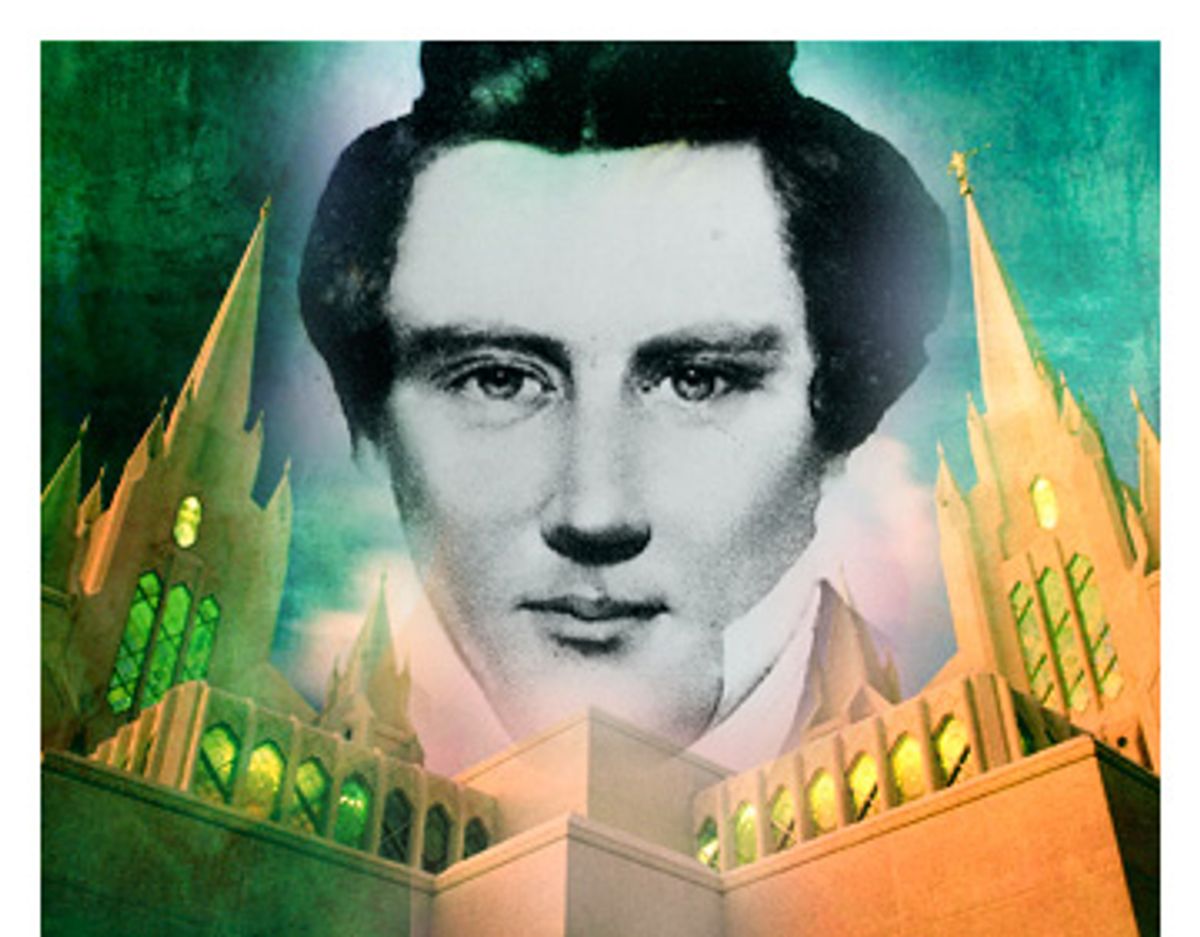
Almost a hundred years before Mitt Romney, Harry Reid and "Big Love," Mormonism had its first big pop-culture moment. It was not a happy one. In the early days of cinema, more than 30 films were made featuring villains drawn from a new and controversial sect, the Church of Jesus Christ of Latter-day Saints. Mormons were generally depicted as bearded, depraved and violent cultists who abducted wholesome American women into polygamous marriages.
In fact, the Mormon church had repudiated the practice of multiple marriage in 1890, although it continued in secret at least into the first decade of the 20th century. Needless to say, that didn't stop the pop-culture juggernaut from spewing out bigotry and misinformation, culminating with H.B. Parkinson's huge 1922 hit "Trapped by the Mormons," which produced a sequel ("Married to a Mormon") the same year and has now spawned a 21st century parody remake, starring a drag king as a seductive Mormon vampire.
Mormons may not be vampires, but I was personally bitten by one. This occurred in the mid-1970s, in an old gold-mining town in the Northern California mountains. I'm not going to say exactly where, because for all I know Dawna, the Mormon who bit me, still lives in that town with an enormous brood of Mormon children. Dawna was the girl next door, literally. She was 13 years old, going on about 24, while I was 12, going on 12 and a half. We were on a sofa in the garage, and Alice Cooper's "Billion Dollar Babies" was on the record player. Despite mimed instructions from her brother, who was on the other side of the room with his arm around another Mormon girl, I had no idea what Dawna wanted me to do. So she bit me, on the hand, hard enough to draw blood and leave an infected wound that lingered past summer and weeks into the school year. I bore it with a mix of puzzlement and pride.
I doubt the LDS church would have put forward Dawna or her mother (a CB radio operator also named Dawna whose on-air handle, I swear to Jesus, was "Dawna Donut Dunker") as ideal examples of Mormon womanhood. By the next summer Dawna junior had definitely joined the ranks of the town's "bad girls," and a few years after that her mom ran away with a truck driver she met over the airwaves. Still, the Dawnas cured me of at least some of the stereotypes I might have held about Mormons; in their own way, they were acting out some of the central contradictions or paradoxes -- especially the tension between separatism and assimilation -- that LDS historian Terryl Givens finds at the heart of Mormon culture.
Across the several summers and Christmas vacations I spent hanging out with Mormon kids and their families in that dusty Sierra Nevada town, I did begin to imbibe the idea that Mormons were culturally distinct, if not entirely separate. Our town was almost half Mormon, and while the Saints mixed occasionally and awkwardly with gentiles (Mormons often use this word, to the perennial amusement of Jews) at bingo tournaments or the pancake breakfast in the Odd Fellows' Hall, mostly they kept to themselves.
If I was welcomed, and fed enormous meals, in various Mormon households it might have been because, as Givens explains, their culture puts a high premium on cordiality and sociability. It might have been sheer pity: I was an only child, and my parents were weird summer people from the Bay Area who stood outside the town's divisions. (They weren't Mormons or Presbyterians or Methodists, or any other denomination people in that town understood; stranger still, they were widely known to be Democrats.)
Nobody in those households ever wasted their time trying to convert me, but I picked up random bits and pieces of Mormon religious belief and cultural practice along the way. I'd heard about the angel Moroni and the Prophet Joseph and the gold plates buried in a hillside somewhere back East, but what did that have to do with all the canning and pickling and preserving that went on in Mormon kitchens? Dawna's brothers and other Mormon boys talked eagerly about the prospect of being sent overseas as missionaries, but given the dusty horizons of life in our little town, that was understandable. Most mystifying of all, why did Mormon kids have to sneak up the hill behind Main Street into the Jeffrey pines to share a Coca-Cola?
I couldn't have known this at the time, and I doubt the Mormons in our town knew it either, but the faith founded in 1830 by Joseph Smith -- who claimed direct and personal contact with God, Jesus, the Holy Ghost, John the Baptist and various angels -- was even then undergoing a dramatic transformation. As Givens discusses in his fascinating new book "People of Paradox," Mormonism has always been seen as a quintessentially American phenomenon, born out of the visionary religiosity of the Second Great Awakening and the fervent individualism of Jacksonian democracy.
At the same time, thanks to its peculiar history of both persecution and self-exile, the LDS church has long been associated with the outer margins of American life. For most of its existence, a large proportion of its adherents have been low-income, low-status rural whites in Utah and other isolated regions of the Far West. If the stereotype of Mormons as polygamous deviants had faded by the '70s, the counter-stereotype -- Mormons as unbearably wholesome, awkward and naive family-values Americans, à la the Osmonds, or for that matter the Romneys -- endures to this day.
But by the end of the decade when Dawna bit me, the Mormon "priesthood," which permits entrance to temples and full adult participation in the faith's most sacred rituals, had finally been opened to men of African ancestry. There are still very few African-American Latter-day Saints (one prominent exception being R&B legend Gladys Knight), but the expedient "revelation" of 1978 launched a new wave of global missionary expansion. Today, fewer than half the world's 13 million or so Mormons live in the United States, and only about 14 percent live in Utah. Given the church's rapid growth in Africa and Latin America, the day when people of color make up the Mormon majority is not far away.
In his introduction, Givens speculates that Mormonism is on the path toward becoming "the first new world faith since Islam." That may be premature, since the global ratio of Muslims to Mormons is roughly 115 to 1. Still, the longer you consider the parallels between these two faiths, the more provocative they become, which I'm pretty sure was not Givens' intention. Most obviously, both religions involve divine revelations directly communicated to a charismatic latter-day prophet, who rapidly attracts followers but is widely viewed by outsiders as a huckster, a fake or even a madman.
To their respective followers, Mohammed and Joseph Smith are not the inventors of new denominations but restorers of the original, uncorrupted monotheistic tradition of Abraham, Moses and Jesus. Even the language of the two faiths' central tenets is strikingly similar. In reciting the Shahadah, or principal declaration of faith, Muslims may say: "There is no god but Allah and Mohammed is His Messenger," or "I testify that Mohammed is the Messenger of God." One of the most frequent forms of "testimony" in a Mormon meetinghouse comes when a worshiper rises to declare: "I know that Joseph Smith was a prophet of God." Both religions make claims to absolute and universal truth, and those declarations are meant to reflect knowledge rather than belief in the ordinary theological sense, which may be tinged with doubt. In answering the oft-asked question, "Are Mormons Christian?" one might ask, only half facetiously, whether Muslims are Christian too.
Givens doesn't go anywhere near that far, but he's a rigorous and fair-minded scholar who handles some of the touchiest topics in Mormon history with grace and dexterity. As he admits, the question of whether Latter-day Saints can be considered Christians does not yield a universally acceptable or historically obvious answer, no matter what Mormons may claim. You might say that the answer depends on who is asking the question, and when. Throughout their church's relatively brief history, Mormons have been torn between a desire to separate themselves from other Christians and other Americans and a desire to assimilate and be accepted. The "dynamic tension" that Givens detects between these poles runs like an electrical current through all the other paradoxes and contradictions that he believes define Mormon culture.
If the assimilationist ethic is ascendant in Mormonism at the moment, with Mitt Romney apparently trying to sell himself to evangelical Christian conservatives as a slightly eccentric fellow traveler, the separatist tendency remains imprinted in the faith's cultural and theological DNA. At the very beginning of Smith's prophetic career, when he was a 14-year-old boy in the woods of western New York state, Jesus Christ personally appeared to him and instructed him to steer clear of all existing Christian churches, saying that "all their creeds were an abomination" in his sight.
Toward the other end of his short life, which ended with his "martyrdom" at the hands of an Illinois lynch mob in 1844, Smith began to formulate the most infamous theological ideas in Mormonism. These are many and various (they include the covenant of "celestial plural marriage," for example), but for sheer heresy nothing outdoes Smith's pronouncement that God did not create man from nothing, since God and man are eternal and coexistent spiritual entities. God is himself a perfected form of man, Smith taught; in fact, God used to be human, and after long ages of exaltation in the afterlife, men can become gods. As Givens observes, "It would be hard to conceive an idea ... more outrageous to Christian dogma, and more hostile to the very cosmology underlying a conventionally theistic universe."
Smith's theological vision, Givens notes, violates the traditional Judeo-Christian distinction between everyday experience and the sacred or transcendent sphere. If God, angels and human beings "are all of one species, one race, one great family," in the words of early Mormon philosopher Parley P. Pratt -- and if these entities appeared numerous times, in tangible, physical form, to a backwoods boy in 19th-century America -- then "the sacred distance at the heart of Western religious experience comes near to collapsing."
This particular sacrilege against conventional dogma is both the source of Mormonism's unique appeal and what makes it such a threat to older, more established denominations: If miracles and divine visitations came routinely to the Hebrews of the Old Testament, Smith demanded, why shouldn't they come to us? In recent decades, many evangelical Protestants and some Roman Catholics have warmed to the possibility of modern-day miracles and personal communication with the deity (over and above inherently private and subjective religious experiences, like visions and prayer). To some Mormons, this is evidence that their restored gospel is working its magic.
One of the central paradoxes of the Latter-day Saint movement, then, is that Mormons want to belong to a larger Christian fellowship when it's socially and politically convenient to do so, while hewing to a set of beliefs most Christians find outrageous and following a prophet who has told them they are the only true Christians. Givens quotes architectural historian Paul Lawrence Anderson on the peculiar design qualities of Mormon churches, which reflected "a delicate balancing act [of] wanting to be different, but not different enough to be marginalized."
Another of Givens' conundrums is that Mormons belong to the most hierarchical and authoritarian church this side of the Vatican, yet one that also has "fanatically individualistic" qualities; every Mormon, after all, is "vouchsafed the right to personal, literal, dialogic revelation with God." Mormons employ an epistemological certainty that may sound like the language of evangelical Protestantism -- "I know Joseph Smith is a prophet of God" -- but Smith's theology offers no "born again" moment of certain salvation. Exaltation and godlike perfection lie eons in the future, at the end of a long and difficult road of spiritual and intellectual learning.
Behind all those apparent contradictions, Givens discerns an overarching view of the universe as "essentially, as well as existentially, paradoxical," in the words of Mormon essayist Eugene England. No better example can be cited than the testimony of Nephi in the Book of Mormon, the purportedly ancient scripture that Smith claimed to have received from the angel Moroni in 1827, on a set of gold plates he apparently translated into pseudo-King James English by talking into his hat. Virtually alone among Abrahamic theologies, Mormon scripture interprets the fall of Adam and Eve as a providential act: "If Adam had not transgressed he would not have fallen, but he would have remained in the garden of Eden ... And they would have had no children; wherefore they would have remained in a state of innocence, having no joy, for they knew no misery; doing no good, for they knew no sin."
Givens observes that in one stroke Smith cut through a problem that has troubled Talmudic and biblical scholars since the dawn of the Judeo-Christian tradition: Why did an all-knowing and all-powerful God allow his children to fall from grace? At the same time, in doing so Smith launched a morally simplistic, eternally optimistic theological tradition without much room for anxiety, tragedy or doubt. Mormonism has no need for the poetry of Milton or the philosophy of Augustine.
Givens is primarily concerned with how the paradoxes he finds in Mormon history and the development of Mormon thought have played out in the cultural realm, meaning both the anthropological and literary-artistic senses of that term. "People of Paradox" is aimed at an educated general readership, both Mormon and otherwise, but if you need to know more about the fantastical and violent story of Mormon origins, the lightning-rod figures of Smith and his successor Brigham Young, and the ordeals that led the Latter-day Saints from New York to Ohio, Missouri, Illinois and finally the shores of the Great Salt Lake, you're better off starting elsewhere. (Leonard Arrington and Davis Bitton's "The Mormon Experience" is the standard work by LDS authors, while Richard and Jean Ostling's "Mormon America: The Power and the Promise" is the best book by outsiders. "No Man Knows My History," by ex-Mormon Fawn Brodie, remains unmatched among biographies of Joseph Smith.)
While the book's discussions of the piecemeal development of Mormon literature and art are fascinating -- I'm mildly curious about the novels of Levi Peterson and the films of Richard Dutcher, and there are several interesting Mormon poets -- his real heavy lifting comes in tackling the history of Mormon intellectual life. One of Givens' principal goals, I suspect, is to convince his readers that even when Mormonism was an all-white, Utah-based movement, it was always more diverse, complicated and internally divided than most outsiders realize.
This is clearly true. Although Mormons are closely associated with conservative Republican politics today, there's a long tradition of liberal, environmental and even feminist activism within the church. The late Arizona congressman Morris Udall and his brother, Stewart, a pioneering environmentalist who served as secretary of the interior under both John F. Kennedy and Lyndon Johnson, might be the most famous Mormon lefties, but they aren't alone. Utah was the second U.S. state or territory to permit women to vote (a year after neighboring Wyoming); perverse as it might seem to contemporary sensibilities, many women in polygamous 19th-century marriages also spoke up for women's rights.
Unlike most evangelical Protestants, Mormons embraced music, dance and theater as vital forms of community expression. The Salt Lake Theatre was completed before the great Mormon Temple was, and the traveling theaters known as "road shows" continued to roam rural Utah as late as the 1980s. The Mormon mania for social dances -- the "dancingest denomination in the country," once wrote Time magazine -- has bled into international ballroom competitions, where LDS-owned Brigham Young University has won numerous awards. From its modest parochial beginnings, the Mormon Tabernacle Choir has risen to global prominence in classical and pop-classical music.
More substantively, Mormonism has always valued higher education, even in periods when evangelical Christians viewed it with suspicion. Utah residents have exceptionally high levels of educational achievement, and Givens claims that educated Mormons don't tend to fall away from faith to the degree other religious people do when they attend college. Furthermore, Mormons are not creationists, and the LDS church has never seen itself as hostile to modern science. Smith never proposed a literal reading of Genesis and specifically rejected the idea of creation ex nihilo, so the geological discovery that Earth is immensely old posed Mormons no difficulties. Darwinian evolution was more problematic, given the semi-divine nature of humanity in Smith's teachings, but Mormons have cautiously agreed that evolution might apply to other species.
As 19th-century explorers began to report discoveries of massive temples and cities hidden in the Mesoamerican jungle, Mormons seized upon the nascent science of archaeology, which promised to confirm the Book of Mormon's accounts of ancient American civilizations founded by itinerant Israelites. By its 1879 edition, the Book of Mormon came with extensive footnotes, correlating its place names with New World sites. The church actually sponsored an expedition in 1900 to search along the Magdalena River in Colombia for the site of Zarahemla, great city of the Nephites in Smith's received scripture.
Zarahemla was not found, and by the 1920s those geographical footnotes were gone. Givens performs a delicate balancing act in approaching the question of Book of Mormon scholarship and church historian B.H. Roberts, whom he views as almost a tragic hero of Mormon intellectual life. Roberts apparently never lost faith in the church and its teachings, but he was among the first Mormons to understand that neither archaeology nor any other science was likely to corroborate the far-flung, trans-historical narrative of the Book of Mormon.
Givens cites Roberts' "willingness to rigorously and honestly investigate" Book of Mormon anachronisms (such as the mention of horses, silk, steel and many other plants, animals and artifacts not found in pre-Columbian America), and to explore the possibility that it might have been plagiarized, as examples of the kind of intellectual independence too rarely found within the LDS church. Later, he criticizes a group of BYU-affiliated scholars whose goal is to prove the Book of Mormon's authenticity, noting that they are evading secular academic standards and "assuming rather than bracketing the supernatural dimensions of Mormon origins."
It seems clear that Givens is situating himself in this debate. If the question posed by his history is how far Mormons can engage with the gentile world while retaining their distinctiveness, his career would seem to be a case in point. Givens is both an active Mormon and a credentialed academic (he teaches literature and religion at the University of Richmond), and in "People of Paradox" he brackets the supernatural dimension rather than assuming it, as professional standards dictate. He never discusses his own religious faith in the book, and probably non-Mormons could read it without picking up the clear LDS signals. (It took me a while to notice that Givens almost always refers to Joseph Smith by first name, which is close to a dead giveaway.)
Even the fact that I feel the need to bring this up testifies to the still-awkward status of Mormons in American life. No one would be perturbed to discover that leading works on the history of Judaism were written by Jewish scholars like Hayim Ben-Sasson or Raymond Scheindlin; it would be surprising if they weren't. And I doubt anyone finds it strange that many of the leading figures in Catholic history, like Richard McBrien and Gerald O'Collins, are Jesuit priests. Why should Mormon history be different?
Well, because Mormon history is different, that's why. Judaism and Catholicism have long traditions of internal debate and intellectual engagement with the world, and within those faiths there is tremendous diversity of belief. Religious Jews and Catholics may believe various things that seem unlikely to outsiders, but they are not required to believe "in a set of scriptures of origin so implausible as to preclude serious engagement" by mainstream scholars, as Givens himself puts it. Mormonism may not stand or fall on a young-earth creation or on evolution, but it does stand or fall on the question of whether a 22-year-old man in Palmyra, N.Y., was given a gold-plated book of ancient scripture by an angel named Moroni and then -- let me say this one more time -- translated it with his face inside his hat.
Fortunately for the future of Mormonism, 180 years is just long enough that the same mythical scrim that protects the empty tomb of Jesus from debunkers has begun to descend over Joseph Smith. One might say that the "sacred distance" between man and God that Smith collapsed has pretty well been restored; with the sole exception of the 1978 proclamation admitting blacks to the priesthood, no Mormon prophet has announced a direct revelation in many years. While there is little or no historical, linguistic, genetic or archaeological evidence to support the Book of Mormon, neither the stories it spins nor the story of its discovery can be disproven at this point.
Givens argues that this paradoxical faith and its tormented history have now produced a distinctive ethnic culture that is buoyant and optimistic, but also oddly cloistered; that is both communitarian and fiercely individualistic; that can seem ultra-American at one moment and anti-American the next. People who grew up in Mormon society and remain committed to it, according to science-fiction author Orson Scott Card (probably the Mormon writer best known outside the LDS world), "are only nominally members of the American community. We can fake it, but we're always speaking a foreign language." That's pretty much how I saw those casserole-baking Mormon moms in our town; they were awfully nice to me, but they and I clearly did not belong to the same nation.
These days Mormonism really does speak foreign languages and has transcended the "American community"; there are close to a million Mexican Mormons, and almost as many in Brazil. (The kingdom of Tonga is 32 percent LDS, making it the most Mormon nation in the world.) Meanwhile, Salt Lake City, settled by Brigham Young and his dozens of wives on a promise of avoiding "trade or commerce with the gentile world," has a non-Mormon majority and a left-wing, secular mayor. Whether the cultural traits Givens describes can survive Mormonism's potential transformation into a world religion is an open question, but a lot more people are going to end up living next to Mormons in the years ahead. They don't usually bite.
Shares