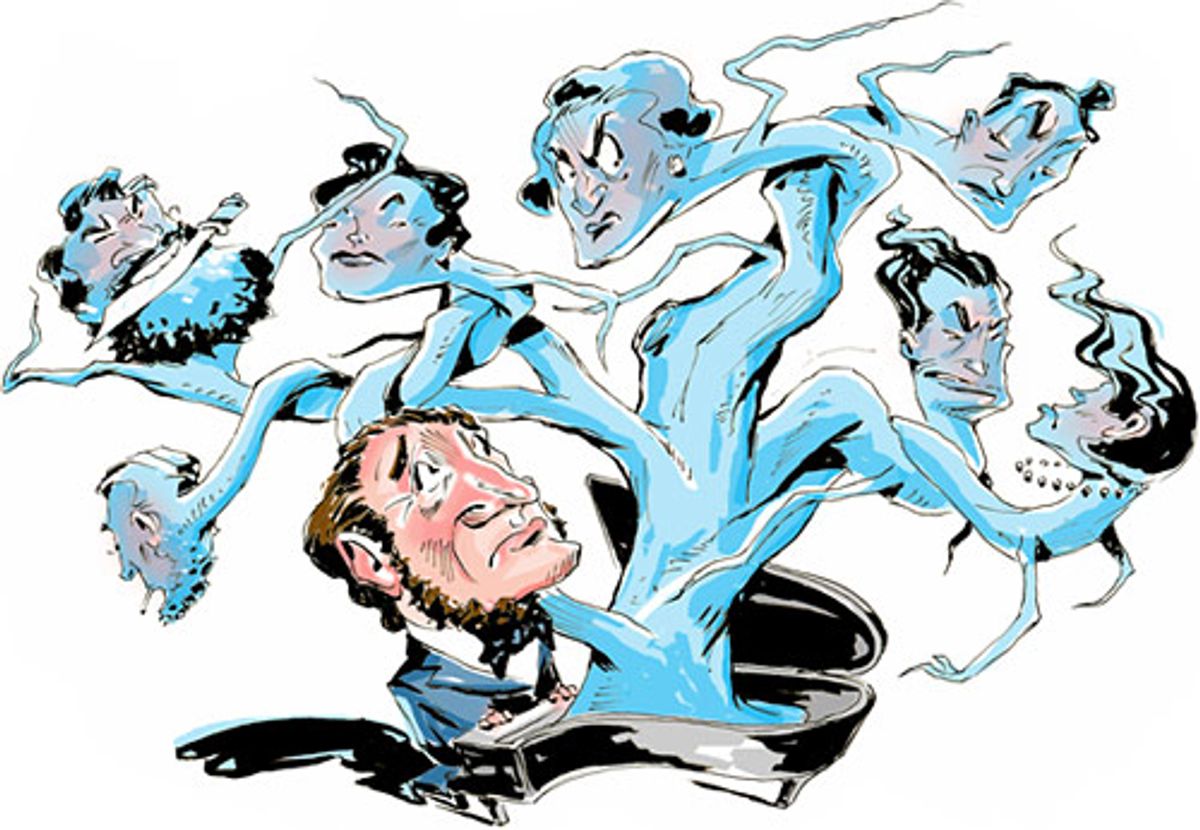
You can't blame an author for claiming that the true story he's about to tell you will "more than match the most lurid episodes of 'Dallas' or 'Dynasty,'" but you might take it with a grain of salt. However, when one of the actual participants describes the story as the saga of an "expanding family hydra, a selfish, pretentious mass with prominent noses and thrusting chins ... in which fathers castrate sons and mothers smother them with love ... in which men are feminine and women masculine and in which a great-grandchild nibbles on the liver of another great-grandchild" -- well, that's when you know they're talking about the Wagners.
The 19th-century Romantic composer Richard Wagner has a relationship to Germany unlike that of any other artist to his or her native land. To many, he's not just the nation's greatest composer, but its greatest artist of any kind, the personification of the (idealized) German soul. When the West German president Walter Scheel gave the keynote address at centenary ceremonies for the Bayreuth festival in 1976 he felt obliged to observe that Wagner was no more than "one of the most important German composers," but even Scheel soon lapsed into drawing mystical equations between Wagner and his homeland. Scheel spoke in the opera house at Bayreuth, the Mecca of Wagnerians, a site that has been devoted exclusively to Wagner's works for the past 132 years. That comparison to Mecca is not made lightly -- Scheel provoked disapproving gasps when he told the assembled worshipers that he didn't regard Bayreuth as "the spiritual center of the world."
It's the exalted, semi-divine reputation of Wagner (in some circles, at least) that makes the often sordid and reprehensible behavior of his descendants so fascinating. He saw himself as the epitome of the Romantic ideal of the artistic genius: child of destiny, redeemer of humanity, law unto himself. If Shelley called poets the "unacknowledged legislators of the world," Wagner thought that the creator of Gesamtkunstwerks ("total works of art") like his operas ought to be not only acknowledged but venerated. By combining music, words and drama into an aesthetically, emotionally and spiritually overwhelming experience, Wagner believed that a profoundly inspired artist such as himself could "regenerate" a society -- specifically, the German people -- restoring the nobility and heroism of the past.
Few modern human beings have claimed a status so godlike, and the philosopher Friedrich Nietzsche, an early friend and devotee of Wagner's, soon became disgusted by the composer's pretensions, likening the receptions at the first Bayreuth festival to "papal audiences." But Nietzsche was only there to begin with because Wagner's music -- epic, enveloping and mystical -- is capable of instilling quasi-religious feelings; he felt it too. After Wagner died, his family decided to match life to art. They turned up the idolatry to 11, carefully buffing all the ignominious aspects of his past out of official accounts, and presiding over the Bayreuth festival in a dynastic succession. Jonathan Carr's fiendishly enjoyable "The Wagner Clan" describes the history of this dynasty, as plagued by scandal and treachery as the snarling millionaires in any prime-time soap opera.
The first hierophant was Wagner's widow, Cosima, the illegitimate daughter of the Hungarian composer Franz Liszt, arguably the greatest pianist of his time. Although every bit as emotionally extravagant as her husband, Cosima had a taste for renunciation that Wagner attributed to her Catholic upbringing. She also had a will of granite. No woman could have been better suited to serve as Wagner's selfless handmaiden in both life and death -- and his death surely facilitated her hero-worship. While Wagner was alive, it was more difficult to ignore the fact that despite his generosity, warmth and talent, he was also, in Carr's words, "a lying, spiteful philanderer" with a hair-trigger temper and a whopping sense of entitlement. It is only after they die, remember, that saints can be properly canonized.
In addition to the highest possible regard for his genius, Cosima also shared the most risible of Wagner's flaws: his anti-Semitism. Wagner published some hate-filled tracts on the subject during his life, and he once wrote to his (unreceptive) patron, King Ludwig II of Bavaria, warning that Jews are "the born enemy of pure humanity and all that is noble in man: it is certain that we Germans especially will be destroyed by them." Nevertheless, Wagner had Jewish friends and allies, and was willing to hire Jewish conductors, musicians and performers when they proved to be superior to the gentile alternatives. At times, he wrote or spoke admiringly of Jews, or suggested that all would be forgiven if they allowed themselves to be "purified" by Christianity. For these (not entirely persuasive) reasons, Carr describes Wagner's feelings on the subject as "muddled and inconsistent."
Cosima's anti-Semitism, by contrast, he calls "chillingly implacable." Whenever anything went wrong, "from supplies of rotten food for the army to a badly tuned instrument, as like as not Cosima found 'Israel' or 'Jewish revenge' behind it." She had "almost none" of her husband's "fondness for individual Jews," and made the "purity" of Bayreuth -- culturally, musically and racially -- one of the festival's primary selling points. As an added bonus, any management difficulties she encountered, from poor box office receipts to bad reviews, could be blamed on Jewish conspiracies against the Master's vision.
Cosima reigned over the festival for 23 years, a period considerably longer than her actual marriage to the composer, and more than anybody else, she cemented the worshipful tone at Bayreuth. She also drew into her orbit the English anti-Semite Houston Stewart Chamberlain, an "effective string-puller" (as Carr puts it) who wrote a bestseller titled "The Foundations of the Nineteenth Century," one of those books that attains great success by bewailing the decadence of modern life. As Chamberlain saw it, history consisted of a mighty, ongoing conflict between the noble Aryans and assorted lesser races, particularly the Semites. His theories would galvanize the burgeoning Nazi ideologues who, in turn, mourned him extravagantly when he died in 1927.
Chamberlain also produced a highly selective biography of Wagner as part of the "campaign of revisionism and distortion" orchestrated by Cosima. Cosima, Carr claims, regarded Chamberlain as a "soulmate," but had no intention of remarrying and thereby forfeiting her status as Wagner's devoted widow. So she married him off to her daughter Eva, who had spent her life functioning as her mother's factotum. "It is hard," Carr writes, "to avoid feeling that, for Chamberlain, the daughter remained to the end something of a proxy for the mother."
Although she retired for reasons of poor health in 1906, Cosima lived until 1930, ensconced in the upper floors of Wahnfried, the family's marmoreal home in Bayreuth, and retaining the informal title of "Hohe Frau" or "Exalted Lady." Her son by Wagner, Siegfried, took over the directorship of the festival, abandoning his youthful ambition to become an architect, and devoting his life to living under his father's shadow. (Carr argues that Siegfried, along with several other lesser-known players in this saga, has gotten short shrift from history, their talents and achievements undervalued.) Named for the half-savage, dragon-slaying, anvil-splitting hero of Norse saga, Wagner's only son was an easygoing, modest and good-humored chap, not the sort of man you'd pick first for a job that required wrangling the hardcore Wagnerians opposed to any variation of the traditional presentation of the Master's works.
Then there were Siegfried's affairs with men, including an ill-fated romance, culminating in a six-month voyage through Asia on a merchant steamer, with a brilliant young British musician whom Carr suspects of being "the love of his life." Fortunately for the Wagner dynasty, Siegfried was bisexual and, just as a newspaper was about to expose his secret sex life, he married a much younger woman and promptly fathered four children.
Siegfried's wife, Winifred, was, like Cosima and Chamberlain, a foreigner. Cosima was French and Hungarian, and Chamberlain and Winifred Wagner were English. Joined to the Wagner clan by marriage rather than blood, all three were far more fanatical in their devotion to the Wagnerian notion of "the German spirit," and more vehement in their hatred of Jews than any of Wagner's direct descendants. All three had disconnected, peripatetic childhoods (none more so than the orphaned Winifred), and Carr speculates that they compensated for their primal experiences of homelessness by seizing fiercely onto their chosen "Fatherland."
It was Winifred who, while providing the clan with two bouncing Wagner boys -- Wieland and Wolfgang -- embroiled the family in its most shameful exploits. She appears to have fallen hook, line and sinker for the young Adolf Hitler when she first met him in the 1920s, and never wavered in her devotion until her death in 1980. (Siegfried soon came to detest "Uncle Wolf," and vainly tried to dissuade his wife from attending Hitler rallies.) Perhaps she was chosen as Siegfried's wife because she seemed so young and malleable, but Winifred turned out to be even tougher than Cosima, and she effectively ran the family from Siegfried's death in 1930, through 1945, a period that encompasses the rise and fall of the Third Reich. It is because of Winifred that the conductor Otto Klemperer was able to greet Wieland Wagner in the mid-1950s with the mortifying question, "What was it like sitting on the Fuhrer's knee?"
Hitler, who adored Wagner's music, regarded the family home at Wahnfried as "sacred ground" and became a frequent visitor there, doting on Winifred's four rambunctious children and annoying her husband. (Carr suggests that Siegfried's will was intentionally designed to prevent Hitler from gaining control of the festival should Winifred marry him after Siegfried's death.) Like everyone associated with Bayreuth, Hitler was fixated on old-fashioned notions of patrilineal inheritance, even though the festival had been successfully run for long periods by two different Wagner wives. As a result, Wieland, Siegfried's eldest son, became the presumed heir to Bayreuth, although he had relatively little interest in the job, and Wolfgang and his sister Friedelind (who believed she was Siegfried's choice for the job) got cut out.
Winifred's special relationship with Hitler, who, for his part, eagerly soaked up the prestige of the Wagner association, had consequences large and small. The first was a bitter rivalry between Siegfried's two sons. Hitler kept Wieland out of the army, on the grounds that he was among the few young men whose personal survival was essential to the Reich. He spent the time dabbling in the visual arts. Wolfgang, on the other hand, was sent to the front and got shot up in Poland before being discharged in 1940. Wieland, with delusions of grandeur no doubt fostered by his status as "chosen one," haughtily refused to undergo a training course at an opera company in Berlin. Wolfgang took it willingly and thereby wound up closer to the course's teacher, who was also the artistic director of the festival and Winifred's closest collaborator.
Then there was their sister, Friedelind, the only Wagner to recognize Hitler for the monster he was. Fascinated by the festival from her childhood, she had befriended several of the regular performers, and was horrified to witness the discrimination one singer's Jewish husband suffered. Friedelind also regarded Arturo Toscanini, a confirmed antifascist who refused to conduct at Bayreuth after 1933, as a surrogate father and mentor. She fled Germany in 1939, and went to South America and England, where she wrote anti-Nazi newspaper pieces. Ultimately settling in the U.S., Friedelind then infuriated the rest of the family by publishing a scathing memoir, "Heritage of Fire," in 1945, revealing Hitler's personal eccentricities as well as Nazi enormities. In that book, she claimed that when she met her mother for the last time before leaving Germany, Winifred warned her, "the order will be given you will be destroyed and exterminated at the first opportunity" (an empty threat, apparently, as Friedelind survived until 1991).
During the war, under Hitler's protection, the Bayreuth festival thrived, supplied with staff, performers and even audiences under the Fuhrer's orders. Bored soldiers and factory workers were sent to classes in Wagnerian opera and then to performances, grateful at least for a day's reprieve from peril and drudgery. Goring and Goebbels, always jostling for better footing within the dictatorship, vied for influence at Bayreuth. Hitler, an inveterate night owl, would drop by Wahnfried unannounced, and the children would be required to sit up until dawn listening to his titanically dull monologues. Last, but far from least, Wieland's exemption from military service didn't prevent him from being assigned, in the last months of the war, to a military research facility that used slave labor from a nearby concentration camp. Wieland never spoke afterward of what he saw there.
Naturally, the Nazi years -- when, for some of the players at Bayreuth, losing your job amounted to losing your life -- supply the most dramatic passages in "The Wagner Clan." But to Carr's credit, he makes the intrigues that came later nearly as compelling. Three of Siegfried's four children battled for control of the festival, with a dark-horse cousin (the son of a child, most likely fathered by Wagner, born while Cosima was still married to her first husband) stepping in to argue that the Wagners were too morally compromised to go on running Bayreuth. Wieland emerged as a brilliant modernist production designer and director, outraging the old school Wagnerians, while Wolfgang fumed and glowered in the background. Various heirs, hard up for cash in the lean postwar period (a strain of profligacy, shared with the Master, runs in the family), took to spiriting valuables out of Wahnfried and discreetly selling them in foreign markets.
Then came the 1960s and '70s, when young people in Germany, including Wolfgang's rebellious son, Gottfried, began asking embarrassing questions and digging up unwelcome facts from their parents' war years. It didn't help things when Winifred, beguiled by a flattering documentarian and unrepentant about her relationship with Hitler, filmed hours of interviews in which she unabashedly gushed over her beloved "Wolf," and insisted that the "dark side" of the Third Reich was the work of perfidious underlings.
She had to be banned from the festival after that, but questions about the Wagners' complicity in Hitler's regime could never be settled to anyone's satisfaction. At most, they lent ideological legitimacy to the Nazi cause, but how could that culpability be quantified? What did it really count for? Winifred was convicted and fined in a denazification trial, but the penalties were relatively mild and she went on insisting that her connection to the Fuhrer was purely personal.
In 1966, Wieland died, in the midst of a tempestuous extramarital affair with the soprano Anja Silja, who once pursued him down a highway, ramming the back of his car with the front of hers. He left the reins to Wolfgang, who, as a result of some ingenious corporate maneuvers, managed to cede financial responsibility for the festival to the newly formed Richard Wagner Foundation, without actually giving up any artistic control. His long, autocratic reign became problematic when, in 1967, he jettisoned his meek first wife and married an ambitious aide. (She was, in compliance with Wagnerian tradition, much younger than himself.) His efforts to install his second wife as his successor were thwarted, but their photogenic daughter, Katharina Wagner, is currently campaigning hard for the job, against her half-sister, Eva, and her cousin Nike is author of the "family hydra" quote in the first paragraph of this story.
Naturally, the true blue Wagnerians will claim that this palace intrigue, all the scheming and skulduggery Carr details so deliciously in "The Wagner Clan," are beside the point. Carroll himself acknowledges that "what really counts is the music." None of this would matter to anyone if Wagner's work didn't command so much passion. The Wagners aren't rich, like the Murdochs or the Redstones. They lack the political power of a family like the Kennedys. And despite their dynastic outlook, they haven't the imperial pedigree of the Windsors. Yet, their scandals and machinations remain captivating. What they do have is a remarkable amount of cultural capital, certainly far more than the relatively remote descendants of any other artist can claim -- all of it located in Bayreuth. The festival is the palpable embodiment of Wagner's legacy.
And that is precisely what Wagner meant it to be. From the beginning, when he hoped that what he regarded as his supreme work, "Parsifal," would be performed exclusively at Bayreuth, Wagner thought of the festival as more than just a concert series. How can you erect a shrine to your work, without suggesting that it contains revelations of the divine? How can you proclaim the artist's imperative to remake society and then insist, as the Wagners are intermittently prone to do, that the results have nothing to do with politics? How can you believe that the effects and even purpose of great art are profoundly moral and then argue that the behavior of the artist and his votaries is irrelevant?
As a less revered but far more succinct songwriter once put it, the harder they come, the harder they fall. Wagner has never entirely fallen, of course, but it is precisely the otherworldly grandiosity of his reputation that gives people such a keen appetite for the inside dish on the Master and his clan. Wagner was supposed to be superhuman -- better than the rest of us Jews and foreigners and money-grubbing businessmen and journalists -- and his descendants are the keepers of his flame. "The Wagner Clan" is a welcome reminder of just how human the lot of them really are.
Shares