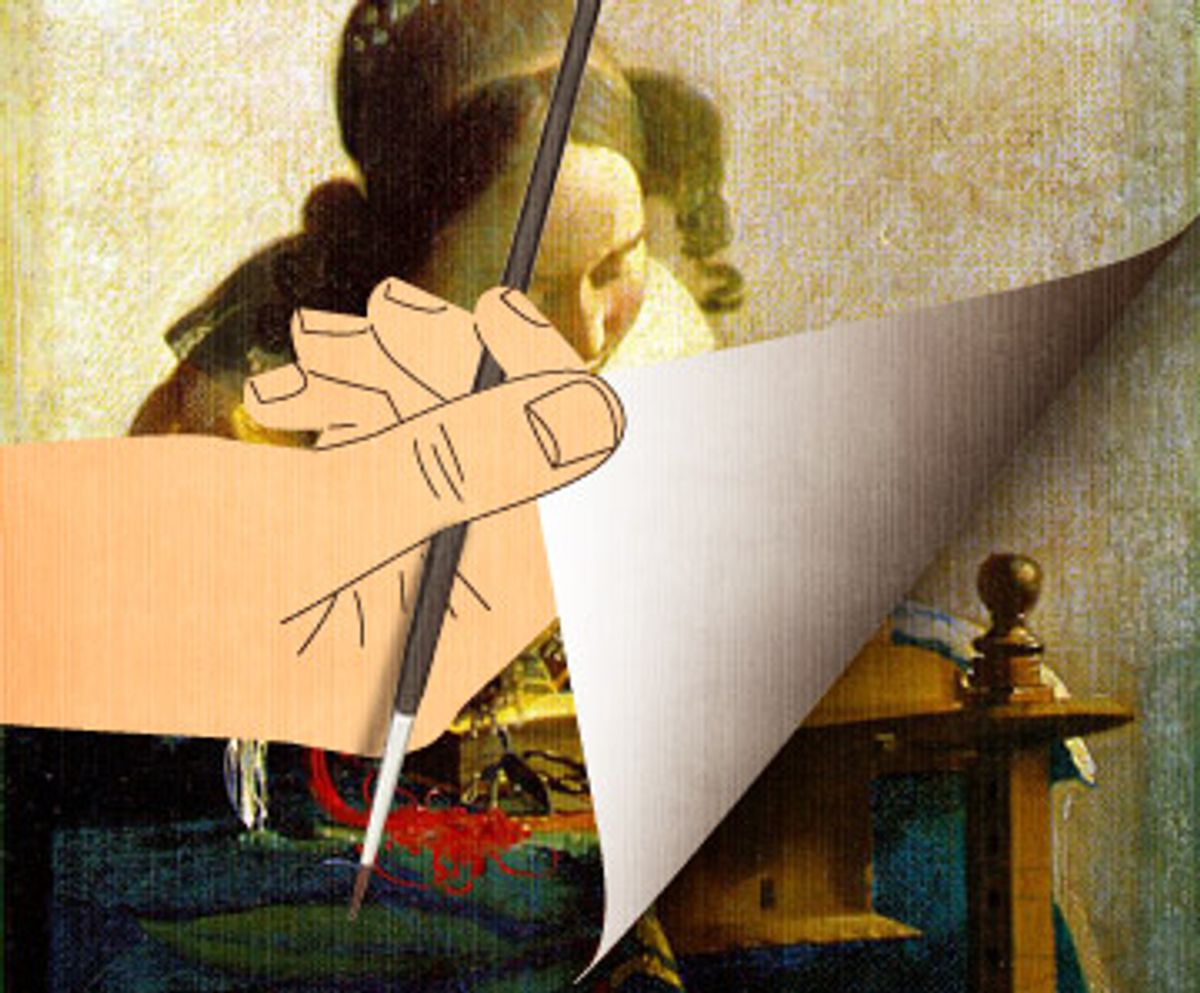
All artists begin as forgers. They hear a chord progression, they see light splash on a canvas, they feel the pull of someone's sentences ... they fall in love. And it becomes the most natural thing in the world to write or draw or compose like the objects of their devotion.
Traditionally, this rite of passage is understood to be both necessary and necessarily brief. Growing up in the early years of the 20th century, for instance, a young painter like Han van Meegeren was expected to mimic the old masters as closely as possible, but only so that he could absorb their accomplishments and, one day, surpass them. What van Meegeren eventually realized -- to his chagrin, probably -- was that he was a much better artist when painting as someone else. So began one of the most audacious careers in the annals of art fraud, a journey superbly etched by Jonathan Lopez in his absorbing history "The Man Who Made Vermeers." Taken together with Lee Israel's eccentric affidavit-memoir, "Can You Ever Forgive Me?" the book raises provocative questions about the links between authenticity and art. Is the "true" better than the "false"? Can art ever spring from a lie?
Han van Meegeren didn't set out to be a forger. A small but elegant man with "a theatrically large presence," he paid his dues in the art world: went to the right schools, courted the right figures. His original work was considered solid enough to merit two solo exhibitions, and his pencil drawing of young Princess Juliana's pet deer (not as twee as it sounds) was widely admired and reproduced. During the 1920s, he made a fine living as portraitist of rich Dutch children.
But with his lifestyle demanding ever-larger infusions of capital, he struck up an apprenticeship with an art-world operator named Theo van Wijngaarden, who had devised a gelatin-glue medium that would simulate oil paint without dissolving under alcohol. (The alcohol test was then the most common tool for detecting forgeries.) Equipped with this new technology, van Meegeren soon began painting "previously undiscovered" variations of Franz Hals classics like "The Laughing Cavalier" and "Malle Babbe."
But he found his truest fit with another old master. For a forger like van Meegeren, Johannes Vermeer had the advantage of being both highly fashionable and deeply elusive, with few works to his name and large gaps in his oeuvre. By recycling panels and canvases from period paintings, van Meegeren was able to create "new Vermeers" so persuasive and unimpeachable, they fooled some of the world's most esteemed art appraisers.
Two of his earliest forgeries, "The Smiling Girl" and "The Lace Maker," were acquired by Andrew Mellon and were still hanging on the walls of Washington, D.C.'s National Gallery well into the 1950s. In 1944, no less an eminence than Luftwaffe chief Hermann Goering acquired the bogus "Christ and the Adulteress" ("the masterpiece of Johannes Vermeer of Delft," declared one art historian) for an unheard-of 1.65 million guilders, roughly $1 million. Goering hung the painting proudly in his country estate, and when Allied soldiers began closing in, he wrapped the canvas around a stovepipe and gave it to his wife's secretary, telling her she "would never have to worry about money again."
Van Meegeren, too, was well above financial worries. By war's end, he was one of the wealthiest men in Amsterdam, the owner of 57 properties, including a garage and a hotel, as well as countless jewels. "If van Meegeren had strolled into a bank vault with a wheelbarrow and a shovel," writes Lopez, "he couldn't possibly have walked away with more money than he made selling fakes during the war."
That wealth, coupled with his history of trading with the enemy, made him hard for liberation forces to ignore. Imprisoned by the Dutch government as a Nazi collaborator, the wily van Meegeren soon found a way both to confess and to expiate his crimes. In a flash of inspiration, he re-created himself as "a misunderstood genius who had turned to forgery only late in life, seeking revenge on the critics who had scorned him early in his artistic career." As for his dealings with Goering ... far from impeaching him, they added to his appeal. Who couldn't love the little guy who had swindled the big Nazi?
And so, against all odds, van Meegeren became a folk hero. In 1947, a Dutch newspaper poll ranked him second in popularity only to the newly elected prime minister and just ahead of Prince Bernhard. Although the state confiscated much of van Meegeren's assets and sentenced him to a year of prison, he died without serving a day of his term. His mythos, meanwhile, lived on -- until later generations of scholars began to uncover disquieting facts about him.
It turned out that van Meegeren was no amateur forger but a lifelong profiteer, as well as a Nazi sympathizer who received direct commissions from the occupying government and who gave generously to Nazi causes. In 1942, he dedicated a book of his drawings to "my beloved Führer in grateful tribute." Even his later Vermeers, as Lopez's astute analysis shows, bear elements of the Volksgeist that figured so prominently in Nazi-approved art. The paintings seem almost calculated to erase the gap between 17th century Holland and 20th century National Socialism.
Van Meegeren, in the final analysis, was "a truly brilliant fraud," but Lopez believes he paid a large price: "He allowed an essential part of who he was, the genuine artist, to wither on the vine. It was a Faustian bargain, one whose consequences included a chronic drinking problem, a failed first marriage, and a series of tawdry affairs."
Well, don't discount tawdry affairs unless you've tried them. At any rate, the moralistic equation Lopez introduces here -- between good conduct and good art -- is more than a little simplistic. And it begs the question: If van Meegeren had never been a forger, would he have become a great artist? Not according to available evidence. Aside from his society portraits, his early work is derivative and drab, and the paintings he actually signed in later life -- a Nazi allegory called "Arbeid"; a 1942 painting of a Dutch pianist imbibing the spectral influences of Bach, Beethoven, Schubert and Liszt -- are howlingly kitschy. One suspects that that van Meegeren had to lose himself in order to find himself.
The same trajectory can be seen in the not-so-cautionary true story of forger Lee Israel. The author of well-received lives of Tallulah Bankhead and Dorothy Kilgallen in the 1970s, Israel saw her fortunes quickly reversed and her book advances swallowed by stalled projects and a disastrous Estée Lauder biography. Within three years, she writes, she had "plummeted from best-sellerdom to welfare, with a couple of pit stops in between." Behind in her rent, her phone disconnected, her apartment teeming with flies and her friends long since fled, Israel crawled, inch by inch, onto the ledge of misdemeanor and, ultimately, felony.
She began by embellishing some old Fanny Brice letters. Emboldened, she moved into whole-cloth forgery: Edna Ferber, George S. Kaufman, Tennessee Williams. Over a two-year period, Israel churned out hundreds of phony letters, selling them for $75 to $100 a pop. (She would later find them in stores, marked up as high as $2,500.) Using the backlight from her broken TV set's electron tube, she was also able to trace signatures. One of her great coups was the John Hancock of Clara Blandick, best known as Auntie Em from "The Wizard of Oz," whose death by suicide had made her signature "the Holy Grail of Oz autographs."
When dealers grew suspicious, Israel graduated to outright theft, taking "a crook's tour" of university library collections, where she replaced valuable letters with forgeries and then, through an associate, sold the originals on the open market. Soon enough, the FBI came a-calling, and while Israel avoided jail time, she was sentenced to five years of probation, including six months of house arrest. ("I was not braceleted because a home phone was needed for that, and I had once again lost my service.") Looking back on her crimes, she can summon up at least some remorse: "I betrayed some people whom I had grown to like. With whom I'd made jokes and broke bread. And in doing so I joined, to my dismay, the great global souk, a marketplace of bad company and bad faith."
Israel's forgeries, of course, pale in scale alongside van Meegeren's, but they were driven by comparable forces: the same toxic brew of creative exhaustion, anger, will to power and alcoholism. (Israel admits to being loaded up on gin during her criminal years.) Like van Meegeren, Israel was almost shockingly resourceful in her deceit, amassing an array of vintage manual typewriters, which she kept in a rented locker: "Royals, Adlers, Remingtons, Olympias, even a German model with an umlaut, which I had bought for Dorothy Parker, knowing that she would have fun with an umlaut."
Neither forger was a mere copyist. Van Meegeren borrowed elements from genuine Vermeers like "The Astronomer," "The Music Lesson" and "The Girl Asleep," but he moved beyond preexisting notions of the artist's career to create an entirely new "biblical phase." The real Vermeer had painted only one biblical scene in his youth -- a bad one, at that -- but van Meegeren convinced a whole generation of scholars that the artist's marriage into a Catholic family had made him a counter-Reformationist. This deception, writes Lopez, had less to do with van Meegeren's artistic prowess than with his "use and misuse of history." He succeeded in "bending the past to his will."
Much the same can be said of Israel. The nominal writers of her faux letters live and breathe as vividly as fictional characters. Louise Brooks: old, ill, drunk, bristling with ancient resentments. Noel Coward, airing out the minutiae of his days: "The Ahernes came to dine on Wednesday and brought along Garbo. We jointed Bobby Andrews at Adrianne's for a lovely buffet." Lillian Hellman, rounding off a perfectly in-character kvetch with the earthy promise of "Come around and I will feed you."
"My success as a forger," writes Israel, "was somehow in sync with my erstwhile success as a biographer: I had for decades practiced a kind of merged identity with my subjects; to say I 'channeled' is only a slight exaggeration." One of her most appealing works is a letter of apology from Dorothy Parker (to a nonexistent correspondent): "I have a hangover that is a real museum piece; I'm sure then that I must have said something terrible. To save this kind of exertion in the future, I am thinking of having little letters runoff saying, 'Can you ever forgive me? Dorothy.'"
"As I wrote it," Israel recounts, "I imagined the waiflike Dorothy Parker apologizing for any one of countless improprieties, omissions, and/or cutting bons mots ... apologizing with no intentions whatsoever of mending her wayward ways." This letter is, in other words, the work of a novelist, who has submerged herself rather deeply in her subject. "I was a better writer as a forger," Israel admits, "than I had ever been as a writer."
A similar claim might be made for van Meegeren. Those early "Vermeers" -- the plaintive "Girl With a Blue Bow," the exquisitely placid "Lace Maker" -- are ineffable in their charm. One could imagine Vermeer himself painting them, had he world enough and time. Only in the guise of another artist, it seems, could van Meegeren taste Promethean fire, but taste it he did. Through a combination of arrogance and humility and expediency, this scoundrel-thief managed to drink the milk of paradise.
Shares