

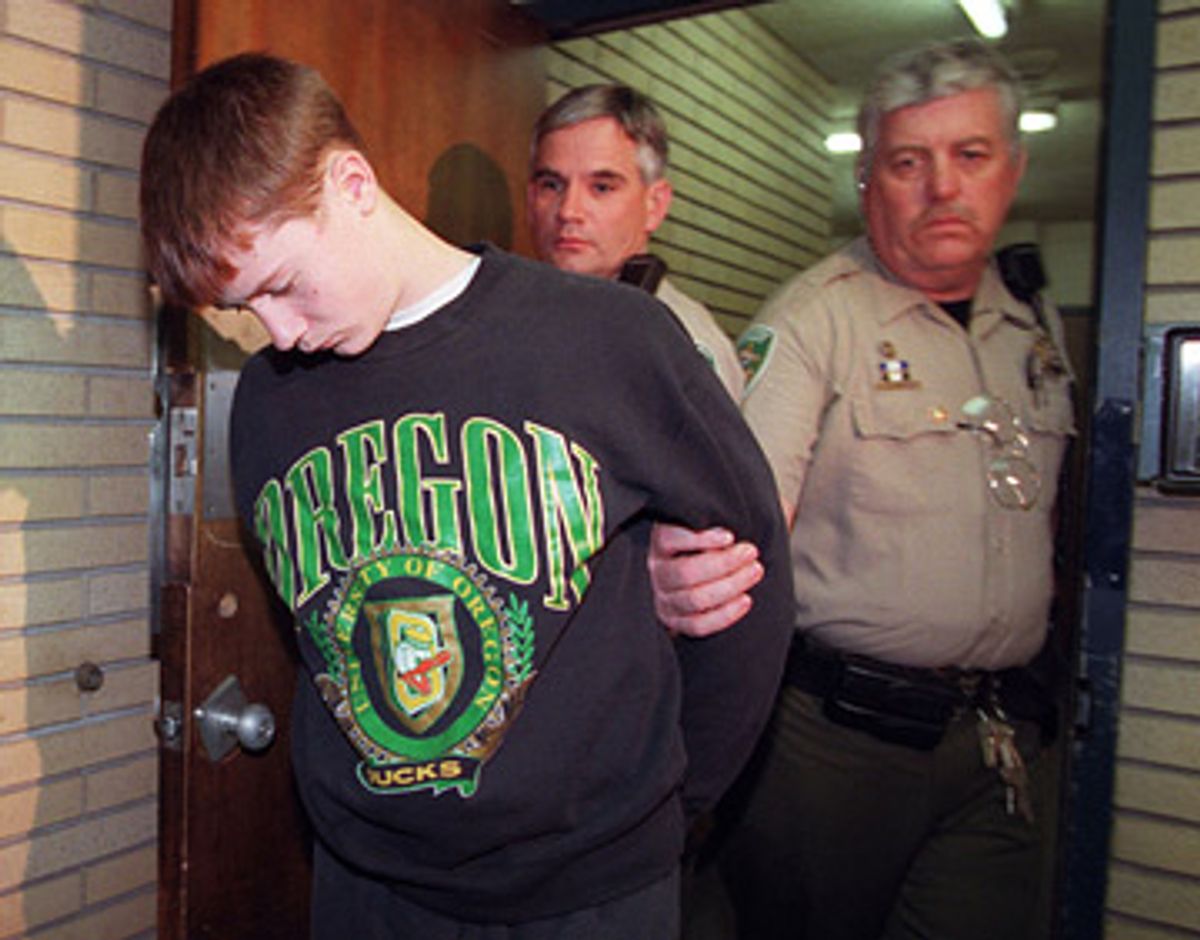
School shootings are an especially American form of horror show, starring several key elements from our national fantasy life: high school, the underdog's revenge (however brief and illusory), violence and, above all, guns. They rarely occur outside the U.S., and when they do, they're perpetrated by adults, not teenagers. Our adolescent massacres are, as Jonathan Fast, a professor of social work, astutely observes in his new book, "Ceremonial Violence: A Psychological Explanation of School Shootings," a type of terrorism, but we have a hard time seeing them as such. We know, or think we know, why terrorists blow themselves up in Middle Eastern marketplaces, but we can't agree on how a 14-year-old winds up toting a semiautomatic weapon to school and opening up on a crowd of classmates and teachers. In the media circus that follows, the list of purported causes is long -- lax parenting, video games and movies, child abuse, declining moral values, religious fanaticism, high school culture, antidepressant drugs, genetics, mental illness, gun worship and so on. Almost before the bodies get cold, partisans have turned to fighting among themselves for supremacy of their pet theories.
Fast, in search of a more illuminating explanation, has made an in-depth study of 13 incidents in which a person (or persons) under 18 shot two or more people on school grounds. The SR (his shorthand for "school rampage") is still a very rare crime, so it's impossible to glean any meaningful statistical information from the handful of examples. Nevertheless, Fast believes he has found some persistent themes and commonalities and lays them out in a grimly compelling sequence of case histories. SRs are, in his view, "acts of terrorism without an ideological core" or "at best there is a sham of an ideology cobbled together from books like 'Mein Kampf,' Ayn Rand's 'Atlas Shrugged,' the writings of Nietzsche, the glamorized pop-culture accounts of Charles Manson and his followers, and such movies as 'Natural Born Killers.'" It's difficult to nail down a single cause because there is no single cause; multiple factors contribute to making a Kip Kinkel or an Eric Harris. Some of those factors -- child abuse or bullying by peers, for example -- are nearly universal to all 13 cases, but as Fast points out, most victims of abuse and bullying don't go on to commit horrific crimes.
School shootings do have a few characteristics that distinguish them from other forms of violence. Most murders, for example, are crimes of passion, committed in fits of rage or fear. Mass murders, however, are "predatory": planned out in advance, with careful deliberation and an apparent lack of emotion. The perpetrators of SRs belong to the category of mass murderers known as "pseudo-commandos," people obsessed with firearms, tactics and military trappings. Fast notes that school shooters tend to take this fetishism even further by adopting sacramental paraphernalia; they wear certain outfits, use purpose-bought weapons, watch particular scenes from favorite movies (one shooter favored the Clint Eastwood film, "Dirty Harry"), recite catchphrases or quotations (Nietzsche and "Natural Born Killers" are popular) or play special music, all as part of an elaborate preparation for the event.
This is what leads Fast to describe the rampages as "ceremonial"; at times, he writes, the elaborate preparations seem like "a throwback to something very ancient and primitive, where the supplicant plays the part of a god, and indulges in a forbidden or privileged activity prior to his own execution or banishment from the tribe." The weird details, leaking out after the attack, are the stuff of whispered playground (and, nowadays, Internet) rumors, and they do make the perpetrators seem even more scary and inhuman -- and therefore morbidly fascinating, like the serial killers in movies or TV shows. Jamie Rouse, a 17-year-old who killed two teachers and a classmate in Lynneville, Tenn., in 1995, had taken to signing his name "Satan" and had carved an inverted cross on his forehead in the months leading up to the day he took his father's rifle to school. This would seem to be a dead giveaway that something was seriously wrong (his parents said they never noticed the inverted cross because Jamie combed his hair over it while at home), but many alienated teens affect menacing and "evil" mannerisms without actually doing anything evil. It's a way of asserting a strong and dangerous identity at a time when they feel vulnerable, unsure and threatened. The shooting is what makes Rouse's "Satan" signature so ominous, not the other way around.
A striking difference between adolescent school shooters and their adult counterparts, even a relatively young adult perpetrator, like Seung-Hui Cho (23), the Virginia Tech shooter, is that the adolescents almost invariably tell their friends about their intentions and even involve them in the planning. Despite their complaints of isolation and loneliness, the shooters tend to belong to a clique of misfits who encourage their antisocial and homicidal yearnings, even if only as fantasies. Evan Ramsey, who killed two people at his high school in Bethel, Alaska, in 1997, told as many as 20 of his classmates about his plans, and a small crowd of these gathered at the safe vantage point of the school's library to see if he'd really do it. On a few occasions, such as Columbine and the 1998 shootings in Jonesboro, Ark., two boys team up to commit the crime, but the informed bystanders are, if anything, just as upsetting. Combined with the creepy trappings adopted by the actual shooter, their passive sanction of the carnage contributes to the widespread fear that young people are becoming ever more callous and ruthless.
In counterpoint to the boogeyman of the Monster Teen is another popular figure, the Man-Made Monster Teen: if not quite justified in his bloody revenge, then certainly well-motivated. After the Columbine massacre, an investigative commission found that the school, whose principal was a former coach, was rife with extreme, sadistic bullying on the part of student athletes. Teachers, even those who personally witnessed the bullying, rarely intervened; some claimed that to do so would have cost them their jobs. Dylan Klebold and Eric Harris, the Columbine shooters, were mercilessly tormented under this regime, as were any students who dared to associate with them. Fast observes that some sort of bullying is involved in nearly every case he examined in "Ceremonial Violence."
SR killers usually blame "the world" for their deeds. "I want people, the world, or maybe just Bethel, to know how mean and cruel the world is or can be. ... The main reason why I did this is because I'm sick and tired of being treated this way everyday," wrote Evan Ramsey, whose ghastly personal history of neglect and abuse by adults and peers certainly vindicated his despair, if not his actions. "All throughout my life I was ridiculed. Always beat on, always hated," wrote Luke Woodham, who killed three people, including his own mother, in Pearl, Miss., in 1997. Plenty of law-abiding citizens who remember their own adolescence as painful and who harbor a lingering hatred for "jocks" and other bullies, as well as the adult administrators who wink at their misdeeds, find such laments credible. (This is one seldom-acknowledged explanation for the quickness with which many credited the rape accusation leveled against the Duke lacrosse team.)
Anti-bullying programs are one of the remedies Fast recommends in the final chapter of "Ceremonial Violence," and he is sympathetic to the misery that many SR perpetrators suffered at the hands of their peers. But he's unwilling to view the shootings as simply the whirlwind reaped by a society that tolerates bullying. Perhaps the most disturbing among the many factors that typically contribute to the making of a school shooter is the role played by a "violence coach" within the shooter's circle of friends. Eric Harris is generally seen as the leader and instigator of the Columbine massacre, egging Dylan Klebold on in quintessential violence-coach fashion. Several solo shooters also had older, charismatic friends who, Fast believes, saw them as handy "proxies" for their own rage. Luke Woodham, for example, was under the sway of a supremely creepy kid named Grant Boyette, who presided over a clique of pseudo-Satanists, younger classmates he referred to as his "army" and even instructed to call him "Father." (Boyette incited Woodham to beat his own dog to death and had a plan to murder the interfering father of one of his "soldiers" by poisoning the doorknobs in the man's house.)
The notion of a "violence coach" comes from the criminologist Lonnie Athens, who has devised a theory of "socialization into violence," elucidated in his book, "Why They Kill." Fast, who is also willing to entertain a countervailing, biological explanation for violent behavior as rooted in temporal lobe brain damage, apparently finds much merit in Athens' theories. Certainly some of the cases in "Ceremonial Violence" conform to his formula. (Others seem better suited to the brain-damage scenario.) Athens defines the socialization process as a series of experiences, beginning with firsthand suffering of abuse; then witnessing the victimization of friends or family members; then coming under the influence of someone who presents violence as the best solution to life's problems; and then, as a final trigger, undergoing a "crisis of identity." In such a crisis, the possibility of finding a stable, meaningful, endurable role in society appears impossible. Trouble with the law, romantic rejection and the behavior of an emotionally disturbed or mentally ill parent can all lead to such a crisis, creating the impression among the people around him that the shooter suddenly "snapped" as the result of that stress. In fact, the movement toward violence is a long time in the making, often in the form of secret plans and discussions with sympathetic friends.
Such traumas are as likely to lead to suicide as homicide. In fact, many school shooters claim to be attempting a version of "suicide by cop," even though the majority of them wind up obediently surrendering to authorities. Central to Fast's own theory of ceremonial violence is an additional factor, the presence of some form of narcissistic personality disorder or "malignant narcissism" (an official diagnosis that nevertheless remains somewhat controversial because it seems to blur into borderline personality disorder). The malignant narcissist finds a merely private suicide to be insufficiently dramatic to satisfy his needs. If he's going to go out, he wants it to be with a bang that will garner him world fame (a stated goal of the Columbine killers) and at the same time annihilate those who have inflicted so many wounds on his overblown, yet fragile ego. The lovingly assembled theater of the school shooting -- the costumes and posturing, the ample documentation of the killer's grievances, the eagerness to make or leave statements to the press -- are all efforts to assert a grandiose identity that the cruel world seems bent on denying.
And finally, there are the guns. Malignant narcissism, social cruelty and child abuse have been around forever, but school massacres are a phenomenon of the past 50 years. "It is a simple fact," Fast writes, "that school shootings are impossible without guns that are affordable, available, easy to load and fire, and capable of firing many rounds within a few seconds." "Ceremonial Violence" contains dozens of astonishing stories of irresponsible gun merchants and adult family members who allowed deadly weapons to fall into the hands of disturbed teenagers. Andrew Golden, one of the Jonesboro shooters, had been given two rifles, a shotgun and a crossbow by the age of 11. His grandfather kept 48 rifles in his house, secured only by a cable. Dylan Klebold's parents, in many respects intelligent and concerned about their son's obvious problems, nevertheless gave him a gun, as did Kip Kinkel's father, despite many warning signs that his son was seriously troubled. Teenage school shooters bought ammo through the mail or at gun shows, using friends who were over 18 as fronts. Or they stole guns from their parents, who either left the weapons lying around or stored them insecurely. Some of those parents were murdered with guns they paid for.
While the Columbine massacre was in fact a failed bombing (few of the 77 bombs Klebold and Harris planted throughout the school ever detonated), the number of people killed was nevertheless still higher than those of many other school shootings because the perpetrators had semiautomatic weapons. (Such was also the case at Virginia Tech, where Seung-Hui Cho killed more than twice as many people as Harris and Klebold.) These and other assault rifles, flooding into the U.S. market from overseas manufacturers in the late 20th century, made their wielders exceptionally lethal, despite the fact that the boys were poor shots and the cheap guns tended to jam. Assault weapons have upped the ante considerably.
School shootings, at least those that kill only one or two people, have come to seem almost commonplace. The killing of one 15-year-old by another 15-year-old in a Knoxville, Tenn., high school cafeteria on Aug. 21 barely registered on the national radar screen. In order to make a name for himself, any malignantly narcissistic adolescent with a dream will need to aim for a body count in at least the low two-figures. Gun control opponents assure us that allowing teachers (and even students) to carry guns will help the situation by enabling potential victims to defend themselves against the likes of Eric Harris and Dylan Klebold. The Supreme Court seems inclined to oblige them, and perhaps regular shootouts will become a high school rite of passage, just like the prom and smoking behind the gym. Deeper, more systemic repairs to our culture will be harder to come by. Like the bullying prevention programs Fast describes in the final chapter of "Ceremonial Violence," such measures demand "attentiveness, self-scrutiny, consistency, detachment, and dogged attention to detail." And that sure just doesn't sound very American.
Shares