

The year is 1960. The place: a posh restaurant just waddling distance from the colonnaded Assemblie Nationale on the Left Bank. Over classic poulet en demi-deuil -- chicken in "half-mourning" shrouded with garlic, black truffles and an artery-plugging butter-and-cognac sauce -- plump Gaullist parliamentarians discuss the Algerian War.
But something's wrong. The statesmen -- there isn't a woman to be seen -- shake their jowls and summon le chef.
"The truffles are sublime, monsieur," snorts a senior senator. "Regrettably your poulet tastes of fish."
"Fish?" gasps the chef, doffing his toque.
"How can we bring Giniral De Gaulle to dine here tomorrow?"
The chef crumbles into a velvet-upholstered armchair. "It's true, messieurs, I can no longer find chicken that tastes of chicken. The caged poulets eat fishmeal with hormones and taste of the sea. I may have to fall on my sword before the Giniral like Vatel!"
The senators drop their cigars; Algeria fades from their minds. Frangois Vatel, chef to Prince Condi of Chantilly, chose suicide rather than serve Louis XIV substandard fare. "This is a national emergency," cries one parliamentarian, "a red emergency!"
Several months later "Poulet Label Rouge" -- the "Red Label" -- is created to certify top-flight French chicken. No fishmeal or hormones, no cages, nothing but the old-fashioned best. And soon -- when the grain-fed free-range roasters have grown to edible age -- the senators, le chef, le Giniral himself (not to mention a grateful French nation), are smiling once again.
The preceding, of course, is fiction, though a similar scenario probably occurred circa 1960. Fiction or not, the Label Rouge system celebrates its 40th anniversary this year, a testament to France's continuing commitment to agricultural excellence. The Label Rouge system is also a reminder, however, that the complicated battle against lousy food -- what the French call "la malbouffe" -- continues.
Bad food in France has been front-page news for the past year. Dioxin-tainted chicken, salmonella, listeria and illegal hormones, not to mention genetically modified organisms (GMOs), have all made for daily reading. There is even a movie out, "La Vache et le President," about a farm boy, mad cows and the French president.
How could this have happened in the land of King Henri IV ("a chicken in every pot") or the magistrate-gastronome Brillat-Savarin ("Tell me what you eat and I'll tell you who you are"), namesake of the country's richest, 75-percent-fat cheese? A country that overthrew the Ancien Rigime for lack of bread ("Let them eat cake"), then named a steak after Napoleon's plenipotentiary minister (Chateaubriand), and, 100 years later, invented the Michelin red guides with their multimillionaire starred chefs? France, a lay republic where food -- the last cultural ID card of vanished duchies and kingdoms -- is sacred? Where "crise de foi" (crisis of faith) and "crise de foie" (liver crisis) are homonyms?
According to some French food experts, including feisty members of the Fidiration Paysanne (an association of small-scale "peasant" farmers) who challenged the WTO in Seattle and attacked a McDonald's in Millau, the trouble really began in the late 1940s. This was when "industrial" or "American-style" farming first took root. With modern agro-business came chemical pesticides and fertilizers, boundless fields sans hedgerows, battery breeding and long-distance transport of products and live animals.
In truth, France's alimentary troubles began with the abandonment of countryside and village -- classic French food is essentially rural (except urbane haute cuisine) -- during the industrial revolution. As many as 120,000 provincials per year poured into Paris in the late 1800s, turning the capital into a culinary crucible while bleeding the countryside; the slaughter of World War I simply sped up the process. French agricultural workers once numbered in the tens of millions. By 1960 there were 5 million; by 1980 only 1.8 million. Two years ago, in 1998, the latest year for which statistics are available, a mere 910,000 were left.
This tiny group now produces a fifth of the European Union's agricultural products, making France the world's second biggest food exporter (after America). Food products remain the country's largest single industrial sector, worth 816 billion francs (about $116 billion) in 1999. Over 67 million tourists a year visit France (25 million go to Paris alone), many of them still expecting to taste the most refined cuisine in the universe. And taste they will -- foie gras, escargot, conserves, wine and hundreds of tangy cheeses made from the raw milk so dreaded by the FDA.
Visitors may also have to swallow "la malbouffe."
For French cuisine, the late 20th century has been a roller coaster -- the perceived lows sometimes coinciding (in critical American eyes) with trade wars, economic cycles and unfavorable dollar-to-franc exchange rates. It's safe to say that French cooking bottomed out in the late 1960s or early 1970s, before the Label Rouge and other high-quality niche initiatives finally bore fruit.
Witness the cookbooks of the period. My modest collection includes a 1969 paperback titled "Cuisine pour toute l'annie" by Monique Maine. Her introduction includes the following ominous observation: "There has been enormous progress in the food industry, packaged foods are now all of excellent quality, but, above all, frozen food has entered our lives." In other words, no more seasonal local specialties, just pop down to the "hyper-market" and stock up on canned or freeze-dried goodies.
As French hypermarkets began to spring up, so died village mom-and-pop shops. This accelerated demographic flight, or what the French dubbed "the desertification" of the countryside. The catchphrase "la malbouffe" was coined in the 1970s by prescient French nutritionist Jokl de Rosnay.
Contrast these facts with the words of English food writer Elizabeth David. In her 1960 "French Provincial Cooking" -- still considered one of the great French cookbooks -- she is strangely, perhaps willfully, out of touch. "Changes brought about by modern methods of transport and food preservation have not destroyed [the] traditions of French provincial cookery," she writes.
Destroyed? Perhaps not. Changed, yes indeed.
Seventeen years later, in her preface to the 1977 edition, David concedes, "Over the years, a certain amount of what I wrote about the provinces of France has inevitably passed into history. Nobody would pretend that the deep freeze isn't everywhere, or that restaurants don't sometimes serve disgraceful prefabricated sauces and inadmissible travesties of famous dishes ... my inclination now is to try harder than ever for quality."
In her 1983 preface to the same cookbook, David recalls that by 1960, when the work was first published, the so-called cuisine classique -- elaborately rich flour-based sauces with overcooked vegetables -- had been outmoded since at least 1939. David looked with a mixture of alarm and wry amusement upon nouvelle cuisine. Was French food as a whole condemned to ridicule, she wondered, because of nouvelle cuisine's "airy little nothings accompanied by their trois sauces served in dolls' house swimming pools round one side of the plate"? No, decided David, "it is not so much the cooking that is wrong, except in the most blatantly arrogant establishments, as a certain coldness and ungenerosity of spirit." By the early 1980s, the excesses of nouvelle cuisine were already clichis.
Just about anywhere in France today you find -- often at the same time -- the haute cuisine of the Michelin-starred chefs; the "classic" cuisine bourgeoise of the gastronomically attentive middle classes; remnants of cuisine rigionale scattered around the provinces; improvised eclectic (a Franco-ethnic mix of store-bought, semi-worked and precooked ingredients); and something like "cuisine nostalgique-ritro" -- what grandma might have cooked (but never did), served primarily in the faux bistros of big French cities.
Add in the countless ethnic cuisines in France (some of the best Moroccan, Vietnamese and Thai food found anywhere), and fast food outlets (over 2,500 of them, including about 800 McDonald's) and you get the picture: It's like looking down into a churning food processor.
Meanwhile, Label Rouge now boasts 27,110 members raising or growing 429 types of high-quality produce (from chickens to snails, shallots to beef), and you can get certified organic or GMO-free foods in every supermarket in the land. Open markets thrive in big cities where nary a street is without its butcher, baker and chocolate maker (not to mention greengrocer, deli, wine merchant and so forth). A recent Louis Harris poll shows that 99 percent of the French describe taste ("le go{t") as a "strong cultural value," and 79 percent consider it the primary determinant in making their food purchases.
All this sounds like great news -- a happy culinary cycle of novelty, reaction and revival, with a welcome opening to the outside world.
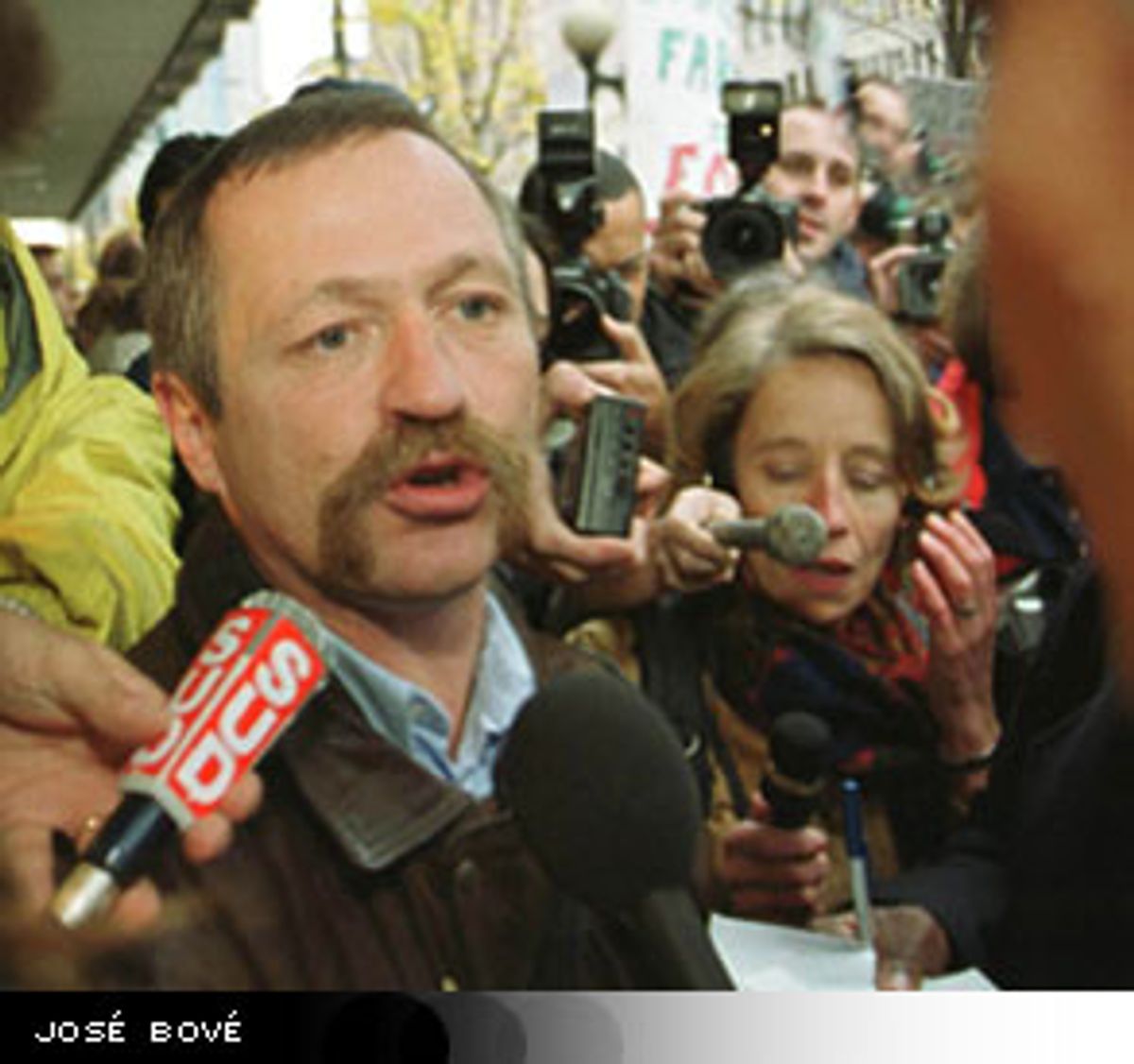
Not according to Josi Bovi.
Bovi, the militant co-founder of the Fidiration Paysanne and co-author of the current bestseller "Le Monde n'est pas une Marchandise" ("The World Isn't for Sale"), insists that this cycle has been broken.
Bovi believes the future of French food -- and, by extension, of French society -- is in mortal danger from wholly new factors. Among them are the European Union's peasant-crushing Common Agricultural Policy (CAP), the United Nations' sinister Codex Alimentarius international food treaty, unfettered global trade, environment-unfriendly agro-business practices, hormones, mad cows and GMOs. Another insidious threat allegedly comes from big-money fast-food chains, specifically McDonald's, which the French call "MacDo."
"If we don't act now it's finished, it's over," the gravel-voiced Bovi told me recently, tracing a doomsday picture with his ever-present pipe.
Bovi's critics call his rhetoric scaremongering. But if everything's hunky-dory in French fields, kitchens and dining rooms, then why is this 50-year-old dairy farmer from Roquefort a national hero?
Bovi's book has been on the bestseller list for months. Wherever he goes, TV, radio and newspapers follow. French people of all ages cajole him to autograph their T-shirts, their pants, their books: whatever's handy when he appears.
Bovi and his fellow Fidiration Paysanne activists have not merely touched a chord in food-worshipping France. They're playing a cacophonous symphony with choral complement. Furious farmers, rabid ranchers, disgruntled politicians from across the spectrum and, most of all, millions of wary shoppers have lined up behind him, making him a Gallic David against the global Goliath.
Bovi's deification began last August in Millau, a bucolic dairy village outside Roquefort, when the stocky curd-wrangler with a horseshoe moustache led a wildly enthusiastic group of 300 local farmers, environmental militants and Fidiration Paysanne activists in the "destruction," according to prosecutors, of an unfinished McDonald's franchise as police watched.
Though several arrests were made at the time of the attack, a manhunt by French secret servicemen followed a few days later. Bovi, along with a handful of fellow Fidiration Paysanne militants, were tossed in jail for about three weeks.
Thus began what Bovi now sees as "$30 million's worth of free publicity" for the Fidiration Paysanne's peasant revolt against "la malbouffe" and its perpetrators.
On Friday and Saturday, an estimated 40,000 supporters showed up for Bovi and his codefendants' hearing in Millau on charges of "ransacking" the McDonald's. But Bovi's anti-"MacDo" crusade began in spring 1999, when the United States, faced with refusals by France to import American beef (as a result of feared growth hormone residues), applied punitive duties on dozens of French products.
One of the hardest hit was Roquefort cheese. Roquefort makers sell 440 tons of their pocked blue curd to America every year at a wholesale value of 30 million francs ($4.3 million). Needless to say, local milk suppliers like Bovi weren't happy. As if to add insult to injury, a new McDonald's franchise -- nearly 800 Golden Arches already grace some 420 French towns -- was under construction in nearby Millau, Roquefort's backyard.
The punitive tariff on so symbolic a food was viewed by Bovi as pure provocation. Roquefort isn't just any fromage. In 76 B.C. the ancient Roman chronicler Pliny the Elder traveled to Gaul, reporting back about the peculiar mold-flecked cheese. Enlightenment philosopher Denis Diderot called Roquefort "the king of French cheeses." In 1925 Roquefort became the first French product to receive the coveted AOC (Appellation d'Origine Controllie), devised to thwart counterfeiters.
"It was truly stupid for the American administration to take Roquefort cheese hostage in the hormone-beef trade war," Bovi tells me in Paris, puffing away. "They represent two utterly irreconcilable types of farming. Doubling the import duties on a high-quality AOC to force us to buy hormone-beef? It's folly."
Despite the confrontational tone, Bovi and his Fidiration Paysanne's gastro-crusaders did not target McDonald's simply because it's American. Nor is Bovi your average French dairyman. He spent part of his childhood in California with his scientist parents. (They were doing agricultural research at the University of California at Berkeley.) He speaks fluent English and scoffs at attempts to discredit him by labeling him anti-American or cravenly nationalistic.
"When I was in America last year I talked to farmers and consumers and our message got through," he says. "Texan cattle ranchers, non-GMO soy growers, Alaskan salmon fishermen -- they've taken inspiration from European movements. I think there's an awakening of consciousness in America, too; things are beginning to move."
Bovi and his federation targeted McDonald's, he says, because the chain serves what he calls "food from nowhere" -- what he and many other Frenchmen perceive as corporate, culture-less and rootless food. Menu items such as hamburgers or chicken nuggets, notes Bovi, are "recomposed" from myriad sources; they're standardized, bland, sterilized. This, to his mind, is the antithesis of traditional French food and all that goes with it -- the art of growing, eating and cooking with a reverence for the soil and the seasons.
"In France the link to your roots is very much through food and cooking traditions," explains Bovi, whose ranchland near Roquefort is encircled by 800-year-old stone walls. "In America there's no sense of an ancient civilization with a rural identity, etched over time into the landscape."
The notion that food is both sacred and site-specific is the root of the emotionally charged French concept of "terroir." First applied to describe the association of grape variety and soil in winemaking, it has come to evoke the wholesome, earthy qualities of regional foods and cooking.
The more France goes global, the more fast foods and hyper-markets there are, the more tenaciously the French adhere to concepts such as "terroir," talismans against an uncertain future.
And for good reason. France's gastronomic future looks increasingly overweight. Researchers such as Dr. Philippe Froguel of France's prestigious CNRS and Institut Pasteur in Lille, believe that Europeans will reach American obesity levels in the next 20 years.
"Half of Americans are overweight," Froguel told me. "A quarter are obese. Right now 30 percent of Europeans are overweight. However, European children are getting fatter all the time. Child obesity has doubled in France in the past five years, and obesity among young French adults has shot up 45 percent." Froguel, also a diabetes expert, adds that "atypical diabetes" (i.e. juvenile diabetes) -- an affliction associated in part with a genetic predisposition and in part with unhealthy eating habits -- was unknown in France until 1999.
Why is this happening? According to Froguel, the French appear to believe they are increasingly under the sway of "MacDomination" and "Cocacolonization." The power of terroir would seem to be weakening.
"Just because we've got these great French chefs it doesn't mean the mass of French restaurants is good," says a pragmatic Bovi. "Responsibility for McDonald's popularity falls on French restaurants and bistros that are frozen in time, like in a [Robert] Doisneau photograph [from the 1950s] ... Institutional restaurants are disgusting, school restaurants are revolting. In them we have tasteless, insipid, homogenous food, so kids prefer to eat at MacDo instead of the school cafeteria."
McDonald's France counters by claiming that its food is wholesome, its beef French (and hence hormone-free). Where the Fidiration Paysanne sees economic and cultural domination, McDonald's sees sponsorship: It builds RonaldLand playgrounds for kiddies, donates money to charity and offers seminars to teach French parents how to behave -- according to McDonald's -- like parents. It has annual sales of over $1.5 billion and its restaurants employ about 30,000 locals and "help animate" downtown areas that would otherwise be deserted (presumably because, as in America, suburban hypermarkets and malls have killed off traditional shopping areas in many French towns and cities).
All of which makes France's enduring Label Rouge glamorous and more important than ever. Now a $1 billion business, its labels distinguish the exceptional quality characteristics of everything from fruit to fish. As a consequence a Label Rouge chicken could cost 50 percent more than a non-label competitor. Slow-growing, slow-fattening species are favored. Farmyard guinea fowl from the Landes, for example, take 94 days to grow to slaughterhouse age, compared to the usual 45. Poultry must be slaughtered locally (within two hours or 60 miles of the farm). Herbivores are fed only top-quality grain; animals must be either "raised in the open air" or "totally free-range." A Label Rouge "farmyard porker raised in the open air," for instance, is better off than your average Parisian: It gets a minimum 50 square meters (about 530 square feet) to trot in -- the size of an average one-bedroom apartment.
"It is not an elitist social class thing," Dominique Chaillouet, a Label Rouge spokesman, told me, "but rather a question of festive food. Even the poor buy Label Rouge for special occasions; it's a question of frequency."
The "Agriculture Biologique" or "AB" label, on the other hand, is an 8,100-member government-certified labeling scheme (recognized by the EU) that imposes strict regulations on about 3,000 organic products, concerning itself only with the healthfulness of its foods -- no chemical pesticides, fertilizers, dyes or food coloring or flavoring; only organic feeds and fodder; free-range conditions; limited use of antibiotics (no more than twice a year); respect for natural cycles; encouragement of biodiversity.
Bigger by far are France's prestigious AOC government-certified products, a 100 billion franc ($14.5 billion) market with 133,000 members. Many consumers mistakenly think AOCs apply only to wines. In fact there are dozens of other AOC food products, each with a specific charter to protect it. They include Vallie des Baux de Provence and Nyons olives and oil; Chasselas de Moissac grapes; Ile de Ri potatoes; Coco de Paimpol beans; green lentils from Puy; Grenoble walnuts; Vosges fir-tree honey; Bresse chicken and turkey; Camargue bulls; Haute Provence essential lavender oil; hay from Crau -- and, of course, Roquefort cheese. (Bovi is the president of the Roquefort AOC.)
But the palette of "labelized" French products is wider still. It also includes IGPs (Indication Giographique Protigie), which specifies the qualities or characteristics of a specific region or regional farming tradition. Then there are the AOPs -- appellation d'origine protigii, which means the product comes from a particular region that is protected for a variety of cultural and environmental reasons. Just to confuse things further, some Label Rouge products can also bear IGP, AOP or AB labels and vice versa. Add in supermarket "labeled" brands ("Agriculture Raisonnie -- reasonable farming; "Agriculture Durable"), plus dozens of other products made to resemble authentic government-sanctioned quality labels, and consumers wind up in a daze.
There is one new label that has grabbed everyone's attention of late: "GMO-free." In part because of the Fidiration Paysanne's ongoing campaign against GMOs -- militant actions have included ransacking grain silos and destroying crops -- but also because of agitation from Greens across the continent, GMOs are a nonstarter in Europe. Most supermarket chains won't stock them and "GMO-free" has become a favorite marketing gimmick. According to GMOs' supporters, science has been swept away by fear and emotion.
The glut of labels is symptomatic of French consumers' desire to be able to trace a product back to its origin. Once upon a time, before the advent of the hyper- or supermarket, you knew your butcher and greengrocer got their goods from their cousins, the local pig farmer, snail and frog breeder or oyster cultivator. Until there is a mass exodus from cities back to the countryside, and a return of small specialty stores to deserted French towns and villages, labels and product traceability will remain important means of informing and protecting consumers.
"This is a historic moment in civilization in terms of its relationship with agriculture and food," Bovi told me, citing the EU agriculture commission's stated goal of eliminating millions of supposedly "inefficient" small-scale European farms.
Historic, indeed.
Last weekend at Millau at least 40,000 pro-peasant, anti-globalization militants and sympathizers provided a large-scale indication that the EU will continue to face considerable challenges in carrying out any policies judged unfriendly to small farming. Bovi's trial also provided a convenient opportunity for a miniature rerun of the anti-WTO demonstrations of last year in America. Millau, sited in the Tarn River region, was dubbed "Seattle on the Tarn."
Like the earlier "action" against McDonald's, this one was nonviolent. The charge against Bovi was redefined from "ransacking" to "dismantling" on the basis of photographic evidence and eyewitness testimony that indicated little damage had been done. Another charge, that Bovi allegedly threatened to bomb the McDonald's, was dropped. Bovi risked up to five years in jail and a 500,000-franc ($72,566) fine. But the magistrate hearing the case recommended a symbolic 10-month sentence with nine months suspended. Since Bovi already spent almost one month in jail in 1999 following his arrest, he probably will not be incarcerated again. The final sentence is due to be pronounced Sept. 13. Bovi, undaunted, says he will appeal whether or not he goes back to jail, and is already calling for yet another mega-assembly of anti-globalization campaigners for the sentencing.
Meanwhile, the feisty dairy farmer continues to crisscross France, signing books and speaking to packed houses. He is less concerned about his destiny than that of his cause. "The real challenge is to face down the prospect of industrial agriculture's triumph, with a little niche market for tourists, so your American readers can still find a good Bordeaux, or a great cheese made by somebody somewhere," he told me in Paris, provocative as always. "But that will be a minimal niche market, for folklore, for tourism. Right now we still have a heritage that we can save in France, but we've got to radically change agricultural policy."
Others are more optimistic, pointing to the groundswell of support for the Confederation Paysanne and France's all-out fight within the European Union to preserve "traditional French chocolate" made with only sugar and pure cocoa butter. France was also a key player last year in the EU's victorious battle with the WTO over raw-milk cheeses. (Had a U.S.-sponsored initiative won, the French would have been forced to stop making brie, camembert, reblochon and many other raw-milk cheeses with centuries-old pedigrees, and even nascent artisan U.S. cheese makers could have been affected.)
Says Frangois Dufour, co-founder of the Fidiration Paysanne, "I think we're stemming the tide, we're reversing things. It's not just the peasants, it's local people in various parts of France who're aware of the problems and willing to stand up and fight."
Battles over growth hormones, raw milk, GMOs, vegetable fats in chocolate and countless other food-related issues are bound to continue. The feistiness of French farmers and consumers -- the country's national symbol is a cocky rooster after all -- is the best guarantee that French food and cooking will continue to be excellent in decades to come. In the meantime, I'm heading to my favorite local bistro for a bang-up 1950s-style meal Robert Doisneau would've loved.
Shares