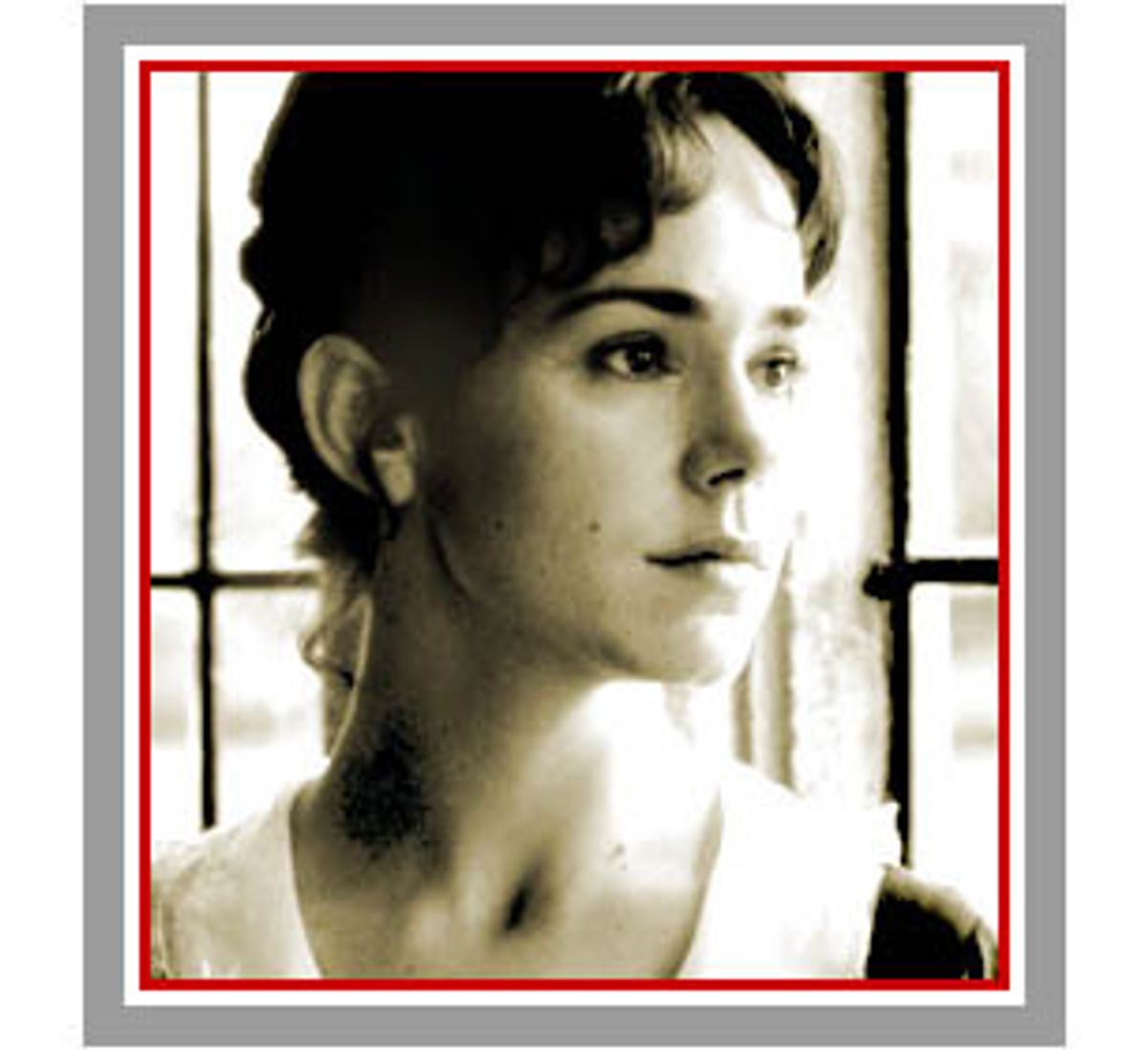
Trash a revered novel and get acclaimed for "audacity"; substitute
topical banality for rigorous observation and win praise for "courage." These
are the lessons of the spanking-new big-screen production of Jane Austen's
"Mansfield Park," a movie so superficially bold and essentially flimsy it
makes "Masterpiece Theatre" come off as an act of cultural heroism. Luckily,
"Greed" -- Erich von Stroheim's 1924 film of Frank Norris' "McTeague" -- has
resurfaced just in time to provide an alternate model for adapters of
world-class fiction. Because he followed his source to its roots, Von Stroheim created a novel-on-film whose density and force matches or surpasses
the original.
- - - - - - - - - - - - - - - - - - - - -
"Patricia Rozema's daring adaptation of 'Mansfield Park' is a witty
look at romance and reality, Jane Austen-style," proclaims the first line of
the Miramax press notes. But as the perfect viewer for this film -- someone
who, beforehand, had read other Austen novels but not this one -- I found it
as daring as a "... for Dummies" book. And "Jane Austen style"? Is that like the "kosher style" of a deli willing to carve a ham next to a corned beef?
The way Rozema has shaped, cast and told it, "Mansfield Park" is a
toothless underdog fable that urges us to cheer on a spunky poverty-stricken
gal named Fanny Price as she proves herself the better of rich relatives. The
worst is her officious aunt, Mrs. Norris (Sheila Gish), but the rest of the family is also a bunch of glittering non-prizes, from brusque patriarch Sir Thomas Bertram (Harold
Pinter) and his laudanum-quaffing wife (Fanny's other aunt) to their
lightweight daughters and wastrel elder son. Only the younger son, Edmund
(Jonny Lee Miller), is close to Fanny's equal and deserving of her affection.
Even he allows himself to be suckered for an unconscionably long time by the
opportunistic Mary Crawford (Embeth Davidtz), whose flirtatious brother Henry
(Alessandro Nivola) sets his cap for Fanny and won't take no for an answer.
In the movie, Fanny's superiority to all she surveys is so obvious that it cheapens rather than
heightens Rozema's chosen themes, including the arrogance of the British
upper class, the pressures a patriarchal system puts on women and the
importance of the slave trade to the landed gentry's wealth. When Fanny's
careworn mother in her insect-ridden hovel persuades her daughter to
entertain Crawford's proposal by saying, "I married for love," audiences
erupt in laughter, reacting to the ludicrous incongruity between the
sturdiness of the film's Fanny and her mother's no-exit view of her
circumstances.
This Fanny is hearty and independent and a literary comedian of Jane
Austen's caliber. Indeed, she spends much of the time declaiming, directly to
the camera, the high points of Austen's youthful writings. (Hence the credit:
"Based on Jane Austen's novel, 'Mansfield Park,' her letters and early
journals.") The actress who plays her, Frances O'Connor, is obscenely
wholesome -- a Sally Field look-alike with a touch of Mary Tyler Moore. She
could turn the world on with her smile, and when she finally wins her man, her
beaming face proclaims, "He likes me! He really likes me!" Rozema frames her
with such gee-whiz romanticism that each of Fanny's love pangs registers like a gong.
Is it a sure sign of a weak conception that everyone in a film reminds you of someone else? Nivola, as that cad Crawford, bears a striking similarity to Jay Mohr, who plays the amoral movie producer on Fox TV's "Action." Sophia Myles, who plays Fanny's grown sister Susan, resembles Leonardo Di Caprio. The only inspired presence here belongs to Lindsay Duncan, who plays the drugged, pug-adoring Lady Bertram with a fragile ennui that in context is downright effervescent.
The slow-mo riding and dancing scenes evoke perfume commercials, but
on the whole this movie has the pumped-up air of Broadway musical dramedy.
After Fanny goes to her first ball you expect to hear her sing "I Could Have
Danced All Night." (A friend counter-proposed that the model for this movie's Fanny is Maria from "The Sound of Music," who also made herself indispensable to aristocrats by exploiting her cuteness and sanity.)
Unfortunately, between all the gliding camera movements and
flamboyant set-ups, what we get are flabby tableaux, not show-stopping
numbers. By transforming early 19th century characters into reckless
hedonists -- Mary Crawford comes on to Fanny, and Henry and one of the Bertram sisters get caught in the sexual act -- Rozema dissipates
the tension instead of notching it up. The erotics of this film are a joke: I
wasn't the only one laughing when Fanny turns Henry down and is next seen
chopping up a carrot. (Sometimes a carrot is only a carrot, but not here.)
A more jarring burlesque ensues when Rozema attempts to graft 20th
century outrage onto the Bertrams' ownership of slaves. Fanny leafs through
the elder son's pictorial record of West Indian horrors and realizes that his
wildness is actually a reaction to his father's colonialist cruelty and
hypocrisy. The effect is not to bring home the horror of moral complacency
but to reduce slavery to a psychological skeleton key -- and plot device.
Since seeing the movie, I have: 1) given the Penguin edition a
swift read, under the influence of Tony Tanner's lucid introduction; 2)
listened to a 170-minute BBC Radio dramatization, from 1997; 3) watched the
four-hour BBC TV production, from 1983; and 4) skipped around in Natalie
Tyler's sprightly compendium, "The Friendly Jane Austen" (Viking, 1999).
Rozema's movie now seems not just silly, but a gigantic wasted opportunity.
The book's Fanny is quiet, gentle, even frail (mere walking tires her out).
Yet her refusal of the dashing Mr. Crawford is as deep and resonant as
Melville's Bartleby saying, "I prefer not to."
As Tanner writes, "In her stillness she is not inactive: on the contrary, she is often holding on strenuously to standards and values which others all around her are
thoughtlessly abandoning. Typically, she welcomes the 'tranquillity' made
possible by Mansfield Park at its best." Turning Fanny into a robust woman of
letters, Rozema throws out what makes the book a masterpiece. Rozema's Fanny,
who plays snap-the-shawl and cracks wise about Joan of Arc, becomes one more
colorful personality -- like the Bertrams or the Crawfords, only more
virtuous and sensible -- while Mansfield Park ends up standing for nothing
more than luxury.
As actress Anna Massey told Natalie Tyler, the BBC TV production
"was not always the deepest of renditions." But Massey was splendid in it as
Mrs. Norris, and Sylvestra Le Touzel proved that a skilled performer could
bring out the dramatic firmness of a retiring Fanny. And the boisterous
BBC Radio version found ways of milking the comedy without obliterating
Fanny's organic identity. By contrast, this "Mansfield Park" is a travesty.
You can't say that Rozema performs an act of literary excavation with her
quotations from early Austen: I found nearly all of them (including the
original and ungrammatical "Run mad as often as your chuse;
but do not faint") in the "Dancing Days and Juvenilia" section of "The Friendly Jane
Austen." Even Austen's own treatment of the slavery issue has more reality
and sting to it. In the book, Fanny tells Edmund she "longed" to press her
uncle about the slave trade -- but when she brought it up to him "there was
such a dead silence!"
Premiering Sunday on Turner Classic Movies (at 8
p.m. EST), in a version more complete than any ever distributed
before, "Greed" remains an inspirational piece of moviemaking, putting
viewers in a state of agitated enthrallment.
"He can't make small of me!" proclaims the burly dentist McTeague
(Gibson Gowland) at the San Francisco saloon-goers who witness his best friend
throw a knife at him. Of course, McTeague's buddy Marcus (Jean Hershholt) can
make small of him, and does. In "Greed," Erich von Stroheim, deploying
streaks of mordant poetry, manages to make his characters small and big
simultaneously. He reveals their petty lusts with a hyper-realistic intensity
that builds to a naturalistic horror.
Von Stroheim is a master at uncovering creatures of the id, monsters
buried inside not only a hulk like McTeague but also his proper, increasingly
miserly wife, Trina (Zasu Pitts). Near the beginning, the glib, seemingly
happy-go-lucky Marcus introduces Trina, then his girl, to McTeague. In a show
of friendship, he even bows out so the dentist can move in on her. But
Marcus can't abide the thought of losing the $5,000 Trina wins in a lottery
right after she and McTeague clinch their engagement. And Trina's stash
becomes her golden calf; she worships it and won't let go of it. (Near the
end, she sleeps with it.)
When Marcus sees that he won't be able to
guilt-trip McTeague into giving him some of the money (McTeague can't get
hold of it himself), he resorts to simple revenge, reporting McTeague for
practicing dentistry without accreditation. Thus begins a three-coiled death
spiral that culminates in the most appropriate setting imaginable: Death
Valley.
Von Stroheim did more than film Frank Norris' 1899 novel, "McTeague," chapter
by chapter. He added scenes only implied in Norris' descriptions and
flashbacks. The director hoped the movie would be distributed as a special two-night
presentation -- but he had produced it for the Samuel Goldwyn Co.,
which merged with Metro Pictures shortly after he finished what he meant to be his final cut. Irving Thalberg, production chief for the resulting corporation, Metro-Goldwyn-Mayer, insisted that von Stroheim truncate the film to normal feature length. Open to
compromise with his studio bosses (first at Goldwyn, then at MGM), the director himself had reduced and polished his nine-hour-plus first cut, arriving at a print that ran between four and five hours.
But this version, too, proved unacceptable. Von Stroheim asked for
help from fellow epic filmmaker Rex Ingram, who assigned editor Grant
Whytock to whittle down the running time even further, and Whytock got it down to three and a quarter hours. MGM ignored their efforts, however, and reduced "Greed" to two hours and 20 minutes. Von Stroheim disowned the MGM edition.
Rick Schmidlin, the new edition's producer, who previously spearheaded
the re-editing of "Touch of Evil" according to Orson Welles' instructions,
has used von Stroheim's script to expand the existing "Greed" with production
stills explored via techniques borrowed from Ken Burns' documentaries. The
result is astonishingly fresh. This "Greed" reconstructs the grand design of
von Stroheim's four-hour cut and goes a long way toward filling it in.
Integrating lost subplots and supporting characters and crucial stretches of
character development, the partly restored "Greed" conjures a forgotten
universe of cinematic possibilities.
Von Stroheim's combination of actual
locations (it's a valuable document of the San Francisco Bay Area in the
early 20th century), veracious action and novelistic details signals the road
not taken to epic film adaptation -- at least for five decades. "Greed" looks
ahead to masterpieces like Luchino Visconti's "The Leopard" (1963) and
Francesco Rosi's "Christ Stopped at Eboli" (1979): movies that encompass
entire cross-sections of society yet also render character with startling
intimacy. In von Stroheim's plan, McTeague, Marcus and Trina occupy the
middle of a spectrum encompassing, on one end, the scabrous shared venality
of a gold-mad junk dealer and maid and, on the other, the sweetly furtive
late-life romance of a veterinarian and his next-door neighbor.
"He can't make small of me!" -- the line McTeague yells about Marcus
-- pops up earlier in von Stroheim's version, when McTeague can't describe
the seats he wants to buy at the Orpheum Theater and lashes out at a
ticket-seller who is trying to help him. "You can't make small of me!" could
be the motto for all the embattled characters in this film's chaotic,
striving society, where the values that determine a man or woman's worth or
happiness are fluid and often elusive. "Love me big," Trina demands -- and
this fuller view of the film makes clear that von Stroheim isn't just dealing
with greed, but with everything that makes a man or woman feel big, from love
and family to career and social status. (One restored sequence depicts Marcus
as the leader of a neighborhood improvement society.) "Greed" is an American
tragedy because all of Mac's, Marcus' and Trina's dreams degenerate into
money.
The intelligence of von Stroheim's and June Mathis' adaptation and the vibrant details
of his direction make it easy to accept the segues between moving pictures
and illustrations. What's wonderful about this version's structure is that it
allows even moments familiar from the cut version to expand in your mind.
Seventy-five years of film history pulsate in this movie's frames. When
McTeague walks to the street after a money fight with Trina and she sneers at
him from the top of the stairs, the slanted, bifurcated composition (complete
with ceiling) presages the Orson Welles of "Citizen Kane." The modulated
hysteria of Pitts' performance, and von Stroheim's eerie, eloquent portraits
of her slumped, defeated figure, rank with Welles' handling of Agnes
Moorehead in "The Magnificent Ambersons." Gowland's blend of animal
wiliness, slow-burning patience and brutishness suggests the three
protagonists of John Huston's "The Treasure of the Sierra Madre" rolled into
one. The treatment of desert heat and gold lust recalls that movie, too. And
contemporary audiences will think of a thrilling sequence from David Lean's
"Lawrence of Arabia" -- the one in which Lawrence goes back to "the Sun's
Anvil" to rescue an Arab warrior -- during the climactic trek through Death
Valley, with the inexorable beating of the sun.
I always felt that when James Agee, the greatest film critic of
the first half of this century, proclaimed that he loved allegory and
symbolism only when they "bloom from and exalt reality," he was probably
thinking of "Greed." This restored "Greed" augments the reality of the tale
and the allegory and the symbolism of it. The small, grinding steps of
Trina's descent into obsession produce prickles of psychic recognition, while
the repeated eerie visions of skeletal arms sifting through coins and of a
solid-gold dining service glittering in foul seduction bring the story to the
plane of parable.
Though Agee never wrote a full-scale review of the
film, his essays are replete with references to it. For example, he called
Judy Garland's dress in "The Clock" "the most appropriate prop I can remember
since McTeague's checked cap." And he paid tribute to von Stroheim and his
cinematographers, Ben F. Reynolds and William H. Daniels, when praising the
"flexible, sensitive" photography of Joseph La Shelle in "Happy Land" and of
Joseph Valentine in Hitchcock's "Shadow of a Doubt." In one of the most
spectacular accolades in film criticism, Agee wrote that La Shelle's and
Valentine's work "takes up the Magna Charta for American films from the cellar corner where it was tossed along with the lost 32 reels of 'Greed.'" This four-hour version provides charter enough.
Shares