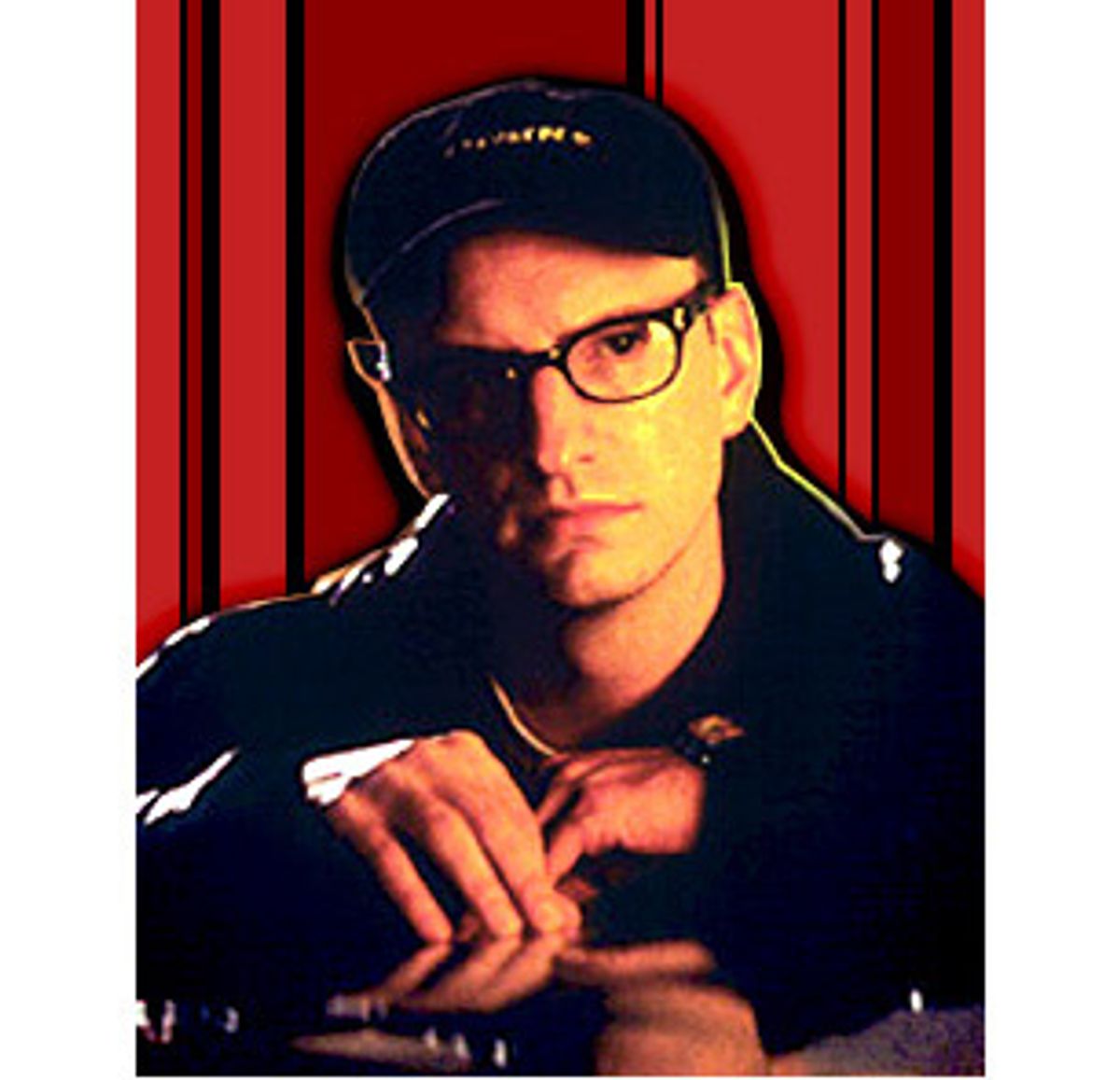
In 1995, Steven Soderbergh had reached a career dead end, just six years after igniting the independent-film craze with his debut film, "sex, lies, and videotape" -- a movie he recently (and correctly) characterized for the British film mag Sight and Sound as "a modest piece with modest aspirations that happened to be what people wanted to see in a way I obviously haven't been able to duplicate." His pastiche "Kafka" (1991) and Depression-childhood saga "King of the Hill" (1993) didn't spark with audiences or generate critical or cult followings. He simply floundered in his flop '95 neo-noir "The Underneath," smothering snappy lines and arresting arcs of character with arty coups de cinema.
But in 1998, he came up with "Out of Sight," a smart, engaging action comedy about the love that ignites between a bank robber (George Clooney) and a deputy federal marshal (Jennifer Lopez) when she stumbles into his jailbreak and gets to know him in the trunk of a getaway car. It won best picture of the year from the National Society of Film Critics, beating out favorites like "Shakespeare in Love" and "Saving Private Ryan." (The group also named Soderbergh, not Spielberg, best director.)
And Soderbergh's "The Limey," which opened last fall and ranks high on many a 10-best list, is an unexpectedly touching act of hard-boiled cinematic seduction. It tells the story of a canny British ex-con (Terence Stamp) who flies to L.A. to exact revenge on the man who killed his daughter. Soderbergh puts this basic thriller setup into a time-hopping form that resembles an elaborate paper cutout -- the kind that comes all raveled up and reveals its true meaning when the last piece is uncovered.
Like "Out of Sight," "The Limey" is a light movie, not a superficial one. Soderbergh has learned that an audience will follow any director to what lies underneath as long as he keeps his film expressive on the surface. History and current events meld in the ex-con's brain, as he thinks back on his daughter and her mother. But Soderbergh does more than play memory games with fleet flash-forwards and flashbacks. At the end we realize that the entire film has been the gangster remembering things past and judging his own culpability.
"The Limey" is a salute to 1967 filmmaking: It echoes John Boorman's "Point Blank" and actually uses footage of Stamp playing a young thief in Kenneth Loach's "Poor Cow." So it's wonderfully appropriate that Soderbergh has come forth with a book on filmmaker Richard Lester, who by 1967 had already made "A Hard Day's Night," "Help!" and the audacious "How I Won the War."
Soderbergh's "Getting Away With It, Or: The Further Adventures of the Luckiest Bastard You Ever Saw -- also Starring Richard Lester as the Man Who Knew More Than He Was Asked" was published in Great Britain in 1999. It treats movie fans to a funny, prismatically illuminating experience.
In addition to his penetrating interviews with Lester, Soderbergh sandwiches in the candid journal of a chaotic year in his own career -- 1996, right after "The Underneath" and right before he landed the directing job on "Out of Sight." He was finishing up two idiosyncratic, small films, "Schizopolis" and "Gray's Anatomy," while doing script work for hire, staging Jonathan Reynolds' play "Geniuses," helping to produce "Pleasantville" and struggling to mount an adaptation of "A Confederacy of Dunces."
What's neat about "Getting Away With It" is that you witness Soderbergh renewing himself as he talks to Lester. The younger director opens up to the older one, who delves into matters as different as evolutionary theory and military milestones. Even the structure of the book expresses Soderbergh's burgeoning energy: It's a delicious parody of the exhaustive, multi-part director interview -- a specialty of Soderbergh's own publisher, Faber and Faber. ("ff" usually does bring their books into this country, but this volume is available right now via Amazon.co.uk and other British-book delivery services.)
Soderbergh's readers were the first in their arthouse or multiplex to hear the name of "Being John Malkovich" screenwriter Charlie Kaufman. In 1996 Soderbergh had tried to launch another Kaufman script, "Human Nature." The director's readers were also the first to learn of "tortious interference," the legal concept at the center of Michael Mann's "The Insider": Paramount invoked it to prevent Soderbergh and his "Limey" producer Scott Kramer from setting up "A Confederacy of Dunces" as a co-venture with other companies.
Most important, the book delivers a privileged glimpse into the sensibilities of filmmakers who use sophisticated film syntax to heighten emotion and find novel ways of embodying old storytelling values of romance, suspense and catharsis.
When I phoned Soderbergh in L.A. in December, he was taking a pause from his forthcoming feature "Erin Brockovich" (due out in March). He instantly made clear that Lester isn't his only idol. He said that "Erin Brockovich," a socially conscious character study starring Julia Roberts, fit "the John Huston plan for career longevity: Never become too hip or faddish."
When will "Getting Away With It" get an official U.S. publication?
Most of Faber and Faber's stuff usually shows up here, but as you probably gleaned from the book they can be somewhat erratic. I still haven't got my box of author's copies!
That's unfortunate, because it has a lot of topical hooks, including the first mention between book covers of screenwriter Charlie Kaufman. Your comment on his "Human Nature" script -- you call it indescribable except for being "very weird" and "hysterically funny" -- hits home for anyone who's seen "Being John Malkovich."
About four years ago, I asked a friend of mine who had some experience in the development-reading world to help me find something to do. She called two weeks after I said I'd hire her and told me "I found the guy." She sent me "Malkovich" and "Human Nature." At that time "Malkovich" was already set up; it was obvious that this guy was going to happen. I got to hang out with him while we were trying to get "Human Nature" set up, and I liked him enormously.
I really enjoyed interviewing him, but he didn't want to reveal too much of himself or analyze his own work.
He's probably, in the long run, pretty smart to do that. I still have fantasies myself of pulling a Terrence Malick. It's really a silly problem, but it's frustrating to be in a situation where you become bored with speaking about what you love to do for a living. You find yourself hating not just the sound of your voice, but hearing it make the work that you do sound boring. It's a terrible sensation. You definitely get to a point where you feel like a homeless person babbling on a corner, saying the same thing over and over to very little effect.
In the long run I don't know how much good talking does. I don't think audiences pay too much attention -- people who want to go to a movie will go. When you look at the selling part of the business, everything that everybody does for every movie feels the same. We did a ton of press for "The Limey." Maybe it would have done even worse if we hadn't, but I can't say what helped and what didn't.
"The Limey" is loved by the people I know who've seen it; I'm surprised to hear you say it didn't do well.
It did really well in New York and L.A., so for a lot of people the perception of it is that it did fine.
Much of your book is about trying to maintain enthusiasm and energy over the course of a career. There's a wonderful interplay between you and Lester -- almost as if you started the book out of devotion to his movies but then had these revelations about your own films.
It emerged from this period when I felt I had to start over again. I think there are two components to doing that successfully. One is regaining enthusiasm about your own work. The other is regaining enthusiasm about other people's work.
When I see people who I think have become either cynical artistically or just competitive to the point of self-destruction, what they share is the loss of appreciation for anything that anybody else is doing. Seeing something good should make you want to do something good; if you're not careful, you can lose that. And that can hurt you. I still get a charge out of seeing a really good movie or reading a really good book or watching "The Sopranos" on TV.
Working my way through Lester's films, and doing these interviews with him, I was reinvigorating myself. And there was also something cautionary about it. Lester did stop working for a variety of reasons. So for me there is the element, whether it's spoken or not, of "Wow, will that happen to me? And to all of us?"
There are recurring topics and themes in the book. You talk a lot about one of Lester's favorite actors, Roy Kinnear, who died after he fell from a horse during the making of Lester's last film, "The Return of the Musketeers." You touch on whether Lester's atheism made him feel more responsible for the accident than he would have if he'd believed in a divine plan, and hastened his departure from filmmaking. It makes the reader confront the moviemaker as a person, not a technician.
I think that's what we were both hoping for. Between the Q and A and the journal, I just thought it was perhaps relevant to somebody to portray the process of what it's like to be a person who happens to do this for a living as opposed to a portrait of a filmmaker. It was hard. I was working while I was doing it and it was a massive editing job. I had 35 hours of interviews with him, and the journal I had was probably five times the length of what you read.
And then you have all these self-deprecating footnotes, which touch on comic battles with your editors at Faber and Faber. You have a jokey "Note From Your Publisher" and two mock author's notes, including an outline for an introduction that will contain an "Awesome display of ego disguised as humility; joke about same." Even the title and the cover design make your book feel as irreverent as a Lester movie.
The footnote idea came late because I felt something was missing; one more deconstructed element was needed. So in the last two weeks just before I turned it in, I came up with the idea of a fictional person at Faber who hates me. The copy editors at Faber got a huge kick out of the "inside" view of how the company works.
I mean, I love all the director books they do, "So-and-so on so-and-so"; I've got all of them. But I thought, We've got to tart this up a bit. We've got to put on some bells and whistles, so if somebody picks it up off the shelf they'll feel they have to buy it.
A lot of younger directors, as different as Danny Boyle ("Trainspotting") and Stacy Cochran ("My New Gun") and Michael Patrick Jann ("Drop Dead Gorgeous"), have taken inspiration from Lester's movies.
And I know in some cases they are taking the right things from his work -- not just the visual dexterity of, Oh, if I shoot a lot of images and do a lot of cutting, it will be just like a Richard Lester movie. There's a lot more thought behind it than that. We would all do well to look behind the surface at some of the ideas he's trying to put across, because he's an intelligent guy and he expressed a point of view -- especially, in his peak years, about society at large.
I think he has a genuine interest and appreciation for people who do not have power. And I think that's getting lost a lot these days. I was talking to a buddy of mine who went into a meeting with some executives and they were describing a lead character in a project they wanted to do. "He's one of these guys, he really has the town wired; he knows everyone and he's doing all these things." We were just sitting there going, "Who is that? We don't know anybody like that. And who, of the people who would go see this movie, knows anyone like that?" The idea that you can make a movie about an ordinary person is almost gone.
Usually, when you talk about a director of ideas, you think of someone cerebral or self-conscious. But Lester at his best is downright blithe about getting his ideas to the screen.
That's the other thing that I took from him, which has helped me enormously in the last few films, including the one I'm finishing now ("Erin Brockovich"). How should I describe it? Tossing things off, instead of being labored about what you do. I'm serious about what I do, but I think there's a real benefit to not being precious and working quickly and going strictly on instinct. It's something I lost and I absolutely got back from him.
Because "Out of Sight" and "The Limey" have such stylistic confidence, it's odd to think of them as in any way "tossed-off." What you call relying on instinct must also mean relying on whatever craftsmanlike reflexes you've built up.
I had the luxury of making a first film that was successful enough to afford me a lot of mistakes. The good news was I took advantage of them. By the time "Out of Sight" rolled around I felt pretty light on my feet and secure in my ability to work in a way that was expedient but detailed. That was my seventh film -- if I was paying attention at all I should have been able to do that!
But as we both know, a lot of people aren't paying attention. Directing has become the best entry-level job in show business. You have to keep your eye on the long term -- which is why I understand what Charlie Kaufman is doing. I try to be careful about things I do and not promote myself separately apart from a film I'm talking about. I've never taken a possessory credit, because anything that furthers the idea of you as a brand name is risky -- because people get tired of certain brands.
Lester is frank about decisions he made that have sometimes been called forced and inorganic. For example, he admits that he conceived the elaborate structure of "Petulia" because he was afraid that if he didn't it might have come off as "a romantic novelette."
In point of fact, does it matter that Lester and the writers who worked on "Petulia" sort of deconstructed it because otherwise it would be a terrible melodrama? No. The bottom line is, that's a great film, no matter how you cut it. Everything is working against it being a terrible melodrama, from the way it's cast to the way the performances are pitched on the set to the way it's composed and cut. That's why it works -- it's because he's cutting against the grain of what's inherent in that material. Sometimes that's a mistake, but in that case it certainly isn't.
Talking with Richard Lester reminded me of how rigorous you have to be; conceptually, you have to sit down and make sure you're wringing everything out of the material that you should be wringing out of it. What frustrated me about "The Underneath" was that I felt I wasn't rigorous with it. On the one hand, maybe there should be an international cultural police force -- so when someone like me says, "I want to splice an armored-car heist movie together with Antonioni's 'Red Desert,'" they come and stop you. But on the other hand, if you make a revisionist nonlinear noir movie, there are more places to go with it than I did in "The Underneath." I was not at a time in my career when I understood that; and I was just feeling sort of dry.
"Out of Sight" is juicy -- just as ambitious stylistically, but with emotional coherence and impact. When I first saw the opening flourish of George Clooney ripping off his tie and the jacket of his suit, I was happy to accept it as an expression of anger and frustration, without knowing whether it would fit into the rest of the movie.
Absolutely. But I don't think you can be arbitrary about that stuff. In "Out of Sight" I knew I was going to use freeze frames and zooms and jump-cutting, but I was also trying to be very aware of the reason for each of them. For instance, intercutting Clooney and Jennifer Lopez in the cocktail lounge and the hotel room: The reason I was doing that was because I wanted to make the sense of intimacy and electricity more palpable to the audience. I thought back to that sequence in "Don't Look Now," and how those two scenes of Donald Sutherland and Julie Christie making love and getting dressed suggested an intimacy that was stronger than either of those scenes alone.
As for "The Limey": That is about a guy who cannot stay rooted in the present. He is completely dislocated.
From the start, the cutting in "The Limey" conveys the play of thought and memory, but I wasn't prepared for the cumulative effect. The whole movie hinges on a speech and a gesture that the daughter of the antihero (Terence Stamp) makes to him as a little girl and to the villain (Peter Fonda) as a woman. Via flashbacks, a woman who is dead carries the film's emotional weight -- and turns it from revenge film to tragedy.
I remember the day when the screenwriter, Lem Dobbs, and I were at his house, talking about the climactic sequence and my belief that there needed to be an emotional reason for why all of this happened. We came up with the idea that when finally forced to tell his side of the story, Peter Fonda's character would essentially repeat something that had happened to Terence Stamp's character. And the result is not explosion but implosion.
Looking back at the movies we were riffing on, "Point Blank" and "Get Carter," I realized that I love those movies but they're not the most emotional experiences in the world. They're very compelling and they're pretty cold. And I thought that if we were going to do one of those movies, we needed to have a strong emotional undercurrent. When you see most shoot'em-up revenge movies you don't get too emotionally invested. The combination of how we thought about it and casting Terence and finding that footage from "Poor Cow" helped build the quiet emotional foundation that pays off in the end.
When Lester was in his prime, he would get an idea and get a writer and just go off and do it. Are you able to operate the same way? Would you want to?
I don't have a lot of stuff that I'm contemplating or attached to or developing; I try not to work more than one or two movies ahead of myself. I tend to feel differently about things when I get out the other end of a movie. For instance, there's "Erin Brockovich," which I'm finishing now. Jersey Films had spoken to me about it right after I did "Out of Sight" for them, and it just sounded terrible to me. But when I got out the other end of "The Limey," it sounded like the perfect thing to do; it was so different from my previous two films, and so unlike anything I had made before.
All I know is that it's based on a real-life story about a woman (Julia Roberts) involved in researching a health-related lawsuit against a utility company. It sounds like "A Civil Action."
But it's not about the lawsuit, it's about her, and that's what drew me to it.
There's one courtroom scene halfway through the film that's two minutes long. I just found her character fascinating. And the story was so aggressively linear that it required a completely different set of disciplines than "The Limey" or "Out of Sight." I had to be a different filmmaker to do what I thought was appropriate for telling it. There are movies where you can get away with a certain amount of standing between the screen and the audience and waving your hands. This isn't one of them. You need an understanding of when you need to let things play and not be intrusive. At the same time, I hope you'll absolutely recognize "Erin Brockovich" as something that I've done, because there is an aesthetic at play that relates it to films I've made before. And it does have a protagonist who is at odds with the surroundings; I tend to be drawn to those. Here it happens to be a lower-income woman. It was fun to make a movie where the protagonist was female and was in every scene of the film.
If you're a certain kind of filmmaker, everything is personal, whether a movie is about yourself or not. But I think, for the most part, people who write about film have a very limited idea of what personal expression is and how it can manifest itself. As a result you often find directors being encouraged to make "personal films" when they would probably grow faster and go further if they began to look outside of themselves. That was the real turning point for me: I wasn't interested in making films about me anymore, and my take on things. I thought, "I've got to get out of the house!" And I've had more fun and I think the work is better since that occurred to me. I'm interested in other people's experiences -- filtered through mine, obviously. I'm absolutely as connected to "Erin Brockovich" emotionally as I was to "sex, lies." Some people just either can't believe that, or don't want to believe it, or just don't understand the process. You don't spend a year and half on something you don't give a shit about.
There's a great passage in the book where you ponder an American director's alternatives: "... make stupid Hollywood movies? Or fake highbrow movies with people who would be as cynical about hiring me to make a 'smart' movie as others are when they hire the latest hot action director to make some blastfest?"
What was bugging me was that both those possibilities were equally calculating, which I think is the enemy of good work. Now what I have managed, luckily, because "Out of Sight" was waved in front of me and I jumped at it, is to find a certain meeting place. As somebody once put to me, bluntly, "If you think Hollywood movies are so fucking terrible, why don't you try to make a good one instead of bitching about it?" So I've been trying to carve out half-in, half-out of the mainstream ideas for genre films made with some amount of care and intelligence and humor -- to see if we can get back to that period we all liked in American cinema 25 years ago.
Shares