

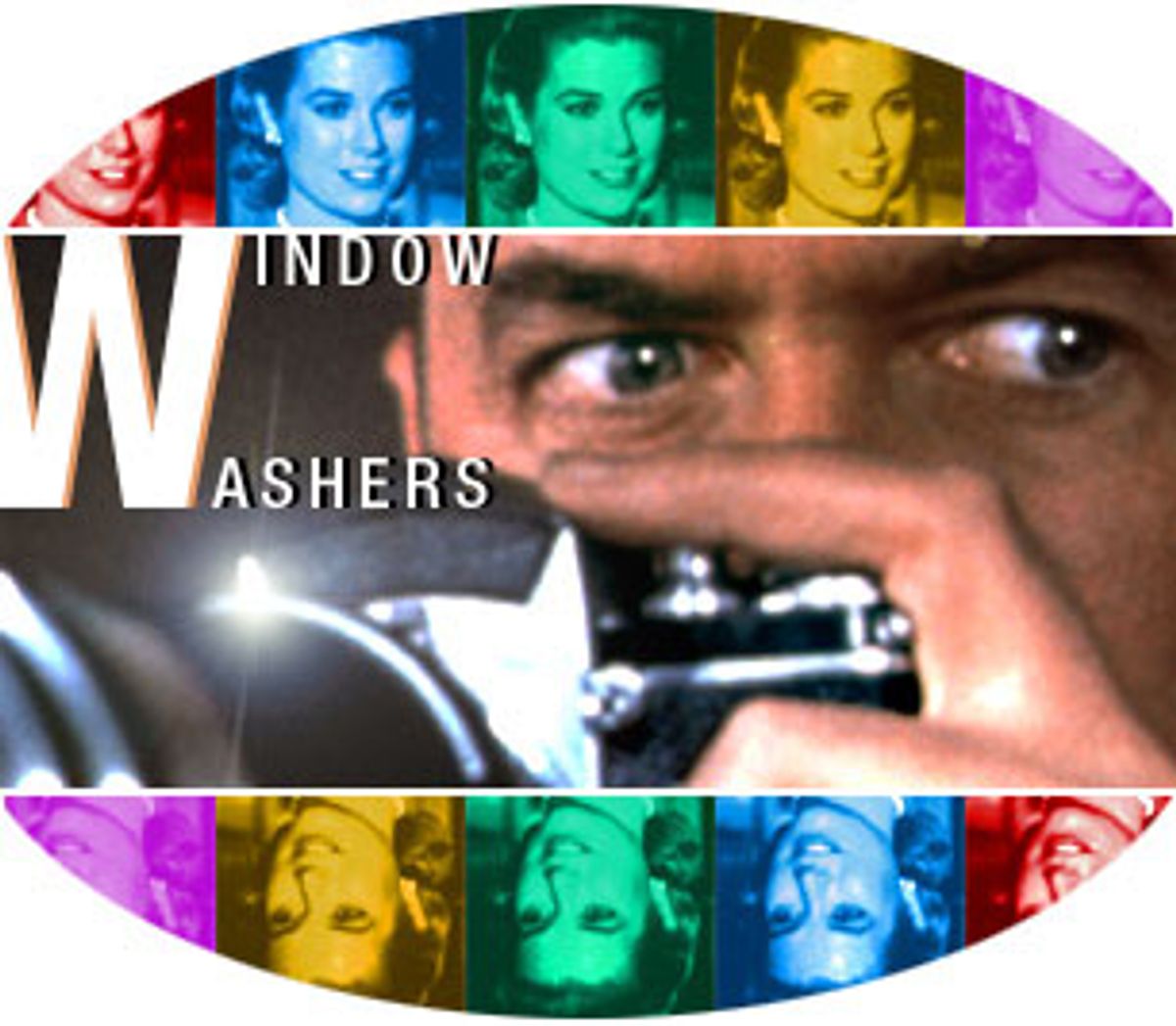
The superbly rich and moody new print of Alfred
Hitchcock's frolicking 1954 masterpiece "Rear
Window" has fewer splashy coups than the previous feats of
those master showmen and restoration experts Robert A. Harris and
James C. Katz. There were no cut sequences to be discovered, as
there were with "Lawrence of
Arabia" (a Harris solo effort) and "Spartacus," and nothing
as spectacular as the stereo recording that brought Bernard
Herrmann's score to new prominence in Hitchcock's "Vertigo."
But as I watched this peerless piece of cinematic play for the
first time since its last theatrical release in 1983, I was
happily stunned. The subtle wonders worked by restoration
director Harris and restoration producer Katz had managed to
amplify this film's comic-dramatic weight without getting in the
way of its fleet wit or its masterfully escalating momentum.
Before seeing it with a cheering audience on opening night at the
Castro Theatre in San Francisco, I had thought that "Rear Window"
called for the Katz and Harris treatment simply because it was a
movie-movie milestone in sore need of repair.
After seeing it, I thought that it was not merely a deserving but
an ideal choice. For one thing, this movie is about
perception -- and the burden it places on the perceiver. James Stewart, the
photographer-antihero with the busted leg, looks out from his New
York apartment with his phallic long-lens camera. He watches
a variety of marital and erotic soap operas from his rear window
through the rear windows of his neighbors across adjoining
courtyards. But he can't keep his distance when one of these
mundane sagas -- about a traveling salesman (Raymond Burr) and
his bed-ridden wife -- appears to end in murder.
Far from being dated, this movie now comes off as prophetic: a
forecast of the kind of close-yet-strange apartment or condo
existence that would become a negative paradigm for
city-dwellers, giving unwonted resonance to real-life tragedies
like the Kitty Genovese case. And Hitchcock's treatment of the
attitudes that Stewart -- and his classy paramour, Grace Kelly,
and his earthy nurse, Thelma Ritter -- express toward romance and
wedlock is spry and satirical.
Visually and dramatically, the blending of light and dark -- and
all the muddy areas in between -- is what makes the movie's
depiction of voyeurism so adult and cathartic. The parallels
between Stewart and Kelly's affair and the stories behind other
rear windows don't solely comment on love and marriage
1950s-style. They show that life is always bigger than our view
of it. If Stewart thinks he uses that long-lens camera as a
telescope, it turns out the reverse is also true: he is turning a
microscope on himself.
In John Michael Hayes' script, as in the original Cornell
Woolrich short story ("It Had to Be Murder"), we absorb the
mystery as the wheelchair-bound hero does, from the blinking
rectangles of light in the apartments across the way. Hitchcock
designed the production around that concept, plotting intricate
yet unobtrusive camera moves in a single enormous set. Built on a
Paramount sound stage, it contained 31 apartments with eight
furnished rooms among them.
The last release print of "Rear Window" gave us little except
those blinking rectangles. The colors had faded, sometimes to
nonexistence. When Burr puffed on a cigar in his darkened living
room, the ash registered light gray, and when "Miss Lonelyhearts"
went looking for love, she walked to a bar that suffered from
brownout. The contours of the backgrounds had dulled, too. When
Stewart, spying on Burr and then retreating from Burr's glance,
pulled himself in and out of the courtyard lights streaming
across his windowpane, he moved between glare and muck. And every
apartment wall opposite him looked more California than New York,
thanks to the soothing earth tones of an aging negative.
In the prints from Harris and Katz's restored negative, Burr's
cigar glows red. Miss Lonelyhearts steps tentatively into a
neon-tinged night-world streaked with all the colors of the
spectrum, and the skimpy workout outfit of the aptly nicknamed
"Miss Torso" has progressed from white to pink. Most important,
you never lose the lived-in quality of Stewart's messy apartment
(and messed-up life), even when you see it in shadows. And you
gain a renewed sense of the weight and emotion of the lives going
on across the way. With the heightening of the palette in her
apartment, Miss Lonelyhearts brews up a forlorn romantic aura
when she sets a candlelit dinner for two -- knowing it's only for
herself.
The subliminal benefit of the restored negative is immense: it
makes Stewart's (and our) peeping Tom-ism more of an adult game
and less of a video game.
"The incredible thing for me," said Katz, in a phone conversation
from his office in Burbank, Calif., "is the reaction of kids who
haven't seen it before. They have no sense of history. Someone
asked me what Stewart is flashing -- he had no idea what a flash
attachment to a camera was. Maybe he would have if it was
attached to the camera. The picture is 50 years old, but because
it looks so good now the audience wants to put it in a modern-day
perspective. I had a screening with a lot of younger people in
the movie business, and one of them asked, 'You couldn't make
this movie today, because the set alone would cost you $60
million.' I said, 'You couldn't make it today because it takes
place during a heat wave and the windows would be closed and
everyone would have their air conditioners on.'"
As with "Vertigo," the major stumbling block for the restoration
was Hitchcock's ill-advised junking of most of the materials crucial to striking quality copies when rights reverted back to him in 1967. For
Katz, the key to making this restoration work visually was the
use of Technicolor's new dye-transfer technology, an update of
the venerable (and venerated) process that used metal dyes washed
over three matrices to create color of unparalleled vibrancy. As
Katz says, "To get the feeling of the Miss Lonelyhearts part of
the story you've got to see her posing in her green suit and red
lipstick against her purple walls."
To clarify the techniques behind the Harris and Katz revamping of
"Rear Window," I contacted Harris at his home in Bedford, N.Y. He
told me that past releases had lost "quite a bit" of background
to fading, in the rooms and in the bar across the alley, and that
"an overall loss of contrast" also blunted the impression of
sharpness. The dye-transfer process helped them "create an
illusion of more sharpness," even when "there really isn't any
more. At the same time it does add a great amount of depth to the
picture -- rather like (and this may be a bad analogy) a really
great paint job on a car, i.e., 14 coats of hand-rubbed lacquer
on a Rolls. The paint takes on a depth that makes it look as if
you can stick your hand in it."
The dye-transfer process fit this film in particular, Harris
said, because "one of the things that sets 'Rear Window' apart
from some of Hitch's later films is that in many ways the color
schemes hark back to the three-strip Technicolor days (even
though it was shot on the earliest incarnation of Eastman stock).
This is most readily seen in the sunsets." But it also registers
in the look of the players, from the deep-blond beauty of Kelly
to the surprisingly dapper appearance of Wendell Corey as
Stewart's police-detective friend, who now makes a spectacular
entrance with his black tie, white shirt and blue eyes. "I'm glad
you noticed," Harris said. "Early on, when we were having
problems, his tie would have green fringe on one side and magenta
on the other."
Imagining what morning, noon and night would look like in the
studio world of "Rear Window" was, to Harris, "Easy. Well,
almost." The few original 1954 prints they had were "faded to
total magenta," but he and Katz were able to use them "to discern
relative contrasts and the comparison of light vs. dark. Based
upon a faded scene, we could still calculate comparatively how
much lighter or darker one scene is compared to the next."
For color, they also had a number of dye-transfer prints made for
a 1962 reissue, "and even through the beige look of the reissue,
one could get quite a good idea where the director of photography
was going." Using these same 1954 and 1962 materials, they judged
just how far to shove Stewart into the darkness in his
peeping-tom scenes. Harris said that if they could have employed
dye transfer in "Vertigo" (the process was revived two years
ago), they could have made the controversial murky climax
murkier and still preserved details of the figures left in
shadows.
In the new prints, Hitchcock buffs will appreciate how crucial
his sophisticated audio effects become to our ecstatic enjoyment
of "Rear Window." The direction of each scream, thud, song or
bark is clear -- and so, amazingly, is the length it travels. The
few frenzied farragoes of growling and whimpering get fuzzier as
they echo up and down the courtyards. Closed windows mute or seal
off noise. And throughout, there's an artful array of audio
graffiti and music emanating from streets and apartments. It's
nothing like the wall of sound you get at today's thrillers: it's
more like aural pointillism.
How difficult was the sound restoration? Harris said, "Oh boy!
As in 'Porgy and Bess,' we had plenty o' nothin'." The elements that had been saved -- including the 35 mm
optical track negative, which was used to print the track to 389
release prints in 1954, as well as other prints "into the early
'70s" -- turned out to be "junk." All Harris and Katz had to go
on "were used 35 mm prints."
What was worse, said Harris, "We found that the track negative
made in '54 had been produced defectively. You've seen
35 mm tracks ... two clear impulses against black. On
'Rear Window,' the inboard impulse was out of focus and narrow,
which acted to mute and distort the sound. Therefore, all of the
sound was taken from the outboard impulse of a number of
different prints, all of which had wear. The fact that sound has
survived, even after being digitized and cleaned, is a tribute to
the superb recording that was done by Paramount in 1954. Remember
this was a Paramount -- not a Universal -- production."
(Universal is re-releasing the film under the aegis of USA
Films.)
"Rear Window" doesn't have the picturesque vistas of "Vertigo,"
but it's a peak example of Hitchcock's mastery at creating
tension with light. While Stewart is spying on Burr, Hitchcock
jacks up our adrenaline whenever he wheels too close to the
window -- which we estimate by the light that splashes in on his
chair.
I asked Harris whether adjusting the color and image density for
these scenes was as big a challenge as any in his career. "Yes ...
and no. Making the color 'correct,' and not only good-looking, is
always a problem," especially with fading negatives, he answered.
According to Harris, the original negative of "Lawrence of
Arabia" -- wherever he had the original negative he needed -- was
barely faded; "the problem was more getting it dead-on." The same
was true with "My Fair Lady." But "Spartacus" had "a totally
faded original negative," and that film's separation masters
(which record, on three positive black-and-white films, the three
separate components of a color negative) "had their own
limitations." And "Vertigo" had "fading from beginning to end and
was a nightmare of trying to get the color, not even dead-on
right, but just close and good-looking, even when we knew what it
should look like."
The pre-restoration shape of "Rear Window" was roughly on the
"Vertigo" level, with specific problems "worsened by the overall
fading of the surviving sections of original negative."
One of those bad-news areas was an amazing erotic shot now known
as "The Kiss," which occurs when Kelly first sweeps in and
plants a beaut on Stewart. I couldn't analyze its tingling whoosh
at a single viewing. Harris explained, "It was slowed down at the
beginning and then run normal speed for the dialogue," making it
an optical-effects shot in the pre-digital era.
Unfortunately, the colors of "The Kiss" had melted down "to
yellow-green." Intent on avoiding a quality gap comparable to the
grainy flashback scene in "Vertigo" ("This would not have made us
smile," Harris said), Harris and Katz experimented with combining
elements that were never meant to be used together. After several
optical-effects houses turned them down, Phil Feiner of Pacific
Title pitched in and agreed to test the team's "rather odd
concepts" of cooking up a "Technicolor milange."
In addition to the original negative, dupe material and an
interpositive (the color master positive used for making
duplicate negatives), the process involved a motion-control
optical camera, new exposures of pure red and pure green
information from the interpositive, blue information from the old
yellow-separation master and digital cleaning.
With this complicated recipe, it's not surprising that one writer
called Harris the Martha Stewart of film restoration. "Try living
that one down with your kid," he groaned.
Then why not gain a reputation as restoration's Don Corleone?
According to Katz, he and Harris are aching to do "The Godfather"
next. Katz said it presents challenges similar to those on "Rear
Window": "It's a dark movie, but with colorful sequences. And it
needs to be saved." Having seen the horrible brown-yellow print
at the movie's 25th-anniversary gala three years ago, I can
testify to the necessity of salvaging this landmark film right
now. Harris and Katz have got to convince Paramount to let them
do it. Artistically, at least, it's an offer the studio can't
refuse.
Shares