

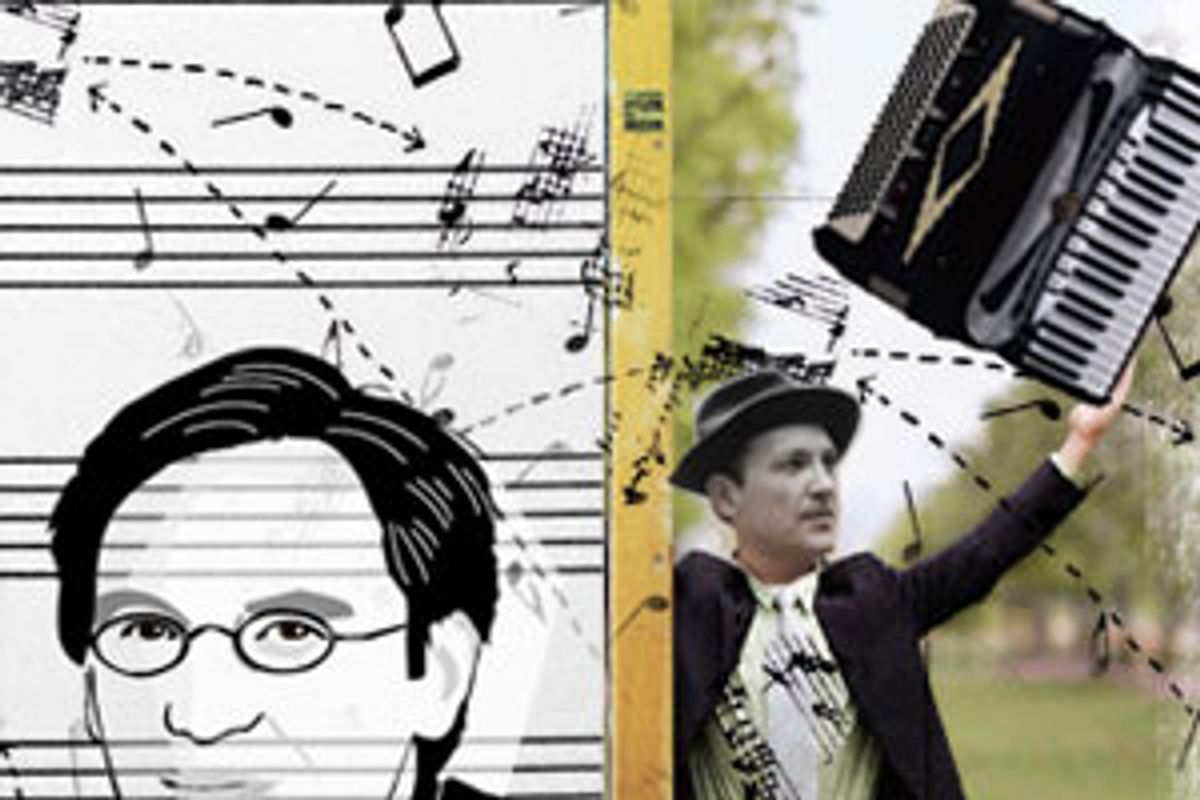
You can hear the world in Osvaldo Golijov's music. Here's the best place to begin -- a nightclub in Buenos Aires, where a lone accordion bellows a Spanish melody with a menacing tone. A last low chord is sustained and the accordion is silenced by a percussive Mediterranean dance, knives being used for drumsticks, unraveling down a Beirut street. The cacophonous beat stops and a female soprano enters a church in Rome, intoning a prayer for Jesus on Good Friday. The Mediterranean dance cuts her off but she returns, more haunted than before, trailing the spare notes of a harp and trumpet, singing in Arabic, "These wounds have no cure." A dictator rallies his troops in Madrid; a siren is heard and fades away. The Spanish accordion returns and exhales its final breath.
These cinematic sounds make up the six-minute song "Wa Habibi" ("My Love"), from Golijov's recent album, "Ayre," which was nominated earlier this month for a Grammy for best classical contemporary composition. "Ayre" means "air" or "melody" in medieval Spanish, but its 11 songs -- more like 11 short movements -- constitute a musical bazaar that couldn't sound more modern.
"Osvaldo is writing music that is vital and important to us today," says vocalist Dawn Upshaw. The magnificent soprano, who has graced the world's stages performing Mozart and Debussy, George Gershwin and John Adams, illuminates the treasures of "Ayre" by singing in five languages, mining caverns in her voice she's never tapped before. "Osvaldo's music forces us to look and listen in a way that we're not asked to do inside other music," she says. "It speaks to the divisiveness and coming together of cultures. There's so much going on in the world right now. Osvaldo's music is asking us to pay attention."
The war and harmony in Golijov's music reflect the countries and cultures that have shaped the 45-year-old composer's own life. He grew up in Argentina, to which his grandparents had emigrated from Russia and Romania, lived in Israel, and moved to America two decades ago. But please understand, says Golijov, who speaks thoughtfully and gently, a generous spirit alight in the timbre of his voice, "I don't believe in preaching. Art shouldn't be a pamphlet saying, 'Oh, let's all be brothers.'" He pauses, and admits with a laugh, "Well, I do believe in that political message."
Up to, oh, nine people, those who follow contemporary classical music, have got the message about Golijov. It's a few more when you include music critics and artists. In 2000, he was enlisted by film director Sally Potter to score her melancholic gypsy affair, "The Man Who Cried." Three years later he was awarded a MacArthur "genius" grant to the pleasing tune of $500,000. Currently he is scoring Francis Ford Coppola's World War II drama about a Romanian fugitive, "Youth Without Youth," and completing an orchestral work for cellist Yo-Yo Ma and the Boston Symphony.
But the composer is about to get the biggest boost in his career. From Jan. 22 to Feb. 22, the Lincoln Center in New York is presenting "The Passion of Osvaldo Golijov."
The series opens with performances of his one-act opera "Ainadamar" ("Fountain of Tears"), based on the revolutionary art and life of the Spanish poet and playwright Federico García Lorca, featuring a libretto by playwright David Henry Hwang, and directed by Peter Sellars. The closing week features performances of "Le Pasion Seguin San Marcos" ("The Passion According to St. Mark"), an extravagant work for orchestra, choir and dancers, which imagines Jesus' last days in a Latin American plaza, and whisks the audience around the musical globe on more than 30 short pieces fueled by bossa nova, Gregorian chant, Jewish folk melodies, Afro-Caribbean rhythms, rumba and Stravinsky-like wedding music.
Between the two staged works, the festival showcases Golijov's scintillating chamber pieces, played by his longtime friends and collaborators the Kronos Quartet and the St. Lawrence String Quartet. Upshaw, who sings the lead role in "Ainadamar," will perform "Ayre" with an ensemble of strings, accordion, clarinet and percussion called the Andalucian Dogs.
Upshaw says she cherishes any chance she can get to expose Golijov's music to a wider audience. His work may be found in classical music aisles, but in its vibrancy and range, she says, it stands to be far more popular, as it tells an entirely unique story in contemporary music. "We relate best to artists when they tell their own stories," she says. "In the classical music world, composers too often reach outside their own box and lose that truth. What Osvaldo does so beautifully is tell his story in a way that is so familiar to all of us, even if we haven't lived anything close to his life."
No artist wants his biography to be the sole map to his work. That's true for Golijov too. At the same time, he knows his upbringing is a key to entering his music. "I grew up Jewish in a Catholic country," he explains. His family lived in La Plata, a university town 40 miles south of Buenos Aires, where his neighbors were Spanish and Italian. "Actually, there was a little bit of everyone from Europe," he says. Golijov's father was a professor of orthopedic surgery at the National University La Plata, where his mother taught piano in the fine arts department.
As a kid, Golijov was enchanted by the classics: Beethoven, Schubert, Tchaikovsky. But his mother's tastes, much to the chagrin of his musically traditional father, didn't stop with the canon. Many extraordinary composers can point to a moment in childhood that formed their creative lives, whether it's Bela Bartok being mesmerized by "Also sprach Zarathustra" or John Lennon being knocked out by "Heartbreak Hotel." For Golijov, that moment came on the night his mother took him to a hotel cafe, where he saw the future of music and its name was Astor Piazzolla.
By the late '60s, Argentina's renowned bandoneon player (a small accordion without a keyboard) was swarmed by controversy. Many felt he had betrayed his country by dressing up tango with strings and jazzing it up with, well, jazz. The story of a taxi driver who refused to pick up a passenger once he realized it was Piazzolla is forever stitched into Argentina lore. But for the young and musically rebellious in Buenos Aires, Piazzolla was the Rolling Stones.
"Without a doubt, the revelation moment in my life was hearing Piazzolla live," Golijov says. "In La Plata, I learned all my music from playing it myself on the piano, listening to my mom play it, or listening to a very bad orchestra play Dvorak. But to suddenly hear a living composer play his own music, hear the sounds of real life become the fabric of music, was just a tremendous revelation."
Echoes of Piazzolla's hybrid tango are heard in nearly all of Golijov's music, including his most overtly political work, the one-act opera "Ainadamar," which in many ways is the sound of his childhood. "Ainadamar" looks back at the vibrant life of Spanish actress Margarita Xirgu, Lorca's close friend, who in the 1930s starred in his plays. As Golijov's opera begins, Margarita is about to take the stage in "Mariana Pineda," Lorca's early play about a real woman, a bold 27-year-old executed in 1831 for embroidering a liberal flag. Throughout "Ainadamar," in which violent rhythms are tamed by sinuous melodies, the character Margarita lovingly remembers Lorca and laments his execution by fascists during the Spanish Civil War.
To Golijov, military oppression and assassination are not literary themes. Coming of age in the 1960s and '70s, he witnessed the horrors of the National Reorganization Process (the "official" name for the military junta that ruled Argentina between 1976 and 1983) and the accompanying Dirty War in Argentina, when thousands of dissidents, students, artists and intellectuals were "disappeared." "It was impossible to live there and not know somebody who was killed or kidnapped," Golijov says. His father was liberal, he explains, and his mother was "ethical" -- "she despised everybody" in politics -- and during the turmoil in the '60s his parents often considered moving to Israel or Australia.
"I had a happy childhood but a problematic adolescence," Golijov says. "I saw the whole city crumbling: violence, shootings, corpses, repression. Of course, one adapts to everything, and I think it was like Sarajevo in a milder version. But neighbors who had barbecues together, played soccer together on the weekends, married each other's families, were suddenly killing each other. As a Jew, I felt that wasn't my battle, even if I felt that some of the ideas of the guerrillas made sense. Argentina was a country in which a Jew would never be a first-class citizen. I didn't want to risk my life for a battle that wasn't mine. So I left, and it's no coincidence that I left for Israel."
Golijov spent three musically rich years in Israel, where he studied at the Jerusalem Rubin Academy of Music and Dance. He immersed himself in the sounds of the Middle East, wandering in and out of clubs and cafis, absorbing folk tunes that echoed Morocco, Egypt, Lebanon and Turkey. He was drawn to ancient Jewish lamentations and especially klezmer, celebratory Yiddish music identified by clarinet lines that ring out like laughter.
In 1986, Golijov arrived at the University of Pennsylvania, where he buckled down with George Crumb, one of postwar America's famously knotty composers, whose works, which meld Western and Eastern music, tonal and atonal passages, are fascinating to unravel, if not always pleasing to audience's ears.
As a foreign student without a visa, and a job, Golijov struggled to get by. His dream of becoming a composer was accompanied by the reality of not being able to pay the rent. At the time, he says, "I was seriously thinking of giving up the dream," and turned to his mother for advice. "She told me: 'Eat less, keep dreaming.' She always had great faith in me." Before the '80s drew to a close, and six days after Golijov and his wife had their first of three children, his mother died. "That experience of death and birth simultaneously marked a turning point for me and my music," he says.
Golijov went on to apprentice at Boston's Tanglewood Music Center with contemporary Scotsman Oliver Knussen, whose rigorously crafted tone poems and episodic, melodic operas -- he adapted Maurice Sendak's "Where the Wild Things Are" -- would help guide Golijov toward writing his own theatrical works in cinematic bursts. (Golijov and his family now live outside of Boston.)
But Golijov had his own ideas about composition in a melting-pot world. "In the past," he says, "composers associated certain keys with certain moods, emotions or dramatic situations, like E-flat with nobility, C-minor with tragedy, and E-major with paradise. They went from key to key in search of archetypal moods and situations. It was a code they shared with the audience. Today, people don't necessarily hear modulation. But they are very aware of cultures, and so cultures become like keys. You can modulate from flamenco to Gregorian chant and people will follow. In 'The Passion,' for instance, I had several vectors for advancing the narrative, like Afro-Cuban drumming and chanting, which are narrative equivalents to recitatives in Bach."
Like all good young academics, Golijov experimented with strict modernist forms in his early pieces, borrowing ideas from Stravinsky and images from Argentina's master fabulist Jorge Luis Borges. It wasn't until he completed "Yiddishbbuk," a three-movement piece for string quartet, in 1992, he says, "that I actually arrived to myself."
Golijov drew inspiration for the work from drawings and poems by children interned in Nazi camps, the vibrant Yiddish tales of Isaac Bashevis Singer, and the genius of conductor Leonard Bernstein in firing up Mahler for a new generation. Golijov identified with Mahler, who reclaimed folk music from his native Bohemia for his symphonies, as Golijov would do with tango and flamenco in his works. In fact, the more the Argentine shed his academic gown, the more he admired the mad Austrian for his fearless flights of emotion.
"I feel close to Mahler," Golijov says. "Wherever you drop the needle on his records, you understand the emotion. The world is overwhelming but you feel his journey. When I write pieces like 'Ayre' or 'The Passion,' I want the same thing. I want people to take that journey with me."
Music fans jarred by Bartok's string quartets will feel the same dislocation in the chaotic glissandi and fervid runs that crack open "Yiddishbbuk." The piece uncovers a loving melody for the violins, issues sharp jabs with the cello, and reaches extraordinary moments of quietude, always haunting and unnerving. David Harrington, founder and first violinist of the Kronos Quartet, which has often performed "Yiddishbbuk," and many of Golijov's works, remembers when he and Golijov first rehearsed "Yiddishbbuk" in 1992. It was 6 a.m. in a hotel room in Pittsburgh "and Osvaldo thought it needed to sound more extreme," Harrington says. "So he said, 'Play it as though you're angry at God.'"
Harrington says he first learned of Golijov, especially his devious side, by reading the composer's program notes for "Yiddishbbuk" from its inaugural performance in 1992 by the St. Lawrence Quartet. In the notes, Golijov writes that the germ for the piece was the first line from a collection of apocryphal psalms, "Yiddishbbuk," that Franz Kafka had been reading at home in Prague: "A broken song played on a shattered cymbalon."
"I've spent a lot of time reading Kafka," says Harrington, "and I've never read that quote. So I called up Osvaldo and I said, 'You know that quote you attribute to Kafka in the program?' There was a silence on the telephone, and he said, 'Actually, I made that quote up.' Then we started talking about the tradition in Latin American literature from Borges on of inventing things that authors have said and, well, we've been friends ever since!"
Did he really make up the Kafka quote? "Absolutely," says Golijov. "David was the only one who figured it out." The fake quote and psalms title remain in the liner notes to the acclaimed 2002 recording of "Yiddishbbuk," and continue to be cited by music critics around the world as a slice of Kafka's biography.
As classical music's preeminent tour guide to world music, the Kronos Quartet has been instrumental in driving Golijov into new musical territory and drawing out his talents as an arranger. Harrington enlisted Golijov to arrange for string quartet the mural of Mexican dance songs and ballads on its "Nuevo" album and an international medley of tunes on "Caravan," notably the hyper-speed "Turceasca." Written by the Romanian gypsy band Taraf de Haidouks, the song knocks listeners for a loop with a stand-up bass line that would make Stanley Clarke sweat, and a drunken accordion that halts the action and engulfs listeners in vertigo.
"One of the things I love about Osvaldo is he approaches listening as a compositional tool," says Harrington. "The way he listens to the world of music also becomes part of his approach as an arranger. Listen to 'Caravan' or 'Nuevo' and you get a sense of the delight he has in other people's music. Transforming a piece of music from one setting to another is really an act of composition, and in that sense, Osvaldo reminds me of Gil Evans or Stravinsky or Bach."
Recently, Golijov arranged a raucous version of "Circus Polka" for the Kronos Quartet, which it will debut at the Lincoln Center. It's an utterly surreal piece that was commissioned in 1942 by the Ringling Brothers and Barnum and Bailey Circus for Stravinsky, choreographer George Balanchine, and 50 elephants.
The new wave of press generated by "The Passion of Osvaldo Golijov" may indeed expose the composer's music to a wider audience. But an eclectic musician like Golijov faces a hurdle in today's cultural carnival. For music fans, inundated by thousands of foreign artists, the idea of multicultural music can feel like a chore, as if you are required to march down to a cafe with couches, which doesn't sell booze, and listen to three hours of Namibian drumming. It can be an OK experience, but a steady diet of music that is supposed to be good for you can lead to a burning desire to hear Fleetwood Mac.
What's so alluring about Golijov, though, is his music really could be more popular. It's fascinating that "Ayre," whose manifold emotions arise out of traditional Sephardic melodies, Christian-Arab Easter songs, Lebanese poetry, and ancient lamentations -- one of which goes like this: "And a mother roasted and ate her cherished son" -- could fit perfectly in any record collection that includes Miles Davis or Björk.
In fact, Upshaw, who calls herself "a huge Björk fan," tried to convince Golijov to color "Ayre" with some of the Iceland songstress's kaleidoscopic phrasings. But as they recorded the album, the composer had other ideas for his vocalist. "Osvaldo's imagination is amazing," Upshaw says. "People think of me as singing high things or ethereal roles in opera. But until 'Ayre,' nothing had been written for me that took me into this really low part of my range in such a forceful and angry way. Osvaldo was always saying things like, 'Now you're from another country, I want to hear more pain!' He caused me to pass into something emotionally and vocally that I didn't even know was there."
Golijov relishes the idea that his work could resonate with popular audiences. He loves the notion that the cultural harmony he has woven into "Ayre," which is his favorite of his own pieces, could resonate with more people. By setting music from early cultures into contemporary orchestral frames, spiced with percussion, even dance-club electronica, "it became more clear than ever how incredibly connected civilizations are and how little it takes to cross that imaginary boundary from Jewish to Muslim to Christian," he says.
Ultimately, what sets Golijov apart from many popular musicians is that his first concern is his compositions, not what audiences might want to hear. He doesn't view his work as superior to pop music; he just writes in his own vein. "I wish that what I write could be heard by many more people," he says. "But it's hard for me to imagine the audience as an abstraction. I write for my friends, for people who play my music, or for my sister in Israel, whom I love, and doesn't necessarily listen to classical music. Music, to me, is an offering."
Then, of course, there is the matter of his talent, and his fidelity to art, which is all audiences can ask of a composer. "The surface of my music is close to popular music," he says. "But in the end, I hope its effect is more related to classical music in the ways classical music can transform listeners. I want people to be different when my piece ends than they were when it began."
Shares