

By all rights there should have been few more ridiculous sequences in the 2004 moviegoing year than the one in which Colin Farrell, in the title role of Oliver Stone's psychohistorical epic "Alexander," confronts Jared Leto's lovesick Hephaistion. The picture has strongly hinted, but not literally shown, that Alexander and Hephaistion have been lovers. Now it's Alexander's wedding night, and Hephaistion, his eyes rimmed in rock-chick kohl -- you can almost smell the patchouli wafting off him -- creeps to Alexander's chambers with a gift for him, a ring, obviously a desperate grab for the great warrior's affection.
Alexander, now a married man, can no longer partake of such youthful high jinks, and he gazes helplessly at the face of his dearest friend. Farrell's hair has been molded into a ludicrous dyed-blond helmet, and it's deal-breaking hair -- he looks more like a St. Louis soccer mom than a world beater. But in this scene with Leto, in particular, he's so ardently grave that you can't laugh at him. There's tenderness in his gaze, but also a solemn eroticism; his Alexander isn't disowning Hephaistion but merely attempting, with a wistfulness he can't hide, to free him from his painfully unrealistic expectations.
Farrell isn't what you'd call, strictly speaking, a Method actor (although the heroes he often cites in interviews, like Marlon Brando and Montgomery Clift, are). But here we see in action one of the tenets of Method acting: Farrell is playing objectives, not emotions. We describe what we see in his face in terms of emotion because that's the handiest way to grasp it, but he's really showing us, with neither embarrassment nor sentimentality, the history of a love affair in a single glance.
Meanwhile, the movie around him is crap.
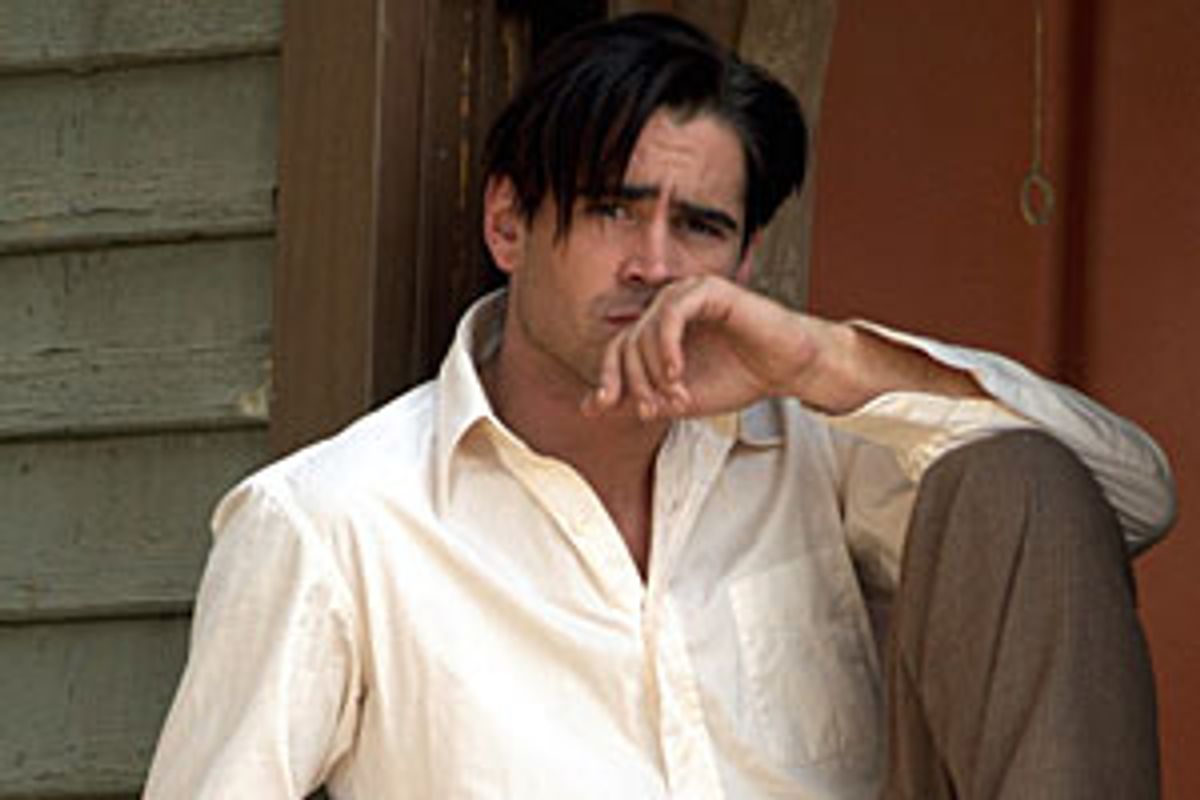
Time and again lousy, or even just inexperienced, directors have gotten gold out of Colin Farrell. And even in his latest picture, Robert Towne's meticulously crafted but ultimately flat adaptation of John Fante's "Ask the Dust," Farrell has moments that resonate -- the problems posed by the performance have more to do with poor casting than with Farrell's commitment to the role.
But perhaps largely because of the loose-cannon quality of the interviews he's given, people seem to think of Farrell as a celebrity who just happens to get movie roles; a good-looking, scruffy Irish mug with a big personality attached -- in other words, a movie star who never really gets his hands dirty with the business of acting. The surfacing last summer of a sex video Farrell made with his then-girlfriend Nicole Narain didn't help. While so many of us claim to be liberal about drinking, drug use and casual sex (the smoking of plain old cigarettes is probably where we gouge the deepest line in the sand), it's so much easier to make sense of the world by using tried-and-true puritanical assessments, and we all fall prey to them now and then. Even though we think we have completely separate compartments for what actors do on-screen and what goes on in their private lives, we still find ourselves wondering, Should an actor who has spoken candidly about moderate heroin use and the pleasures of engaging prostitutes ever be taken seriously?
But that, right there, is the great puzzle of Farrell, and the thing that sets him apart from the Brad Pitts and the Tom Cruises of the world, occasionally appealing actors who now and then are able to pull off a stunt that somewhat resembles a performance. Farrell has given bad performances and terrific ones. But I've never seen him coast through a role -- not even in a throwaway action movie -- as if cushioned by the certainty that good looks and swagger will get him everything he wants out of life. He's a bad boy whose work betrays a sterling work ethic, and as a nation of celebrity watchers and movie lovers, we have no idea what to make of that.
With his black-caterpillar eyebrows and velvet-brown eyes, Farrell has the distinction of being both regular and extraordinary. He's a receptive actor more than an emotive one; even when he's talking, as opposed to listening, you get the sense he's attuned to every signal around him. But Farrell's finer qualities are sometimes veiled by his choice of material: His career choices so far don't seem to have been guided by making money first, banking on the hopes that he can get better, subtler roles later. His strategy seems to be that of grabbing everything at once -- one year he'll do a dumb action picture like "S.W.A.T."; the next, he'll show up as a tenderhearted man-child in Michael Mayer's "A Home at the End of the World," based on a Michael Cunningham novel. Similarly, in 2006 we get Farrell not just in "Ask the Dust," in the role of disillusioned writer Arturo Bandini (Fante's stand-in, in this tale of early-'30s Los Angeles), but also as Sonny Crockett in Michael Mann's movie updating of his hit '80s TV show "Miami Vice."
Farrell's choices may seem indiscriminate, but when it comes to acting in the contemporary filmmaking business -- maintaining a balance between making money and doing work that means something to you, all the while knowing that your choices may become extremely limited after you reach a certain age -- it's hard to know if being too discriminating is all that wise. The price an actor pays for actually working can be quite high: Just six years ago, after his breakthrough performance as the enigmatically sensitive Pvt. Roland Bozz in Joel Schumacher's otherwise tedious "Tigerland," nearly everyone had high hopes for Farrell as a "serious" actor. Now there's a tendency to judge him more by the projects he takes than by what he does in them.
There's another problem, too, in that Farrell doesn't always work with directors who are particularly sensitive to actors. Stone is one example; Terrence Malick, who cast Farrell in his arty stinker "The New World," is another. Malick has stronger feelings for visuals than he does for people: His movies are dazzling to look at -- for a while -- and emotionally static. Farrell, as John Smith, the Englishman who falls, hard, for Pocahontas (played by the luminous Q'orianka Kilcher), has some astonishing moments in the picture. In an early scene, when he realizes he's losing his heart to the princess, the liquid longing in his eyes is tempered by the fear that nothing good can come of this attraction. That's a lot to pack into one look, and thank God, Farrell can pull it off: A performance has to be economical to carry any weight in a Malick movie, when so much more lens time is lavished on skies, trees and flying birds than on the actors' faces or bodies.
Still, it's not at all surprising that Farrell would want to work with Malick: When he's not making action pictures, he seems to have a longing to be part of some greater vision. And Towne's adaptation of "Ask the Dust," flawed as it is, is clearly a labor of love on Towne's part. Towne first read Fante's much-loved novel when he was writing the screenplay for "Chinatown." He struck up a friendship with the novelist (Fante died in 1983), and has spent much of the past 30 years trying to bring the book to the screen.
Farrell is charismatic enough to play Arturo, a penniless young author who, fresh off the success of his first published story, relocates from Colorado to Los Angeles, fully believing in his right to all the money, fame and beautiful women the city has to offer. But he runs out of money; nobody knows or cares who he is; and even though he's in search of a blond goddess, he instead ends up falling in love with a Mexican waitress, Camilla (Salma Hayek, in a remarkable, deftly shaded performance).
Camilla is a reflective surface for Arturo's own self-loathing and insecurity, and he's pointedly cruel to her. He feels free to humiliate her because of where she's from, an obvious projection of his own shame over his Italian-immigrant roots. And he has no sexual experience with women, which makes him fear and despise her all the more.
It probably wasn't a good idea to cast Farrell, an erotic presence even when he's not trying to be, as a sexual naif. Then again, he has enough innate vulnerability to make even that angle of Arturo's character believable. What's harder to buy, as Farrell plays it, is Arturo's cruelty. Farrell can play brutal and aggressive (his astonishing opening scene in John Crowley's 2003 "Intermission," a combination seduction speech and holdup, is proof of that). But the kind of meanness that he has to summon to play Arturo seems foreign to him. When he mocks Camilla for wearing huaraches instead of "real" shoes, there's a note of apologetic hesitation in his voice, just enough to clue us in that he doesn't think it's right for even a fictional character to talk to a woman that way.
Obviously, without knowing Farrell personally, we can't be sure how he really feels about women: There have been plenty of actors who know how to look at a woman on-screen and yet haven't a clue about how to behave honorably in real life. But since we all feel certain that we know Farrell intimately, from reading the gossip pages, as well as the candid, hugely entertaining interviews he's given so freely, what's to stop us from examining some of the things he's told the press as if they were a kind of performance -- if not a wholly reliable indicator of the "real" Colin Farrell, whoever he may be, then at least a thumbnail guide to the image he wants to present to the world?
Some of the best Farrell quips come from the 2003 interview he did with Playboy, a freewheeling conversation in which he admits to liking drink, drugs and casual sex, and notes that using a condom is always a good idea. But the Playboy quotes have also come to haunt him. A few years back, Glamour magazine took Farrell to task for having admitted to Playboy that he'd done business with prostitutes, citing, with wattle-shaking disapproval, the way he likened paying for sex to phoning up for a pizza. But it's important to note that, before that specific quote, Farrell also said, "It's really as fucking simple as sometimes I don't want to go to a bar and get to know someone because I know all I'm looking for is the simple act of sexual intimacy." The subtext of that comment, if there needs to be one, may be that sometimes it's more honest to just pay for sex, as opposed to trying to fool a woman into thinking you really like her just so you can get laid -- although even that may be a truth some people don't want to hear.
But my favorite story about Farrell appeared in, among other places, More magazine. (More is aimed toward women over 40, who may possibly be more forgiving of the unrepentant guyness of guys than the younger readers of Glamour are.) A few months back, a brief front-of-the-book article told how Farrell had spent more than two hours trying to convince his "Ask the Dust" costar, Dame Eileen Atkins (who was 69 at the time), to have sex with him. Atkins spurned his advances, but Farrell persisted, reportedly saying, "The reason you won't do it is because your body isn't as good as it was when you were young, isn't it? But I don't care about that."
Atkins didn't succumb to Farrell, but she did say that the episode made her feel much better about facing her 70th birthday. Of course, there's always a way to spin a story negatively: You could read the anecdote as proof that Farrell will go after anything that moves. But who's to say that he wasn't acting out of a genuine attraction to Atkins? We become annoyed when older male actors date increasingly younger women, but we're just as suspicious when they express interest -- even just interest of the one-night-stand sort -- in an older one.
It's true we can never fully know what makes a celebrity tick just from reading the interviews he's given. But Farrell is less guarded than many. And his reputation as a substance-abusing, sex-maniac "bad boy" notwithstanding, he rarely (if ever) engages in macho posturing. (Here I should note that I watched the small portion of the infamous "sex tape" that has been circulating on the Internet, and all I can say is that I found it to be remarkably unsleazy. In fact, Farrell's enthusiasm for the task at hand -- so to speak -- strikes me as nothing but gentlemanly.) My second-favorite Colin Farrell story also comes from the Playboy interview, in which he tells of the mad crush he had on Marilyn Monroe when he was 8 or 9. Maybe that's an unoriginal crush -- but stronger men, and women too, have fallen hard for Marilyn.
"When I saw her in movies, I'd just never seen anything like her," Farrell told Playboy. "I used to leave Smarties, the Irish equivalent of M&M's, under my pillow with a little note saying, 'I know you're dead, but these are very fucking tasty and you should come and have a few. I won't tell anyone.'" Farrell says he'd be disappointed and annoyed when he'd wake to find the Smarties still there. "I couldn't figure out why Marilyn didn't just want to take one of my fucking Smarties."
If you want to put a negative spin on the story, you could read it as a classic example of male entitlement: How dare Marilyn Monroe refuse my Smarties! On the other hand, an 8-year-old boy who's willing to sacrifice his favorite candy to a dead goddess probably has more layers to him than any outsider can adequately plumb. With that kind of compassion and imagination, a kid could grow up to be a terrific actor -- perhaps a bettter one than the movies around him deserve.
Shares