

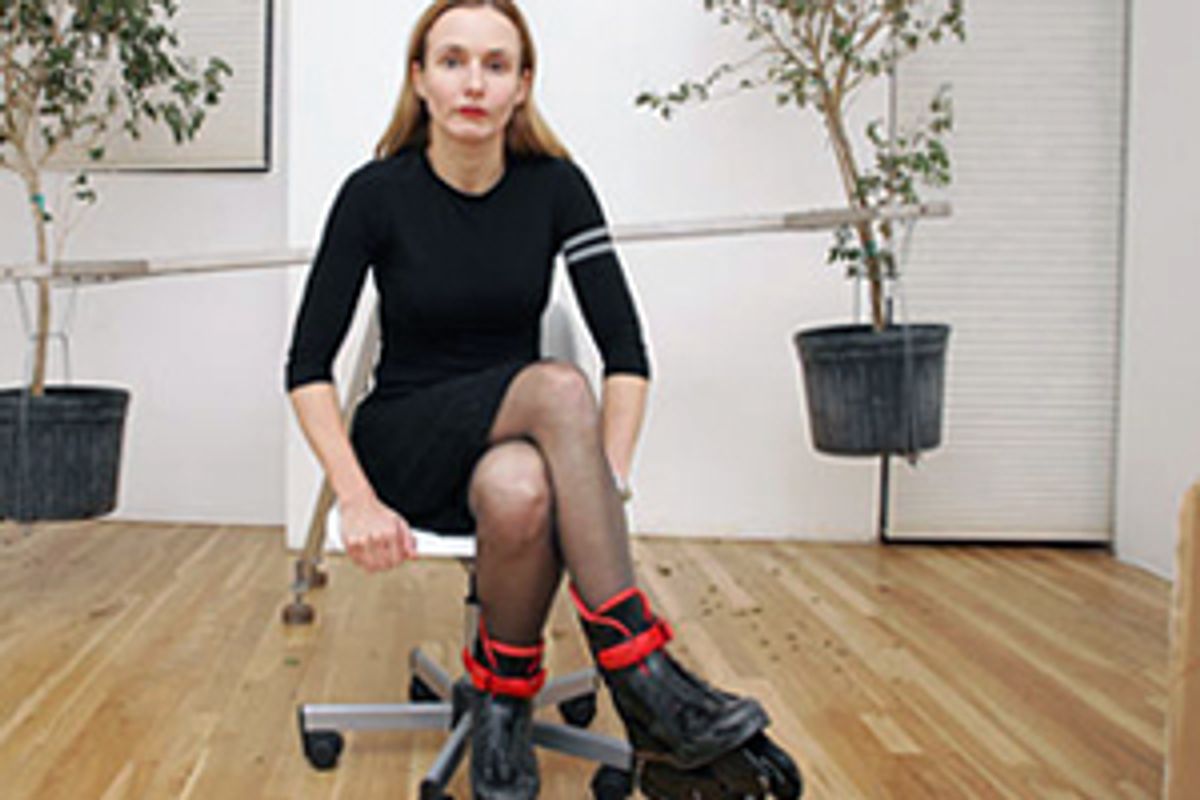
It's an icy spring morning and Natalie Jeremijenko skates into the Soy Luck Club on Rollerblades. The boutique cafe in New York's West Village has polished concrete floors, brick red walls and burnished wood counters. It feels like it was designed to be featured in one of those big modernist architecture magazines. But Jeremijenko's chaotic energy seems to melt the frosty interior into thin air.
Wearing a parka with a fake fur collar over a tight dress, she rolls around the glossy Knoll furniture, talking nonstop about her latest art project. She has all kinds of science degrees and drops terms in biology and mechanical engineering the way most people do the names of film stars. With her animated eyes and sly smile, her blond hair pulled loosely behind her head, she has the magnetism of a natural actor. Yet her enthusiasm often overtakes her logic and her sentences dart around like children. Born and raised in Australia, she retains her Aussie accent and seems to live so comfortably on abstract planes that at times you don't know where she's coming from. And that, her husband, Dalton Conley, a New York University sociology professor and writer, later says, goes for him too.
Alighting at a table, Jeremijenko, 39, explains that her work is "all about creating interfaces that draw people into the environment and get them to reimagine collective action." She cracks open her laptop and displays an image of 100 polycarbonate tubes or "buoys" that she's engineered to glow when fish swim through them in the Hudson River. Yes, she really has government approval to position the buoys in the river. Given her day job as a professor, she convinced state environmental officials her project was all about science. But never mind that. Did you know the fish were on Zoloft? All the antidepressants that New Yorkers take are flushed through their urine into sewage treatment plants, which overflow into the river. You doubt her? Go to the Whitney Museum and see one of her drawings hanging on a wall by a bathroom. It features a woman's bottom, her pants below her knees, on a toilet seat. It asks, "Why are the Hudson River fish and frogs on antidepressants?" Printed on it in tiny letters are actual studies that attest to the chemical drug compounds in the waterway consumed by the unsuspecting bass, sturgeon and crabs.
Anyway, when the buoys light up, you can feed the fish food treated with chelating agents to help cleanse the PCBs from their blood, planted there from decades of General Electric dumping waste into the river. The fish food, in fact, will not be much different from the energy bars we're always eating on hiking trails. "The idea that we eat the same stuff is a visceral demonstration that we live in the same system," Jeremijenko says. "Eating together is the most intimate form of kinship. By scripting a work where we share the same kind of food with fish, I'm scripting our interrelationship with them."
Oh, and one more thing. Do you know about the American doctrine that says a corporation has the status of a person and enjoys all the legal protections afforded by the Constitution, including the right to own property? Well, beginning this week, Jeremijenko is selling the buoys to collectors. With the money, she plans to form a corporation called Ooz Inc. -- zoo spelled backward -- and put the fish on the board. That way the fish, as shareholders, will acquire personhood, and have a say in the preservation of their grungy habitat.
Is she kidding? No, she's not. She wants us to feel as connected to wildlife in New York City as we do in the Adirondack Mountains. And reflect on the ways we impact nature and the ways it affects us. She's a maverick environmentalist whose field notes are public artworks. But she is being playful, a hallmark of her art and personality, and the trait that allows her work to stand out in the vital cultural arena where art and science collide.

Project photos and diagrams from the "Ooz Project."
The thesis of the famous 1959 essay "The Two Cultures," by British scientist and novelist C.P. Snow, that science and the humanities represent two worlds that don't meet, has vanished into history. Science has become a daily topic in the cultural conversation. Biologists like Richard Dawkins and physicists like Brian Greene write so fluently about their fields that readers pore over their books with the passion of pursuing a good story. And ever since Oliver Sacks set fountain pen to paper, everybody at cocktail parties seems to be an expert in neuroscience.
Science is now permanently stitched into the arts themselves. Filmmakers have long flocked to science for Frankenstein themes about controlling nature. In recent years, genetics, math and physics have informed, respectively, genuinely moving works in literature (Richard Powers' "The Gold Bug Variations"), theater (David Auburn's "Proof") and opera (John Adams' "Doctor Atomic"). But it's the artists working in studios, labs and garages out of pop culture's shadow who have been melding science and humanity in the most challenging, fascinating and profound ways. And that goes for Jeremijenko.
She set her artistic course in 1994 as a consultant research scientist at Xerox Palo Alto Research Center, the famed Silicon Valley lab where artists and computer scientists are paid to let their minds wander. There, she created "Live Wire," a vibrating cable that symbolized the energy consumed by the Internet. Just as the Web was being celebrated as a virtual reality where egalitarian dreams came true, Jeremijenko was saying the electricity required to run it, and the people being used to build it, were creating environmental and labor conditions that were far from utopian.
Her next project, "Suicide Box," was also a grim twist on cultural infatuation. As people seemed obsessed with NASDAQ and Dow Jones numbers, Jeremijenko created a numerical calculation for suicide. Using a motion-sensitive camera to track vertical movement off the Golden Gate Bridge for three months, she recorded 17 people who appeared to have leaped to their deaths. In 2004, she aired out her politics. During the Republican convention in New York, she fashioned medical face masks for bicyclists to wear around the city. The grime the riders inhaled was displayed in a sooty bar beneath the words "Clear Skies," an ironic echo of the Bush administration's air pollution policy. On the lighter side, her proposed project for parking lots, in which cars are assigned spaces by color to create artistic patterns in the lots, is a quite lovely idea.
While public spaces are her main stages, her works have been exhibited in art museums from Sydney to Amsterdam to San Francisco. Earlier this year, along with her drawing, her outdoor installation "For the Birds," a wry comment on avian flu, was featured in the 2006 Whitney Biennial, the always controversial assembly of contemporary art at the New York museum. She has held academic positions at NYU and Yale and currently is an assistant professor in visual arts at the University of California at San Diego. True to her frenetic life, she commutes to San Diego two days a week from her home in New York.
Art critics at major newspapers seldom pay attention to Jeremijenko, busy as they are with reviews of the latest Monet exhibit or Henry Moore retrospective. "The art world is a very prissy little thing over in the corner, while the major cultural forces are being determined by technoscience," Jeremijenko said in 2000. She said that in the New York Times Magazine, so, yes, she's gotten her fair share of feature coverage. Accolades for her work are easily found in avant-garde art magazines and Web sites, science and design journals. In 1999, MIT's Technology Review named her one of the country's top young innovators, and in 2005, I.D. (International Design) magazine named her one of the 40 biggest "influencers" in architecture and design, listing her alongside Steve Jobs, Frank Gehry and Rem Koolhaas.
"Oh, yes, Natalie is a star in the alternative art world," says Stephen Wilson with a laugh. Wilson is a multimedia artist and art professor at San Francisco State University, and the author of "Information Arts," the definitive tome of contemporary artists at work in the fields of science and technology, which includes numerous references to Jeremijenko. Philippe Vergne, who co-curated the 2006 Whitney Biennial, also chuckles when he mentions Jeremijenko, recalling the first time he met her six years ago. Then, Jeremijenko had just finished hanging six maple trees upside down at the Massachusetts Museum of Contemporary Art. She wanted to upend the view of city trees as pretty little rows on streets. "Honestly," says Vergne, "I thought she was totally mad." Which only kept him coming back to her work. "From science to politics to genetics, she's really putting her finger on controversial questions that are framing our culture right now."
To be sure, she's not alone. As Wilson's book (900 pages!) makes clear, Jeremijenko is only one player sounding the noisy times with notes from biology, engineering, zoology, genetics and physics. Christa Sommerer and Laurent Mignonneau illuminate the harmonies between real and artificial life, and the human impact on ecosystems, in wondrous interactive 3-D exhibits that simulate plants and animals. With wit and strange beauty, Alexis Rockman unearths urban wildlife -- seagulls, rats, cockroaches -- in fantastical paintings that the late biologist Stephen Jay Gould has praised for splintering calcified scientific views. And the ways technology alters our view of ourselves and the environment, seen through ingenious robotic installations, informs the work of Ken Goldberg, and, more apocalyptically, that of Eduardo Kac.
Kac is the movement's most notorious star. In 2000, he made headlines when he injected a jellyfish gene into an albino rabbit, causing it to glow green when illuminated. The idea was to stimulate discussion about the ethics of transgenics, although Jeremijenko calls it "a stupid piece that is exactly not what bioart is." The grandstanding exhibit skirted the issue that sparks Jeremijenko and her comrades in political troublemaking, the Critical Art Ensemble, whose radical adventures in public art have earned international renown. To them, the burning issue in science is how government scientists and biotech companies are shaping how we think about genetics, and how gene-mixing is employed in the manufacture of food and medicine, despite questions about its ecological effects.
Jeremijenko spliced into the controversy in 1999 with her project "One Trees." When daily news about decoding the human genome had us all fearing we were programmed by DNA, she and a California nursery produced hundreds of clones of a walnut tree from its stem-cell-like tissue. She placed the tiny sprouts in individually sealed cups and displayed them at Yerba Buena Center for the Arts in San Francisco. The various shapes into which the plantlets sprouted in uniform environments underscored that genes alone don't sit in nature's director chair, but are one of many biological processes. Later, she planted 20 pairs of the trees in various places in the San Francisco Bay Area. Now she gave urban reality its turn in the spotlight by demonstrating how social conditions -- the trees were planted in poor and wealthy neighborhoods -- caused the genetically identical trees to blossom into a bounty of sizes, some rising into the open sun with vigor, others drooping under the industrial shade.
"'One Trees' is one of the landmarks so far in art and science," says Wilson. "A lot of artists just sit back and comment on the world. Natalie actually went out and employed the science. It was very powerful, more powerful than just sitting back and commenting."
Jeremijenko lives her work like few artists. She even tries to involve her three kids, much to the chagrin of Conley, who laments that family vacations to Costa Rica and Australia turn into fact-finding missions for her ongoing project about manufacturing, "How Stuff Is Made." Finding the woman behind the artist, though, can be exhausting. Ask her what's personal about her art and she will say, "My thesis is nothing can't be autobiographical. The idea that there is a rational truth out there that is not embodied in a person's politics is something I can't understand or subscribe to."
But ask Conley and he will tell you her "work is very personal, which doesn't always come through because she presents a scientific front. But the initial spark is always personal." Spend enough time with Jeremijenko and the woman in her art does come into view. You see an artist with a frightening drive; dark, passionate and joyful motivations. It's just that, like her art, she requires translation.
People are beginning to fill up the Whitney Museum on a Saturday morning. Some trickle down to the gift store on the lower floor, where Jeremijenko cuts a path through them and rolls aside a bookshelf on wheels. Behind the shelf, she retrieves the laptop that controls her installation, "For the Birds," created with Phil Taylor and her artist collective, Bureau of Inverse Technology, set up on a patio outside the store. Museum goers are not sure what Jeremijenko -- wearing a long silver coat, black knee boots and straw cowboy hat -- is up to. But she pays them little mind. She is focused on showing me how "For the Birds" works. As I can see, there are translucent bird perches affixed to the outdoor patio walls. When real birds land on them, they set off prerecorded voices that warn museum goers about the encroachment of avian flu. Next to the perches are miniature reproductions of some of the paintings inside the museum. "It's the Whitney Biennial for the birds," Jeremijenko says with a short laugh.
Before she goes into detail about "For the Birds," a companion to her buoys for the Hudson River, Jeremijenko regales me with the philosophy behind them. She calls both projects "Hudson River School 2.0," a reference to the 19th century painters who lushly rendered the Eastern countryside a pastoral Eden. "The Hudson River School romanticized the American landscape for the first time," she says. "It showed it as beautiful vistas of great green expanses with great shimmering blue skies and lots of water. It was a view of nature as something out there, something pretty, something apart from people." Although the Hudson River School may have enchanted people for generations, drawing them closer to nature, its views are now quaint and counterproductive. The American landscape after two centuries of human development is not a pretty picture. It's time for environmentalists to stop seeing nature as scenery that should be preserved like a painting in a museum, Jeremijenko says, and more like a dying body that needs to be nourished back to health.
With Hudson River 2.0, she continues, we get "a view of nature where we're inside it, interacting with it, where urban forms are a part of nature and act as their own natural systems." It's a global view, informed by ecology, where city and country, humans and birds, exist in an interrelated dance. And right now, the dance of nature is a dangerous waltz with a deadly flu virus in the mix. Or so the birds in Jeremijenko's Whitney Museum piece are trying to tell us. Or would, if New York's real birds would cooperate by landing on the perches and triggering the voices. Given their reluctance at the moment, Jeremijenko, sitting on a window ledge in the gift store, her computer in her lap, has to intervene and manually play the bird voices for me.
"Tick, tick, tick. That's the sound of genetic mutations, of the avian flu becoming a deadly human flu," says a professorial male voice. "Do you know what slows it down? Healthy sub-populations of birds. Increasing biodiversity, generally. It is in your interest that I'm healthy, happy, well fed. Hence, you could share some of your nutritional resources instead of monopolizing them. That is, share your lunch."
Next comes a female voice. "You have such a strange relationship to ownership that holds across species. I'd like to suggest that we share the land and its productive capacity -- the worms, the plants, the future generations of seeds, the nesting grounds. Do you think you own this too?" The haughty voice continues. "You know those mute swans now dying all over Europe? They don't normally migrate," she says. When it comes to bird flu and human deaths, "You're bringing it on yourselves. But that means you can fix it. The first step is to give me a little bit of that bar."
These are some brainy birds. They're telling us how the destruction of biological diversity is a crime against nature and increases the risk of disease. Jeremijenko explains that wild birds in Europe and Asia, fleeing ailing wetlands, are forced to roost near scummy ponds on farmlands, where they come in contact with infected chickens. Yet rather than preserving wild lands, she laments, the international response has been the "mass slaughter of millions of birds," which only fans the flames of the flu.
"The birds are arguing that the reason we have diversity in nature is to protect us against disease," she says. "The birds are arguing that if we were to address the problem effectively, with a systems-level view, we would increase the health of domestic and wild birds, and that would be our best protection." Her birds, she says, also remind us we don't live in plastic bubbles. "The greatest vectors of bird flu have been freeways, airports and railways. People get on with infected birds, get off, and trade at stops along the way. It's human migration that is transmitting this disease, not the migration of wild birds themselves."
Jeremijenko always sounds like an excitable activist. But she does do her homework. A recent report by the United Nations Environment Programme concluded, "Restoring tens of thousands of lost and degraded wetlands could go a long way towards reducing the threat of avian flu pandemics." Ecologists at the University of Georgia, as reported by New Scientist, "have shown that killing wild animals with a disease like flu could actually lead to more infected animals, not fewer." The theory is that older animals build up immunities to disease and so killing them leaves the younger and more populous ones vulnerable. As for roads and railways leading to the outbreaks of bird flu, Nial Moores, director of the conservation group Birds Korea, says: "There is abundant evidence that poultry flu is spread over significant distance through the transport of poultry."
Jeremijenko's views about bird flu have also been informed by one of her brothers, Andrew, a physician, epidemiologist and head of influenza studies at a U.S. Navy medical research facility in Indonesia, where the first human cases of bird flu were studied in detail. The naval medical center, which Scientific American called "the largest, most experienced and best-equipped avian influenza laboratory in the country," was shut down earlier this year due to ugly politics inside the Indonesian government, related to lingering resentment against the U.S. for backing the independence of East Timor in 1999, formerly controlled by Indonesia.
The mere sight of Jeremijenko's bird perches doesn't exactly engage museum goers in the important political and ecological debates over bird flu, or enrich their reveries with a theory of natural systems. In a previous project, "Feral Robotic Dogs," Jeremijenko and her students hacked toy robot dogs, implanted chemical sensors in their noses, and unleashed them in urban "brown sites," public spaces where toxins like lead and arsenic, remnants of chemical plants, lurked beneath the surface. With the media in tow, and a bunch of happy school kids, Jeremijenko set the robotic dogs loose alongside the Bronx River, near a long-shuttered Con Edison plant. It created just the kind of spectacle she loves. I remark that the bird installation seems less successful and represents a significant problem with conceptual art -- that its effects often remain locked in the artist's head. Jeremijenko bristles.
"In terms of conceptual art, I'm a populist," she responds, perfectly serious. "My strategies of representation are supposed to be questions. What are those perches? They're not supposed to be hammering you on the head as some kind of didactic science lesson."
Well, she has to admit that a lesson given by birds on the evils of land ownership is didactic, if not anthropomorphic. "There's nothing wrong with being anthropomorphic," she says, sounding as peeved as one of her talking birds. "That's how we understand the world. Contemporary science doesn't pretend we're not human and have a solely objective view of things. We only have certain tools to understand the world. So I'm not scared of anthropomorphism at all. When science becomes unbelievable is when it pretends it's coming from nowhere, that it's a universal description of everything. That doesn't make sense anymore." And too often in our culture, she says, when empirical science rules, activism fails. "I don't think there's a scientist anywhere in the world, in any discipline, that has the kind of power to make as much of a difference as an interested, engaged, diverse community."
She pauses and grins, her wry humor having returned. "Besides, walk through the rest of the Whitney and ask me again if I'm not a populist."
She does have a point. Strolling through the museum, we stop by two large holes knocked out of a drywall. Through the ragged sheetrock openings you see horizontal tree branches hanging from the ceiling by chains. The branches rotate in a circle and drip wax from their tips onto the floor. I'm not certain why the piece is called "Intelligence of Flowers." I comment to Jeremijenko that I think it suggests how art breaks through the "fourth wall" of museums. "Radical, huh?" she says dryly.
We pass by a tangled mass of bicycle handlebars sheathed in red, white and blue. It appears that a massive bicycle troop crashed into a wall at the end of a Fourth of July parade. Even Jeremijenko is not sure what to make of the wreck of aluminum tubes. However, she does nod approvingly at a lifelike rubber toddler kneeling in the middle of the museum floor with a green parka over its head.
Abstract art apparently has the opposite effect on Jeremijenko as it does on most people. Triangle drawings, green bottles and huge paintings of red high-heel shoes draw out her more personable side. As we walk through the fluorescent pawn shop of art, she talks about her long haul in academia. Showing an aptitude for math and science, apparently a rarity for girls in Australia, she was "pipelined" into science studies and never got out. In Australian universities, she earned bachelor's degrees in biochemistry and physics and a master's in English, and she completed the research but not her Ph.D. dissertation in neuroscience. She transferred to Stanford and did all the course work but didn't finish her dissertation for a Ph.D. in mechanical engineering. "I'm not that interested in credentials," she says coyly. Finally, she returned to Australia and completed her Ph.D. in computer science and electrical engineering at the University of Queensland.
Not that school was enough, however. In 1987, she had a daughter with her high school sweetheart, a rock musician, and named her Mr. Jamba-djang Vladimir Ulysses Hope. She was reading and loving Nabokov and Joyce at the time, she says, "and got a little carried away."
In 1988, she got involved in another all-consuming project. With a buddy, Peter Walsh, she borrowed $5,000, ostensibly for a car loan, and started a rock festival called Livid. They wanted to spotlight Brisbane's rock scene, notably the Go-Betweens, and surround the musical stage with theater and visual art, an idea that predated the Lollapalooza Festival by three years. As usual, she was doing 10 things at once. "I remember one day, while doing neuroscience research, I was slicing up rat brain in the lab and negotiating with Nick Cave on the phone. My advisor was watching me and said, 'Natalie, take a break and get this arts thing out of your system.'"
She never did. In fact, the Livid Festival sowed the seed of public art in her. "When you have to produce art that works with 20,000 inebriated 20-year-olds, it becomes very different than doing reverent, hushed, respectful art," she says. "One year, we worked with Act Up to produce huge frozen ice penises that, in the middle of the Brisbane summer, everybody was licking. We had helicopters fly over and drop cocktail umbrellas printed with political messages on the crowd. We soaked rope in gasoline, rolled it in gunpowder, and placed it on the grounds. If you dropped a cigarette, it would light the rope and a flame would sear through the crowd. It was a tremendous spectacle. So with the festival, I really learned how to create culturally exciting art and different forms outside of the museum."
We leave the Whitney and take a cab to the West Village. Along the way, Jeremijenko insists the driver drop us off on the West Side Highway, an illegal move if ever I've seen one. Near a dilapidated pier on the river, she points out where she plans to put her fish buoys in the water. After a brief oration on the industrial history of the area, we walk to a restaurant called the Spotted Pig, across the street from her apartment. She quizzes the waiter on whether the pinto beans are cooked in animal fat, and when she's reassured they're not, she orders them, a salad and a glass of wine.
In a buoyant mood, she explains that she grew up in tropical Mackay, a coastal city alongside the Great Barrier Reef. Her father is a family physician and her mother, who has a Ph.D. in education, is a schoolteacher. The first thing she tells me about her mother, with affection, is "she was the first person in Australia to have a microwave. She was a great believer in domestic technology -- it enabled her." Her parents were also great believers in kids; they had 10 of them. Natalie is the second oldest.
The five girls and five boys are "an interesting bunch," Jeremijenko says with understatement, offering me some examples. Her oldest sister, Valerie, is the dean of students for a branch of the Virginia Commonwealth University, based in Qatar. Her brother Michael was a commercial pilot until he decided to go into coal mining in New South Wales with their brother Paul, who tired of his jobs as a professional football player and physiotherapist. Peter is a stuntman who has performed in countless movies, including, most recently, "The Matrix Revolutions" and "The Matrix Reloaded." And her sister Melanie is a math and science teacher in Darwin, Australia, where "she works on the front lines of extraordinary racial and class violence."
Seizing the rare moment when she talks about herself without using the word "hermeneutics," I ask her about Jamba, her now 19-year-old daughter. She sighs. When Jeremijenko left Australia for the U.S. in 1994, it wasn't to work on her art at Xerox Parc. She went looking for her daughter.
Jeremijenko broke up with her boyfriend when Jamba was a toddler, leaving her a single mother. When Jamba was 4, her father wanted to spend time alone with her. In a decision that continues to haunt Jeremijenko, she agreed. She packed a bag for Jamba, but her daughter never came home. Her ex-boyfriend disappeared with Jamba for a year and a half. Jeremijenko desperately tried to find them. Finally, she heard from a contact, a flight attendant, who told her that she had seen Jamba and her father on a flight to California. Indeed, the father had moved in with a new girlfriend in San Francisco. Distraught and relieved at the same time, Jeremijenko packed up her studies and moved to Berkeley, where she lived with a friend, and later by herself in San Francisco.
For years, Jeremijenko was trapped in a Bleak House of California and international custody law. Sorting out which foreign parent deserved U.S. custody of a child born in Australia was "a vicious and ugly carnival," she says. And one that marched against her. Judges sided with her ex-boyfriend and Jeremijenko was granted only visitation rights until Jamba was in high school, when her daugher finally moved in with her. Later, she would tell me that she couldn't do anything right in court. "If I showed emotion, I was hysterical, if I didn't, I was cold and uncaring, disinterested. It was a trial of motherhood and made me understand how women could be burnt as witches."
It was during those first years in the Bay Area that Jeremijenko created her project "Suicide Box." Was it her response to depression over her daughter? "Fair enough," she says, taking a deep breath. A few moments of silence pass. "I hope you're not going to depict me as a suicidal maniac."
Changing the subject in the restaurant, Jeremijenko asks me if I've read Conley's books on families and race, and his memoir called "Honky," about being one of the few white kids to grow up in a housing project on the Lower East Side in the '70s. When I say no, she calls him on her cellphone and tells him, considering they live across the street, to bring his books down to the Spotted Pig. With the trim body and no-nonsense stare of a lightweight boxer, Conley looks uncomfortable in the trendy restaurant. Similarly, he speaks in a native New York accent seldom heard in the upscale Village. The hardcore New Yorker certainly seems the polar opposite of his wildly cerebral Australian wife. But he does share her wry sense of humor. "I've come to rescue you from Natalie," he says, handing his books to me. Jeremijenko smiles, sort of.
A week later, Conley, 37, is sitting in a coffee-and-muffins cafe down the hall from his NYU faculty office, located in a recently refurbished building in SoHo. He's director of the university's Center for Advanced Social Science Research. As candid as his wife is evasive, he says that being married to a restless artist is not as strange as it may seem. His father was a painter, "an old school, macho De Kooning, Pollock kind of character," and his mother a novelist. They were committed New York bohemians, determined to paint and write rather than hold down 9-to-5 jobs. Which explains in large part why in 1968 they moved into the graffiti-covered Masaryk Towers housing project on Columbia Street, just south of Avenue D in Manhattan -- it was cheap.
Conley and Jeremijenko met in 1996 at a technological art show in a San Francisco gallery called Blasthaus. At the time, he was doing post-doctorate studies at U.C. Berkeley and she was at Xerox Parc. A friend had taken him to the gallery and while admiring an electronic orb that shot off lightning bolts, Conley was astonished when a blond woman strolled by and touched them. She explained the air resistance reduced the voltage to safe levels. "Natalie likes to say there were literally sparks flying when we met," he says.
Speaking of his parents, Conley says, he remembers when he was dating Jeremijenko and his father first met her. She was giving a lecture at the Museum of Modern Art. "I was in California and he called me and said, 'She's a genius.' I felt warm and proud of that. Later, he said we're a perfect couple because she's out of control and I'm a control freak." As for his mother, "I'm scared to admit this, but Natalie and her are very similar. My mom had all sorts of crazy notions. She wanted to start a pet disposal business in New York because she worried that low-income people didn't know what to do with their dogs and cats when they died." It could have been an idea right out Natalie's head, he says.
Conley admits that he takes as much responsibility as Jeremijenko for the kids' kaleidoscopic, multicultural names -- E Harper Nora for their daughter, now 8, and Yo Xing Heyno Augustus Eisner Alexander Weiser Knuckles, now 6. They go by "E" and "Yo." Conley explains the names are "interactive" because E can tell everybody her first initial stands for whatever they want it to, and because Yo, when he got older, was able to add his own name to the list. He chose "Knuckles," the name of Conley's childhood dog.
Given that Jeremijenko, like matter itself, is constantly in motion, I wonder how she manages as a mother. "It's a big tension in her life," Conley says. "The way she resolves it is to try and integrate family into her work. She's given lectures with a Baby Bjorn on, and sometimes even breast-feeding, which is very funny. As the kids get older, she thinks they'll fit her vision of life as a fluid integration of family and work. She has this ideological idea that there's too much age segregation in our society, and children should be more integrated into adult lives. For me, it's a little too idealistic. A lot of her visions are utopian, and I'm more of a pessimist or a realist. But any two professional folks who don't have a live-in nanny are going to go a little crazy. There's a lot of stress involved. But it's a team. She leans on me pretty heavily when she has an exhibition. We all understand that we won't be seeing much of mommy."
Does he like her work? "I do like her work," he says. "It's completely different than anything I would ever do. Her mind doesn't function the way mine does. I like that. It's just a completely different way of looking at the world. That's the best thing about being together with her. It's always engaging in a way that I wouldn't get anywhere else. She always says things that are surprising to me, even after 10 years. But the price of that is having to live with a mad scientist."
At the same time, Conley admits, because they see the world differently, their work strains their relationship in more ways than one. He means his work too. Last December, Conley wrote what became a controversial Op-Ed (including with Salon readers) in the New York Times. Titled "A Man's Right to Choose," he declared that if "a father is willing to legally commit to raising a child with no help from the mother he should be able to obtain an injunction against the abortion of the fetus he helped create."
"Natalie was seething mad at me for a month," he says. "I gave it to her to read but she was too busy. That's the price she had to pay. In every fight we've had since then, I just wait for the line to come up, 'You would chain me to a bed for nine months!' She was so pissed. 'What kind of person am I who would compromise women's autonomy?' She was also personally embarrassed because she thinks it hurt her political credibility in her left-leaning, insular world of science studies and techno-art. She had to deal with the same fallout I did in my academic world, and was angry because she was collateral damage."
The marital harmony of the writer and artist, I say, does seems a rather challenging one. Conley nods. The Times Op-Ed, he admits, "was largely a response to how much responsibility I've had with the kids. I thought I would be the kind of disengaged, workaholic, distant dad, and Natalie outdid me on that front, not the disengaged part, but the workaholic part. I also realize it's an incredible gift she gave me. I'm very close to the kids. I arrange the play dates and am deeply engaged in everything they do in a way I might not have been if I were to leave it all to somebody else. Because I'm living with a mad scientist, I often have to be the boring disciplinarian one, and she gets to be the fun, crazy one. It's largely a reversal of gender roles. Sometimes I resent it deeply and sometimes I really appreciate it."
Not long after, I get a vision of the orchestrated chaos of their life. Their West Village apartment is both cozy home and crowded workplace, books and journals strewn about tables. Dissected parts of Jeremijenko's robotic dogs lie on the kitchen and living room floors. Parakeets and Zebra finches perch on a tree in the living room and fly around the apartment. Yo lies on the floor and coils a stuffed toy snake around a stuffed tiger. He might be imitating the animal behavior he once saw on a nature show, except Jeremijenko banned TV from the house fours year ago, mostly because, Conley says, she herself got addicted to it, watching cartoons and movies with the kids for hours, and crying over the slightest thing. "Natalie weeps at everything," Conley says. "She'll be watching a video and screaming at the screen, 'Swim, Nemo!' I'm like, 'Are you serious?'"
Jeremijenko and Conley have invited friends over for dinner and are trying to find the kids' sweaters and jackets, gather up the food -- Conley ordered Pakistan takeout from a place he always sees taxi drivers go to -- and move everybody to Jeremijenko's studio two blocks away, where there's more room. After 30 minutes or so of particle-colliding energy, I understand what Conley means when he says that Jeremijenko somehow manages, with two kids, to re-create her experience of growing up in a family of 10 kids. Jeremijenko gathers Yo in her arms, E helps carry some of the bottles of wine, and everybody piles into the street and the New York night.
The intellectual and emotional storm that is Jeremijenko's life may not always be apparent in her art. But it's there. When you think about her cloned trees and talking birds and Hudson River fish buoys, and the extraordinary effort it takes to bring them to the public, you have to marvel at the artist behind them. Working in the nucleus of our increasingly scientific times, she is succeeding, with fantastic irony, to illuminate our humanity, to expose the chain of consequences of our actions, and, worse, to her, inactions. She's doing it solely by the force of her personality, which, with a few keystrokes on the computer here and turns of a screwdriver there, may be her greatest work. Standing by the Hudson River one afternoon, talking about how the fish will swim through the glowing buoys, she says, "It's a work in progress. That's always part of my story."
Shares