

According to Dylan Avery, a 22-year-old filmmaker in upstate New York, no terrorists hijacked United Airlines Flight 93 on the morning of Sept. 11, 2001, and no passengers heroically revolted. The plane didn't even crash in that Shanksville, Penn., field, he says, but instead landed safely in Cleveland. And not only that. As Avery sees it, the true 9/11 attackers brought down the World Trade Center in a controlled demolition, most likely to get at $160 billion in gold bars he believes were buried under the towers. As for the attack on the Pentagon, Avery insists it was hit by a cruise missile, not a terrorist-commandeered Boeing 757.
Who, in Avery's telling, is the dark force behind all this destruction, the spinner of the big lie that Avery believes envelops the popular perception of 9/11? A most usual suspect: "The first person I'd bring into a court of law would be Dick Cheney," Avery says. "He's the person in the administration who I think is most responsible."
Quizzing Dylan Avery on the events of 9/11 is like taking a peek into an alternate history, a parallel universe of half-truths and audacious propositions that rarely ever disturb the peace of the reality-based world. In another time, that long-ago pre-digital age, you might have dismissed such theories as the rantings of a crank; what a young man like Avery believes about a world-shattering event like 9/11 would seem to be of little consequence to the larger narratives that have grown out of the misery of that day.
But these are days of amateur experts and self-made provocateurs, an era in which a young man with a laptop and a few far-out ideas can easily garner a huge audience in the self-referential online watering holes that dominate modern rhetoric. In the spring of 2005, Avery released "Loose Change," a feature-length documentary film that proposes that the terrorist attacks on America weren't terrorist attacks at all, and were instead conceived, planned and executed by people at the highest levels of the government. Though it has not been distributed in theaters, Avery's film -- sold on DVD and available for free online -- has emerged as the leading gateway drug for thousands, and possibly millions, of converts to the "9/11 truth movement," the loose affiliation of skeptics who doubt the official story. The film has transformed Avery into one of world's most influential proselytizers of the theory that the 9/11 attacks were an "inside job."
I've heard some of Avery's fans describe his movie as "the red pill," the drug that takes Keanu Reeves down "The Matrix's" rabbit hole. During the past month, I've swallowed the pill about a half-dozen times, following Avery and other 9/11 skeptics down a treacherous path toward the alleged truth. I'm sorry to say I didn't find it; much of Avery's film has been debunked even by fellow 9/11 skeptics, and some of its theories verge on the bizarre. If you care to look, you won't find a shred of proof that Flight 93 landed in Cleveland, or that the World Trade Center was stuffed with gold bars, or that the Pentagon was hit by anything other than a commercial jet.
But that's not the whole story. "Loose Change" may traffic in fiction, but it sinks its hooks in. If you're unfamiliar with the official story -- if you haven't, say, perused the hundreds of pages of documentation supporting the 9/11 Commission's conclusions -- you may well find the movie's false reality strangely seductive. And going online to debunk "Loose Change" doesn't necessarily boost your faith in the 9/11 Commission's story; following the path that Google presents in response to queries like "pentagon plane crash" or "world trade center collapse" could make matters worse. While discovering flaws in the movie's claims, you'll find yourself bumping up against entirely different 9/11 theories, some of which propose a theory of the case that's far stranger than you'd ever imagined. Once you jump down the rabbit hole, you find it goes only deeper.
"Loose Change" comes along at a ripe cultural and political moment. No longer is 9/11 sacrosanct in the national consciousness; in the nearly five years since the attacks, we've grown increasingly suspicious of governmental reactions to the attacks, and more amenable to various re-imaginings of that day. Today Oliver Stone is free to fictionalize scenes in the trade towers, and Martin Amis can give us a Mohammed Atta beset by boredom and blocked bowels. Meanwhile, according to an astonishing recent Zogby poll, 42 percent of Americans believe that "the US government and its 9/11 Commission concealed or refused to investigate critical evidence that contradicts their official explanation of the September 11th attacks."
Jamie Gorelick, a former deputy attorney general and a member of the 9/11 Commission -- the independent committee set up by Congress to investigate that day's events -- told me that people who "should know better" routinely ask her about some of the kinds of theories presented in Avery's film. At a recent conference of business leaders in Boston, she recounted, "One prominent executive came up to me and asked me if there was any truth to the story that it was a missile and not a plane that hit the Pentagon."
Gorelick's story illustrates the power of "Loose Change." Its allegations may be preposterous and fact-free. But since when has that been a barrier to widespread public acceptance?
Avery released the first version of "Loose Change" in April 2005. He produced it for less than $2,000, using off-the-shelf video-editing software on his notebook computer, and though some scenes betray the film's budget, its overall aesthetic is surprisingly professional -- set against a breezy pop-synth soundtrack, it resembles nothing so much as a show on MTV. Avery's research methods also set "Loose Change" apart from other skeptical 9/11 documentaries in circulation; instead of conducting his own investigation, he stitched together the many arguments and observations about 9/11 that have long been gestating online, making "Loose Change" something like a film version of a highly contested Wikipedia page. He has updated his movie in response to advice and criticism from others in the movement, releasing "Loose Change: 2nd Edition" in January, and is at work on the ultimate version, to be called "Loose Change: Final Cut."
Insofar as any film without a distributor can be called a success, "Loose Change" has been a smash hit, selling a purported 100,000 DVDs and racing to the top of online video sites. Korey Rowe, Avery's close friend and the movie's producer, told me that a few Hollywood studios have expressed interest in distributing the movie nationally later this year. Avery, who'd like the film to open on Sept. 11, says, "We're pretty confident that it's going to be in theaters one way or another."
Avery's theory hinges on his idea that the U.S. government is a far likelier suspect in the 9/11 attacks than 19 terrorists. Thus the film launches its argument by pointing to Operation Northwoods, a 1962 U.S. military proposal to drum up public support for an invasion of Cuba that included a plan for staging a Cuban shoot-down of an American passenger plane. Northwoods shows that the American government has previously contemplated military plans using "drone" aircraft painted to look like civilian planes -- an integral ingredient in the film's larger conspiracy. Then there's "Rebuilding America's Defenses," a 2000 report by the Project for the New American Century, a neoconservative group. The document includes the smoking-gun argument that the process needed for a necessary foreign policy transformation "is likely to be a long one, absent some catastrophic and catalyzing event -- like a new Pearl Harbor."
"Loose Change" then puts forward three alternative ideas for what actually happened on 9/11. They are:
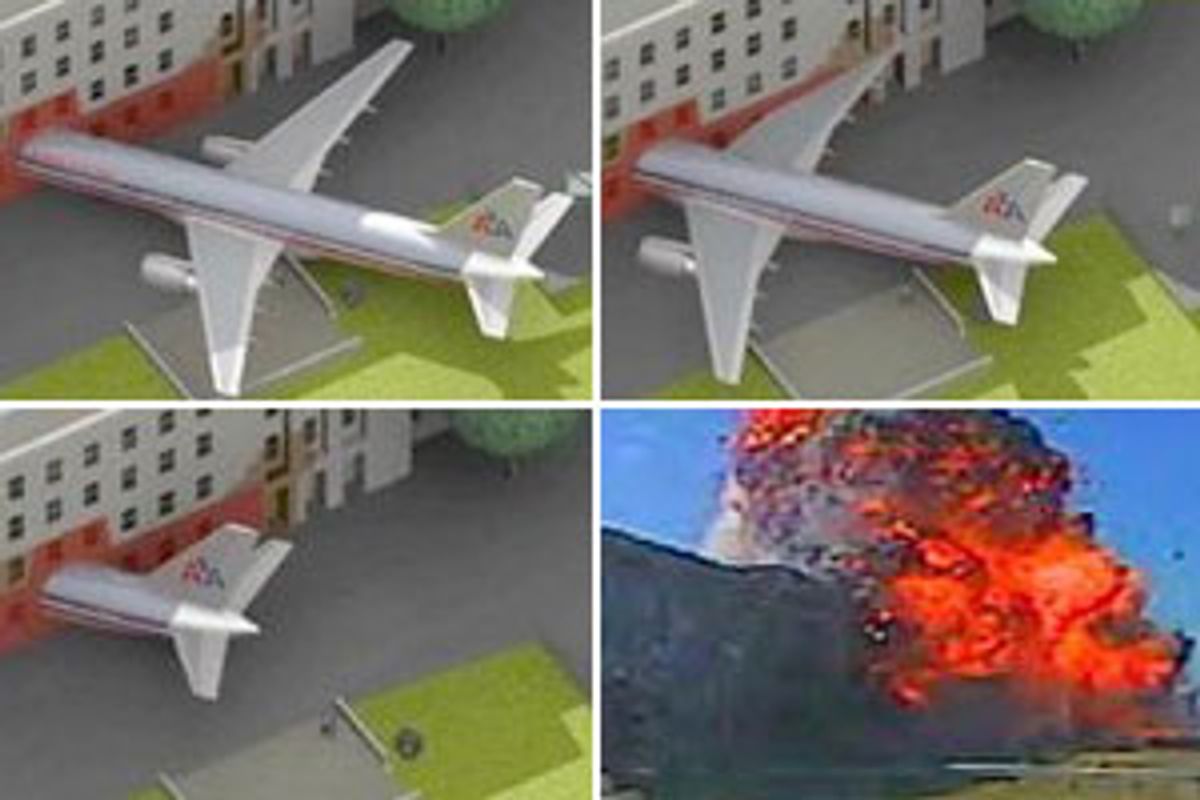
- American Airlines Flight 77 did not crash into the Pentagon. First popularized by the author Thierry Meyssan, whose book "L'Effroyable Imposture" ("The Big Lie") hit the bestseller list in France, this is one of the oldest and most enduring claims made by 9/11 skeptics. "Loose Change" argues that Hani Hanjour, the terrorist pilot alleged to have been at the controls of Flight 77, was not skilled enough to have made the difficult diving maneuver that characterized the plane's approach. Avery, who narrates the film, also shows a montage of images from outside the Pentagon that he says don't fit a plane crash -- there's no airplane debris outside the building, he says, and the damage pattern looks suspiciously similar to that of a cruise-missile strike. He also points out that the government has not released surveillance tapes from cameras mounted on the freeway and at a nearby gas station and hotel. "If the government has nothing to hide, why are they so afraid to answer a few questions, or release a few videos?"
- The World Trade Center towers were brought down by controlled explosives. The film points to eyewitnesses who reported explosions coming from many areas of the buildings after the planes crashed. Willie Rodriguez, a janitor who was working in the North Tower, says that he heard a loud explosion near the base of the building. "Loose Change" also includes footage captured by French filmmakers Jules and Gedeon Naudet in which firefighters at the scene report the sound of explosions preceding the collapse of the buildings. (After the Naudet brothers threatened to sue Avery for copyright infringement, he agreed to remove their footage.) And Avery shows several shots of the towers collapsing in which he says "explosions can be seen bursting from the buildings 20 to 30 stories below the demolition wave."
- United Flight 93 did not crash in Shanksville, Penn. Instead, it landed safely in Cleveland, and 200 people on board were evacuated. Avery says that the debris field in Shanksville showed nothing resembling a downed aircraft, that neither plane parts nor passenger remains were visible at the scene. The movie cites reports of an airplane landing at the Cleveland Hopkins Airport on the morning of 9/11, and in a tangle of logic deduces that, actually, two planes landed there and that one of them was Flight 93. Including hijackers and crew, the official story says that there were 44 people on board Flight 93 when it crashed, but Avery alleges that about 200 people were taken off the plane in Cleveland. He suggests that in addition to Flight 93's passengers, these 200 people included the passengers of the flights alleged to have crashed into the Pentagon and the trade towers. Avery says, cryptically: "It's interesting to note that the combined total of all the passengers from all four flights is 198. Or 243. Depending on who you ask."
Overall, "Loose Change" presents a story of 9/11 that some have labeled the "no-plane theory," because it argues that the aircraft crashing into buildings were essentially a pyrotechnic distraction from the main destructive acts, the missile at the Pentagon and the controlled demolition of the trade towers. "Loose Change" acknowledges that two planes did actually hit the trade towers -- this marks a variation from more outré versions of the no-plane theory, which propose that live videos of the crash were doctored to include the 767s or that some kind of highly classified holographic technology created the illusion of planes hitting the towers (both theories have obvious flaws). But "Loose Change" suggests that remote-piloted drones, and not American Airlines Flight 11 and United Airlines Flight 175, crashed into the World Trade Center; the drones, according to Rowe and Avery, contained no passengers.
It's at this point that your head really begins to spin. Here, as the film discusses Flight 93 landing in Cleveland with all four planes' passengers on board, a merely controversial argument crosses into unhinged ridiculousness. Basic questions -- like, why would the government spare the lives of the people on those planes only to kill thousands more? -- go unaddressed. Your frustration builds when Avery attempts to bolster his theory by proposing that passengers' cellphone calls from the airplanes were phony. He cites a study that he says proves that phones wouldn't get cellular signals at high altitudes, and he argues that the manner in which people spoke to their families -- Mark Bingham identified himself using his full name in a call to his mother -- means that "voice morphing technology" was involved. Come on, really?
Many of "Loose Change's" most vociferous online critics actually agree with its principal conclusion that the government is behind the attack, and only disagree with the film's specific 9/11 story line. Deep down the rabbit hole one day, I found Jim Hoffman, a 49-year-old software engineer in Alameda, Calif., and one of the most diligent 9/11 researchers in the movement. Hoffman, who runs 9-11 Research and 9-11 Review, two enormous troves of attack-related documentation and analysis, has looked into the film's claims more thoroughly than just about anyone else online. Though he agrees with Avery that the government was behind 9/11, he finds much of "Loose Change" wanting. "Sifting Through 'Loose Change,'" Hoffman's point-by-point critique of the movie, is withering. He discovers flaws in just about every second claim in "Loose Change," and he points to a mountain of evidence to rebut two of the film's central arguments, the idea that passenger planes didn't crash into the Pentagon and into a field in Shanksville.
Let's start with the Pentagon. Avery says that photographs from the scene show "no trace of Flight 77," but Hoffman points to pictures that show "engine parts, landing gear parts, and scraps of fuselage that match the livery of an American Airlines Boeing 757." Hoffman also notes that damage to the Pentagon's facade is "consistent in every way" with a 757 crash -- photographs taken before the outer ring of the building collapsed show "punctures in the paths of the densest parts of the plane, and breached limestone in the paths of the wing ends," he writes. The movie's suggestion that eyewitnesses expressed huge differences over what they saw coming at the Pentagon also turns out to be false. As Hoffman explains, most witnesses say they saw a large jetliner approaching the building, and the few who say they saw a small jet were those farthest away from the site.
Hoffman and other "Loose Change" debunkers offer an even more devastating critique of the movie's strange claim that Flight 93 ended up in Cleveland. Avery bases his Cleveland idea on a story posted on the Web site of WCPO, a local TV station in Cincinnati, on the morning of 9/11; Avery says that the report proves that "two planes landed at Cleveland Hopkins Airport due to a bomb threat," and that "United Airlines identified one of the planes as Flight 93." It turns out that Avery is right that WCPO reported this news on its Web site -- but the story was actually authored by the Associated Press wire service, and the AP corrected the news minutes after it was posted, as WCPO has explained. (You'll recall that false media reports were widespread during that morning's hysteria.)
Hoffman finds a host of evidence indicating that Flight 93 crashed in Pennsylvania, including numerous photographs of the Shanksville site -- some of which were released as part of the Zacarias Moussaoui trial -- in which you can see a deep impact crater and huge airplane parts. Many human remains were found at the scene -- according to the Washington Post, searchers discovered "about 1,500 mostly scorched samples of human tissue" around the crash crater. Hoffman also points to flaws in the study that Avery says proves that cellphones wouldn't have worked at high altitudes. The particular experiment only tested Motorola-brand phones, and it was conducted over London, Ontario, rather than on the flight paths of the 9/11 jets -- thus the research says nothing about whether different kinds of phones might have worked in the parts of the sky that the planes flew that morning. Moreover, Hoffman points out, several crew and passengers placed their calls using on-board GTE Airphones designed to work in the sky.
In addition, Avery seems to be oddly confused about the number of people who were on board the four flights on 9/11. He says that there were either 198 or 243 "passengers" on the planes; in fact, there were 232 passengers on board, excluding the crew but including the hijackers. The number is relatively easy to check, and it's unclear what Avery means when he alleges that the number shifts "depending on who you ask."
"'Loose Change' speculates that 200 people were somehow herded onto Flight 93 ... and then mysteriously disappeared into a NASA research facility," Hoffman writes. "Could it get any more ridiculous?"
Conspiracy theorists often respond to criticism by expanding the conspiracy to include their critics. Both Avery and Rowe, without naming names, say they suspect some who've heaped scorn on their movie might be secretly working for the government. "I'm pretty sure our movement has been infiltrated," Avery says. Rowe argues that "the government puts out disinformation agents within the movement to splinter it. This is what they do, they try to create dissension between head members." Both say they've looked over the rebuttals, but stand by their film's major claims.
Ironically, Hoffman levels the same charge of government complicity at Avery. Indeed, here's where the conspiracy theories grow even stranger: Hoffman argues that the 9/11 planners specifically engineered the attacks in a way that would lead some people to embrace flimsy 9/11 theories. Avery, Hoffman says, has fallen into the government's trap; the government wants people to say that an airplane didn't hit the Pentagon, because the claim makes 9/11 skeptics look silly. In the movie, Avery wonders why the government hasn't released surveillance videos captured near the Pentagon that would show definitively whether an aircraft crashed there. (The Pentagon recently put out a couple of videos that don't at all settle the matter.) Hoffman says he knows exactly why the government is being stingy with the videos -- not because it has something to hide about the Pentagon, but because it wants to feed the no-plane theory. It's all part of the plan to "divert attention from the core fraud of the attack -- the Big Lie that the Twin Towers collapsed due to impacts and fires."
Two official structural engineering studies of the World Trade Center collapse -- one conducted by the Federal Emergency Management Agency and the other by the National Institute of Standards and Technology -- have concluded that the towers fell due to uncontrollable fires sparked by the plane crashes. NIST, which created a computer simulation of the crashes, found that the aircraft dislodged fireproofing material in the buildings, leaving the trusses that held up the floors vulnerable to extreme temperatures. The sagging trusses pulled in each building's perimeter columns, which consequently weakened its inner core; when the floors above each crash site gave out, the towers came crashing down.
Hoffman has written several technical papers criticizing this theory. I spent a few hours one afternoon reading them very slowly, and I also pored over the work of Steven Jones, a physicist at Brigham Young University who argues that there's little evidence to support the official structural engineering explanations. "Everybody has an intuition of what things should look like when they're falling," Hoffman explained to me one afternoon. The trade towers seemed to violate the natural way things fall. For instance, just as the South Tower began to collapse, the top 30 stories of the building tipped 15 degrees to the side. "If you have an object in rotation it tends to stay in rotation unless operated on by a torque. So it should have toppled faster and faster," he explained. "But instead of that happening, it just stopped toppling. The top actually stopped rotating." As Hoffman saw it, the way it stopped rotating indicated that something -- something explosive -- was forcing the structure to fall straight down. (Feeding Hoffman's suspicion, the NIST and FEMA studies did not examine what he calls the curious manner in which the buildings fell. But in its report, NIST "found no corroborating evidence for alternative hypotheses suggesting that the WTC towers were brought down by controlled demolition using explosives planted prior to September 11, 2001 ... Instead, photos and videos from several angles clearly showed that the collapse initiated at the fire and impact floors and that the collapse progressed from the initiating floors downward.")
Then I watched what are perhaps the most compelling images supporting the notion of a forced demolition -- the many videos showing the collapse of World Trade Center Building 7 at 5:20 p.m. on 9/11. The collapse, which FEMA also pinned on the fires started in the neighboring twin towers, is extraordinary; the building simply disappears into itself, disintegrating like it had been planned for weeks. In one shot from CBS News, Dan Rather, narrating the scene, says the sight is "reminiscent of those pictures we've all seen when a building was deliberately destroyed by world-class dynamite to knock it down." His immediate reaction seems just right -- the building falls so gracefully, so cleanly, it's mystifying.
Hoffman offers a theory of the attacks that seems more simple and straightforward than the one presented by "Loose Change." He agrees with the main points in the official story: Hoffman thinks that hijackers did board the planes (though they were patsies, he says), and he believes the airplanes actually crashed into the buildings (though he suspects Flight 93 was shot down). In Hoffman's scenario -- which he stresses is speculative, because of course you can never really know for sure -- ground-based attackers used some kind of gas to render everyone on board the planes unconscious, and they subsequently controlled the aircraft through remote control. The real work occurred in the Trade Center, where Hoffman believes a small team could have secretly planted "thermobaric" explosives in the elevator shafts of all three buildings in the weeks before the attack.
While the no-jetliner theory "Loose Change" presents assumes a vast conspiracy (just imagine how many people you'd need to replace the real aircraft with drones, to handle all the passengers, to secure that airport in Cleveland), Hoffman says a relatively small team of a few dozen or so people could have carried out his plan. Yet when you dig into his theory, it turns out that Hoffman, of course, is proposing something grand. Like many in the movement, he questions the loyalties of members of the 9/11 Commission and other panels that have investigated the attacks. Hoffman doesn't believe that commissioners were involved in the attack, but he says they were certainly part of the coverup. If you search the commission's report for an explanation of Building 7's collapse, you won't find a thing. Why is that? Hoffman believes they weren't really interested in the truth. "They created this vast myth about the hijackers," Hoffman says of the commission. "It was a mass diversion, steering attention away from all these burning unanswered questions."
The official theory of 9/11 -- 19 hijackers, tall fundamentalist bearded guy in a cave -- is, in the strictest sense of the term, also a "conspiracy theory." Indeed, as portrayed in the 9/11 Commission's report, the hijackers exhibit hallmark conspiracy theory behaviors. They meet surreptitiously and talk in code ("'architecture' referred to the World Trade Center, 'arts' the Pentagon, 'law' the Capitol, and 'politics' the White House," to quote the report); they possess unimaginable commitment to their cause, and show superhuman discipline and technical abilities (their proficient piloting skills despite minimal training, their calm while committing murder and suicide); they harbor transparently irrational, immoral beliefs, the sort that cranks usually ascribe to secret societies; most important, they succeed against tremendous odds without anyone wising up, pulling it off right before our eyes.
The whole thing does sound sort of unbelievable, doesn't it? The commission's report is exhaustive, and over the course of hundreds of thrilling pages, it renders the conspiracy in a way that's thoroughly credible. Yet there is a certain are-you-kidding-me quality to any condensed version of the tale: Nineteen guys did that!?
"I think the basic facts here indicate that these attacks occurred as a consequence of a conspiracy," Bob Kerrey, the former Democratic senator from Nebraska who was a member of the commission, told me. "Unlike the Kennedy assassination, we're not asking, 'Was there a conspiracy?' In the case of the attack on the United States you begin with the presumption that there was a conspiracy. The 'conspiracy theorists' are presenting an alternative conspiracy."
Whether you take the official view or the conspiracy theorists' view, the 9/11 attacks were not only spectacularly horrific, they were also spectacularly strange and complex. Ultimately, for many of us who aren't experts, choosing what to believe about 9/11 is something like a leap of faith. If you trust members of the 9/11 Commission and the government's structural engineers you'll put your money on the official explanation; in a larger sense, if you trust your government you'll find it truly difficult to comprehend the possibility that anyone on the inside could have been behind something like this.
And it's on the key point of motive -- why would the government do this? -- that the conspiracy theorists seem most vulnerable.
"Loose Change" addresses the matter only briefly, about five minutes before the film concludes. "I hope you're sitting down," Avery says as if he's going to offer something spectacular. But the blockbuster is mostly bluster. "According to Wikipedia" -- not something you want to hear in a documentary -- "one of the world's largest gold depositories was stored underneath the World Trade Center," Avery says. Without attribution, he alleges that "rumor has it that over $160 billion in gold was stored in the World Trade Center," and that only a couple hundred million dollars of that was ever recovered. So that's why the government did 9/11 -- it was a gold heist?
Another idea comes from Jim Marrs, one of the world's most prolific professional conspiracy theorists and the author of a 9/11-doubting book "Inside Job," which Avery uses as the source for some claims in "Loose Change." Over Memorial Day weekend I watched Marrs give a presentation on ancient astronaut theory at Conspiracy Con 2006, and I listened as Marrs described his belief that human beings were created as slaves by technologically superior aliens who landed on Earth hundreds of thousands of years ago. Marrs' theory (inspired by the author Zecharia Sitchin) mines classic secret society tracts; he believes that the aliens entrusted their superior knowledge to an elite group of humans, and this elite group has kept the knowledge to itself throughout history. The elites aim to cultivate a borderless, one-world government -- and it's to these ends that they would have pushed something like 9/11.
While at the conference, I also discussed the government's possible motive with Phillip Jayhan, a businessman who runs LetsRoll911.org, a prominent 9/11 skeptic site. Jayhan provided some early funding for "Loose Change," and Avery featured Jayhan's theory that one of the Trade Center planes was equipped with a missile in the first version of the movie. "I don't think people can have a proper understanding of 9/11 without understanding the power structure of the international cult," Jayhan explained to me. He went on to describe an extensive theory of satanic cultism, one in which Satanists provide kidnapped children to politicians for sexual trysts; the cult then keeps the politicians in line through blackmail. Jayhan sold me a copy of "The Franklin Coverup," a book by former Nebraska state Sen. John DeCamp that he said would fully expose the situation to me. Jayhan believes that ultimately, Satanists were behind 9/11. "Everything is a lie," he said.
The theory of satanic cultism appeared plausible to others in the movement as well. "It's out there," Korey Rowe told me. "There are definitely controlling interests like that." When I asked Hoffman about it, he said, "That gets into things that are easily exploited -- it sounds crazy when people talk about it, even though I think there's something to it." Hoffman added that he believes the most likely motive is "geopolitical" and probably not satanic, "though it's possible, because our government is so thoroughly corrupt."
Only Avery disagreed with the idea conclusively. "As soon as you say that Satanists were behind 9/11 you start to lose people right off the bat."
I asked Gorelick if she believed the commission had been sufficiently open to investigating the idea that the government, and not terrorists, was behind the attack. "I think it's fair to say that our assumption going in was not that the World Trade Center was blown up by our own government," she said, "but had the facts led us there we would not have hesitated to go there. And we ourselves blew up lots of myths -- for example, that the 19 hijackers were undetectable, or that there was a relationship between 9/11 and Saddam."
Slade Gorton, the former Republican senator and commission member, told me that the most serious threat to the commission's work so far came not from conspiracy theorists but from Rep. Curt Weldon, R-Penn., who alleged that the commission ignored information that the classified military program Able Danger had identified Mohammed Atta and other 9/11 plotters before the attacks. Gorton and the other commissioners believed that the commission weathered that storm with its reputation intact.
Kerrey was dismissive of the conspiracy theories as well. Asked about the possibility of a controlled demolition at the World Trade Center, he scoffed, "There's no evidence for that." But he also noted that, quite apart from what Avery and others in the "truth movement" have proposed, many legitimate mysteries still surround the events of that day. "There are ample reasons to suspect that there may be some alternative to what we outlined in our version," Kerrey said. The commission had limited time and limited resources to pursue its investigation, and its access to key documents and witnesses was fettered by the administration. "I didn't read a single PDB," Kerrey said, referring to the president's daily intelligence briefing reports. "We didn't have access to Khalid Shaikh Mohammed," the mastermind of the plot. "We accepted a compromise, submitting our questions to him through the CIA. Now, that's not the best way to go about getting your questions answered. So I'm 100 percent certain that [bin Laden] directed that attack, but am I completely comfortable saying there was no direct Saudi involvement, or that Saddam Hussein wasn't involved in some fashion, or that the Iranians weren't involved? I'm pretty close to 100 percent certain, but I'd be more comfortable if we'd interviewed Khalid Shaikh Mohammed."
Still, Gorelick says that because the commission operated in a transparent manner, its findings will have enduring appeal. "Before we began we studied the commissions that looked into the Kennedy assassination and Pearl Harbor and we saw that for decades or more there were unanswered questions," she said. "We were trying to be as comprehensive and transparent as possible so people would know what we had looked into even if there were unanswered questions."
Yet Gorelick acknowledges, too, that she may have an optimistic view: "That's why I don't live on the Internet," she said. "I spend a lot of my time online, but I don't live there. And if I were to live there, I'd wish for someone to put me out of my misery. There are lies out there."
Shares