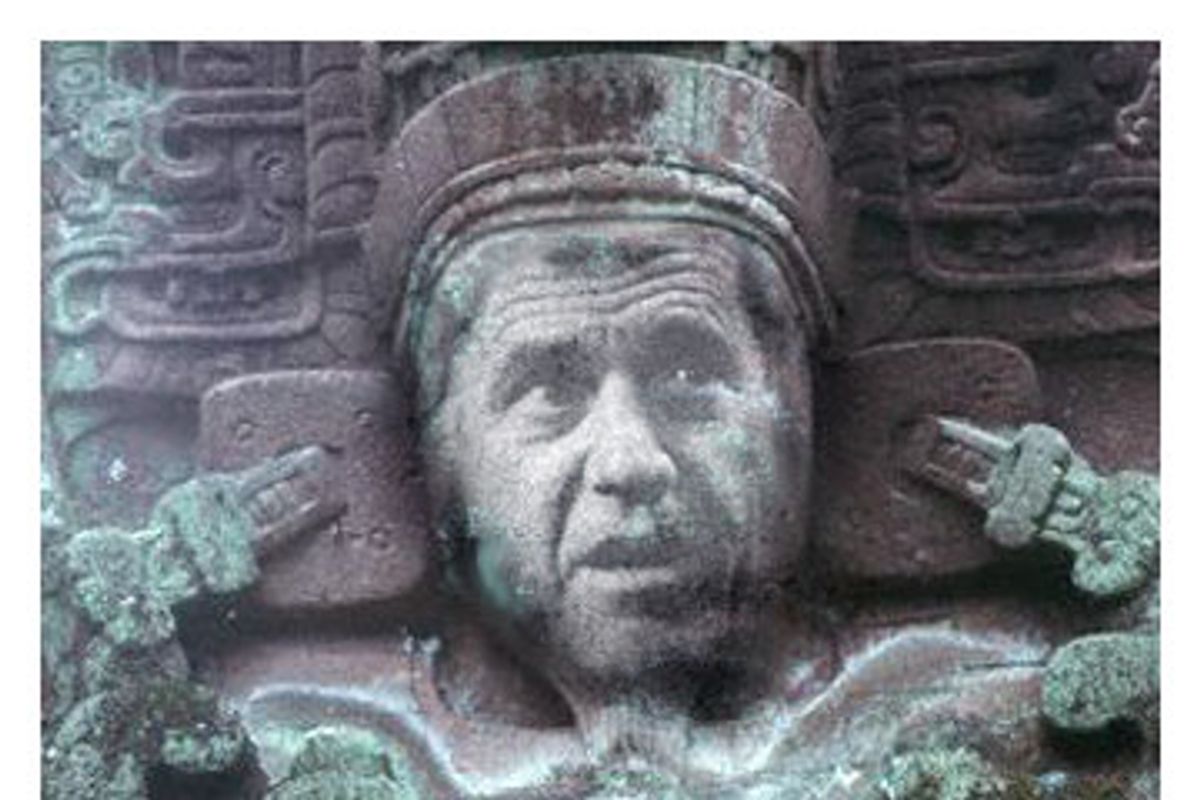
As a scholar of the Maya civilization, I was anxious to see Mel Gibson's portrayal of the Maya in "Apocalypto." Of course, I realize the movie is not a documentary and was mindful of the director's artistic license. I was happy to see that Gibson got some details right, like personal adornment, tools and body decoration. Although the main actors are native North Americans, I applaud Gibson's use of some Maya actors, as well as his decision to have the characters speak in a native Maya language, Yukatek, still heard in Mexico. While these are brave and ambitious choices, they also imply that "Apocalypto" is a sincere depiction of Maya society. In fact, the movie is not an accurate portrayal of the Maya at all; rather, it is a reflection of Gibson's own feverish imagination.
The movie tracks a young Mayan man who is captured in a surprise raid on his village. Forced to abandon his family, he and his companions are taken to the nearby city to be sacrificed. He manages to escape and, pursued by his captors, attempts to return to his village to save his family. During his getaway, he reaches a beach where he witnesses the arrival of Spaniards.
This final scene tells us that the movie focuses on Maya society on the eve of Spanish contact in the 16th century. Yet the Maya city portrayed in the movie, central to its plot, dates roughly to the 9th century. This is akin to telling a story about English pilgrims founding the Massachusetts Bay Colony, and showing them living in longhouses described in "Beowulf." In fact, Gibson incorporates Maya images from as far back as 300 B.C. Throughout the movie, these anachronisms make Maya civilization seem timeless, and undermine the idea that the Maya could and did respond to change.
"Apocalypto" opens with a village of Maya hunter-gatherers living in harmony within a tropical forest. While the Eden-like scene makes for great cinematography, it is not supported by archaeological data. To begin with, the Maya were not organized into small hunter-gatherer groups sustained by the jungle's bounty. Starting in the first millennium B.C, Maya society was organized into complex farming villages. By 200 B.C, their landscape was dominated by cities of thousands of people composed of monumental temples, royal palaces and public art. Five centuries later, dozens of royal cities like Tikal and Calakmul were thriving in a region with hundreds of thousands of people. During this time, Maya society was made up of farmers, masons, warriors, scribes, priests, artists, musicians, noble elites and holy lords -- many of whom are not even seen in "Apocalypto."
The movie's infamous violence begins when the tribe's idyllic world is shattered by a surprise attack of fierce raiders seeking both captives and slaves to take back to their city. The ensuing carnage leaves little to the imagination. But Gibson forces us to empathize with the ingenuous villagers by juxtaposing their baffled terror with the puerile sadism of their attackers.
However, the Maya were hardly babes in the woods. By 300 B.C., the Maya had developed political and economic systems that were regionally integrated. People living in nearby towns, villages or homesteads -- within a day's walk from larger centers -- would venture into the city to sell or buy at the market, pay tribute requirements, witness political spectacles or attend to religious devotions. Therefore, populations that lived near larger centers would have been more substantially aware of activities in these capital cities than the movie implies. The villagers would have understood the threat of raids, battles and wars -- which were a regular part of Maya society.
The movie continues with a harrowing march of tears and blood. Captured villagers are led to a "place of stone houses." They witness the felling of the sacred ceiba tree, hear the admonitions of a pestilent infant Oracle and the ravings of a sickly elder, intermingle with a ghostly army of construction laborers, and suffer the degradation of being sold in a slave market. Elites, portrayed as "ugly without silliness," are shown killing the innocent with schoolyard cruelty.
These scenes reflect the exploitation of natural resources, violence, social repression, and detached ruling class that archaeologists have proposed as causes for the "Classic Maya collapse" in the 9th and 10th centuries. Although the debate about the collapse continues, the images of a diseased populace in the movie do not fit with the data. Maya cities were likely to have been much healthier than contemporary European ones.
Whatever the causes, the collapse was primarily of a system of governance, not a self-immolating culture. The movie misses this important distinction by creating a spurious contrast between a rural idyll and an urban miasma of excess and violence. The truth is that within several generations of the Classic Maya collapse, other regal cities with different forms of government would flourish in other parts of the Maya area. Over several millennia, the Maya underwent many cycles of growth and decline, each with its own major cities. The idea, proposed by the movie, that Maya civilization was at the verge of final self-destruction makes for good drama, but does not reflect the depth of this civilization's resilience and history.
Once in the city, some of Gibson's villagers are designated for sacrifice. Slathered in blue body paint, they are led through the central ceremonial precinct of the city. Amid a throng of possessed dancers, they see murals depicting blue-painted figures with their chests cut open. The villagers are led up scaffolds along a pyramid, where a long line of captives are being killed. One by one they are splayed across an altar, their chests cut open and their hearts ripped out by the king. They are then decapitated and their headless bodies flung down the massive frontal staircase to the cheers of the ruck below. Gibson's portrayal of a fervent and orgiastic mob completely violates what we know about Maya propriety in ritual behavior. Many modern Maya rituals, such as processions or prayers, are deliberate and serious affairs.
The treatment of sacrifice is also inaccurate and misleading. Much of what we see recorded by the Maya is a form of sacrifice known as auto-sacrifice -- self-inflicted bloodletting involving piercing ear lobes, fingers, tongues and penises. This practice was often the duty of ruling families, interceding on behalf of the people to the gods. Animal sacrifice was also common. In fact, Gibson's villagers would have conducted such sacrifices for their household and agricultural rites, although we never see them do so in the movie.
Interestingly, murals recently discovered at San Bartolo in Guatemala depict scenes of auto-sacrifice and animal sacrifice. They reveal gods undertaking rites that bring the world into creation. Gibson cribbed these images for his mural scene but saw fit to alter them to convey a view of the Maya involved in wanton human sacrifice.
Human sacrifice was indeed important to Maya society. The Classic period gives us numerous depictions of severed heads, and even of headless bodies flung down staircases. However, in most cases, such sacrifices were of single victims of noble rank whose identity was prominently recorded for posterity, not a mass of unknown farmers. We have evidence of larger mass graves. But in these rare examples, it appears that warfare between competing cities led to the capture and summary execution of enemies. In either case, the victims would not have been anonymous individuals.
It's true that sacrificial practices among the Maya did change somewhat during the final centuries before the Spanish arrival. Spanish accounts note that some Maya pyramids along the Yucatan coast were covered with blood -- presumably human, though the Spanish never witnessed any of the sacrifices themselves. It is also true that "skull-racks," as seen in the movie, were found at some sites in the Yucatan. However, these were practices adopted by Maya groups very late in their history.
But in the movie, our hero is spared from being sacrificed, thanks to a fortuitously timed solar eclipse. The king announces that the eclipse is a good omen -- the gods are sated and require no more human flesh. This raises the problem of what's not in the movie.
The prediction of the solar eclipse is the only allusion to one of the more celebrated and important facets of Maya civilization -- their advanced state of knowledge in mathematics, astronomy and geometry. Maya calendrical, astronomical and mathematical systems were so advanced that they could predict eclipses, track Venus as morning and evening star, and compute the annual solstices and equinoxes decades in advance. In fact, the Maya made regular use of the concept of "zero" centuries before Fibonacci introduced it to Europe. Although an emphasis on Maya intellectual achievement would have been appropriate, it would have been inconsistent with the movie's theme of a cruel and savage Maya civilization.
In an action scene that springs entirely from Gibson's imagination, our hero is able to escape the city. Pursued by his captors, he runs through a dead corn field and hides in a field of decapitated corpses. This "killing field" is perfectly consistent with the movie's blood lust, but ever more distant from the real Maya. He flees through the jungle, and with only two pursuers remaining, he bursts out of the forest onto a beach. There, where the land ends and the water begins, both he and his tormentors witness Spanish galleons and rowboats ferrying Spaniards and Christianity to the lands of the Maya. His pursuers, as if in a trance, walk weakly toward the arriving Spaniards. Their pursuit is now irrelevant, as their world is about to end.
Again, the historical facts tell a different and more compelling story. Several accounts exist of Spanish expeditions in the early 1500s, sailing from Cuba and making stops along the Yucatan coast for provisions. Invariably these encounters ended badly for the Spaniards. So fierce was the Maya defense of their lands that Cortis avoided much of this coast, choosing to land farther west along what is known today as the coast of Veracruz. The Maya, at the time of the conquest, were intractable and fiercely autonomous. Most villages resisted the Spaniards. In fact, the Spanish conquest of the Maya was a long protracted campaign that some claim goes on to this very day.
In "Apocalypto," the arrival of the Spanish signals "a new beginning." Remarkably, the event is portrayed as tranquil, as if the Spaniards are the adults who have finally come to rescue the "littleuns" stranded on the island of William Golding's "Lord of the Flies." In reality, the arrival was anything but serene.
Within decades of the first contact with the Spaniards, the Maya would die in the hundreds of thousands as European diseases, colonial exploitation and cruelty took root. In 1552, in the name of Christian piety, Fray Diego de Landa ordered that hundreds of Maya codices, carrying sacred knowledge accumulated over centuries, be burned as works of the devil. If there were ever an apocalypse in the history of the Maya -- and herein lies the ultimate demoralizing irony of the movie -- it would be because of European contact. But in the movie, after two hours of excess, hyperbole and hysteria, the Spaniards represent the arrival of sanity to the Maya world. The tacit paternalism is devastating.
After many centuries of misguided and simplistic views of the Maya, recent scholarship has shown the complexity and historical depth of their civilization. In Maya society, as in all civilizations, violence, surfeit and disparity were balanced by accomplishment, restraint and illumination. Gibson's feverish vision of a childish Maya society sacrificing itself to extinction is more than inaccurate, it works against the progress of decades of diligent scholarship to restore to present-day Maya people a heritage of which they are proud, and from which we have much to learn. I can only hope that audiences seeing this movie will be motivated to learn about the Maya -- present and past -- rather than be sated by Gibson's sacrificial offering at the altar of entertainment.
Shares