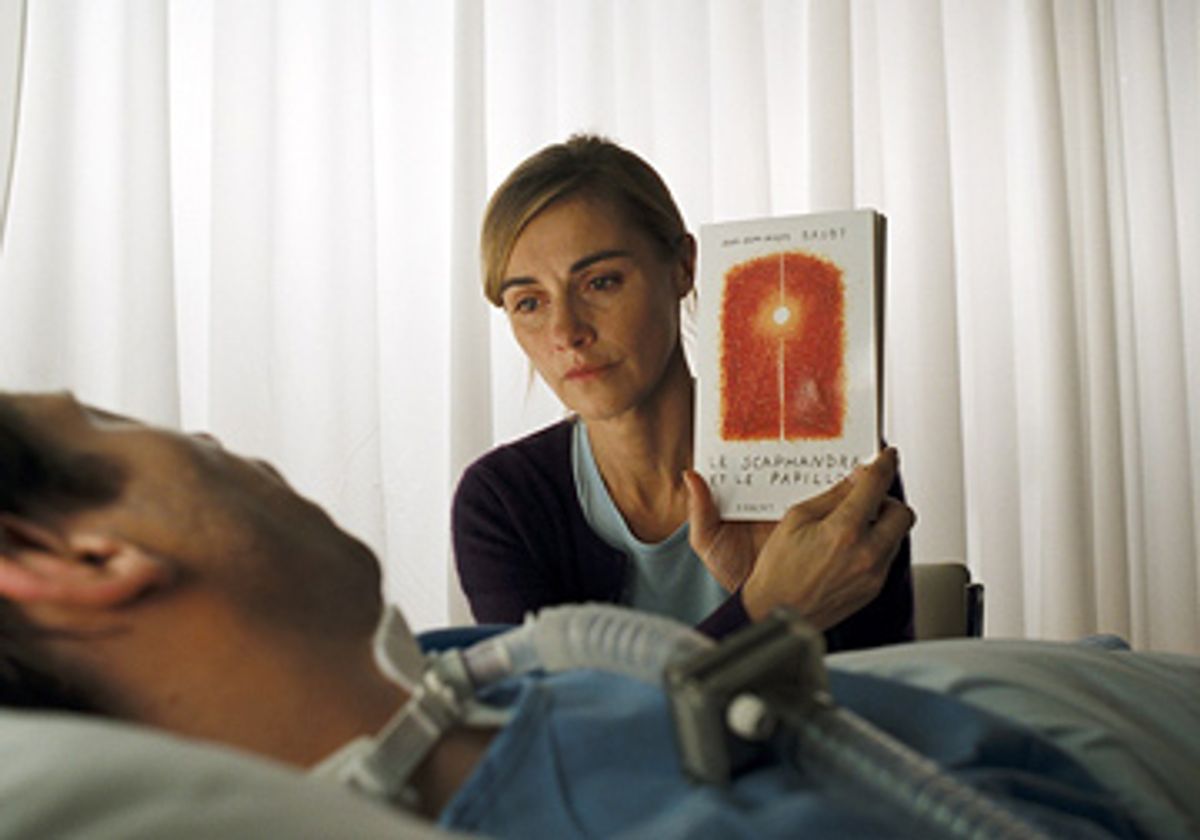
Anyone who has read Jean-Dominique Bauby's slim, extraordinary 1997 memoir "The Diving Bell and the Butterfly" is likely to wonder how it could possibly be made into a movie. In 1995 Bauby, then 43 and the editor of French Elle, suffered a stroke that left him incapable of speaking and barely able to move, the victim of a rare condition known as locked-in syndrome. The one part of his body he could control was his left eyelid, and so Bauby learned to communicate by blinking. He wrote the book by working with an assistant, who would slowly recite a special alphabet; Bauby would blink to select the letters he wanted. In this way, letter by letter, word by word, sentence by sentence, Bauby built "The Diving Bell and the Butterfly" -- to say "wrote" seems barely adequate, considering the mental discipline and physical effort the book must have cost him. Bauby died just two days after the book's publication in France, but what he left behind is a small wonder of architecture, an intimate structure in which the reader and the narrator find a private, shared space with windows that open out onto the vastness of the world. It's the very opposite of locked-in.
So how do you make a movie about a man who can communicate only by fluttering his one functional eyelid? The painter and filmmaker Julian Schnabel has given us two previous pictures, both of them also based on true stories of men who are no longer with us, the 1996 "Basquiat," about '80s wunderkind painter Jean-Michel Basquiat, and the 2004 "Before Night Falls," based on the memoir of the Cuban poet and novelist Reynaldo Arenas. "The Diving Bell and the Butterfly" -- which was made in France, with a cast of French actors -- is only Schnabel's third movie, but it's hard to imagine that any other, more experienced director could have done it better. The picture is so imaginatively made, so attuned to sensual pleasure, so keyed in to the indescribable something that makes life life, that it speaks of something far more elemental than mere filmmaking skill: This is what movies, at their best, can be.
Mathieu Amalric plays Bauby, or Jean-Do, as his friends and family call him. As the movie opens, he has no idea what's going on, and neither do we: We see portions of blurry human figures, from oblique angles, incomplete portions of something so incomprehensible we can't even call it a puzzle. We hear a voice asking, "What's going on?" It's Jean-Do's voice, but it may as well be coming from us. In these early scenes, shot from a point of view that's baffling both to the audience and to the narrator, Jean-Do is us, and we are his John Doe -- not just witnesses to his journey but anonymous accomplices traveling with him.
A voice -- we'll later see that it belongs to an officious doctor -- asks, "Do you remember what happened?" Jean-Do answers, "Like I said, vaguely -- images," but the words are forming only in his head. He asks, "What's going on?" and gets no answer. He blinks, and the camera blinks with him.
What's strange and wonderful about this opening is that although it could have been made to feel like a nightmare, it's something far more delicate -- Schnabel, screenwriter Ronald Harwood and cinematographer Janusz Kaminski keep us floating on a cushion of incomprehensibility. Later, we learn exactly what happened to Jean-Do, but what happened to him is far less important than who he is -- or even than who he was. In flashback sequences we see the old Jean-Do, an energetic wood sprite in a middle-aged guy's body, supervising a fashion shoot (Azzedine Alaïa and Lenny Kravitz show up, playing themselves); collecting one of his three kids for a visit, in a snazzy new sports car and dealing with the indifferent resignation of his estranged partner, Céline (Emmanuelle Seigner); joking with and teasing his elderly father (played, in a performance as close to perfect as any human could get, by Max von Sydow) as he gives him a shave; driving to Lourdes for a not-so-dirty weekend with a girlfriend, Joséphine (Marina Hands). (Schnabel and Kaminiski open that last sequence with a dazzling shot of Joséphine's sandy-blond hair, seen from behind, blowing in the wind as the two drive along in their convertible. The strands of hair fan out and flutter wildly, like tentacles, alive in every way.)
That's the Jean-Do that was, but Schnabel and his team make us far more interested in the one who is. The early scenes of the movie are filmed not just from Jean-Do's point of view, but from behind his eyes: His blinking becomes the movie's punctuation, its commas and pauses. (Schnabel and Kaminski found that the best way to simulate a blink was to hold two fingers in front of the camera lens in a horizontal "V," closing it at precise moments -- an imaginative and brilliantly organic solution to a technical challenge.) At the beginning of the movie we're inside Jean-Do; later, we float outside him, although the distance between him and us has already dissolved. The Jean-Do we come to know is the one who's being held captive not just in a French seaside hospital, but in his own body. When he half-glimpses his reflection in a window, we see, with the same horror he does, what he really looks like: His head lolls on the cushion of his wheelchair, his mouth is askew, but his one eye is dazzlingly alert. "God, who's that?" he asks, but his next step is to find the gag lurking inside the horrific revelation: "I look like I came out of a vat of formaldehyde."
My mission, if I achieve nothing else, is to impart how resolutely undepressing "The Diving Bell and the Butterfly" is, while acknowledging that it's also carried by undercurrents of sadness. In a filmmaking climate where screenplays are so often tinkered and monkeyed with that it's obvious they bear little resemblance to what the screenwriter originally put to paper, there's no doubt that Harwood's script is the backbone of this picture. When he was asked, at a press conference, about the biggest challenge he faced in adapting this complex little book, he said, "It took me a while to find a way in because I didn't want the entire film with a man in bed ... Then I found the way in, which was that the camera becomes the man."
That's how you make a screenplay, and a movie, breathe: This picture isn't about the limits of a life, but of its wholeness. We can see the closeness that develops between Jean-Do and his interpreter, Claude (Ann Consigny); the way he teases and flirts with his two pretty therapists, who skim into his room like earthbound angels, hoping to help him speak and move again. (They're played, wonderfully, by Olatz Lopez Garmendia, who is Schnabel's wife, and by Marie-Josée Croze.) Jean-Do is connected to life largely through women, and even though his body has betrayed him, his mind hasn't: He takes great pleasure in getting close-up views of their open-necked shirts (we're not even talking about anything so obvious as cleavage here). And in one deeply moving scene, his ex, Céline, acts as an unwilling intermediary between Jean-Do and his girlfriend. Seigner plays the scene with a faux-coolness that's heartbreaking; she has never been better.
The picture is so beautiful to look at that it's practically buoyant: Kaminski makes it look simultaneously dreamy and alive. And Amalric, who gave one of the finest performances of 2005 in Arnaud Desplechin's "Kings and Queen," is marvelous here, in a performance that's anything but interior: As Amalric plays him, Jean-Do's vitality has nothing to do with the shell of a body he lugs around with him. In a dream sequence, Jean-Do (because he quickly realizes that his useless body is no deterrent to his dreams) indulges in a sumptuous feast at Le Duc, and Claude happens to be there too: He beckons her to his table, where they slurp oysters and drink from fat, rounded goblets of wine. This Jean-Do is not the Jean-Do of "now," twisted in his wheelchair, nor is he the Jean-Do of "then," a dashing figure in a tiny sports car. He's a man in between: There he is, smiling, clean-shaven, beautifully groomed, but he's wearing his dressing gown in the middle of a chic Parisian restaurant. In this scene Amalric's face and his body language speak of the pleasure that the Jean-Do of "now" is still capable of feeling, even though his muscles no longer do his bidding.
"The Diving Bell and the Butterfly" suggests -- perhaps it even proves -- that our capacity for joy, and our ability to process it through whatever senses are available to us, are more durable than we think. In his book, Bauby wrote about how although his ability to hear the outside world had been somewhat impaired, the hearing inside his head had changed dramatically. He wrote of being aware of the butterflies "that flutter inside my head. To hear them, one must be calm and pay close attention, for their wingbeats are barely audible. Loud breathing is enough to drown them out. This is astonishing: My hearing does not improve, yet I hear them better and better. I must have butterfly hearing."
If you've ever seen Schnabel, in pictures or in person, you know he's a portly, unshaven, eccentric-looking guy given to tromping around in pajama-like garments. In interviews, he's Falstaffian, intelligent and a little nuts. But now we also know something else about him: He's a filmmaker with butterfly hearing.
Shares