

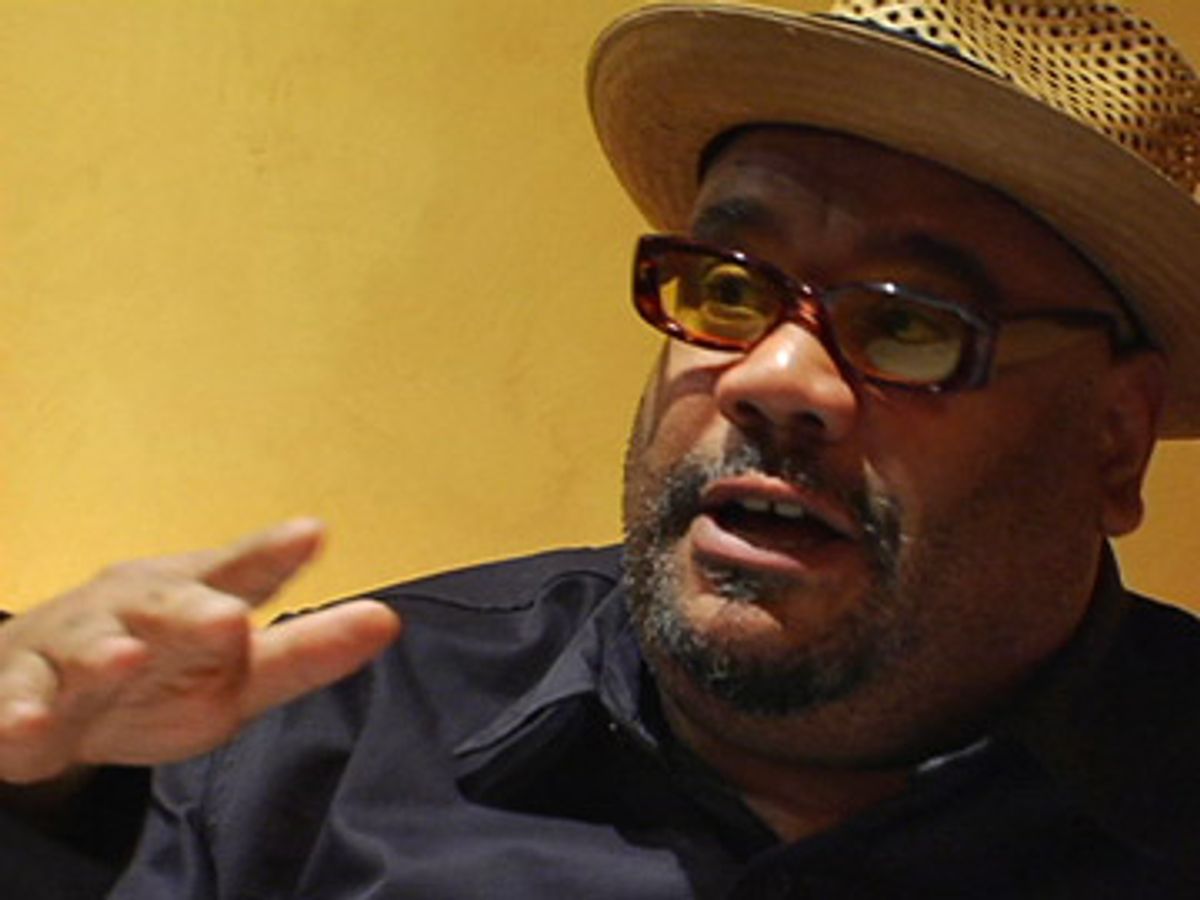
Stew, composer and star of "Passing Strange," which has been nominated for seven Tonys, would have had a tough time pitching his semiautobiographical musical to Broadway investors if it hadn't already done smashingly well at New York's Public Theater. The coming-of-age story concerns a young, gifted and black man called only "The Youth" who rejects his church upbringing in Los Angeles, flees his earnest, Lola Falana-ish mom and heads off to the Netherlands, then Germany. Tossing convention to the skies, the musical explores radical politics, performance art and experimental music, and encourages young Americans to have lots of illicit sex with Europeans. The orchestra -- technically a rock band, some of them from Stew's L.A.-based pop group the Negro Problem -- performs all the songs on the stage. The actors, in a homage to Brecht, move among them, sometimes interacting with the narrator, played by Stew himself, a short, self-described "chubby black man" with odd ears and a fondness for fedora hats. Hooked?
Well, no matter. Broadway's eager to fill the void that will be left by the closing of "Rent" this fall, and while last year's Tony darling, "Spring Awakening," has brought some much-needed rock attitude to the Great White Way, "Passing Strange," which premiered at California's Berkeley Rep, has an even more staunchly alternative aesthetic, a downtown pedigree and a cast of mixed-race folks who can play Germans -- convincingly. It has come along at the perfect moment. Accordingly, the quirky musical Stew referred to as "the black, gay, rock 'n' roll cousin of 'The Color Purple'" has garnered Tony nominations for best musical, best featured actor (Daniel Breaker, who plays "The Youth") and best featured actress (de'Adre Aziza, who gives life to the protagonist's diverse love interests). The other four nods -- best book, best original score, best orchestrations and best lead actor -- are for Stew himself, sometimes with collaborator Heidi Rodewald, with whom he wrote the music. This ties him with one of his similarly offbeat heroes, Anthony Newley (songwriter of "The Candyman" and "Goldfinger" among other accomplishments), and composer Elizabeth Swados for the record number of Tony nominations in a single year.
You'd think that by now Stew would be getting beverage service on his ego trip, but the 46-year-old still conceives of himself as an outsider and a nonactor, and remains convinced that "Passing Strange" isn't even a musical. The show's director, Annie Dorsen, he says, nailed it when she referred to the goings-on as a rock concert from which a play emerges. When he says he doesn't think he's going to win anything, it smacks of denial rather than false modesty. Stew sat down with Salon at an exposed-brick bistro near the theater where "Passing Strange" has been knocking out audiences including celebs like Rosie O'Donnell, Lauren Bacall and Harry Belafonte. In person, Stew was effervescent, not to mention exceptionally chatty -- more than once, he repeated the same sentence four times in a row.
"Passing Strange" is one of the few shows I've ever seen and thought, "Oh, I've had experiences like that." I said to myself, this must be what white people think about culture on a regular basis.
We made it for you! Most plays I see don't tend to speak to the so-called outsider. We did our play assuming that everybody had smoked pot as a teenager, that they knew what Amsterdam was all about, that they'd experienced racial alienation, and assuming they'd been as oppressed by their own community as they had by the outside world. We didn't go in thinking, "Oh my God, we're going to Broadway now -- we have to make it understandable for everyone." We assumed that everybody had a little bit of outsider in them.
That was the idea from the beginning?
Yeah, what the director liked was that when Heidi and I did our club act, when we talked to an audience of 250 people at Joe's Pub [the cabaret embedded in the Public Theater where "Passing Strange" had its New York debut], we said, "You're at this rock club at midnight. Odds are you're the kind of person we can talk to directly." Now, not everybody in the Broadway crowd has maybe snorted coke with a transvestite at 4:30 in the morning. But I'm like, "Well, if they haven't, I'm going to try to make them know what that's like." I'm not going to pretend that didn't happen. I think that's why we end up getting these 75-year-old ladies who come out of the play saying they really relate to it. And we ask them, "Oh, because you're a mom?" And they're like, "No, because I came to Greenwich Village in 1959 and freaked out!"
You started working on "Passing Strange" three years ago. Where did you see your career going before this?
Well, as a rock band, the Negro Problem had a lot of critical acclaim, which of course translated into millions of dollars -- you know critical acclaim always translates into millions of dollars. I'm just taking a break from my swimming pool in Hollywood to be on Broadway with the regular people. Actually we don't consider it "going" anywhere, Heidi and me. We're artists. We're lifers. We're not doing this to get famous or rich.
What did you know about theater or Broadway before you developed this show?
Very little. I had a lot of respect for people like Bertolt Brecht. I had read Brecht, and he touches a lot of rock performers more than any other theorist or writer in the theater world, I think, because his theories are very rock 'n' roll. Like the way he talks about the way an actor plays a role without trying to make anyone think that they are that character, and reminds the audience that they're watching a play. In high school, when you're a rock 'n' roll stoner, your mortal enemies are the thespians. We thought that musical theater was the dorkiest thing in the world and had nothing to do with the music we listened to. And quite frankly we still feel that way. I mean, uh, we don't understand why Broadway doesn't, for the most part, utilize the music of the street, the car, the headphones.
Who encouraged you to think independently when you were young?
There was this Jehovah's Witness kid in my second-grade class, and he wouldn't stand up for the Pledge of Allegiance. I thought that kid was the most badass, punk rock ... I'm not saying that Jehovah's Witnesses are revolutionary, but you couldn't stand up to those 50-year-old black ladies who were like 6-foot-seven with wigs on and say, "I'm not doing anything." You did exactly what they told you to do or you got taken into the broom closet and slapped. But wow ... I would say I was influenced to think independently by everybody from Angela Davis to John Lennon to my mom.
In "Passing Strange," the father doesn't come into the story at all, I noticed.
No, he doesn't. One of my private subtexts for this play was the relationship between this kid and the women in his life. Forget about the race stuff, the politics, the artist thing; I just wanted to examine the relationship between a young man and the women in his life. Honestly, in the writing I did not feel the need [to explain the father's absence] -- that's another play. And I love the mystery, too. You don't know if he died, you don't know if he left -- and it's not a cliché, you know, the ramblin' man crap. He might be on an extended vacation.
Unlike the show's main character, you didn't go to Europe immediately. The first time you left home, you went to New York, in 1982. When so much exciting stuff was happening here culturally, what made you leave for Europe?
Because all of my conscious life, the lure of this myth of Europe as the promised land for black artists was deeply embedded into the psyche of every black artist from my generation. We read Baldwin and Wright and Ellison; we learned about Dexter Gordon and other musicians. We always heard the same thing: "When I went to Europe, I was treated as a human being." As a teenager I went to see all these foreign films -- Godard, Truffaut, Fellini. I didn't look at these films like fiction; I looked at them like documentaries, and in a sense, they were documentaries. They were documentaries of a mentality. I really wanted to see if the myth was true.
Obviously your perception of it changed, since you're calling it a myth.
Oh, very quickly. I recently opened a suitcase of writing I was doing at the time and I was shocked at how cynical I was within weeks of arrival. I would like to think that the honeymoon phase lasted a little longer. I was already tired and hyperconscious of the objectification thing.
Yes, a lot of Europeans aren't shy about expressing their fascination with black Americans, sexual and otherwise. My first night in Paris, a woman exclaimed to me, "So, you are ze black man in Paris, and in Paris, we love ze black man!"
Even before I moved to Berlin, in Amsterdam, where there are more blacks, you would think there'd be a little less of that.
You have called "Passing Strange" "the black, gay, rock 'n' roll cousin of 'The Color Purple.'" What did you mean by that?
Well, I was definitely trying to have a good time. But I meant that if black theater is a family, and "The Color Purple" is the box-office hit that everybody's proud of -- you know, that's accepted by the mainstream and pushes all the right buttons and does all the right things and tells a certain truth -- we are that cousin in the corner at the family reunion, who maybe gets a little tipsy and has a few drinks and decides to tell his truth.
Speaking of telling truths, didn't CBS censor one of your songs from the taping of the pre-Tony telecast, which will include numbers from a lot of the other nominees?
It's so typical of these large stations who have advertisers that they're scared of offending. We have a song called "We Just Had Sex." The song features no curse words whatsoever, not even implied curse words. It's basically a celebration of being open about sex. And of course, [CBS] deemed it inappropriate for a 7 p.m. viewing audience. In the New York area. Trust me, there are no teenagers who don't know what we're talking about. And who are these teenagers that watch TV at 7 p.m. but don't watch TV at 10 p.m.? Every kid I know watches TV till all hours of the goddamn night! It's a really boring subject at this point because we know how puritanical and hypocritical we are.
It must be especially boring for someone who, on one of his solo albums, "Guest Host," recorded a song about a guy who gets his girlfriend to plow him with a dildo.
Well, at least I understand why they wouldn't put that on. Because maybe that's actually controversial. I will accept that dildos are actually controversial. I would support them being on TV -- because dildos are an important part of a lot of American people's lives -- but when do you see a dildo on TV? Maybe never.
Dildo or no, do you think you'll win big on Tony night?
I don't think I will win a single Tony. I used to think that people were liars when they said, "It's just great to be nominated," but in my case it's really true. All those other nominees are musicals. I think we are something new. We'll be forever filed in the musical category if you look us up in the encyclopedia or whatever, but I don't think we're a musical. So I'm not going to walk into that Tony place expecting them to go, "The crazy rock 'n' roll guy is our poster boy!"
Stranger things have happened.
Stranger? No. You're wrong.
Didn't Doug Wright win the Pulitzer for "I Am My Own Wife"? That was strange.
But he's an actual playwright. I'm an outsider.
You're working on another musical, though. Will you be an insider when that opens?
I'm not going to suddenly become a playwright and get a sweater with leather patches and a pipe and an old typewriter and start walking my dog on the beach. I'll never become that.
But will you be an outsider anymore?
That's up to them, I think, to decide.
Maybe as an outsider you can create a new inside.
That would be fun.
Shares