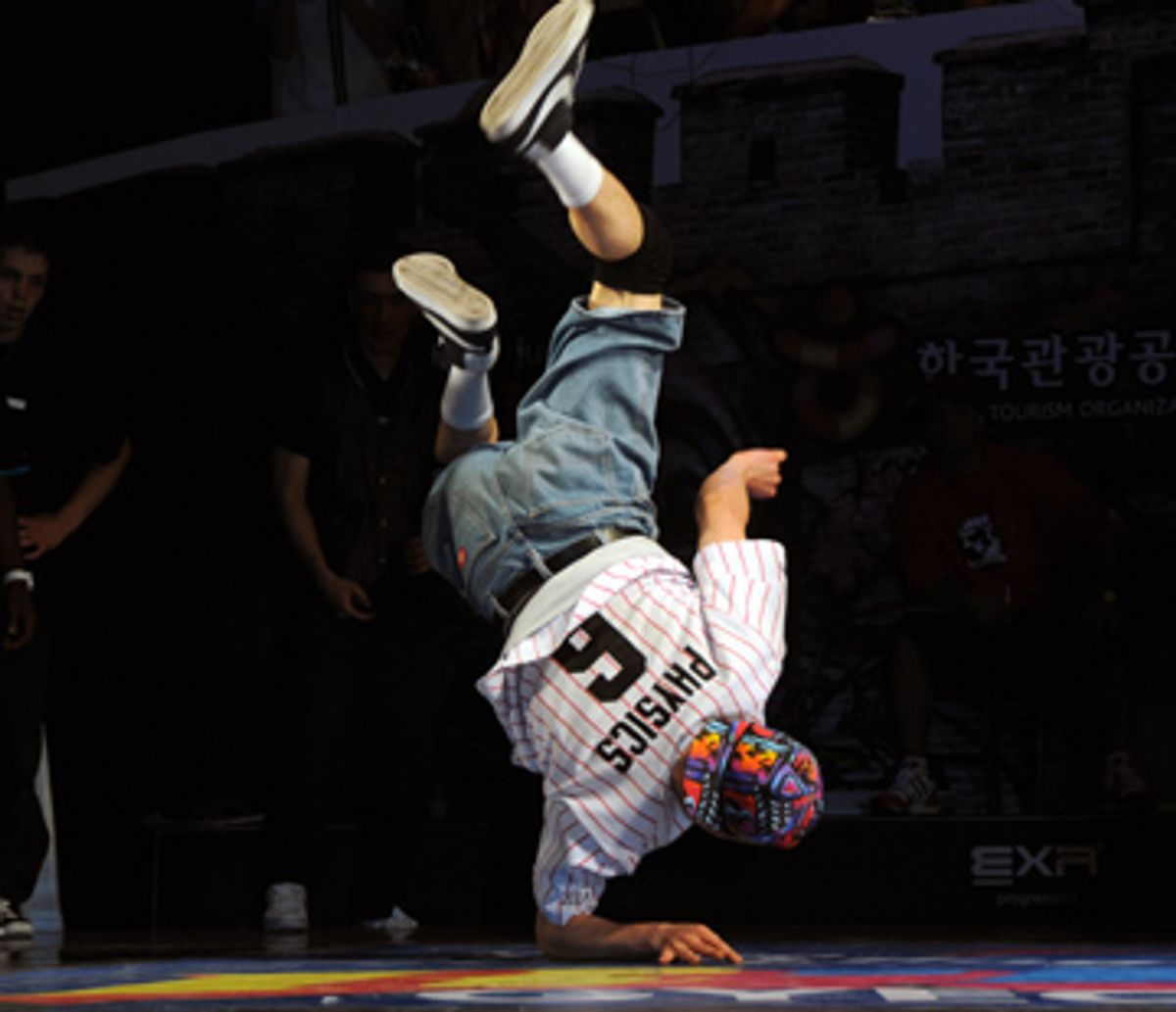
This summer, the United States is reaching new heights of dance fever as TV shows like Fox's "So You Think You Can Dance" and MTV's "Randy Jackson Presents: America's Top Dance Crew" have returned to the airwaves. MTV's runaway hit is considered especially cutting edge, showcasing hip-hop dance groups from across America. But if MTV really wants the best dance crew, it should be looking in South Korea.
"Of the top six or seven crews in the world, I'd say half of them are from Korea," says Christopher "Cros One" Wright, 33, an American dance promoter and b-boy who was recently in Suwon, South Korea, to judge the second annual global invitational hip-hop dance competition, called R16, that was held at the end of May.
The development of South Koreans' hip-hop dancing could be seen a cultural parallel to their sharp global ascendance in electronics and automaking. A decade ago, Koreans were struggling to imitate the Bronx-style b-boy and West Coast funk styles that are the backbone of the genre. Now, a handful of these crews are the safest bets to win any competition anywhere.
Certainly no country takes its hip-hop dance more seriously. The Korean government -- through its tourism board and the city of Suwon -- invested nearly $2 million in this year's competition. Two of the most successful teams, Gamblers and Rivers, have been designated official ambassadors of Korean culture. Once considered outcasts, the b-boys now seem to embody precisely the kind of dynamic, dexterous and youthful excellence that the government wants to project.
Although hip-hop dance goes back at least 35 years, the top Korean b-boys trace their histories back just 11 years, to 1997, the Year Zero of Korean breaking. By 2001, the first year that a Korean crew entered the Battle of the Year -- the world's biggest b-boy contest -- they won "best show" honors and a fourth-place trophy. Every year since, a Korean crew has placed first or second. Says Battle of the Year founder Thomas Hergenrother, "Korea is on a different planet at the moment."
The R16 competition, held at the Olympic Sports Complex, is broadcast live in prime time in South Korea and dozens of other countries. The government expects to gross $35 million from advertising and TV rights this year. And it isn't the only one profiting: Gamblers Crew, formed in 2001, may now be one of the most world's most lucrative hip-hop dance groups. The members regularly tour Asia, have endorsement deals with Fila, Kookmin Bank and Enerzen energy drinks, and will star opposite American teen idol Omarion in the $25 million movie "Hype Nation," the latest in the Hollywood dance-ploitation genre, set to open next year.
While some fans on the message boards for "America's Best Dance Crew" still don't know what a "b-boy" is, the word in South Korea has become synonymous with national pride. B-boy contests around the world attract mostly young males, but the R16 Sports Complex is full of grandparents, high school couples and teenage girls in their school uniforms. When one holds up a sign that reads "I (Heart) Physics!" she isn't referring to her college-prep curriculum, but to the 24-year-old, Bogart-faced, elbow-spinning star of the Rivers crew, Kim "Physicx" Hyo-Geun.
In South Korea, b-boying rules. The question even Americans are asking is, "How did this happen?"
During the 1970s, an array of dances practiced by black and Latino kids sprang up in the inner cities of New York and California. The styles had a dizzying list of names: "uprock" in Brooklyn, "locking" in Los Angeles, "boogaloo" and "popping" in Fresno, and "strutting" in San Francisco and Oakland. When these dances gained notice in the mid-'80s outside of their geographic contexts, the diverse styles were lumped together under the tag "break dancing."
The most physically demanding style -- the Bronx dance called "breaking" or "b-boying"/"b-girling" -- fueled a global fascination. In the mid-'80s, b-boys could be found spinning at the Olympics or at President Reagan's inauguration and promoting consumer products. But after the explosion, the dancers were cast off, the detritus of an exhausted fad.
Still, the dances took root around the world. While South Koreans have often been hostile to American imports, from Hollywood films to Washington beef (massive street protests against the government's lifting of the ban on U.S. beef broke out in Seoul the day before R16), hip-hop dance has been welcomed.
That may be partly because of South Korea's history of cultural repression of youth countercultures. During the 1970s, young Koreans in Seoul were being exposed to "Soul Train" and funk music via the U.S. Armed Forces Korea Network. A club scene arose in Itaewon to service American G.I.s. But as early as the summer of 1971, U.S.-backed dictator Park Chung-hee ordered his police to round up longhaired Korean men and cut their hair.
As the decade wore on, he escalated his "social purification" campaign, detaining artists, intellectuals and church leaders. In the first six months of 1976 alone, police reported checking over 600,000 men on hair length and possession of "obscene" T-shirts. Park's censorship committee blocked hundreds of American songs, from "We Shall Overcome" to "Me and Mrs. Jones."
"Black music was considered illegal because it was not good for the youth. The only music allowed was folk music," said Lee "MC Meta" Jae-hyun of the influential Korean rap group Garion, through a translator. "The music scene itself died. Influential music makers left the country." When he and his peers became enthralled with images of b-boys at the 1984 Olympics, they had no outlet for their creativity.
It was not until opposition leader Kim Young-sam became South Korea's first civilian leader in 1992 that youth culture seemed to flower again. At first, dance-friendly pop imports like Bobby Brown and MC Hammer spawned a host of Korean copies. "Up until then, it was all ballads," said Choi "DJ Wrecks" Jae-hwa, a pioneering Korean DJ who now spins for the Rivers crew, through a translator. But, Lee added, "the curiosity began and people became hungry for the real thing."
In just five years, Koreans would have their own thing.
It's a cool evening in front of the Ibis Hotel, an imposing postmodern gray slab that commands the Suwon skyline. Dozens of b-boys from around the world gather in groups in the lobby, bolts of color and noise against the hotel's minimalist white marble.
The Dutch crew, Funky Dope Manouvres, looks as ethnically diverse as Supercrew, the American one (which will fly directly from R16 to tape "America's Top Dance Crew"). Drawing dancers not just from Holland but Scandinavia too, FDM includes second-generation kids whose parents come from Brazil, Indonesia, Poland, Ghana and Suriname. Iranian-Swede Mahan "King Foolish" Noubarzadeh, 21, talks about how b-boying has brought together Muslims and Christians. Then he scans the lobby and sizes up the competition: "The favorites here? Gamblers and Rivers."
The next day is the marquee event, head-to-head elimination battles that are the heart of b-boying. Two crews challenge each other with aggressive, stylized choreographed steps and freestyle solo and ensemble moves. Egos are on the line. Tempers sometimes flare. "America's Best Dance Crew" doesn't dare approach this kind of a format. But the heat of the battle often makes the dancing spectacular.
Outside the hotel entrance, a Belgian dancer is challenging Kim "Bang Rock" Hyun-jin, 24, a genial round-faced dancer from Rivers, the defending R16 champs. They don't speak each other's language, but the Belgian is calling out the Korean by pointing to the ground and staring out from a chin-up tilt. Kim won't step in the cipher, the space between the dancers surrounded by a circle of onlookers that forms the battleground. So the Belgian starts with a six-step, then drops to a flurry of footwork and ends with a shoulder roll.
Now Kim has to respond. He humiliates the Belgian by imitating the European's movements, and climaxes with a series of virtuoso body spins. When he comes to a stop, he is leaning upside down at an inverted angle, balanced on a shoulder and a hand. He grins up at his opponent. This encounter is over. The Belgian offers a congratulatory hand.
Later, sucking on an ice cream treat, Kim laughs. "I didn't want to battle. I keep asking, 'Why?'" Of course, he knows the answer. It's the reason Korean crews regularly practice five hours a day, seven days a week. "We know there's always somebody trying to catch up with us," says 27-year-old Gamblers crew spokesman Chung "B-Boy Sick" Hyung-sik through a translator. "We always have to be ahead."
R16 co-organizer Johnjay Chon says that a decade ago, there were just five crews in the whole country. This spring, more than 50 entered the country's qualifying competition for R16. At events or clubs in Seoul, Chon regularly spots unknown b-boys taking out experienced pros. "What happens is they practice on the lowdown until they're up at a level where they can actually come out and shock somebody," he says. "They practice in the shadow."
Cho "C4" Chung-woon of Rivers says through a translator, "We've been praised for our technical skills, but that's because we would practice head spinning all day long. That's what sets us apart."
Still, the old "Asian work ethic" explanation is just part of the story. When Koreans first emerged, Americans praised them for their power moves -- the highflying crowd-pleasing spins, freezes and gymnastics moves -- but criticized the Seoul b-boys for lacking soul. They were thought to be mechanical, unable to rock with the beat, and lacking in "foundation skills," such as the top-rock and footwork moves that form the historical roots of the dance.
"What the Americans said really influenced them," says Charlie Shin, Chon's business partner and a Korean b-boy advocate. "They went back in the lab. It changed them."
They mastered routines, the choreographed ensemble moves that are essential parts of a showdown. They immersed themselves in the music and the rhythms. They studied the history of b-boying and hip-hop culture. Three members of the Rivers crew -- Born, C4 and Red Foot -- are now affiliates of Mighty Zulu Kings, a crew whose lineage can be traced back to hip-hop pioneer Afrika Bambaataa's Bronx River Project dances in the early 1970s. Even their crew name, Rivers, was chosen to capture an aspect of the hip-hop aesthetic.
"You know how rivers flow? Rivers flow swiftly, and that's also how we move and how we think," C4 says. "B-boys in other countries do it as a hobby, but to the Korean b-boys, our life is b-boying."
R-16 organizers Shin, 31, and Chon, 32, are what Asian-Americans call one-point-fivers -- young people born in Asia but raised bilingual and bicultural in America. Shin's 15th birthday came days after riots erupted in Los Angeles on April 29, 1992, after the Rodney King verdict, a traumatic period that Korean-Americans now simply call Sa-I-Gu or "4-2-9" the way one might refer to "9/11." Parts of Koreatown were still in flames and hundreds of Korean-American businesses had been reduced to ashes. The era had poisoned mainstream perceptions of Asian immigrants. White pundits used them to score rhetorical points against welfare and affirmative action, while black leaders boycotted their shops. But neither Shin or Chon was close enough to the fires to have been burned by them. You could call them members of the post-Sa-I-Gu generation.
Hip-hop formed a crucial part of their identity, and a source of redemption. "For me, growing up in the States, I had been called all kinds of names," Shin says. When he moved to Seoul eight years ago, supporting Korean b-boys became a cause. Seeing them win respect from others, he says, "kind of dissolved all that racial bullshit I grew up with." The Korean-Americans became exemplars of hip-hop culture at a moment when young South Koreans were trying to define a new national identity.
Chon was born in Japan and raised in Seattle. After forming and competing nationally with the multiracial Circle of Fire crew, he came to Seoul on a summer trip in 1997 to visit family. Armed with videos and DVDs of dozens of contests, Chon began scouring the clubs for b-boys to battle. He met the Expression crew -- now a hip-hop dance theater troupe -- and gave it a video of a legendary Los Angeles b-boy competition called Radiotron.
"A year later I came back and I just saw there were more b-boys. They were telling me, 'Oh you gotta see this footage,'" Chon says. "I'm watching it and it's the Radiotron [video] that I brought out a year ago. It's been dubbed so many times the screen is shaking."
During the year Chon was gone, teenagers such as the Gamblers' B-Boy Sick had caught religion after watching grainy videos like that one. Lively Internet groups brought hip-hop fans together. Japan's obsession with underground American hip-hop was at its peak, and CDs and videos found their way to South Korea through Tokyo. As South Korea's economy spiraled downward in 1997, a vibrant counterculture was emerging in Seoul.
At the Master Plan club in the Chungjeong neighborhood, rap groups like Garion, Artisan Beats & Keeproots and Drunken Tiger JK explored the rhythms of their native tongue and sometimes disclosed personal traumas or attacked social ills. In Taehongno, an area rich in college campuses, nightclubs, galleries and theaters, b-boys suddenly appeared. The Rivers crew and Expression crew, South Korea's first Battle of the Year winners, were among the b-boys who gathered there.
They battled all evening in front of the crowds at the popular Maronie Park, then moved to the clubs in the early morning hours. When dawn broke, they headed to school. Their intensity impressed Chon. "I'm like, 'OK how does this work?'" he says he asked the b-boys. "I just sleep in school" was their invariable reply.
These Korean hip-hop heads were the first generation to grow up after authoritarian rule. Those before them had come of age on the front lines of demonstrations against American-backed dictators. But these youths lived under relative, if yet unstable, democracy and prosperity.
They were also mostly working-class outsiders. "The minute you're born in Korea, depending on what your economic background is, or who your parents are, what network you're in, what neighborhood you're in, what high school you went to, what college you went to, your life is pretty much decided for you," Shin says. "The b-boys, it's not like they're the most highly educated kids, but they're good at what they do, and they put as much effort into practicing as the other kids do into the Korean SATs."
Because South Korea is still a country at war, looming over every young man's life is mandatory military service. For working-class b-boys, it acts as a passage into a bleak future. "If they're not in college, they have to do some kind of menial job," according to Shin. Many say that the prospect of military service is the main factor that has accelerated the Korean breaking scene's development. "You see that hunger and that drive," says Korean-American filmmaker Benson Lee, whose 2007 hit documentary "Planet B-Boy" featured a DMZ scene with members of Gamblers and Rivers as battling soldiers.
They know that the freedom of b-boying can't last. "The service will come up when you're 21, 22. But they can always extend that using some excuse," Chon says. "A lot of the b-boys -- now they're like 26, 27, they haven't gone. They have to go soon. They keep putting it off because the culture is kind of peaking now."
He estimates that four out of five b-boys currently competing in South Korea have postponed their service or have illegally evaded their conscription. Chon and Shin say they know many b-boys who have mutilated themselves to dodge the army. Kim "Bang Rock" Hyun-jin of the Rivers crew says through a translator, "Everyone tries to avoid the service." Then he switches to English for emphasis. "It's like going to hell."
On the final day of R16, there are more government officials in suits wandering around backstage, the crowd is thicker and louder, the TV crews are everywhere, and the energy is high.
Through the opening rounds of the crew-on-crew battles, the Gamblers and Rivers dispatch their rivals easily. In the semifinals, the Gamblers face the fluid and elegant Brasil All-Stars, whose moves vibrate with the traditions of capoeira. They win in a pleasingly close contest, three judges to two. But when the Rivers crew faces Russia's Top 9 crew from St. Petersburg in the other semifinal -- potentially a classic duel of power versus finesse -- tension builds.
On an arena stage, crews must face each other across the floor, as if across a DMZ turned battleground. This staging emphasizes the metaphor of the attack. By the rules, each crew must give the other its space on the floor while it is performing. They alternate their turns. No touching of opponents is allowed.
But minutes into the contest, Physicx begins dancing before Russia's tiny dynamo Flying Buddha has finished his solo. (See the battle here.) When Buddha moves over to stare down Physicx, who has begun a difficult flare sequence, a Rivers member pushes him away. Physicx backs out of the cipher, comes around to high-five Buddha and motions for him to retake the floor. Instead Top 9 starts a three-man routine. Physicx steps back in to disperse Top 9, then motions again to Flying Buddha. The Russian takes a wide berth, flings off his light blue shirt, does a six-step, then launches into a spectacular one-armed move known as an air chair. Now Top 9 is fired up.
B-boy Robin, Russia's assassin in a brown Yankees hat, oversize polo shirt and cargo slacks, circles the floor and then taunts the Koreans by pulling back his eyes. Some in the crowd gasp at Robin's slanted-eye dis. But his subsequent solo, featuring a Tony Hawk-style hand plant and surging rolls broken up with one-armed freezes, is flawless. In what b-boys call a "commando" attack -- a routine in which a run is begun by one or more b-boys but finished by another, named for the post-gang-era Bronx dancers who invented it as a tactic to prevent the other crew from immediately responding -- C4 dives through two Rivers members and leaps straight at Robin, pulling his own eyes back, then miming a castration of Robin. The crowd roars.
But as the battle continues, Rivers seems exhausted, while Top 9 gains momentum. In their final routine, the Top 9 b-boys do a number of clever duet Lindy Hop-style routines, jumping off each other, flipping each other into spins and forming circles for crewmates to leap through. When Top 9 wins 5-0, some in the crowd boo. But this won't be Rivers' day. It finishes fourth behind the Brasil All-Stars.
In the finals, South Korea's Gamblers crew counters Top 9's routines with elaborate commandos and ample personality. (See the battle here.) As the clock ticks down, the dancers play "pass the hat." B-boy Pop handstands across the stage and balances on his left hand. Then he arches his body into the heart of the Top 9 line and passes a white baseball cap to a hand-spinning Soul Soy. On the Gamblers' last run, b-boy Sick chases Robin and Top 9 out of the cipher, drops down for some fleet footwork, then quickly contorts himself through a set of wire-doll freezes that wouldn't look out of place on a Cirque du Soleil stage.
When the Gamblers are announced as the champions, Pop flings his shirt into the crowd and strikes a kung-fu matinee idol pose at the edge of the stage. Cameras and cellphones flash. Soul Soy announces to the media that it is donating its R16 winnings to victims of the earthquakes in China and Myanmar. It's an audacious statement. The $15,000 first-place prize is the largest that has ever been offered at any b-boy event in the world.
Later, Sick signs autographs and takes pictures with two stricken schoolgirls. As he waves and disappears into the bus, they clutch their autographed programs and continue blushing and bowing. There are few big-name b-girls now in South Korea, but who knows? Perhaps those girls will form the next generation of champion dance crews.
"The world is a big place, man, and there's another hungry competitor stepping up," R-16 judge and legendary Rock Steady crew b-boy Ken Swift says. "It's a cycle, and the cycle is based upon crews like these Korean crews who go out and inspire these new fans. And then five years from now, those new people are going to be saying, 'OK we're the shit now.'"
Shares