

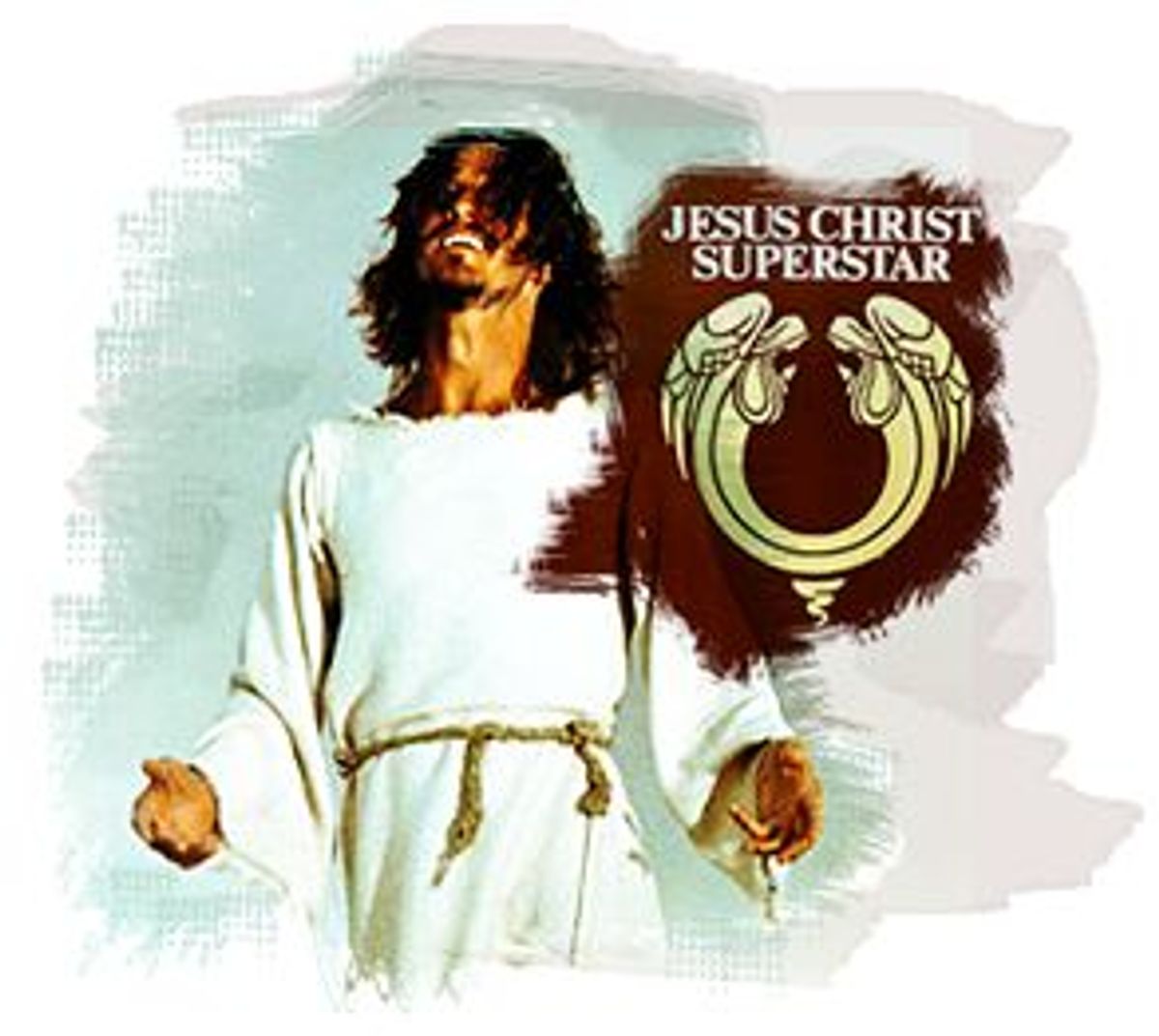
I arrived late and had to stumble in darkness past the sprawled legs of a few other midweek moviegoers. At last I got popcorn-situated and settled into my seat, just as the music began to swell. On the screen, a cluster of bodies stepped back and the camera froze. My heart stood still. It was His face, unmistakable, huge, looking right at me.
"Oh. My God." My whisper echoed through the theater, prompting shushes from disapproving adults around me. I didn't care. All I knew was that Jesus Christ Our Lord was a total fox. I snuggled down for the next two hours, an instant convert, mesmerized by the story, moved by the music, nursing a crush the size of Montana for the Lamb of God. I felt a not unfamiliar twinge, down there. I was most certainly going to burn in hell.
It was 1973. I was 12. While those two facts would seem enough to explain my initial fascination with Andrew Lloyd Webber and Tim Rice's rock opera, my love for it has only grown through the years. It's not hyperbole to state that "Jesus Christ Superstar" has had far greater impact on my own religious beliefs than any other single event in my life. Certainly it's affected me more profoundly than my sporadic Sundays in church ever did. I can assure you I've thought a great deal more about the deeper meaning of "Everything's Alright" than I ever did about a single one of those Bible stories for children.
Seeking spirituality with a pop-culture twist was a popular pastime in the '70s. Hordes were looking for a brand of redemption that didn't involve fire and brimstone: Hell, you couldn't turn around without running into acoustic guitars and "folk masses" at your local Catholic church, Hare Krishnas dancing in suburban malls, groovy Jesus freaks and sold-out est conference rooms. "Jesus Christ Superstar" set my own adolescent quest for meaning into overdrive. After that fateful day at the movies, I was driven to actually read the gospels, digging out the old "Good News for Modern Man" (American Bible Society, 1967) that a born-again playmate had pressed on me way back in third grade.
God help me, I ended up getting baptized four times in those heady times. Just, you know, covering the bases.
That sort of reaction wasn't as extreme as you'd think. Even today, more than 30 years since it was released, a multitude of like-minded souls have put up Web sites in homage to various permutations of "Jesus Christ Superstar." They trade gossip and tidbits about the various actors who have portrayed this passion play's principals over the years and share stories of how the rock opera has changed their lives. Hey, just saying, I'm not the only one.
"Jesus Christ Superstar" has been staged countless times over the past several decades, but for aficionados there are really just three significant artifacts. There's the first album, released in October 1970, which purists insist is the most excellent. This is the version that features then-obscure rocker Ian Gillan (of Deep Purple) as Jesus Christ, and it comes with a handy booklet of lyrics for those who'd like to follow along at home. The LP sold more than 3 million copies before the Broadway opening, and the U.K. production went on to be the longest-running musical in British theater history.
(Somewhat less immortal is the initial 1971 Broadway show, which featured one-time Black Sabbath session singer turned born-again Christian Jeffrey Fenholt as Jesus and Ben Vereen as Judas. Time magazine described the latter's singing style as "Sammy Davis Jr. imitating Chuck Berry." Other reviews were less kind.)
Then there's the movie that first bewitched me, the hippie-dippy one directed by Norman Jewison that came out in 1973, sandwiched, in terms of Jewison's career, smack in between "Fiddler on the Roof" and "Rollerball." This version was made into an album as well. (For those keeping track, it's the one with a silhouette of the crucifixion on the cover.) Both those slices of rock history feature the anguished Carl Anderson as Judas and Ted Neeley in the title role, that same foxy savior who first loomed over me in the dark. While he doesn't have anything near the vocal range of Gillan, Neeley certainly looks the part of hapless messiah. He's scrawny, more than a little scruffy, not necessarily the brightest bulb in the chandelier, but he burns, baby, he burns.
More recently, a new "Jesus Christ Superstar" was launched in the U.K. and wound up making it to Broadway for a revival in 2000. This production's staging, by Gale Edwards, was captured on film for PBS' "Great Performances" in 2001. For this updated foray, Christ was played by the overly perfect Glenn Carter, whose crinkled locks and buff physique made him seem like the Lord as interpreted by Calvin Klein.
But the real star of the show here, as always, was the great betrayer, Judas Iscariot. Much as Carl Anderson's rendition of the disciple-gone-wrong stole the show in Jewison's movie, balding Frenchman Jérôme Pradon emotes his doomed ass off in the new version. Brooding anti-Jesus Pradon is thin and dark where Carter is sculpted and golden, and the hints of homoeroticism in Judas' jealousy over Christ's friendship with Mary Magdalene add a contemporary queer-studies twist. Truth to tell, by the end of the video, I had a new crush object, edging Jesus to one side for the first time in years.
While Webber and Rice's story wouldn't seem to need much explaining -- being, you know, a loose chronicle of the last seven days of Jesus -- for those poor souls who managed to miss the "Jesus Christ Superstar" train as it's chuffed through every station in the country over the past 30 years, a brief synopsis might be in order.
The eerie overture kicks off with a wailing guitar lick that builds with ominous intensity, a frantic mélange of sounds presaging the score's major numbers. It's an anxious layering of riffs and fragments, blending orchestral flourishes with hard rock's escalating tension, until the rhythm finally melds together into a lavish celebration of the familiar chorus to the title track, which is immediately cut short by faint wailing voices and discordant notes. Five minutes in, the listener is already exhausted and exhilarated.
No time to rest: As the story opens, Judas is freaking out, big-time. His pondering quickly escalates to wailing doubts about Jesus' exploding popularity, the cluelessness of His followers and the inevitability of conflict with the authorities ("We are occupied, have you forgotten how put-down we are?"). Cut to the apostles, a bunch of useless slackers forever milling about and asking: "What's the buzz, tell me what's happening."
There's a hint of the old nudge-nudge, wink-wink when Mary Magdalene steps in to soothe Jesus, punctuated by Judas' sneering take on how all this female attention is just another troubling symptom of the direction Jesus is heading. In the first great exchange between the pair, Judas sneers that the former prostitute "doesn't fit in well with what you teach and say." Mary attempts to defuse the situation with the placating ditty "Everything's Alright," but Judas blows a gasket. While the two men keep ragging on each other, Mary continues to insist that all is copacetic. It's not.
Meanwhile, the high Jewish priests are discussing the Jesus problem. An insinuating bass line keeps their conversation building with ominous foreshadowing for the carpenter from Nazareth. In the end, it's decided: "This Jesus Must Die." Uh-oh. With unfortunate timing, Jesus and His supporters pick that moment to hosanna their way past the priests' council. Inside, the priests strategize the best way to deal with resistance: "His half-witted fans will get out of control." Oblivious, the crowd continues to sing and prance about like mindless twits.
Horns sound as the parade swells to Lollapalooza-like numbers, and an infectious piano line kicks into a groovy sing-along: "Christ, you know I love you, did you see I waved?" Jesus' follower Simon Zealotes slyly advises Him to "keep them yelling their devotion, but add a touch of hate of Rome." Like the rest of the apostles, Simon wants a revolution. He wants a Jewish homeland. He wants the "filth from Rome who rape our country" to get their comeuppance. Bad move, Simon. Jesus is a lover, not a fighter.
Cut to Monday morning. Pontius Pilate sings a soft lament about his premonition that bad shit's about to go down. The tempo kicks into high gear when Jesus enters the temple, where decadence and depravity abound. A driving riff plays off the line, "Roll on up, for my price is down." Jesus pitches a fit and smashes everything all to hell. He muses sadly about how the end is coming, then is promptly hit with pleas from beggars who reprise the temple riff ("See my eyes, I can hardly see"). Overwhelmed, Jesus ends up telling them -- with an anguished rock 'n' roll howl -- to heal themselves.
Mary Magdalene's sweet love song diffuses the tension. She's conflicted over her love for Jesus. He's just a man. She knows all about men. Nonetheless, she doesn't know how to love this one.
Come morning, Judas has decided to turn traitor, almost in spite of himself. Relentless rhythms punctuate his rationalizations that he really didn't come of his own accord. Whatever, shrug the priests, who toss him some coins and tell him it's not blood money, just a fee. When Judas takes the money and tells them where to find Jesus, a mournful chorus intones, "Well done, Judas. Good old Judas."
The Last Supper finds the apostles behaving like blithering fools as usual, drinking wine and dreaming of their post-Gospel immortality. Jesus knows He's doomed and finally tells them the buzz they're incessantly asking for: He's going to be betrayed and denied, and then He'll wind up dead. They act clueless when He asks them to remember Him via the old bread-body, blood-wine analogy, and He blows up at them: "Look at your blank faces. My name will mean nothing 10 minutes after I'm dead." As the tension builds to near-unbearable tautness, Judas screams out his disillusionment, sneering that it would serve Jesus right if he didn't turn Him in after all. But of course, he has no choice.
Once the useless apostles fall asleep, it's time for Jesus' showstopper: his obligatory, if temporary, loss of faith. He howls his doubts to God, whose silence is deafening. The song builds to a bombastic crescendo, but in the end, of course, He acquiesces. He has no choice, either.
Right on cue, Judas shows up with some soldiers and gives his betrayer's kiss. The apostles are ready to kick some ass, but Jesus tells them to chill out. "Why are you obsessed with fighting? Stick to fishing from now on." The once-adoring crowd turns fickle, clamoring for His thoughts and feelings. ("How do you view your coming trial? Have your men proved at all worthwhile?") He doesn't respond, which pisses everybody off.
After Peter's denial, the action jumps to Pontius Pilate, who's unimpressed, and sends Jesus off to be judged by King Herod. He's trotted over to the wacky monarch, who merrily warbles a ragtime ditty, urging Jesus to "rock the cynics" and prove His deity. No dice, dude, so Herod sends Him away with all the petulance of a spoiled toddler.
Judas can't stand the guilt; in a reprise of his earlier "doomed for all time" tune, he belts out his realization that he's "been spattered with innocent blood." His howls are briefly softened when he echoes his own doubts about how to love Him ("When He's cold and dead will He let me be?"), but soon enough he's back in bummersville and kills himself. The (heavenly?) chorus kicks in with a mournful buh-bye: "Poor old Judas. So long, Judas."
The priests demand that Pilate do their dirty work, and reprise an earlier melody ("Hosanna, superstar") into a new, grimmer sentiment ("We need him crucified"). As the music drives the action forward, Pilate finally agrees to have Jesus whipped; guitar riffs ripple and build for 39 lashes, in a distinctly sexual rhythm, as the beat gets faster and faster and faster. While Pilate begs Jesus to speak, to save Himself, the crowd keeps shouting for blood, and Jesus finally speaks. "Everything is fixed and you can't change it." The crowd screams for blood. Finally, Pilate howls out the death order in despair: "Die if you want to, you misguided martyr!"
Stand back, give them room, 'cause it's time for the glitzy title track, the grand finale belted out by Judas in the afterlife, backed up by a soulful female chorus. It's the biggest of this show's showstoppers, designed to get an audience on its feet and swaying like an old-time gospel chorus while Judas poses pesky theological questions like, "Did you mean to die like that? Was that a mistake or did you know your messy death would be a record-breaker?"
As the last note fades, eerie laughter, faint discordant notes and the pounding of nails punctuate Jesus Christ's last few words. It's all over. A subdued echo of the overture brings us full circle. Curtain.
As an art form, rock operas never really took off. The oeuvre came and went during the early '70s and consists, pretty much in its entirety, of the unholy trinity of "Jesus Christ Superstar," "Tommy" and "The Rocky Horror Picture Show." Just as well, probably.
While "Cats" and "Evita" were still ahead of them, for my money, Andrew Lloyd Webber and Tim Rice's collaboration never again reached the sublime heights of "Jesus Christ Superstar," whose score and lyrics are woven together with near seamless momentum. The pair's abysmal first effort, "Joseph and the Amazing Technicolor Dreamcoat," was written while both were still at school. It shows. ("Joseph" is mainly of interest because of how silly Donny Osmond looks in the film version's title role -- and for a few hints of musical themes that anticipate "Jesus Christ Superstar," their next effort.) The phenomenal success of JCS, as fans call it, made millionaires of Webber and Rice and led them, for good or ill, to a long career as theatrical collaborators.
Lord knows there's no credibility to be had in proclaiming one's love for "Jesus Christ Superstar." In most quasi-sophisticated circles, finding JCS anything but pure drivel makes a person suspect, not just as a critic but as a music lover and perhaps as a human being as well. Witness all the terrible reviews the work has gotten over the years: "Bombastic kitsch that [doesn't] rock," said Rolling Stone. "The lyrics are pedestrian and often absurd," harrumphed the Nation. "Flat, pallid, actually pointless," sniffed the New York Post. Infidels, every one.
Of course, religious sorts had kittens over the whole thing from the start. Devout Christians howled in protest at Webber and Rice's blasphemous gospel, which puts Judas squarely at center stage and doesn't include the Resurrection. (Which is, after all, sort of the point of Christianity.) When the show opened on Broadway in 1971, religious groups protested en masse. A pamphlet put out by the Faith Free Presbyterian Church in Greenville, S.C., cautions the faithful to keep their distance from JCS:
"'Jesus Christ Superstar' is a conscious blasphemy against Christ ... If you do not wish to fill your mind with Satan's evil misrepresentation of the Son of God, you should avoid 'Jesus Christ Superstar' ... Tim Rice plainly stated that he did not believe that Jesus Christ was God ... His opera constantly drives home this denial of the Son of God. He has Mary Magdalene say, 'He's a man, he's just a man.'"
Ironically, it was that very possibility that led me and so many others to delve deeper into the scriptures. That, and the fact that Jesus was not merely a man but, you know, a total fox.
Sadly, my quest to have the Lamb of God for a boyfriend was never fulfilled, although I spent much of my teens hooking up with one scruffy longhair after another. None of them ever measured up to my first glimpse of Neeley's Jesus, although more than a few whined just as convincingly as Neeley does when He's asking God why He has to go through all this passion-play stuff anyway. Of course, my loser boyfriends were usually whining for blow jobs. But still.
As I've made abundantly clear, my personal JCS obsession has lasted for years. On a tipsy evening during a girly weekend getaway last year, I popped my own copy of the 1973 film into the VCR and, God help me, lectured to my bemused friends about recurring musical themes, pausing the video at key moments to pontificate.
I told them about how, in the early '90s, when a stage revival featuring some of the movie's cast was making its way around the country, I talked some editor or another into letting me do a story when the road show came through San Francisco. Of course it was all just an excuse to meet Jesus and Judas in person.
I ended up spending an enchanted hour alone in a room with Neeley and Anderson, drinking hotel coffee, nibbling stale breakfast rolls and babbling fan-girl nonsense. While my tapes of that conversation have gone missing -- for the best, no doubt -- I vividly recall that Neeley was wearing a deep-blue silk shirt with the top two buttons undone. A tuft of chest hair peeked out. I wanted to touch him but restrained myself, just barely. I told him how he'd made me feel sitting there alone in the dark when I was 12. He laughed, flashing blinding white teeth, looking all Jesus-y.
"I wish I could have come right down off that screen and sat next to you in the dark," he said soulfully. I swooned.
OK, I didn't actually swoon. But still. Holy shit. The Son of God was flirting with me.
In 1995, a group of Atlanta musicians got together to do a few performances of "Jesus Christ Superstar" both in their hometown and in Austin during the annual South by Southwest Music Conference. Of course I had to go, even though I didn't really have an assignment, as I'd just quit my job as music editor of an alternative San Francisco newspaper after it had been bought by an evil chain. But I wasn't going to miss the Indigo Girls doing JCS, damn it, so I cashed in some frequent-flier miles and headed off to Texas.
Ever the groupie, I talked to the project's organizer, Michael Lorant of the band Big Fish Ensemble, before I saw the show. He told me that he'd been into JCS since he was a little kid. In fact, as a Jew, it taught him everything he knew about Christianity. "I always identified with Judas," he confided. "Jesus, not so much."
The subsequent album -- "Jesus Christ Superstar: A Resurrection" -- which featured the Indigo Girls' Amy Ray in the part of Jesus and her bandmate Emily Saliers as Mary Magdalene, got decent reviews and raised money for gun-control issues, but for Lorant, who played Judas, the project was never about fame or fortune.
"Judas spoke out to me as very Jewish. He was misunderstood, a tragic character who didn't get a fair shake in history," Lorant said. "He did what he thought was for everyone's good, turning in someone he loved."
That night at the Austin Music Hall, a thousand of us watched, enraptured, as Lorant opened the show, taking his turn as Judas. This time out, Judas had long sidelocks and a yarmulke. And the part of Jesus, of course, was played by a lesbian folk singer in carpenter's garb, complete with tool belt.
As usual, I found myself half in love with her. Once they'd crucified her, just as they always do, and Ray came back out on stage for the bang-up climax, now dressed in blinding white overalls, I swooned all over again.
Call it my own version of a messiah complex, but there's something about me and the Son of Man. Even when He's a girl.
Shares