

While the contents of the list that follows are not arbitrary, the number is. The best of a decade, a year, a millennium cannot be rounded off to a random number. So while I've chosen 10 films that represent the best the movies offered in the '90s, there are others that deserve mention, including two it broke my heart to leave off. John Boorman's "Where the Heart Is," a highlight of a decade of superb work from the director, was perhaps the decade's most mindlessly dismissed film. This magical family comedy played like "King Lear" done in the mood of "Twelfth Night" under a spell of enchantment out of "A Midsummer Night's Dream." Like Boorman, Jacques Rivette is one of the giants of movies, and his sort-of musical "Haut/bas/fragile," which follows three young women over the course of a Parisian summer, bringing each to a moment of decision in their lives, was perhaps the most beguiling of his poeticization of everyday life.
My ideal list of the decade's best films would make room for them, and for Robert Altman's "Vincent and Theo," Bernardo Bertolucci's "Besieged," Chris Marker's "The Last Bolshevik," Philip Kaufman's "Henry and June," Steven Soderbergh's "Out of Sight," "Fred Schepisi's "The Russia House," Terry Gilliam's "The Fisher King," Danny Boyle's "Trainspotting," Alfonso Cuaron's "Great Expectations," Erick Zonca's "The Dreamlife of Angels," Agnes Varda's "Jacquot" and Steven Spielberg's "Schindler's List."
There is much to say about the obstacles that movies have faced in this decade and continue to face -- the way the dominance of special effects has reduced movies to spectacle that banishes characterization and psychology; the way the studios' publicity machines have attempted to co-opt and do away with criticism by shifting attention to entertainment reporting; the paltry distribution of foreign films in the States -- but I've chosen not to dwell on it. That the movies on this list are as strong as they are in such times is proof enough of Pauline Kael's line, "There must be a separate God for movies." Each, in its way, illustrates Truffaut's ideal, expressing both an idea of the world and an idea of the cinema.
1. "Vanya on 42nd Street" (United States, Louis Malle and Andre Gregory)
For his final -- and greatest -- picture, Louis Malle filmed the version of "Uncle Vanya" that Andre Gregory and his actors rehearsed for three years in New York's crumbling New Amsterdam theater and then performed for small, invited audiences. A direct descendant of the legendary naturalistic Chekov productions staged by Stanislavski at the Moscow Art Theater, this "Vanya" obliterates the distinctions between the artifice of theater and life -- the actors perform in their street clothes, with the audience a few feet from them in the dilapidated theater -- in a way that seems the realization of the playwright's dreams. Malle, Gregory and their actors break down the barriers that keep us from getting to the inner life of the play.
The film also features perhaps the greatest ensemble acting ever captured on film with a cast that includes Julianne Moore, Brooke Smith (whose concluding monologue is transcendent), Larry Pine, Phoebe Brand, George Gaynes and, as Vanya, Wallace Shawn, seething with anger and self-disgust but coming too close to our own thwarted ambitions for us to shut him out.
2. "Irma Vep" (France, Olivier Assayas)
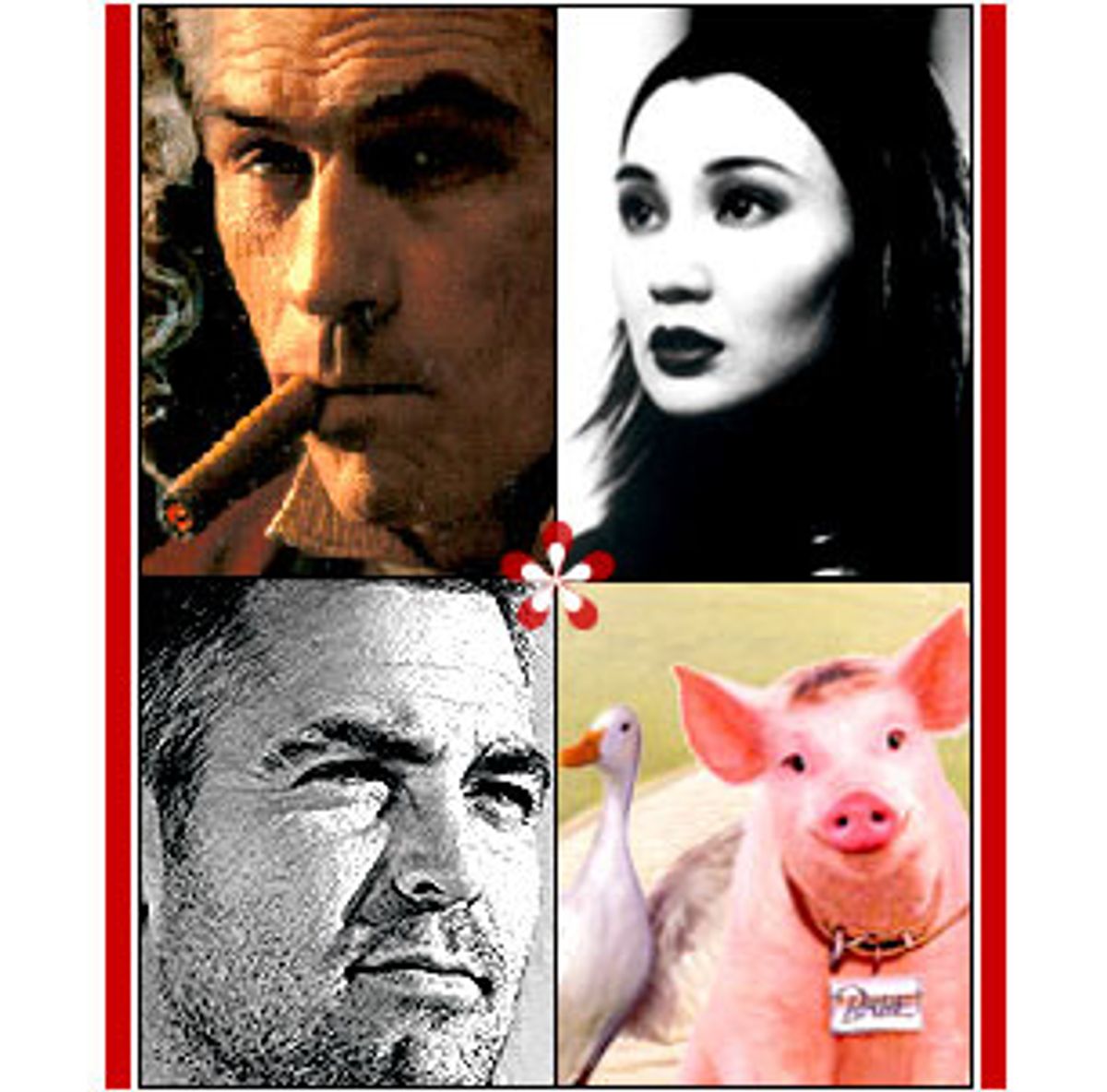
Olivier Assayas has been at the forefront of the directors who have revitalized French cinema this decade. But it's the spirit of the French New Wave that hovers over this comedy about the making (and unmaking) of a movie. At the center is the nouvelle vogue's great icon, Jean-Pierre Leaud in an endearingly eccentric performance as a shambling wreck of a director taking on the impossible task of remaking Louis Feuillade's 1915 serial "Les Vampires." To star as the cat-suited jewel thief Irma Vep, he casts Hong Kong star Maggie Cheung (playing herself). Parodying the foolhardy insularity of both art movies and the mainstream, Assayas' film is a comic elegy for the New Wave that brims over with precisely the freedom and lyricism that defined those films of the late '50s and early '60s. It is also a demonstration of how, for a filmmaker, a movie can be contained in one face. Scampering over the roofs of Paris in scratched-up black-and-white, Maggie Cheung could stand for the glories the movies have given us and the glories they've yet to yield up.
3. "Before Sunrise" (United States, Richard Linklater)
An American boy meets a French girl on a train in Europe. Disembarking in Vienna, they spend the night walking around the city and talking, finally making love hours before each is scheduled to depart for home. Within that simple framework Richard Linklater, working from the note-perfect script he wrote with Kim Krizan, made the most exquisitely poetic romantic film since "Sunrise," "L'Atalante" and "The Umbrellas of Cherbourg." Ethan Hawke, charming as a slacker version of the earnest young American abroad, and Julie Delpy, looking as if she'd just stepped out of a Botticelli, perform the script as if it were a pair of intertwining arias. This is a movie about language as self-portraiture, foreplay, seduction and, finally, as a means of remembrance. Hawke and Delpy are in such full flower here that it hurts a little to watch them. The evanescence of a great romance that lasts one night becomes a parallel to the evanescence of watching a movie. The lovers slip through our grasp as quickly as they slip through each other's.
4. "Babe: Pig in the City" (Australia, George Miller)
One of the cinema's genuine masterpieces of fantasy filmmaking, but with the emotional purity of De Sica. George Miller replaced the pastoral idyll of the original "Babe" with a bughouse inventiveness whose whirligig pace matches the city in which Babe, marooned by circumstance, finds himself a guest in a hotel for animals. Like the skyline the brave little pig sees when he looks from his window, a view that mashes together landmarks as far and wide as the Eiffel Tower, the Statue of Liberty and the Sydney Opera House, the movie is a pipe-dream vision of the city as part bustling metropolis, part Oz. At the end of the crowded Yellow Brick Road that Babe travels is a calming, well-deep humanism. Miller brings each of his animal characters to an emotional precipice where they stand completely revealed and because of that -- and this is the grace of the film -- they're able to realize what links them to their fellow creatures. Thank the pig.
5. "Three Kings" (United States, David O. Russell)
At once a blood-soaked political vaudeville and a classic adventure story that allows for the possibility of heroism. Reacting against the comfortable video game distance from which Americans watched the Gulf War, David O. Russell brings us the reality of the operation in relentless close-up. A cynical film about the limits of cynicism, the movie takes a wised-up attitude to the moral hypocrisy of the U.S. position -- encouraging Iraqis to overthrow a weakened Saddam but offering them no assistance -- but refuses to be cynical about the impulse of its heroes to defy that hypocrisy and act like decent human beings. The emotional tone switches constantly, which threw some viewers.
Like the work of many young directors, "Three Kings" is an adrenaline-soaked amalgam of action, rock-video technique and pop culture reference (this is a movie where Iraqi rebels wear hooded robes and gas masks that make them look like the Jawas from "Star Wars.") But alone among those films, "Three Kings" never sacrifices its moral compass for the sake of sensation.
6. "Cobb" (United States, Ron Shelton)
One of the few American films that can stand comparison with "The Wild Bunch," Ron Shelton's biography of the baseball great and prize son-of-a-bitch is the story of an old warrior's dying days. Unlike Sam Peckinpah's film, Shelton's isn't romantic, but it's just as steeped in mortality. Sadly, "Cobb" opened to some of the decade's stupidest reviews. As a result, Warner Bros. never released it in most cities. A meditation on how greatness does not equal goodness, and on how legend vies with fact, the film features a scarifying, towering performance by Tommy Lee Jones as Ty Cobb, using his final months to dictate a self-aggrandizing biography to sportswriter Al Stump (Robert Wuhl). But the real story of Cobb is too much of a temptation, and as he ghostwrites Cobb's fantasy of himself, Stump also writes his own book (a book that took the real Al Stump nearly 30 years to finish). Profane, raucous, raging, this is a movie that joins vitality to corruption, in which the life force and the death rattle exist in the same body.
7. "Kundun" (United States, Martin Scorsese)
Martin Scorsese's films about street life have become empty vessels for his increasingly mannered virtuoso camera moves. But when he tackles a religious subject, as in "The Last Temptation of Christ" or in this biography of the Dalai Lama, both his technique and emotions are purified without being hamstrung by reverence. Ravishingly shot by the great Roger Deakins, "Kundun" tells the story of the Dalai Lama from the age of two-and-a-half to his exile, at 24, from Tibet as if it were a fairy tale. In this Buddhist version of the Arthurian myths, a child is revealed to be the chosen leader of his people and taken away to a mysterious place where he must grow into his predestined role. Replicating the experience of its hero, "Kundun" requires you to accommodate yourself to a pace and customs that must be understood by experience rather than explanation. A film of great dignity and tranquil conviction, and the director's greatest work since "Mean Streets" and "Taxi Driver."
8. "Backbeat" (U.K., Iain Softley)
The title is a play on "backstory." Iain Softley's debut, one of the great rock films, is the story of Stuart Sutcliffe (Stephen Dorff), the talented young painter who was the Beatles' original bassist and who, after leaving the group, died of a cerebral hemorrhage in Hamburg at the age of 21. Softley tells Stu's story as a romantic triangle in which Stu finds himself torn between the rock 'n' roll ethic of his best friend John Lennon (Ian Hart, in a performance that captures all of Lennon's cutting wit) and the new world opened up to him by the beautiful young German photographer Astrid Kircherr (Sheryl Lee), with whom he falls in love.
But when Astrid takes the photos that would become the definitive early images of the band, or when Stu throws paint on a canvas while the band rips it up on the soundtrack, Softley resolves the contradictions Stu never quite managed, presaging the world in which rock 'n' roll would come to be realized as not just music but as spirit, sensibility. There's a fan's raging love in Softley's portrait of the band. Determined to rescue the Beatles from the lovable mop tops tag, Softley depicts the speed-induced marathons of their Hamburg shows as proto-punk. (Their music is performed by a band that includes Sonic Youth's Thurston Moore, the Afghan Whigs' Greg Dulli and R.E.M.'s Mike Mills.)
At times, the whole movie seems contained in Sheryl Lee's face. Following perhaps the decade's most fearless performance in "Twin Peaks: Fire Walk With Me," Lee is heartbreaking here as a woman who makes her life her work of art. Seeing the Beatles for the first time, she radiates the joy of seeing something she has dreamed of and dared not hope for. Walking away from their stage show after her lover has died and his old mates have hit the big time, she conveys the bittersweet pain of being excluded from something that once seemed an inseparable part of you. Hitting the theaters one month after Kurt Cobain's suicide, her performance spoke with the same clear language of defiance and loss as did Hole's "Miss World."
9. "Mon Homme" (France, Bertrand Blier)
Bertrand Blier had long ago seemed to reach the limits of his comedies of male sexual attitudes in films like "Going Places" and "Get Out Your Handkerchiefs." Seen from a female point of view, "Mon Homme" is Blier's deepest, most sadly funny portrait of men and women plunging into the intoxicating and infuriating mysteries of sex. Using a typically outrageous setup, the story of a hooker (the delicate, ineffable Anouk Grinberg) and the homeless man who becomes her pimp (Gerard Lanvin, a great simian sad sack with the drooping eyes of a silent movie clown), Blier hits the fullest, saddest notes of his career. An erotic romance in which desire holds the power of an ecstatic and terrible enchantment, "Mon Homme" restates the director's great theme: The way that sexual attraction makes nonsense of logic, upsets all our most deeply held beliefs about who we are and what we want. By the last scenes, Blier has achieved something akin to the stylized lyrical melancholy of silent films -- if they were written by Henry Miller.
10. "Hamlet" (U.K., Kenneth Branagh)
So, one of the two greatest British actors now working, and the movies' most exciting interpreter of Shakespeare since Olivier and Welles, makes a film of the uncut "Hamlet" and nobody pays any attention? Did the four-hour running time scare off audiences? British critics, with the condescension they apply to their countrymen who have found success in America ("Can't be that good, then") long ago dismissed Branagh. What was the excuse of American critics? Lavish and at times overdone, with both casting coups (Derek Jacobi as a Claudius whose weakness is inseparable from his duplicity, Julie Christie as the tenderest of Gertrudes, Billy Crystal as a gravedigger who seems to have come from Denmark via the Catskills) and casting gaffes (Jack Lemmon mangling the verse as Barnardo, Robin Williams swishing it up as Osric), ravishingly shot by Alex Thomson and appallingly scored by Patrick Doyle, Branagh's film is, nonetheless, the most emotionally direct and breathlessly exciting version of this sometimes baffling play ever committed to film. Branagh gives an embittered, charismatic performance, winning you to the Dane without making him easily likable. There have been torrents of twaddle expounded on the greatness of Shakespeare by people who refuse to understand that he is simply not accessible to everyone. Branagh realizes that greatness is not self-evident, and the key to bewitching audiences is the story. In his three Shakespeare films, of which "Hamlet" is both the greatest and the most flawed, Branagh has accomplished the considerable feat of making Shakespeare accessible without insultingly simplifying the material. He's made his films for everyone, and thus saved Shakespeare from the shackles of culture.
Shares