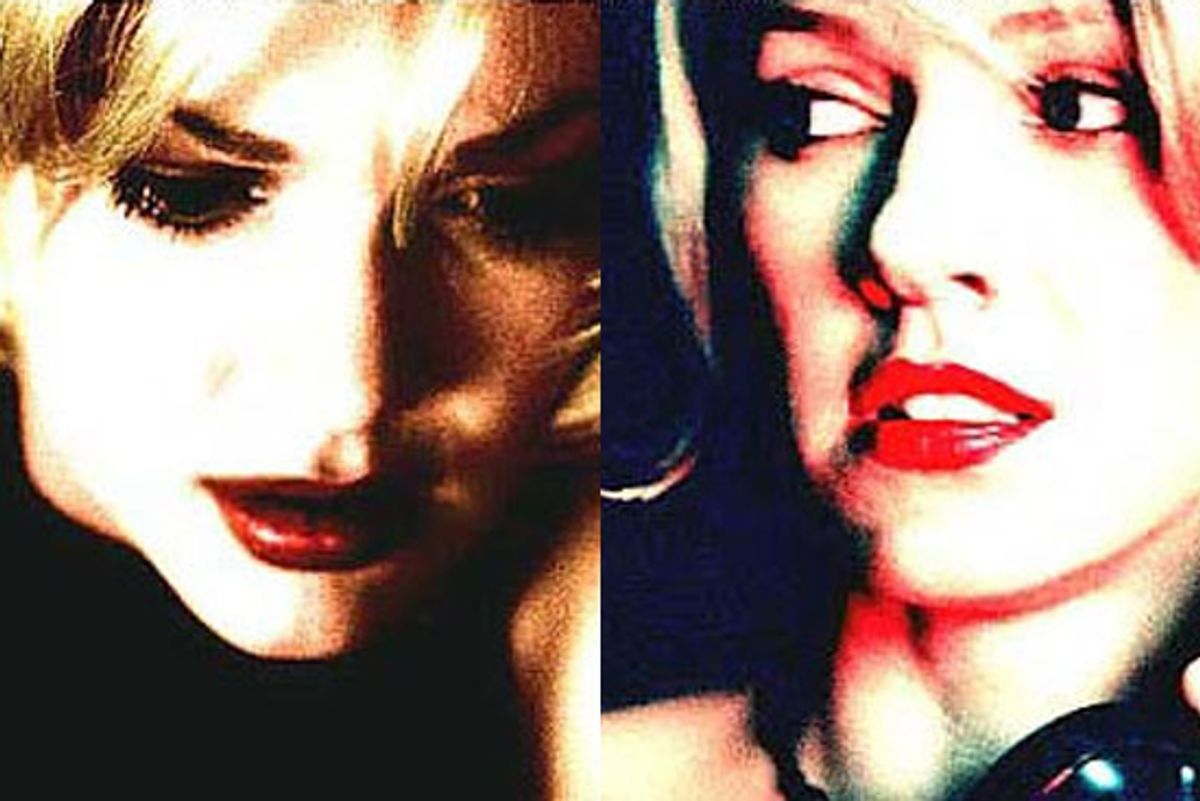
"Mulholland Drive," the latest feature from director David Lynch, is exhilarating -- two hours and 25 minutes of macabre thrills, highly charged erotica and indelible images. But it's also confusing. Bits and pieces of plot dribble out; characters appear and disappear; the film takes an incomprehensible turn two-thirds of the way through; and there seem to be three or four disparate story lines that have virtually nothing to do with one another.
In this way, the film is similar to Lynch's "Lost Highway," his cinematic scud missile of 1997. In that film, the 40-something Bill Pullman languishes in a locked prison cell. He then, without explanation, turns into the 20-something Balthazar Getty and is released from prison, and the movie goes off on a new story tangent. That was just one puzzling development in a film whose plot was regularly described as a Möbius strip by reviewers.
"Mulholland Drive" is a movie along those lines, though its filmic palette is broader, its setting (Hollywood and the film industry) more portentous, and its themes plainer. Beyond that, the narrative is intricate and playfully surreal rather than opaque and frustrating.
Indeed, it may be the most conventional and coherent of Lynch's "hard" movies ("Eraserhead," "Blue Velvet," "Twin Peaks," "Fire Walk With Me," "Wild at Heart," "Lost Highway"). All the themes that cycle through his work -- strange figures pulling the strings behind the scenes, random acts of extreme violence, bizarre character fixations and the feeling that the surreal is an active part of our everyday life -- are present here, but he's tied them to a narrative structure that, in the end, resolves itself. For aficionados, there are red herrings that will maintain many a debate, but others will suspect that Lynch is finally coming out and telling us what he's all about.
Still, of recent American movies, only "Memento" is remotely as challenging, and it's still almost impenetrable on first viewing. What follows includes a synopsis of the plot and then questions and answers about what in the world is going on in "Mulholland Drive's" strange universe. So stop reading now if you haven't yet seen the film.
- - - - - - - - - - - -
Here's the basic plot: The film opens with garish, distorted footage of people jitterbugging; it's a hellish version of a Gap ad. Then we see washed-out superimposed footage of a young woman with a sort of beatific homecoming queen smile on her face.
Then there's a few seconds of a red blanket; breathing sounds pulse on the soundtrack.
Then the movie proper starts, with a few parallel stories: In one, a gorgeous woman is in the back of a limo, climbing the winding curves of Mulholland Drive above Los Angeles. The driver stops unexpectedly and points a pistol at her. But before he can fire the limo is rammed by one of a pair of drag-racing cars. The voluptuous woman gets out in a daze and stumbles down the hills into Hollywood and ends up sleeping in an apartment whose owner is away on vacation.
Then we see a diner, with an odd, nervous, nerdy-looking young guy talking to a more composed middle-aged man. The younger one says he's had a dream about the diner and a monster outside. They go outside and see the monster! The young guy collapses.
Someone is after the woman who wandered off from the car wreck. We see a strange man pick up a phone and hear that they haven't found her yet. He calls a number and passes along the message; we see a dirty yellow wall phone picked up and accept the message. Then we see that phone hung up, picked up and dialed. A phone rings on a coffee table next to an ashtray, but no one answers.
We are introduced to another character, Betty, as she gets off a plane, chatting gaily with an elderly couple she met on the flight. Betty is a bushy-tailed, almost painfully chipper young woman just arrived in Los Angeles to make her fortune as an actress. The older couple effusively wish her luck.
In yet another narrative stream, a young director, Adam, is being forced by some evil Hollywood studio types to cast a certain ingénue in his film -- a blond named Camilla. Arrogantly, he refuses; a strange man in a spooky room orders that the film be shut down. Adam leaves for home in despair and finds his wife in bed with the pool man, who beats him up.
Meanwhile, a scruffy blond-haired guy is talking to a long-haired guy in a shabby office, who mentions something about an accident. The blond guy pulls out a gun and shoots the other, apparently to get a mysterious black book that has some sort of connection to the attempted killing of Rita. But a shot goes awry and hits a woman in the next office. The hit guy tries to strangle her, then shoots her. Then he shoots a janitor who wanders by. Then he shoots the janitor's vacuum cleaner and starts a fire, which sets off alarms and sprinklers.
Betty is staying in the vacant apartment of her aunt, in a building run by an older woman who calls herself Coco. Betty stumbles on the bruised woman hiding out in the shower! She's under the impression, at first, that she's a friend of her aunt's; but it eventually is revealed that the strange guest is suffering from amnesia. She christens herself Rita, after seeing Rita Hayworth's name on a movie poster; the pair find $50,000 and a mysterious blue key in Rita's pocketbook. This suits the Nancy Drew-like inclinations of the out-of-towner perfectly, and they set out to figure out the secret of Rita's life.
The director is thoroughly menaced by some dark forces, including a very scary guy in a cowboy hat in a deserted corral at the top of Beachwood Canyon, high above Hollywood.
The cowboy, calm but dangerous, tells the director again to hire Camilla, the ingénue. "If you do what you're told, you'll see me one more time," the cowboy says calmly. "If you don't do what you're told, you'll see me two more times."
Betty, meanwhile, is preparing for her first audition. She and Rita practice her lines; she's clumsy and conventional. But at the actual audition she turns into a sensual bombshell -- and blows away the producer and everyone watching!
Then a casting agent walks Betty over to the director's movie set. It seems to be some sort of '50s period piece. We see a woman sing Connie Stevens' "16 Reasons." Then Camilla, the ingénue the bad guys are shoving down Adam's throat, sings Linda Scott's "I've Told Every Little Star." "This is the girl," Adam says.
Betty and Adam's eyes meet. But she runs home to Rita.
The two women follow clues to the apartment of another young woman, Diane. They speak to Diane's neighbor, then break into her apartment and find her dead and decayed in her bed!
Shaken, the two return home and dress Rita in a blond wig as a disguise. Betty invites Rita to share her bed that night. Rita makes a pass and the pair find comfort in each other's arms.
"Have you even done this before?" coos Betty.
"I don't know," replies Rita, "-- have you?"
Betty says, "I want to, with you. I'm in love with you."
Rita has a dream about a stage show in a nightclub. She drags them to the club, which is called Silencio. There, musicians and singers pretend to perform, but the music is all canned. Says the emcee: "This is all a tape recording. It is an illusion."
Up in the balcony, the pair begin crying. Betty shakes and weeps in some hyperemotional response to the music. Without explanation, she finds a glistening blue box in her purse.
They go home. Rita turns to the closet. When she turns around, Betty has disappeared. Rita uses the key to open the box. She's apparently sucked into it; we zoom into it, presumably from her point of view, and it drops to the floor.
The movie suddenly changes. We're back at the dead Diane's apartment. We hear knocks at her door; we even see the mysterious cowboy again! "Hey, pretty girl, time to wake up," he says.
Her neighbor, whom we met before, finally wakes her up. Diane is a haggard, dirty-blond with a nervous twitch and a beaten-down look. She notices a blue key on her coffee table.
She's involved with a taunting but cold brunet -- the amnesia victim, Rita! The brunet's real name, we learn, is Camilla -- which is the same name as the ingénue the studio bad guys are pushing. But that woman was blond and much shorter -- an entirely different woman.
The two women have sex on the couch, but Camilla suddenly goes cold. Camilla says, "We shouldn't do this any more."
Diane, horrified, says, "Don't say that," and tries to force her way with her.
This Camilla is suddenly the object of the charms of the young film director, now happily separated from his wife. We see him putting the moves on her on his movie set. Camilla makes sure that Diane can watch, which she does, glowering.
Later we see Diane masturbating in an unhappy frenzy.
The phone rings; the phone she picks up is the one that isn't answered at the beginning of the movie. Diane is taken in a limo to the party -- the same limo, it seems, we saw Rita in at the beginning of the film. It's on the same ominous trip up Mulholland Drive, too.
But she's not about to be shot. Instead, she's greeted at a party by Rita, who is now Camilla. The host is the director, and the weird Coco is now the director's mother! She questions Diane with a look of disapproval on her face. We learn that Diane was a teen jitterbugging champion in Canada who came to Hollywood after her aunt died and left her some money. Diane says she's acted a bit, and met Camilla at an audition for a big part in a movie called "The Sylvia North Story," directed by Paul Bruckner. But she lost the part to Camilla.
Diane, humiliatingly, is forced to watch first as the blond Camilla from the first half of the movie comes over and kisses her Camilla, deeply on the lips. And then Camilla and Adam make out in front of her at the table. They seem to be about to announce their engagement.
This scene abruptly cuts to one in which we see a distraught Diane sitting again in the diner, paying the shaggy hit man $50,000 to kill her girlfriend. He's holding a black book. She'll find a blue key on her coffee table when the deed is done, he says.
The camera pans out into the back lot of the diner, where we see the monster again. It's a homeless man, it turns out, his face filthy and his hair matted. He's turning the mysterious deep blue box over in his hands.
We suddenly are reintroduced to the cheerful elderly couple who accompanied Betty off the plane -- incredibly tiny, and crawling out of the mysterious box. Now they are shrieking and horrific. They chase Diane around her apartment in a phalanx of terror. She flees to her bedroom and shoots herself in the head.
The couple laugh maniacally.
We see the ominous L.A. cityscape at night. Spectral washed out images float over it, just like at the beginning of the movie. This time we can see Betty and Camilla's faces.
Then there's a shot of an odd, heavily made-up actress from the club the women went to.
"Silencio," she says.
- - - - - - - - - - - -
This all leaves a number of questions. Let's take them in order. (Feel free to send us suggestions, quarrels or further thoughts on the film.)
What the fuck is going on in this movie?
Well, it seems that Diane had her girlfriend murdered. Then, in a masturbatory fantasy cum fever dream in the moments before she commits suicide, she reimagines her ruined career and failed relationship with the woman she loves.
The dream begins with Camilla/Rita miraculously escaping the hit Diane had taken out on her. From there, Diane, a product of Hollywood, imagines the story in cinematic fashion: She sees herself as the naive wannabe starlet Betty, who succeeds on sheer talent and solves whatever problems are thrown her way. She even gets the girl!
Thematically, Lynch seems to be working out a number of things: the enticing but empty imagery of the movie screen; the accompanying imagery that is used as stardust to cover up the unpleasantries of the movie-making process; the imagery that the ambitious use to reimagine and remake themselves; and the imagery and imagination actors put to work to create their characters.
Wait, go back to the Diane and Rita stuff. Where does Betty fit in?
Diane and Betty are the same person.
Get out!
Some viewers see that it's the same person right away; others are flummoxed because they just seem different. If you look closely, you see they're the same actress. The actress, Naomi Watts, delivers a technically dazzling performance. It's difficult to believe that chipper Betty and the ground-down Diane are the same woman, but they are.
As a reader points out in a letter to the editor, Lynch even slips in a wry joke. "It's weird to be calling myself," Rita says as the pair call Diane. "Hi, it's me," Diane says immediately afterward, on her answering machine.
Fine: "So it was all just a dream." Is that the cliché you're contending Lynch is giving us?
Well, it's a little more complex than that. It certainly does explain the exaggerated gestures, heightened emotions and odd plot turns in the first part of the movie. Seen as dream motions, Betty's hokey "I'm goink to be a stah, darlink" schtick makes more sense.
Diane's fantasy is a number of things. It's obviously a dream of a world in which her relationship with Camilla was different -- a place where Camilla loves her and is dependent on her. But it's also a requiem for her lost career, and arguably an elegy to a lost Hollywood as well. But Lynch seems rather ambivalent about the lost Hollywood, which by analogy undermines Diane's dream vision, too.
Lynch may be telling us that this is the dream we all share when we watch Hollywood movies, and reminding us at the same time that it is a dream -- that it is wishful, and says a lot about the dreamer. The movie's most problematic conceit is Diane's hallucination of the mad powers behind the scenes in Hollywood. Are those imaginings the incoherent ones of a cockeyed youngster turned sour by failure? Or the unvarnished truth of someone who'd seen it happen, up close and personal?
Indeed, Diane herself is someone who deals with personal rejection by hiring an assassin. Lynch does a great job intertwining the dicier sides of Diane's character with a wider critique of Hollywood as a business and the complex relationship between Hollywood as dream factory and its audience. It's possible Lynch sees consumers of popular Hollywood fare as unable to work out their grievances in their real lives, so they resort to fantasies of revenge.
What's the time period of the movie?
It's apparently the present, but the dream part of the film is an eras-spanning romanticized netherworld of ivied Hollywood apartment buildings, aging stars and picture-perfect period re-creations on busy sound stages. (In "Blue Velvet," too, Lynch pulled off the trick of creating a modern setting that seemed somehow to have previous decades still hanging heavily in the air.) The women ride around in cabs a lot, an anachronistic touch. But the thuggish hit men and crack-addled hookers wandering around are up to the minute. Overall it's typical of the fine line Lynch walks between the fantastic and the real, all set against a malevolently filmed skyline, harsh parking lots and the endless expanse of light that is L.A. from the hills at night.
Speaking of which, despite a few night scenes, this is one of those odd noirs in which terror lives in broad daylight.
OK, so what about the box?
We don't know about the box.
What about the monster?
The monster, who hides behind the diner where Diane contracted the killing, seems to be the demon Diane metaphorically begins dealing with when she decides to have her girlfriend knocked off. In the end we see he's just a homeless man, a reminder of the grimy Hollywood Diane came to know after her jitterbug-queen optimism got beaten out of her. And, OK -- he's also the keeper of the box, the symbol of Camilla's death and perhaps reality contained (sort of like a movie). Once it's unlocked, Diane has to return to the physical world and accept that she's done an inhuman thing.
Readers see a lot more in the box: Several found an amusing -- and hard to argue with -- sexual connotation. (Maybe that's why the hitman laughs when Diane asks what the key opens.) Others make a case that it's a television. The multiplicity of meanings fits in well with the film's texture.
The blue key is supposed to mean Camilla's dead; but we see her alive after that.
After the fairly straightforward narrative of the film's first two-thirds, the last part of the movie is a staccato sequence of flashbacks. Diane sees the key, and understands that the deed is done. (She probably understands that she's going to pay a price for it, too; her neighbor even tells her that "Those detectives were here again.") She starts reflecting on how she came to be in this position, from Camilla's coolness to her flirtations with Adam to the unforgivable humiliations at the party. Diane sees that she's been reduced to an object of pity and contempt by even someone like Coco. That takes her into the downward spiral that produces the hallucinogenic first part of the movie and then her decision to shoot herself.
Let's talk about the 50 grand. Diane gives it to the hit man; why is Rita carrying it?
This is a good example of Lynch's dream logic. Diane fetishizes it, and it turns up in an odd place in the dream. Same with the mysterious blue key. The hit man says he'll leave a normal blue key in her apartment when the deed is done. This transmogrifies in her fantasy into that futuristic one. Both are also necessary to Diane's dream mélange of film clichés, particularly noir film clichés (and the director's deconstruction of the genre as well: "A dame appears out of nowhere with 50 grand in her purse and a mysterious key.")
Watch the movie carefully and you see that many characters and props in the last third of the film are picked up in Diane's mind and repurposed for the dream: The hit man's black book; her grouchy neighbor; the waitress at the diner; the director's mom; the director who didn't give her the movie part; the woman Camilla kisses at the party; the cowboy; even her aunt.
What mélange of film clichés?
Diane seems to have imbued herself with the worlds of film, TV, even pop-culture camp, in her time in L.A. Much of what she and Rita attempt are procedures right out of a Sam Spade noir handbook by way of Nancy Drew -- peeking into windows, talking to neighbors, making anonymous phone calls and so forth. When the two are in their bed together, there's a double-profile shot that's an homage to Bergman's "Persona." Betty helps Rita turn herself into a blond, a rough doppelganger of Betty, à la "Vertigo." The sequences in which the director is bullied into using Camilla in his film have a tangential similarity to the conversations leading up to the infamous horse's head scene in "The Godfather." Readers note that "The Wizard of Oz" is in there too, as well as a strange pattern of parallels to "Pulp Fiction."
There are also vague echoes of TV soap operas, pornography and a lot of other things, not to mention the presence of Chad Everett (the guy Diane does the audition with), '40s hoofer Ann Miller (Coco), Lee Grant (the aunt's weird neighbor), Billy Ray Cyrus (the pool guy), Robert Forster (a cop), and others.
The references all seem to be what the theorists call "blank," just memories ricocheting around in poor Diane's head at a really bad time.
Fine, fine. Isn't the cowboy just sort of a twist on the menacing Robert Blake character in "Lost Highway," the reindeer man in "Wild at Heart" etc., etc.?
It certainly seems like it. The goofy Roy Rogers getup is also another echo of a prelapsarian Hollywood when the studio system ruled and studio heads of virtually limitless power really did pull the strings.
The director did what he was told. Why did we see the cowboy twice?
Well, the cowboy appears once to Diane as a transition from her dream back to reality, apparently part of her fantasies before she kills herself. In the "real" last third of the film, we see the cowboy passing out of the party at the director's house. To us, caught up in the backward dream logic of Diane's fantasy, this would have been the one last time the director would see him, since he agreed to put Camilla in the movie. But in reality he was just someone she once saw out of the corner of her eye who was then incorporated into the paranoid fantasy of her dream.
What about that hooker the hit man questions and then ushers into his van? And what about those diner waitresses?
They seem to be Lynch's nods to the milieu he's filming in and the diverse women Hollywood chews up in various ways. Diane imagines herself as Betty in the dream after seeing a waitress named Betty when she's talking to the hit man. In the dream, Betty meets a waitress named Diane.
Betty loses a part in "The Sylvia North Story" to Camilla. Who's Sylvia North?
Beats us. But note that the director of that movie is Paul Bruckner -- the milquetoasty guy at her audition.
That weird old couple?
They appear in the opening jitterbug sequence as well. They may be the judges of the contest she won, or her parents. In the end, they seem to be signs of her innocent past come back to terrorize her.
The film's dedicated to Jennifer Syme. Who's that?
Syme was an actress who appeared in "Lost Highway." She died in a car accident. The tragic death was noted in the tabloids because she used to date Keanu Reeves.
What about the Silencio Club?
In the dream logic of Diane's imaginings, it's part of the glamour of Hollywood, and the out-of-body existence of many actors, and perhaps the ultimate emptiness of the reality that films purport to give us. The unexpected focus on sound, as opposed to image, which is what the rest of the film seems to be about, is typical for Lynch as well: His soundscapes, here as in his other difficult films, are extraordinary, and he regularly conflates sound and image. Remember that in "Blue Velvet," which also dealt with the reality beneath the surface image, young Jeffrey, the Kyle MacLachlan character, is introduced to that netherworld via a severed ear.
Lynch's longtime composer, Angelo Badalamenti, plays the espresso-drinking movie exec at the beginning of the film, incidentally.
Also, speaking of "Blue Velvet," Dorothy Vallens lived in the Deep River apartments. Betty is from Deep River, Ontario.
What is the point of that scene with Chad Everett, Diane's audition?
This strikes us as possibly the heart of the movie. It's the linchpin of Diane's idealized image of herself. Yet beyond that, the care with which the sequence is set up and the scene's immense punch seems to suggest that Lynch believes, perhaps passionately, that there is such a thing as acting, even great acting. It may be his tribute specifically to the miracle of character imaginings like Diane's and, by extension, to the creation of self in our subconscious and the many selves we don't know. Actors make it up out of nothing more than sheer imagination and persuade the audience to believe it. Lynch has been doing the same thing explicitly over his entire career.
Again, Naomi Watts, the actress, should be given credit for balancing the many levels of control needed to convincingly act the part of a ground-down starlet imagining herself as a chipper and idealistic young thing who then can convincingly deliver a unexpectedly searing audition performance -- and then have the levels of the conceptions make emotional sense to viewers at the end of the film. Brava!
The hit man thing is confusing. Who is the long-haired guy he murders? And what about the prostitute he ushers into the van? Is that Diane, too?
The guy he shot so perfunctorily made some remark about a car accident. The implication seems to be that he was in one of the joyriding cars that hit the limo, and that he ended up with some sort of black book that the guys who were about to kill Rita possessed. In the logic of Diane's dream, the hit man needed that as a lead to where she was. We know that it's not going to help him find Rita, but he doesn't know that.
The scene is also another movie nod, this time to the absurdist modern black noir; here it allows Lynch, at his bleakest, to film a senseless carnage that out-Tarantinos Tarantino. It's also part of the confusing background noise Lynch likes to put into his movies. It is a deeply felt contention of his that not everything makes sense. Less charitably, you can say it's a loose end from the TV series that never got made.
What TV series?
"Mulholland Drive" was supposed to be the pilot for an ABC TV series that was going to both make ABC the network of the moment and put Lynch back into a "Twin Peaks"-like limelight. Fat chance. The network approved the script, but balked when execs saw the two-hour-plus result. Lynch apparently tried to slice off the last 40 minutes, but the network didn't like that either. He eventually found a French film company, Studio Canal, to put up some money. He reassembled the cast, filmed some more and created the feature version out now.
So what is Lynch trying to say about Hollywood?
You can't help noticing that no one comes off very well in this fetid world. In interviews Lynch has been putting the screws to ABC. While he points out that the network had approved the script before he filmed it, it's hard to believe any sane person would expect broadcast television to air a movie anything remotely like this. And we're somewhat suspicious when a director like Lynch -- who's been given tens of millions of dollars to make extraordinarily dark, sometimes positively inhuman ("Wild at Heart," for example) movies for more than 20 years -- whines about Hollywood. He's been nominated for a best director Oscar twice. What does he have to complain about?
All that said, the movie is certainly no polemic. Lynch seems pretty detached from this. The character of Adam the director seems a mocking version of himself. Lynch's nuances and implicit respect for the magic of the art make the film a complex portrait of the industry.
And the artistic rationale for the extended sequences of lesbian sex would be ...
He's playing explicitly with how Hollywood uses women predominantly as sex objects -- except he's turning the formula on its head, making the women's world a closed one, at least in Diane's fantasy of it. But of course, in the end she's doing the same thing a Hollywood movie normally does to a Camilla -- imagining that she's an empty object that she can possess.
In the end, "Mulholland Drive" is Lynch's most sympathetic film, particularly to women. Even if Betty's dream is an extended apologia for a terrible crime, the density of her character, the expansiveness of her dreams and desires, and the catch-all giddiness of her imagination all make her something close the one the thing she always wanted to be: the ultimate movie heroine.
And she's just part of the film's dense milieu. The network of aging actresses and incoming starlets ineffably captures the implacable Hollywood mill. Lynch seems to accept the manifold processes by which women come in to self-invent themselves: by sheer talent, the way Betty does; desperately, as Diane does; by hook or by crook, as Rita does, plucking a new identity off a movie poster; or sexually, the way Camilla does. All, he seems at pains to point out, are ultimately in the business of dream fulfillment, which is why we as consumers go to the films as well. Right?
- - - - - - - - - - - -
If you liked this feature, please take a minute to click here to read a note from the Arts & Entertainment staff about Salon Premium.
Shares