

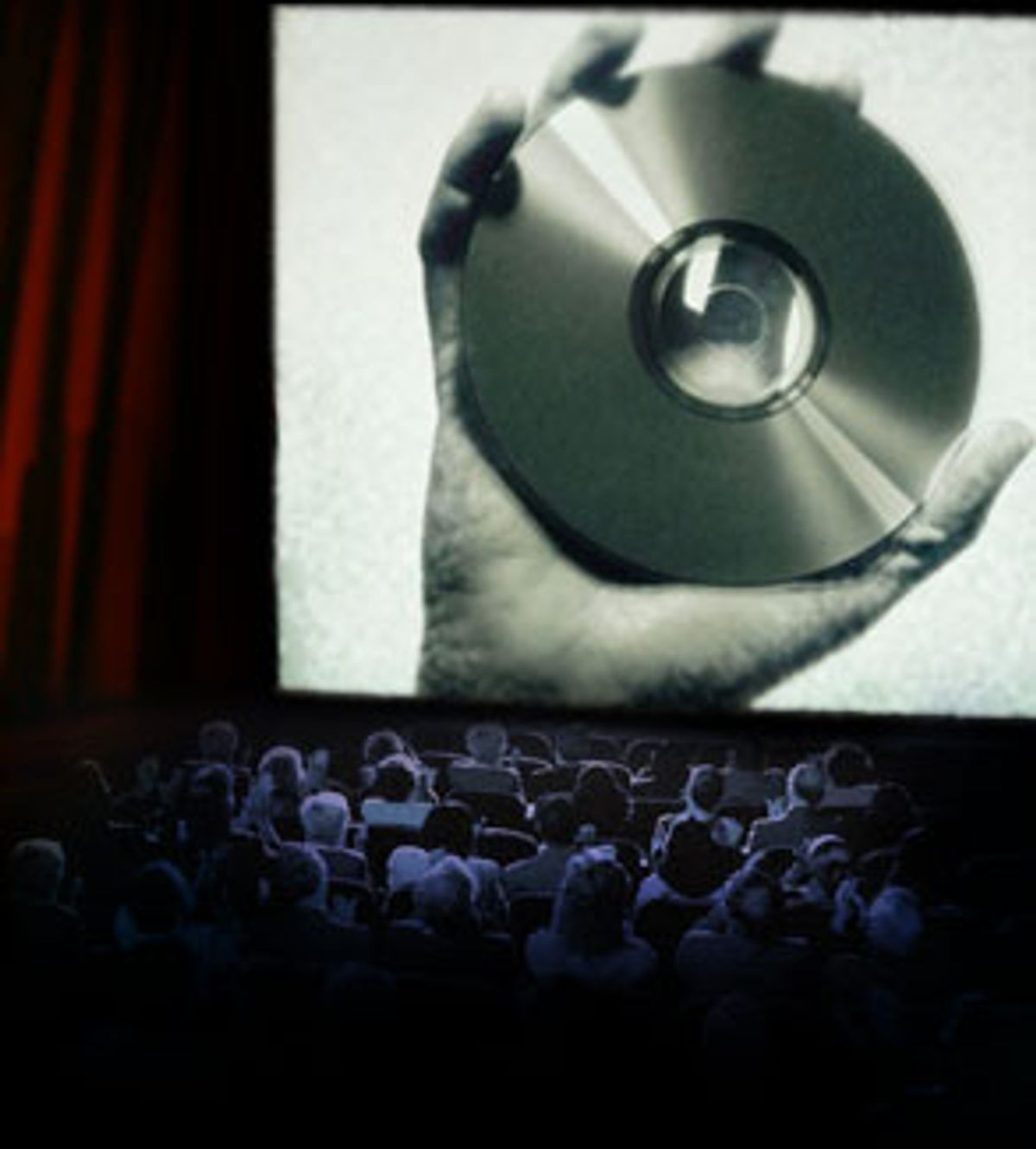
"Movies as they were meant to be seen." To film purists that has long meant one thing only: on the big screen. It's also a phrase used by the premium cable channels that run movies without the cuts imposed by the major networks, and by DVD manufacturers who have raised the bar on the quality of movies available for home viewing.
With high-definition TV poised to become the standard in a few years, and with DVDs on their way to leaving VHS video in the dust, the way movies were meant to be seen no longer seems so clear. The death of the theatergoing experience has been proclaimed for nearly 20 years now, and it's no more true today than it was when the first VCRs rolled off the assembly line. The fear of technology among film critics and purists (not necessarily the same thing) may obscure the possibility that DVD heralds the dawn of a new age. By that I mean an age in which movies have a life span far beyond their theatrical runs, and an age in which the condition of classic movies is immeasurably improved.
The argument that home technology will kill movie theaters is the latest version of one that began in the '50s with proclamations that television would kill the movies. (In Joe Dante's "Matinee," set during the Cuban missile crisis, there's a shot of a local movie house with a banner hanging outside that says "FIGHT PAY TV.") A half-century later, the death of the movies (at least as far as their commercial viability goes) is no nearer than it was when this issue was first raised.
By the time VCRs became common in the early to mid-'80s, repertory houses had been struggling for most of a decade. The movie audience that coalesced during the '60s and '70s and provided a backbone of support for emerging new American directors and foreign films had started to disintegrate around 1975. By the time the Reagan decade rolled around, audiences who would have laughed at movies like "Ordinary People" or "An Officer and a Gentleman" just a few years earlier had made them, and even worse pictures, into big hits. The audience drift away from quality movies coincided with the studios learning, courtesy of one terrific movie ("Jaws") and one lousy movie ("Star Wars") that there were enormous profits to be made from blockbusters.
Not that it was ever easy for quirky, personal movies. Even during the '60s and early '70s, when moviegoers were most adventurous, some of the films now rightly regarded as classics never found an audience. No greater American director than Robert Altman emerged in the '70s. But apart from "M*A*S*H" he never had a commercial hit. "McCabe and Mrs. Miller" turned a minuscule profit, but gems like "The Long Goodbye," "Thieves Like Us" and "California Split" didn't even do that.
Even in New York, Jean-Luc Godard's '60s movies routinely got commercial runs of about a week. When the restored version of "Band of Outsiders" opened in New York last year, it was the first time it had played the city since its original American release -- and this run was about four times longer.
I share the nostalgia for repertory houses. I was lucky enough to grow up outside Boston at a time when that city and neighboring Cambridge had a thriving repertory scene. In my high school years, a small rep house operated for a while right in my suburban town, and my best friend Steve and I were able to see pictures that ranged from "The Third Man" to "The Discreet Charm of the Bourgeoisie" to "Straw Dogs" for the first time, as well as new foreign films and commercial American movies that had disappeared before finding an audience. The theaters in Cambridge and Boston allowed us to see Godard and Ingmar Bergman festivals, legendary and little-seen foreign movies like "Celine and Julie Go Boating," and Hollywood should-have-been-classics like "The Crimson Pirate."
Everyone who loves movies owes a debt of gratitude to the theaters that are somehow managing to keep that tradition alive, like the Brattle in Cambridge and the Film Forum in New York. But it's hard to feel nostalgic for the slim pickings of what followed the glory years of rep: Endless double bills of "King of Hearts" and "Harold and Maude" (or, later, "Diva" and "The Road Warrior").
The most inconvenient truth obscured by waxing nostalgic for the glory days of rep houses -- and the one that is most pertinent in defending DVDs and home video -- is that people who don't live in big cities or college towns never had access to anything but mainstream commercial movies.
Video changed all that. Not only could movies be watched at home uncut and uninterrupted, but video extended a movie's shelf life. To this day, good movies that did bad box office ("Galaxy Quest" is a good recent example) become hits on video. It's unthinkable for us to imagine a world where people heard about but couldn't read Melville or Joyce, or, for that matter, P.G. Wodehouse or Raymond Chandler. But that's exactly what the availability of movies was like in the pre-video era.
Suddenly, for the first time, people could go to a video store the way they went to a library. Sure, you have a better chance of finding a wider selection of movies to rent if you live in a more cosmopolitan area, but outlets like Facets and newer services like Netflix have made it possible to rent virtually any DVD or video by mail. Even with the access I had to repertory houses, video was the only way for me to see many films. I no longer had to imagine movies I'd read about. This extended life for movies has been invaluable to movies with minuscule advertising budgets, limited releases (one of the greatest movies of the '90s, "Cobb," never played outside a handful of cities), or bad luck at the box office.
A few years ago a nephew of mine in Maine fell in love with Asian culture. Luckily, he lives near a good video store and his mother rented Kurosawa's "Seven Samurai" for him. He simply would not have had a chance to see it otherwise.
If we insist that movies are only meant to be seen on the big screen, then we have to be honest about the consequences of that. Specifically, we have to be comfortable with the fact that large numbers of people will not have access to movies. And some of those people are not just the potential filmmakers and critics of the future, but perhaps most important, the moviegoers whose enthusiasm helps keep movies alive.
A critic I know once got a letter from a schoolteacher in a small Australian town. He wasn't near a theater, but he was lucky enough to have access to a good selection of video and his school owned a VCR. So, as generations of Americans did with drive-ins, this man and his wife would bundle their kids into pajamas and sleeping bags, head to the school and watch the movies they'd read about in my friend's column. That's a writer's dream, knowing that your writing isn't going into the void but to an audience that can respond to you, that has a chance to see the same things you do.
Given the choice, I'd much rather see something on the big screen first. In a perfect world, that's the choice that everyone should make. Watching a movie like "Lawrence of Arabia" or "Spartacus" at home, even in a letterboxed print, can never be more than a memento of seeing it in the theater. And the same is true of more modest-scaled movies like "L'Atalante" or "The Umbrellas of Cherbourg."
I shrink a little when I hear people who can afford to go to the movies say, "I'll wait till it comes out on video." There's also no doubt that the availability of films on video has encouraged a certain laziness. Movies weren't meant to be watched for an hour at a time and finished later. But home technology shouldn't take the rap for bad viewing habits, any more than libraries should take the blame for people who can't force themselves all the way through "Moby-Dick."
For all the benefits of video, there are drawbacks that the form has never overcome. A few years back, when DVDs were coming in, an editor -- overstating the case and dead-on at the same time -- said to me, "I think VHS is going to be remembered as one of the great aesthetic crimes of the century." That may sound simply like the enthusiasm of someone captivated by the new technology. But sometimes, especially in criticism, overstatement is the quickest route to the truth.
Many VHS videos were simply transfers of faded prints that had been gathering dust in studio archives for years. They weren't cut or censored as movies still are on the broadcast networks, which still want to believe that cable is a trend. But aesthetically, they were often just as much a mess. It took years for movies to be released on video in letterboxed format, which meant that the cropped image you saw left out at least a third of what the director had meant to show you, as if you had picked up a book to find a third of the text had been been randomly cut.
For years, Bantam paperback books have carried the disclaimer: "This edition contains the complete text of the original hardcover edition. NOT ONE WORD HAS BEEN OMITTED." That's not only a point of pride, it's a selling point as well. Yet we regularly rent or buy videos whose package says, "This movie has been reformatted to fit your television screen." And the fact is that any widescreen movie made by someone who knows what he or she is doing is nearly impossible to watch that way.
When I tried to teach Brian De Palma's "Dressed to Kill" and "Casualties of War" to a film class a few years back, I found myself having to stop the film at certain points and explain what had just happened. De Palma has consistently used split-screen images, or used the widescreen frame to show us two things happening at once. Watching the cropped and reformatted video of "Dressed to Kill," my students could see Nancy Allen boarding a subway train to escape a killer on the left side of the screen -- but they couldn't see the killer slipping into the same train on the right side. More movies have become available in letterboxed video, but even if we were to reach a point where every movie released on video were in the correct aspect ratio, we would still have to deal with the picture quality of video.
Getting to see the entire picture was the only thing my wife and I had on our minds when we bought a laserdisc player. We were sick of renting movies that had been "panned and scanned" (the technique used for television, which, in order to show everything going on in a widescreen frame, creates camera movements or editing that was not in the original film). We wanted to be able to see all of the movies we loved. But the quality of the laserdisc image knocked us for a loop. The image was crisp and vivid, with none of the lines and watery color still common to video, and it wasn't prone to the fading that inevitably occurs with video.
I love laserdiscs. I've put together a substantial collection of them and I'm hoping that I'll be able to keep getting my player serviced or buy a new one if I need to. But the technology never caught on, perhaps because it was expensive (anywhere from $34.95 to $100 or more for multidisc sets) or because, in the age of mini-size technology, the discs, which is the size of an LP, struck people as cumbersome.
When it became clear that DVD was going to supplant laserdiscs, I grumbled the way a lot of us did when it became necessary to switch from records to CDs. For a while I hung onto the rumors I heard that the picture quality of DVDs wasn't as good as the quality of laserdiscs. It was wishful thinking, and the evidence of your own eyes should tell you that it's not possible to indulge in wishful thinking about the future of video.
If you frequent any store that sells both videos and DVDs, then over the last couple of years you've watched the DVD section expand while the video section has been reduced. Even small neighborhood stores are stocking at least some rental DVDs. But the greatest threat to the future of VHS is not just the quality of DVDs but their price.
With the exceptions of a few big hit movies hustled onto retail video to capitalize on their theatrical success, most videos are still released "priced to rent" (usually at a list price of $109.98) before they appear in retail stores "priced to own" (usually at a list of $19.98). By comparison, DVDs arrive in stores at the same time as priced-to-rent videos, at considerably lower list prices, ranging from $14.95 to $29.95. And since new DVDs, like new CDs, go on the market at a sale price, they can usually be picked up online or at big-box discount stores for cheaper than that. They can generally be rented for no more than it costs to take home a video. Online rental services are making DVD rental even more convenient than going to the video store, and some of them (like Netflix) allow you to keep the disc as long as you want and then return it in a prepaid mailing envelope.
How can video hope to prevail against an increasingly available technology that offers comparable prices (which keep dropping; a low-end DVD player can be had now for less than $100, and a pretty good one for less than $200) and immeasurably better picture quality? Of course the big advantage VHS still has is the ability to make your own tapes at home. But now that DVD burners are popping up, that advantage may be ending. If someone can come up with a cheap, easy and reusable method of recording from TV to digital discs, especially when high-definition broadcast becomes standard, it may be time to throw away that VCR.
That also means that the question of "how movies were meant to be seen" is now up for grabs. Much as I would love to rhapsodize the moviegoing experience, reality gets in the way. In the last few years, the owners of the big theatrical chains seemed to have finally registered moviegoers' disgust with sitting in theaters the size of extra-wide bowling alleys, watching postcard-size screens. Most prevalent now are the new stadium-seating megaplexes that offer unobstructed sight lines, comfy chairs and enormous screens. (Art houses, especially in New York, are still a problem. The two main art-film theaters in Manhattan, the Lincoln Plaza and the Angelika, are not raked. If you see a foreign film with a decent-size audience, chances are you'll spend part of the movie bobbing and weaving around the head of the person in front of you to read the subtitles.)
Despite the better physical condition of the multiplexes, the problem of projection remains. In an attempt to save money by freezing out the projectionists' union, most of these chains have resorted to automated projection, with one or two projectionists scrambling between umpteen screens. So if an image comes on unframed or out of focus -- on the new, bigger screens, it's pretty common to see an image that is at least partly out of focus -- you have to leave the theater, tramp the miles to the concession stand and hope to find someone who can fix the problem. And even if a picture is in focus, you have to hope that the image is projected in the correct aspect ratio, or that the theaters are properly equipped to show it that way.
The advent of movies projected on digital video rather than celluloid raises all sorts of questions about what the quality of the movie image could look like in a few years. I haven't seen any movies projected on digital video so I don't feel qualified to comment on their quality. But at least one director has come out in favor of it. In an interview a few years back, Mike Figgis said that he prefers audiences see his movies on DVD.
He explained that his films "The Loss of Sexual Innocence" and "Miss Julie" each had fewer than 10 prints made. What that means is that by the time those prints reached smaller art houses in the middle of the country, long after the film opened in New York and Los Angeles, audiences were seeing prints that had been projected several hundred times, nicked, scratched and often spliced. Repertory audiences are just as vulnerable to seeing bad images, though for different reasons. Often, the prints of the older films they show have not been restored and have been deteriorating for years in studio vaults.
Unless you're going to see one of the handful of older movies that are rereleased each year in newly restored prints (something that Film Forum in New York has made a specialty), you are likely to see a print in mediocre to atrocious condition. The Criterion DVDs of "The Lady Eve" and "My Man Godfrey" restore those movies to an Art Deco luster that I have never seen in any existing print. The company's DVD of Hitchcock's "The 39 Steps" is even better, cleaning up sound as well as picture, and doing such a great job on the latter that it shows visual details (like a black cat crossing the street at night) that I had never seen, not even in Criterion's laserdisc version.
Before his death, director Roger Vadim got to see Criterion's restoration of his sun-drenched "... And God Created Woman" and said that the film hadn't looked as good since its original release. Universal has released Hitchcock's "The Birds" and "Marnie" (as well as other films by the director) in versions that restore the vibrancy of their original color. The DVD of King Vidor's sumptuous and ludicrous "Duel in the Sun" restores the film to its original roadshow presentation, including the overture.
Unfortunately, not every company has been as scrupulous. As with the initial videos, some companies are merely rushing out existing prints to get movies on the market. The letterboxed print of Godard's "Pierrot le Fou" on the Fox Lorber DVD is the same faded one as on the old Connoisseur video. And while some DVDs offer both widescreen and reformatted (i.e., full-screen) versions of movies, some films are appearing on DVD only in reformatted versions ("Babe," for instance). Still, a substantial number of movies have made it to DVD in remastered versions that surpass what you're likely to see even if you're lucky enough to have access to repertory houses.
So I return to my original question: Does seeing movies as they are meant to be seen mean risking watching a faded and spliced print in order to preserve the "theatrical experience" -- or seeing the film as it was made, with image quality and aspect ratio intact?
I'm not arguing against the theatergoing experience. From the point of view of someone who loves movies and wants to see them in as good shape as possible, I'm simply identifying some of the problems associated with theatergoing. No one who truly loves movies will ever forgo the experience of going out to see them. Sitting enveloped in the dark is too elemental an experience, as is the communal feel of watching movies with an audience, especially comedies or thrillers or horror films. Who wants to laugh or be scared alone?
DVD won't stop people from going to the movies any more than video or cable or TV itself did. The idiot box is always an easy scapegoat, especially for people who don't want to consider the rest of the country beside the big cities. It's nice to pretend that "La Strada" and "Breathless" and "Yojimbo," "The Lady Eve" and "The Band Wagon" and "Rio Bravo" are all coming soon to a theater near us. For most Americans, it simply ain't so. But all those movies and more can be seen in their living rooms, in better condition than they've been seen anywhere for years.
Even that experience -- watching a DVD of a favorite movie at home -- need not be a solitary one. For movie lovers, the new standards set by DVDs aren't just a promise of being able to see the movies we love as they were meant to be seen. It offers the possibility that we'll be able to share the experience with others, many of whom would otherwise never have gotten the chance.
Shares