You know you're at the South by Southwest festival when the guy in front of you in the popcorn line at the movies, the shambling dude with the giant Afro comb stuck in his giant Afro, actually is ?uestlove of the Roots, rather than just some hipster who looks like him. And when the woman with equally impressive hair who is standing in the auditorium doorway telling him to hurry up and get his ass inside is Erykah Badu. (Admittedly, I've never seen anybody who looked much like her.)
On Day Three of this year's SXSW Film Festival, some of the event's vaunted convergence came to the fore, with rousing world premieres of two new music documentaries: the anti-corporate screed "Before the Music Dies," in which Badu and ?uestlove are prominently featured, and "loudQUIETloud," which follows '80s indie-rock legends the Pixies through their 2004 reunion tour. Beyond that, SXSW's friendly, slightly scruffy alterna-vibe began to seem more coherent. In its own unthreatening, vintage-clothes-'n'-cappuccino manner, this festival is launching one protest after another against the way America is right now and how it's being run.
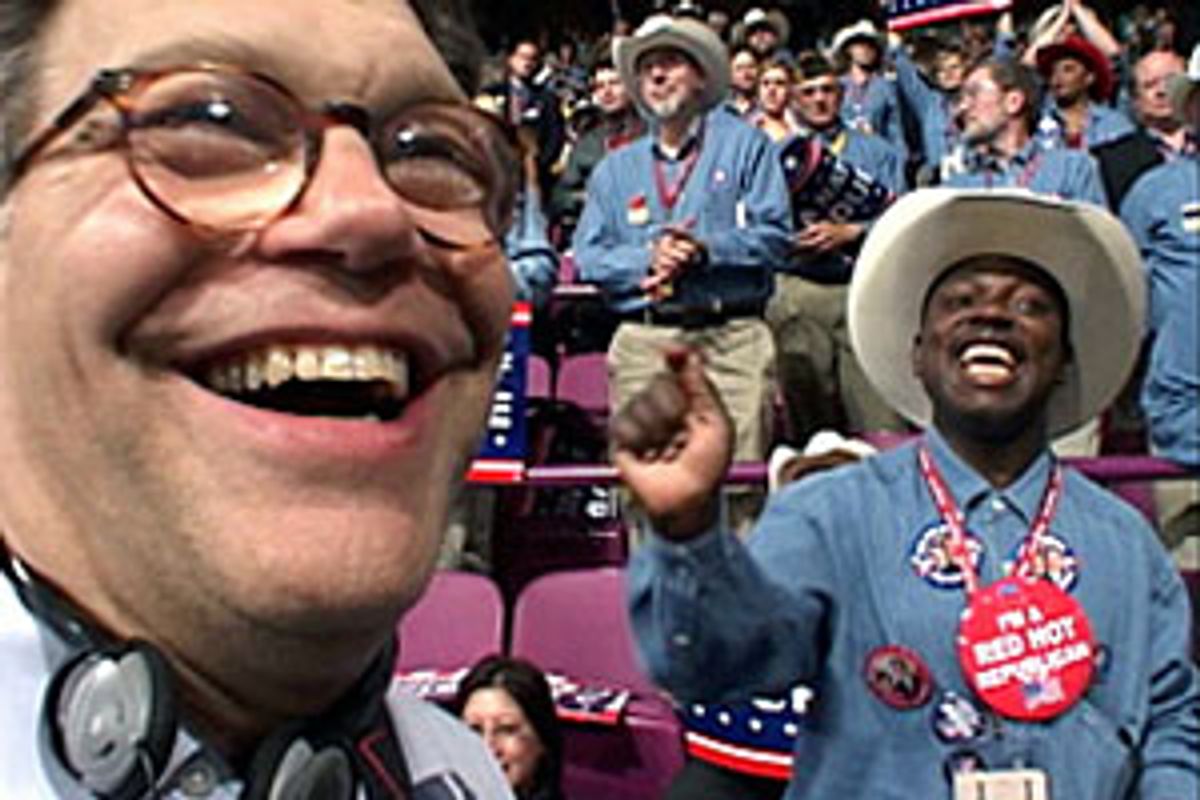
Nothing distills this tendency more succinctly than "Al Franken: God Spoke," the painful and hilarious new documentary from cinéma-vérité veterans Nick Doob and Chris Hegedus that premiered on Saturday night. It's hilarious because Franken, of course, remains a killer comedian even as we watch him engage the so-called major issues of the 2004 campaign season, do his Saddam Hussein routine for American troops in Iraq, or wrassle such media dragons as Ann Coulter and Sean Hannity. It's painful because, as in all tragedies, we know what's going to happen at the end of that campaign, and Franken and the rest of the cast don't.
Hegedus, the longtime colleague (and wife) of documentary legend D.A. Pennebaker -- her directing credits include "Jimi Hendrix at Woodstock," "The War Room" and "Startup.com" -- tells me during an interview here that it's still tough for her to watch the Election Day footage in "Al Franken." Confident of an impending regime change in Washington, and buoyed by those infamous exit polls, Franken gathers his youthful writing staff around him at a Boston hotel. "How do we make gloating funny?" he asks them, before launching into a series of mean-spirited anti-Bush riffs he hopes to use on his Air America program after President-elect Kerry is anointed the next morning.
Pride goeth before the fall and all that. Or, as Doob puts it, "Then the karma police came and got him." Liberals are known for their masochism, and this film, funny as it is, forces you to revisit those dark, dark days two Novembers ago when we had to face the fact that a majority of Americans were still not sufficiently disgusted with George W. Bush. Doob and Hegedus hope, of course, that the masochism has a point -- but whether the kind of audiences likely to be interested in a Franken film are willing to go there is an open question. (At this writing, "Al Franken: God Spoke" has no distribution deal.)
One thing the Election Day scenes clearly establish is that Doob and Hegedus haven't made a Franken infomercial, but rather a portrait of a complicated and enigmatic guy who is making a rapid and sometimes awkward transition from entertainer to political commentator and finally to potential candidate. Franken allowed the filmmakers to follow him around whenever they could, but he had no control over any aspect of their work, and the movie is in no way a collaboration. He seems both profoundly committed to his cause and at the same time a pool-hall hustler working all the angles: He chats affectionately with Karen Hughes, and performs his Henry Kissinger impersonation for an appreciative Henry Kissinger. (That's good, but not as funny as Franken's killer Dick Cheney impression, which may be the only reason to regret the vice president's eagerly awaited retirement from public life.)
"Al didn't help us and he didn't hurt us," Doob says. "He did lots of events he never told us about," including hosting a private meeting at his New York apartment between John Kerry and several prominent journalists early in the campaign season, an exercise in insider power the filmmakers would obviously love to have captured. By the end of the film, in the grim aftermath of Bush's reelection, Franken begins to seriously explore a campaign against Sen. Norm Coleman, R-Minn., in 2008. As he tells an enthusiastic St. Paul audience, he'll be "the only New York Jew in the race." (Although he has made no formal announcement, Franken recently bought a home in Minnesota, where he grew up, and continues to raise campaign money.)
There's certainly material in the film that Franken's opponents -- Bill O'Reilly, for one, seems bizarrely obsessed with him -- can pull out to make him look bad. In a television debate with Ann Coulter about the semi-notorious 2002 memorial service for the late Sen. Paul Wellstone, for instance, Franken is preoccupied by relatively minor details: Was Sen. Trent Lott actually booed? Was he ever actually onstage? He never adequately challenges the big-picture smear, in which the event was depicted by right-wing media as a partisan hatefest rather than a spirited farewell to one of the American left's few office-holding heroes.
"We try to make Al a human being, not a cardboard hero," says Hegedus. "I think he loses that debate with Ann Coulter. But you know, I tend to make films about people I'm fundamentally sympathetic to, even if it's in a bizarre way, like with my film about John DeLorean ['DeLorean,' 1981]. When we started this project, we didn't know that much about Al. But when we went on his book tour [for 'Lies and the Lying Liars Who Tell Them'], he was drawing such huge crowds, and they were so hungry for the message he was bringing them. In making this kind of movie you go on an adventure with your characters. You're certain that something exciting is going to happen, but you don't know what it is."
Doob says, "We felt a kind of groundswell around Al, and we connected to that. He's the court jester of the Democratic Party, and he's also so passionate about what he believes is right and wrong. We hope Al inspires people. He inspires us." That said, Doob adds, when the filmmakers called Franken to tell him that the Austin premiere had gone well before a packed house, the comedian wanted to know only one thing: Which of his laugh lines had connected, and which ones had fallen flat?
Speaking of satire gone awry, even the most abysmal failure among the films screened so far partakes of the protest theme. "Danny Roane: First-Time Director," written and directed by its star, cult comedian Andy Dick, has already become a murmured legend among those who were at the Saturday world premiere. Intended as a vicious satire of Hollywood's inanity and self-obsession, "Danny Roane" drags its cameo-laden cast into a downward spiral of gross-out humor and finally becomes exactly the thing it's trying to parody: a disastrous vanity project made by a damaged TV comic whose career has hit the skids.
Undoubtedly "Danny Roane" has cult-movie potential, but all the reasons that might happen are bad ones. Let's put it this way: James Van Der Beek plays himself in this film, or at least himself playing the lead character in Danny's autobiographical film, an alcoholic actor suffering from an unexplained bloody anal discharge. Not enough butt for you? Later in the film we see Dick himself passed out naked on TV actress Maura Tierney's front lawn, with a black Labrador eagerly exploring his hindquarters. Like most other reporters, I fled the Austin Convention Center's hall after the screening, and so missed the Q&A session in which Dick reportedly humped an audience member's head while mumbling vile obscenities. Maybe that'll show up on DVD, fans -- but some distributor will have to buy the film first.
"Before the Music Dies," which premiered Sunday afternoon for a nearly full house at the Paramount Theatre (including Badu and ?uestlove), is also a work of inspiration, engagingly mounted and certain to thrill like-minded audiences. Its premise is pretty much old news: The mainstream American music industry no longer nurtures talent with any degree of patience or farsightedness; it's basically become a factory for inoffensive pop product, most of it in young and pretty packages. Well, shiver my timbers!
Despite the obviousness of this proposition, Andrew Shapter's directing debut is lively, passionate and well-informed. It gathers musicians from Badu and ?uestlove to Bonnie Raitt and Elvis Costello, as well as industry insiders from the radio and record industries, to explore how and why this happened. As jazzman Branford Marsalis puts it, Ray Charles and Stevie Wonder probably wouldn't get a shot at stardom today: They were black, they were blind, they looked kind of weird.
In one hilarious riff, Badu explains that "back in the day you could be ugly as a motherfucker" and still have a professional career in music. Today, she says, "If you really want to rock somebody's world in the music business, you need to get those implants in your ass ... In 2006, it's about being butt-naked, covered with glitter and wearing a beeper."
Shapter and co-writer Joel Rasmussen have infused "Before the Music Dies" with contagious sincerity, and obvious enthusiasm for the many varieties of American music (principally meaning folk, blues and jazz, and the adjacent areas of rock) we rarely get to hear through mainstream channels. The film has widespread potential appeal, largely because it comes at the problem from a fan's perspective, rather than via knowing insiderism. It also has a half- conscious generational bias against recent musical trends and takes for granted the idea that music created by playing old-fashioned instruments is superior to that created through technological means.
The filmmakers seem only dimly aware of the vast universe of indie and/or experimental rock, underground hip-hop, and other genres avidly pursued by the kind of culturally connected music fans that have made Austin famous. If, as the film argues, blues-rock guitarist Doyle Bramhall would have been a huge star in the 1970s, instead of the marginal alt-Americana artist he is today, does that argue anything beyond the fact that Bramhall hit his Claptonesque peak 20 years too late (or too early)?
When it comes to peaking early, the Pixies were lucky. The innovative Boston band that dominated alternative rock in the late '80s and early '90s was too early by only half a generation. When they decided to reunite in 2003, they were many times more popular than they'd ever been the first time around. In a quote superimposed over the opening frames of Steven Cantor and Matthew Galkin's "loudQUIETloud: A Film About the Pixies," the late Kurt Cobain explains that "Smells Like Teen Spirit" was basically his effort to rip them off.
If "Before the Music Dies" tells you that contemporary pop has a problem with authenticity, "loudQUIETloud" shows you. I wasn't a massive Pixies fan in the old days (like a lot of other people, I learned to appreciate them more after their breakup in 1994), so I didn't approach this movie as a tear-drenched trip down memory lane. It's more like an extraordinary spectacle: Here are four middle-aged people who look like they've lived pretty hard -- OK, really, really hard -- playing dense, thrilling, loud rock music that sounds more dangerous (and a lot less derivative) than about 95 percent of what passes for indie rock these days.
If the live shows in Cantor and Galkin's film positively burn down the barn -- they said after the screening that they shot roughly 65 hours of concert footage -- "loudQUIETloud" also offers a fascinating look at the band's peculiar inner dynamics. If the Pixies split up the first time around because of constant tension between lead singer Charles Thompson (aka Black Francis) and bass player Kim Deal, these two prickly talents seem to have healed the rift a decade later by barely speaking at all.
No Mick-and-Keith antics are on display here; the tour is alcohol-free (in deference to Deal's clean-and-sober status) and the band members spend the evenings in their separate hotel rooms, talking to their families, reading or working on side projects. While the reunion tours of Europe and North America were massively successful, the band's future is unclear; they haven't recorded any new material, or even seriously discussed doing so.
I don't know whether this is intentional, but Pixies fans close to the band's age may experience the film as a sobering look in the mirror. Black Francis is now a bald, overweight husband and father, with two kids, two stepkids, a minivan and a house. Guitarist Joey Santiago is a film composer with two kids of his own; drummer David Lovering has basically quit music for a career as a professional magician. When we first see Deal, she's sitting at home in Dayton, Ohio, doing embroidery. You'd pass her in the aisles of K-mart without even noticing; it's as if the drugged-out alt-rock goddess of the early '90s had evaporated. Onstage, though, they sound as good -- if not tighter, leaner and actually better -- than ever.
At the after-party in a just-opened Austin club, Santiago and Lovering hung out late into the night, looking like about every other badge-wearing SXSW hipster of a certain age. (Deal and Thompson sent their regrets.) Clad in an orange Texas Longhorns cap, Santiago responded to questions about the band's future with a shrug. His parents live in San Antonio, he explained; he came to the premiere on his way home. "I'm a professional magician," said Lovering. "I don't reveal trade secrets." A familiar skunky, smoky odor rose into the Texas night.
This is a complicated movie, a story of resistance and rebellion grown old and adapting to changing times, but without losing its resonance. In that sense it's the perfect film for this festival, and late in the night it was impossible not to feel great affection for both. Galkin told me after the film that he and Cantor spent several hundred thousand dollars of their own money on "loudQUIETloud," essentially mortgaging their professional future on a rock documentary that compels you to think uncomfortable thoughts. May it come back to them, as money or as karma. Money would no doubt be preferable.
Shares