The guilds and societies and film circles have all been lavishing their praises on a fairly predictable group of people. On Monday, the Globes will likely follow suit. We get it. "Babel" is better than we were first told, as is, allegedly, "Dreamgirls." And Helen Mirren should probably build a nice apse in her living room for the little gold man she almost certainly will be handed on Feb. 25, the night Oscar holds the world hostage.
But wait! There are still 24 hours before Academy voters submit their final ballots (end of day Saturday), and we've noticed some regrettable absences in the early season nominations and awards. Take heed, Academy, or else you could look back on 2007 with the same twinge of nausea and regret that you do 1988 ("Rain Man") or 1980 ("Ordinary People") or, god help you, 1965. We love Julie Andrews and Christopher Plummer too, but really, how could you?
Stephanie Zacharek's picks:
Best actor: Peter O'Toole, "Venus"
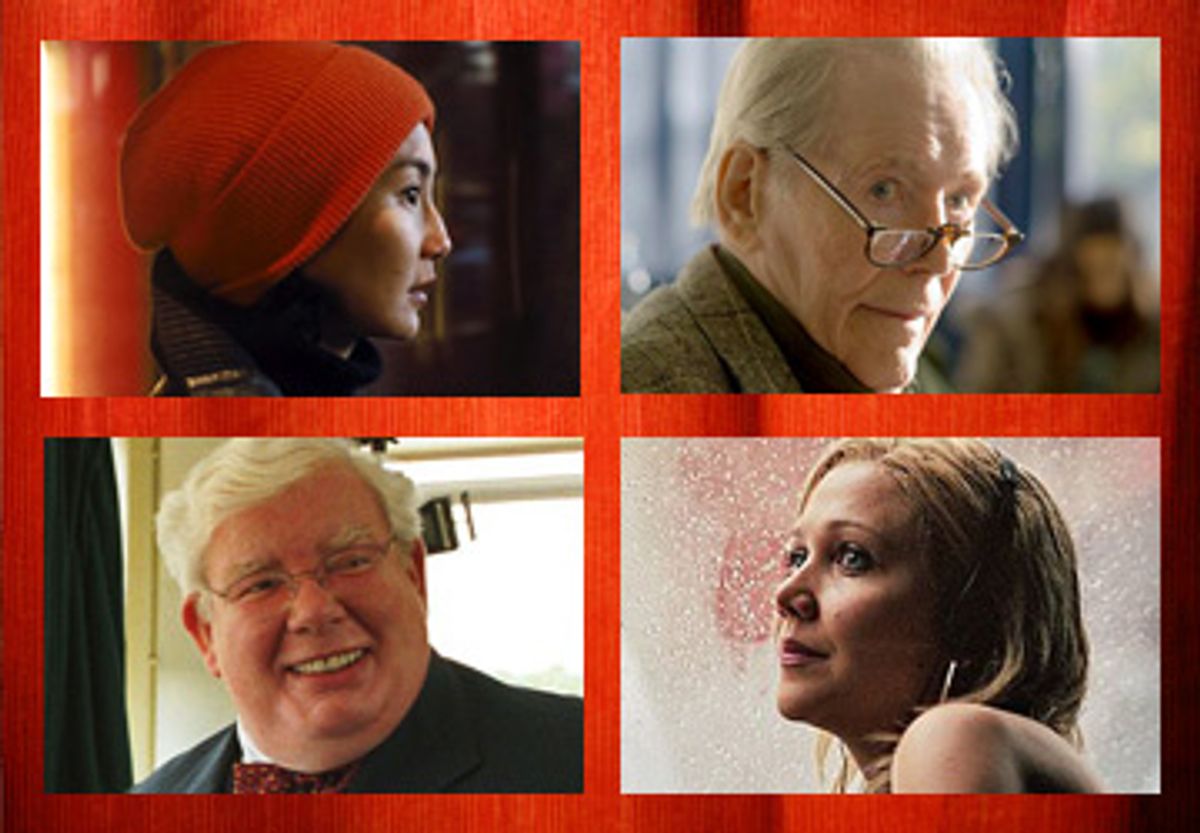
It's likely that Peter O'Toole will receive an Oscar nomination for his performance in "Venus." But let's not take any chances. After all, the Academy has had the opportunity to give O'Toole an Oscar seven times before -- and if it was dumb enough to overlook his performances in "The Stunt Man" or "My Favorite Year" or the 1969 musical remake of "Goodbye, Mr. Chips" (one of the screen's great forgotten performances), how can we trust that bunch now? Yeah, yeah, a few years back he got one of those honorary Oscars the Academy doles out when its members figure someone is getting old and they'd better cover their asses. But even though O'Toole accepted the award graciously, he bristled at the implied notion that all his best work was behind him. And in "Venus," as an elderly actor who defies the idea that advancing age automatically extinguishes carnal desire, he plays a character, not an age, giving a performance so vital that it feels youthful at its core. At the end of "Goodbye, Mr. Chips," O'Toole's character is about the same age as the one he plays here in "Venus." O'Toole played the aged Chips without any horrendous age makeup -- the only real cosmetic touch was his whitened hair -- instead conveying the essence of his character in his carriage and his gestures, and by changing the timber of his voice. Now, O'Toole doesn't have to pretend to know what it's like to feel old, but the choices he makes are no less remarkable. It's just that this time, he's a young man inside an old one, instead of the other way around.
Best actress: Maggie Cheung, "Clean"
Maggie Cheung is one of our great modern actresses: She once played a silent-film star (in the 1992 "Centre Stage"), and in many of her performances, there's something gravely charismatic about her, as if she doesn't quite fit in the modern era. In Olivier Assayas' "Clean" -- which was made in 2004 but wasn't released in the United States until 2006 -- Cheung plays a reforming junkie trying to rebuild her relationship with her young son, and her performance is iron-willed and brushed with unspeakable sadness. There isn't a hope in hell that the Academy would recognize Cheung -- an Asian actress in a two-year-old non-American film -- with a nomination. But in a dream world where members of the Academy might make choices based not just on actors they're already familiar with, on people who already have some mythically "proven" star power, she'd at least have a shot.
Sound design: "Children of Men"
Alfonso Cuarón's dystopian fable about a world in which babies have stopped being born is the most beautiful-looking movie of the year. But the sound that goes with Emmaneul Lubezki's images is just as impressive, not because it grabs your attention, but because it's so unnervingly subtle. Bullets don't go bang; they make a soft popping noise that almost seems benign, as if death-by-gunfire were the least of man's problems in this lonely new world. Confused wildlife have stumbled into man's habitat, and sometimes we hear them before we see them: A deer wandering through a deserted school announces her presence with a gentle rustling. And there are moments when we can hear the wind slipping between the branches of trees, a hollow, lonely sound -- but one that's at least comfortingly familiar.
Cinematography: "Idlewild"
Many critics' groups have already recognized "Children of Men" for Emmanuel Lubezki's cinematography, an honor I'd never want to take away from that picture. But "Idlewild," the musical starring the members of OutKast and shot by Pascal Rabaud, is the greatest-looking movie of 2006 that almost no one saw. Director Bryan Barber has filled "Idlewild" with inventive visual details: A rooster embossed on a whiskey flask comes to life to tease and taunt its owner; a wall full of cuckoo clocks join in on a musical number. Rabaud knows how to blend those novelty visuals with reality -- and he also makes the movie's version of reality look astonishingly beautiful. The lighting in "Idlewild" is exquisite, an interplay of shadows and light, of texture and color, that echoes old Hollywood even as it feels distinctly modern. It works even on the small screen, although it really belongs on the big one.
Screenplay: "Casino Royale"
The "Casino Royale" screenplay, by Neal Purvis and Robert Wade, working with Paul Haggis, is proof that there is (or can be) such a thing as a well-written action movie. But by any measure, this is a wonderful script, one that satisfies every craving you might have for smart interplay between characters, dialogue that moves with as much grace as the actors do, and the occasional spontaneous-sounding wisecrack. When a solicitous bartender asks Daniel Craig's Bond whether he prefers his martini shaken or stirred, 007 shoots back, "Do I look like I give a damn?" It's a clever, jazzy line, but it also serves the purpose of cluing us into Bond's concerns and frustrations at that moment in the plot -- an example of the way dialogue can simultaneously move a story forward and bring us straight into the mind of a character. The "Casino Royale" team get something else right, too, by writing Vesper Lynd (played by the terrific Eva Green) as a fully rounded character instead of just a "Bond girl." This is the sort of pleasurable, smart writing Hollywood needs more of.
Andrew O'Hehir's picks:
Actor in a leading role: Ryan Gosling, "Half Nelson"
In the best-actor sweepstakes, Gosling has to be viewed as a dark horse but not a rank outsider. Playing what could easily have become a movie-of-the-week role as a crack-addicted junior-high teacher, he comes through with a complicated, dominating performance. Dan is a sympathetic character but not always a likable or honorable one; his instincts toward decency and toward self-destruction are at war, with the end result never clear. Plus, a nod for Gosling is the easiest way for Hollywood to acknowledge Ryan Fleck and Anna Boden's film, a classic example of the mid-budget indie at its most interesting and ambitious.
Actress in a leading role: Maggie Gyllenhaal, "Sherrybaby"
There might not be room for more than one druggie among the leading-role nominees, but anyone who sees Laurie Collyer's gritty slice of New Jersey realism is blown away by Gyllenhaal's totally convincing performance as a tough-vulnerable ex-con trying to rebuild a relationship with her daughter. Sherry is, if anything, a less reliable character than Gosling's Dan in "Half Nelson" -- she lies, whines, bitches, starts fights with strangers and flirts with interstate kidnapping. Without hammering the audience with messages, Collyer and Gyllenhaal make it clear that everything in Sherry's environment has conditioned her to selfish (and, let's just say it, whorish) behavior, but they never let her off the hook.
Actress in a supporting role: Frances McDormand, "Friends With Money"
Sure, with four previous nominations and one win (for "Fargo" in 1996), you can't say McDormand has been ignored by the Academy. But as great as she is, I'm not sure she's ever played a role quite as wrenching as Jane, the woman on the verge of a nervous breakdown (with increasingly greasy hair) in Nicole Holofcener's "Friends With Money." I believe this film was widely misunderstood and marketed in misleading terms (more on that below). Philosophical questions aside, the scene when Jane picks a hysterical fight with a stranger in Old Navy and then walks into the glass door is the most terrifying representation of middle-class, middle-aged angst I've ever seen.
Actor in a supporting role: Robert Downey Jr., "A Scanner Darkly"
Of course Downey has made a career out of oddball supporting roles, and one could argue that nearly all of them (in recent years) play off his disordered personal history. But with Barris, the thoroughly untrustworthy slacker alpha-idiot of Richard Linklater's animated cult-classic-to-be, Downey digs deeper into the life of a drug addict than he ever has in any live-action role. Charismatic, duplicitous and a know-it-all with a highly inflated sense of his own competence, Barris will remind you (or anyway he reminded me) of that college friend you knew was bad news but couldn't resist. What is it actually like to get high with Bob Downey? Now we know.
Director: Nicole Holofcener, "Friends With Money"
Sony Classics is a highly skilled operation when it comes to marketing semi-difficult films, so savvier people than I must have decided that the best way to sell Nicole Holofcener's razor-edged study of middle-class married existence was as a gal-pack comedy. This was a little like advertising "Cries and Whispers" or "Scenes From a Marriage" as a barrel of laffs. Between the publicity campaign and the presence of Jennifer Aniston (as the sad-sack, stoner single friend), "Friends With Money" sent confusing signals, and despite an opening-night slot at Sundance and $13 million at the box office, many viewers were appropriately bewildered. In fact, the brilliant ensemble cast and ambitious widescreen camerawork mark this picture as Holofcener's most ambitious by far, and establish her as the reigning champion of post-Bergman, post-Woody domestic drama. But no, it isn't all that funny, and the parts that are funny also hurt.
Cinematography: Zhao Xiaoding, "Curse of the Golden Flower"
This is always a crowded and poorly understood category, and one could argue that Huo Tingxiao's overwhelmingly opulent production design for Zhang Yimou's epic of 10th-century imperial China is a likelier Oscar winner. But to make a film shot on this massive scale appear as orderly and elegant as Zhao Xiaodong does is a near-historic accomplishment. His camera patrols the corridors and courtyards of the Forbidden City, swoops from the skies during combat scenes, frames the doomed beauty of Gong Li and the severe arrogance of Chow Yun Fat with baroque precision. You can't call this restrained filmmaking, but that's not what this category is for. (In a near-dead heat, my second-place vote goes to Benoît Delhomme's sun-blasted widescreen Aussie vistas in "The Proposition.")
Original Screenplay: Nick Cave, "The Proposition"
OK, I'm a huge fan of Cave's songwriting and my judgment may be clouded, but I think his first screenplay was a classic, with all the bloody-mindedness and moral ambiguity you'd expect. Drawing as much from Greek myth and the Bible as from Sergio Leone and Sam Peckinpah, Cave crafted an epoch-making Aussie western that pits brother against brother, civilization against anarchy and married life against masculine freedom. Although Cave professes not to be much interested in Australian history, "The Proposition" also presents his homeland in the 19th century as a violent, near-lawless place where good and evil melt into each other and no one escapes unscathed.
Mary Elizabeth Williams' picks:
Actor in a leading role: Richard Griffiths, "The History Boys"
You'd think that Richard Griffiths' devastating turn as Hector, the increasingly irrelevant "general studies" Sheffield schoolteacher in "The History Boys," would be exactly the stuff that garners shelves full of prizes -- and you'd be right. When the actor created the role onstage, first in London and then on Broadway, he picked up an Olivier, a Drama Desk Award and a Tony (the play itself, and costars Frances de la Tour and Samuel Barnett, have racked up an array of well-deserved awards to boot).
Why, then, have the film version and Griffiths' blustery, witty and heartbreaking performance in it been so overlooked this awards season? Is it that movie audiences can't see past the outsize actor's long résumé of buffoonish characters? The fact that the somewhat staid and stagy adaptation doesn't shine as brightly as the play? Or is it the film industry's discomfort at a motorcycle-riding Mr. Chips who can quote Housman, speak fluent French -- and has an unfortunate penchant for groping his students? Whatever the cause, it's a ludicrous oversight. Whether he's exuberantly leading a troop of unruly teenage boys through a passage of poetry or dissolving into sobs before their embarrassed eyes, Griffiths is the heart and soul of Alan Bennett's wry, unsentimental ode to the humanity in that all-but-forgotten discipline known as Humanities. And in a career that encompasses "Harry Potter" and "The Naked Gun," it's the 59-year-old actor's breakout role.
David Marchese's picks:
Best original song: "Shine on 'Em" from "Blood Diamond" as performed by Nas
Stuffing more eloquent anger and sharp intelligence into two and a half minutes than "Blood Diamond" does in two and a half hours, Nas' "Shine on 'Em" is a fiery condemnation of the moral calculus of the African diamond trade. Over an ominous synth loop and a spare drum beat, Nas spits lines like, "It shocks, so many are killed annually, 'cause of greed, lust and pure vanity/ stop talkin' and do something about it, every holiday season the jewelry stores crowded." Past winners like "Lose Yourself" and "It's Hard Out Here for a Pimp" proved that the Academy is willing to vote for rap, but neither of those songs raised the tricky questions that "Shine on 'Em" does so fiercely. Let's hope the voters have the guts to bring Nas to the Kodak Theatre on Feb. 25 -- the prospect of a roomful of Hollywood's bejewled elite awkardly fingering their Harry Winston loaners while sitting directly within the song's cross hairs is too perfect to pass up.
Best original song: "Encarnacion" from "Nacho Libre" as performed by Jack Black
Taken from Jack Black's bellyflop of a Mexican wrestling movie, "Encarnacion" feels fresher and fuller than any of the more ballyhooed Oscar contenders because it isn't afraid of being stupid. Composed by Nacho as a tribute to his beloved Encarnacion (a nun at the orphanage where he works), the song's absurdity fits the character and moment perfectly. The sweetly idiotic and childishly romantic song is exactly what the sweetly idiotic and childishly romantic Nacho would dream up for his cherished nun. It's a wonderful synthesis of story, character and song. Matching up marvelously with the emotional content of the scene, and completely honest in its buffoonery, "Encarnacion" is organic in a way made-to-order star turns like the moldy Limburger of Beyoncé's big "Dreamgirls" number, "Listen," which will almost surely be nominated, could never hope to be. It's also really funny. Using a melody that sounds like bad transcription of some forgotten power ballad and adopting a bizarro Ricardo Montalban Spanish accent, Black builds from delicate crooning to bug-eyed fervor as he sings lines like, "I ate some bugs/ I ate some grass/ I used my hands/ to wipe my tears." Could Jennifer Hudson -- or anyone else -- get anywhere near the gleefully unabashed and love-struck enthusiasm needed to pull off a song like "Encarnacion"? No way, Jose.
Shares