

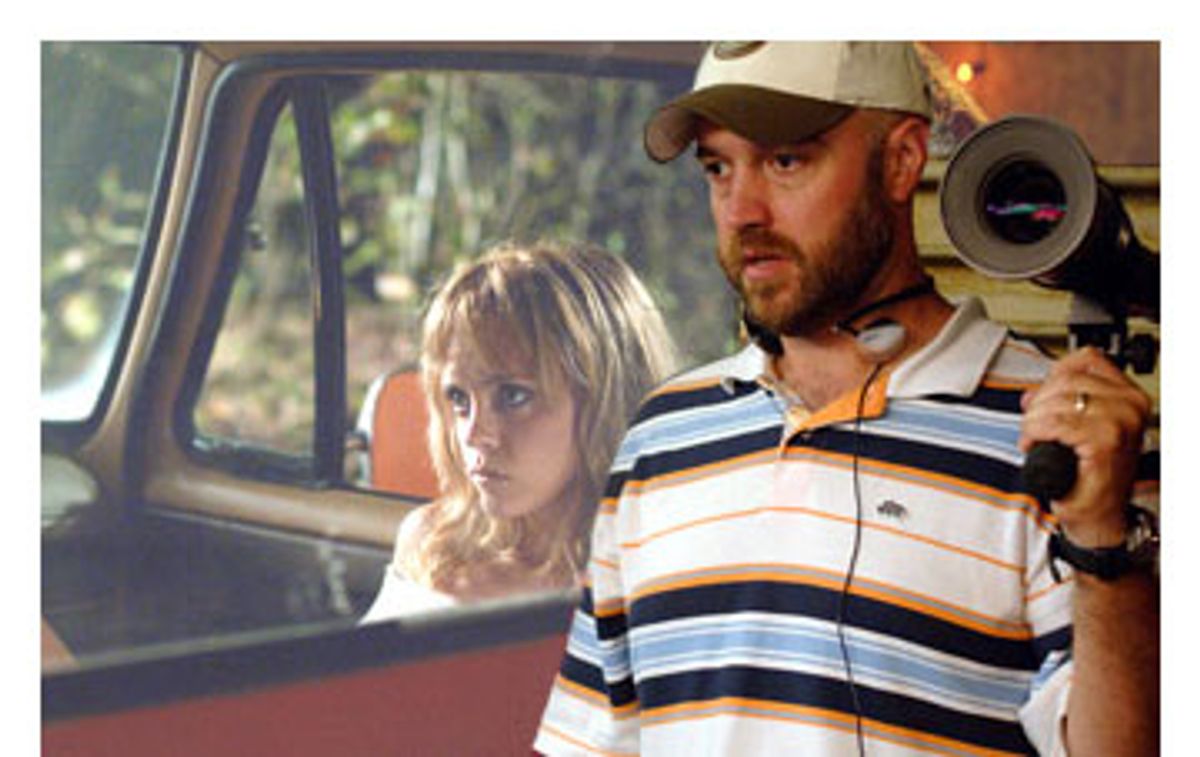

To listen to a podcast of the interview, click here.
To subscribe: Click here to add Conversations to iTunes or cut and paste the URL into your podcasting software:

Craig Brewer admits he's asking for trouble. In 2005 he made "Hustle & Flow," a movie about a pimp -- played by Terrence Howard -- that had the temerity to suggest that we might feel some sympathy for the guy. In Brewer's new movie, "Black Snake Moan," Samuel L. Jackson plays a God-fearing but messed-up bluesman-turned-farmer who takes a promiscuous young woman, played by Christina Ricci, into his home to help save her from the devil, or perhaps just from herself. And because she resists being saved, he chains her to a radiator.
The unapologetically lurid posters for "Black Snake Moan," showing a chained-up Ricci in a crop top and cut-off shorts, are designed to shock, and they seem to be doing the trick: When Salon's Andrew O'Hehir wrote about "Black Snake Moan" from Sundance, plenty of readers chimed in to denounce the movie for its misogyny, despite the fact that none of them had yet seen it.
But no matter what "Black Snake Moan" looks like, either from the trailers or from the poster, there's more to it than Ricci's skimpy outfits. This is a picture about the redemptive possibilities of the blues (Jackson does his own singing), and it also features Justin Timberlake, as Ricci's soldier boyfriend, in a nonsinging role. Salon met with Brewer, 35, in New York, where he talked about his hometown of Memphis, about making movies in the South, about how, when you need it the most, music sometimes miraculously finds you -- and about why he's the woman chained to the radiator.
In both "Black Snake Moan" and "Hustle & Flow," the South -- particularly Memphis -- is practically a character. Your parents' families are from Memphis, and you live there now. Tell us about what it's like for you to make a movie in the South, and how that experience might be different from that of someone who just jets in to film on location.
The first thing is the notion of regional filmmaking. For a lot of people, it's almost like saying "regional theater." They feel like, "Well, regional filmmaking isn't Hollywood filmmaking. Once you move up to the big leagues -- that's moviemaking."
But what regional filmmaking means to me is not only utilizing the actors of your area, the musicians and the artists, but probing what it means to be of that region. And for me, the thing about Memphis that I've always responded to is its music scene, from Sam Phillips recording Howlin' Wolf, Rufus Thomas, Elvis Presley, Johnny Cash, Jerry Lee Lewis, Charlie Rich.
It's a maverick town. It's a town that doesn't have professionals. Jerry Lee Lewis can't really play the piano all that well. He plays it a certain way. You can't really give him a Bach piece and expect it to sound like Bach. It's going to sound like a Jerry Lee Lewis song, because the energy he uses to attack the keys is specific to himself.
Also, in the South, you do a lot with not much. And that makes what you're making more unique and more lasting and memorable. You look at Johnny Cash singing "I Walk the Line." They couldn't have drums on the stage of the Grand Ole Opry, and he really wanted that song to cross over to the country charts. So he just took a dollar bill and wove it through the strings of his guitar. And it created that chk-chikka-chik-chikka-chik. You look at Ike Turner coming up from Clarksdale, Mississippi, in a jalopy filled with his band, and he's writing a song about a car that passed, called the Rocket 88. He gets pulled over by a cop, and the amplifier falls off his car and smashes on the pavement. He goes into Sun Studios, and there's Sam Phillips, this crazy white man from Mississippi. And Phillips says, "Aw, don't worry about that, Ike." He starts shoving newspaper inside the amplifier. They plug in the guitar and it has this raw, distorted sound. And now all amplifiers try to duplicate that sound.
There's something about that spirit, where we know, when we listen to music, when we make music, when we worship, when we go to football games. And especially when we eat. We're bound to each other more than people outside of the South give us credit for. I guess I respond to that kind of spirit. It makes me feel I can be creative and not be judged. I can be poor and not be ashamed.
I go to L.A. and people lease their cars. They don't want you to see that they can't afford a big, important place. The men in Memphis? I'll go to a concert one night, and I'll see somebody up on the stage, like a rock god, covered in sweat, women clawing at him. And the next morning he's serving me coffee, and there's no shame in it. That to me, that's the safety of regionalism. That's the safety of living in a place where, if your movie tanks with critics or at the box office, you just feel at home. Everybody knows you and still loves you.
A lot of critics didn't like "Hustle & Flow" because they couldn't have any sympathy for a pimp. Do you think there's something in our culture, some kind of moralism, that prevents people from having sympathy for characters they don't also approve of?
The first time I experienced the problem with that particular scenario happened in Hollywood as the movie was getting made, or trying to get made. There were many studios that said, "Could you please make him funnier?" or "Could you perhaps make it more violent?"
In Hollywood sometimes you take these notes and you try to see what's underneath the note. I finally realized what it was -- finally somebody just spelled it out for me: It's dangerous for us to identify and sympathize with somebody that reprehensible. It's so much easier to lampoon him. Then we can keep him at a distance.
I think what bothered people about "Hustle & Flow" was that I was allowing for a narrative where you could actually be sympathetic to him. And why should anybody be sympathetic to somebody who exploits women? And where they came after me is that I did not address the issue of exploiting people.
But to be honest with you, I wasn't interested in it because I don't think my character was interested in it. He was at a time in his life where he knew that his whole existence was based on manipulation. His whole job was talking people into buying what he was selling. I think many people identified with that. They just had a problem with him being a pimp.
I think people are going to be a lot easier on "Black Snake Moan" because it takes place in a more fabled type of Southern town. But I look at Rae and I look at DJ, and I think they're quite similar. I tell people, "The nymph to this movie is the pimp to the other movie." Because people, for the first half hour, are kind of mad at her. And it's the same way with DJ. And they begin to soften, at least toward her heart, and begin to understand what she wants.
There seem to be quite a few people who have decided that this movie is sexist because the Christina Ricci character is chained to a radiator. What's your response to people who are ready to judge the movie without having seen it?
To me it seems a little limiting. I sometimes do this little flip thing, where I say, Lemme tell you about this movie I wanna do, where this guy's playing dominoes with his boys, and his pregnant wife is in the other room, playing music really loud, and he gets mad at her, he goes in there and throws the radio out the window. And he starts punching on his pregnant wife with a closed fist. And everybody's ripping him off of her, and they're like, "Oh, man, you can't be hittin' on her." And they take the girl upstairs, and he's punching at everybody, and they try to sober him up under the shower. And then he goes outside, calling up to his girl, "Come down here, bring my girl down here! Yo, Stella!"
And then Stella goes downstairs and she fucks him. And I think to myself, Wow, that's taught in high schools. "A Streetcar Named Desire," if you just kind of updated it a little bit -- I think people would just cry unbelievable misogyny and sexism about that movie, whereas some of those people have Marlon Brando on their walls, and we can get some distance from it.
So can we actually have movies where a woman chained up can be a character in a narrative, like you would in a Flannery O'Connor short story, and not represent my take on women? I question anybody to come to the end of "Black Snake Moan" and really believe I'm a misogynist -- the definition of which is a hatred of women.
I'm exploring something that has nothing to do with race or gender. I'm the crazy girl on the end of that chain. I'm the one who felt I was losing control of my mind and my body because I was not tethered to anyone. And I needed to be snapped back. I needed my father, who died at 49 of a heart attack, to tell me, "It's gonna be OK, and you're not alone. Everybody goes crazy at certain times in their life. You're entitled to some happiness, you're entitled to some unconditional love. And it will never stop. You will constantly be getting punched in the gut, being exploited, being judged."
So I think it's foolish to immediately jump to sexism because of the imagery. But I will give them this: I'm asking for it. I guess I could have chosen some other way to do it. But, look, you can't do a movie about the blues and not explore biblical imagery and Southern iconography. And it is an obvious flip to see that black man with a white woman on the end of a chain, walking with her in his beautiful bean field, with her in those white cotton panties and a crop top with a Confederate flag and an American flag on it. I can't believe people are thinking this is, like, a documentary -- that this goes on in the South every day.
It doesn't, but "Tobacco Road" doesn't happen every day in the South, either. "Baby Doll," the Elia Kazan movie, doesn't happen every day either. But we give those movies a pass. We're in a very cautious culture, and to some extent I think that means we've created a bigger divide.
You've got a God-fearing but troubled black man chaining a promiscuous young white woman to his radiator. That imagery is pretty combustible, for reasons that have to do with both race and sex, and even though we live in supposedly enlightened times, people are bound to have trouble with it. Do you see people's potential discomfort as a liability, or is it really more of a tool? A way to shake people up?
Sure, I guess I view it as a tool. But I guess it's a liability to some. I remember the first time I read "To Kill a Mockingbird." My dad really wanted me to read it, and we had discussions about each chapter, and we finally got to the end. In the book, a black man is on trial for raping a white girl. And by the end of the trial it's so clear that this man was asked to come into her house to move a chifforobe, I mean just to move something -- and she attacked him. He didn't attack her. So when he gets a guilty verdict, I remember asking my dad, "How could he have gotten a guilty verdict? His hand couldn't even have done the bruises on her face. It's so obvious her dad did that. Why did this guy go to jail?"
I'll never forget what my dad said. He said, "Well, you gotta understand the South and you gotta understand white people's fear about black sexuality with their women. They sent that guy to jail not because he did anything wrong, but because she wanted him. He had to pay for that."
That's when I realized that that never goes away. I don't explore race or gender when these two characters [Rae and Lazarus] are together. Just them being in a room together does a lot. There's a moment where Ricci's character, in an incoherent state, lunges forward and kisses Sam on the lips. There is nothing sexual between these two in the whole movie, except that one kiss. And audiences flinch like it's a horror movie. Now that says a lot about that audience. They audibly shout when she lunges forward and kisses him.
So it's still very much in the ether, this tension and titillation with the whole thing. But nobody wants to talk about it ... So that's where we are. I don't know if I'm ever going to be able to change that. But I definitely don't want to not make a movie, and explore issues for myself, in my own region, where, by the way, we have blacks and whites who fuck with each other and do all kinds of stuff with each other -- and it's no big thing, and yet at the same time it's the thing.
I'm not writing from a place of progress. I'm not writing a movie that I want people to necessarily intellectualize. And I think that really messes with people who feel that they need to make a statement against this, and they don't quite know what it is they're against.
Because man alive, you look at this imagery on this poster, and I'm so obviously banging this drum. It's like, you really believe that I believe this? That women need to be chained up? Can we not think metaphorically once race and gender are introduced? ... Can we never go back to that time when people can be people and we can explore whatever the hell we want to? Of course we can, but there are going to be people who take exception to that.
In this country, especially, there are people who believe actors shouldn't sing and singers shouldn't act. Yet in France, actors like Jeanne Moreau and Catherine Deneuve make records that become huge hits. And singers can be amazing actors: Frank Sinatra, Dean Martin, Bette Midler, Dean Martin, Willie Nelson, Kris Kristofferson. In "Black Snake Moan," you've got an actor, Samuel L. Jackson, singing, and a singer, Justin Timberlake, acting.
And in "Hustle & Flow," there are rappers who don't rap. All these artists are coming together and they're all just a little bit out of their comfort zone. So they all work a little harder. Also, perhaps I write a bit differently than other people. I don't think, "Oh, this would be a good story, and wouldn't it be cool if blues music were a part of it." The music is the cake; it's not the frosting.
I was having these bad anxiety attacks when we were trying to make "Hustle & Flow." We couldn't get it going, we didn't have any money, we'd just had a baby. I was selling furniture just to pay my mortgage.
They say that music finds you sometimes in life. I had known about blues all my life, I'd loved it and studied it. But it wasn't until those moments of absolute crippling fear -- I thought, I'm going to check out, just like my dad did, at 49. I had this image in my head, of a radiator with a chain around it, with that chain yanking up against this radiator. And I had to explore what that idea was.
So the actors kind of have to do the same thing. You discover your character through the music ... We took Sam down to Clarksdale, Mississippi. We got him with Big Jack Johnson, Kenny Brown, Alvin Youngblood Hart, Sam Carr. And he just soaked it up like a sponge. So one day he went into his trailer with his makeup artists. He came out, and he had the forehead of R.L. Burnside, he had the chops of Robert Belfour, he had the big, open-crown gold grill that Big Jack Johnson had, he had the moles of Junior Kimbrough. And to me, that's an artist who found his character by way of the music.
So I'm discouraged when people say actors shouldn't be singing, or singers shouldn't be acting. They're artists. And Ludacris of course should be in movies. Justin Timberlake should absolutely start his acting career. I think he's doing a great job, and now everyone's coming around to it.
Sometimes the blues are treated like a cliché, maybe especially among Northerners. People think, "Oh, it's just all about suffering and hard times."
They don't realize it's true exorcism music. These men of the Delta were not Uncle Toms. They were bad-asses in a time when you could get hung from a tree for speaking your mind. They were the first to sing about injustice and pain. And to sing about the injustice of the heart. I think they had fear in their heart, and they were the first to articulate that in a club, out loud, with everyone shouting back. And they began to take control of their fear instead of their fear controlling them.
It's call and response.
It's total call and response.
Shares