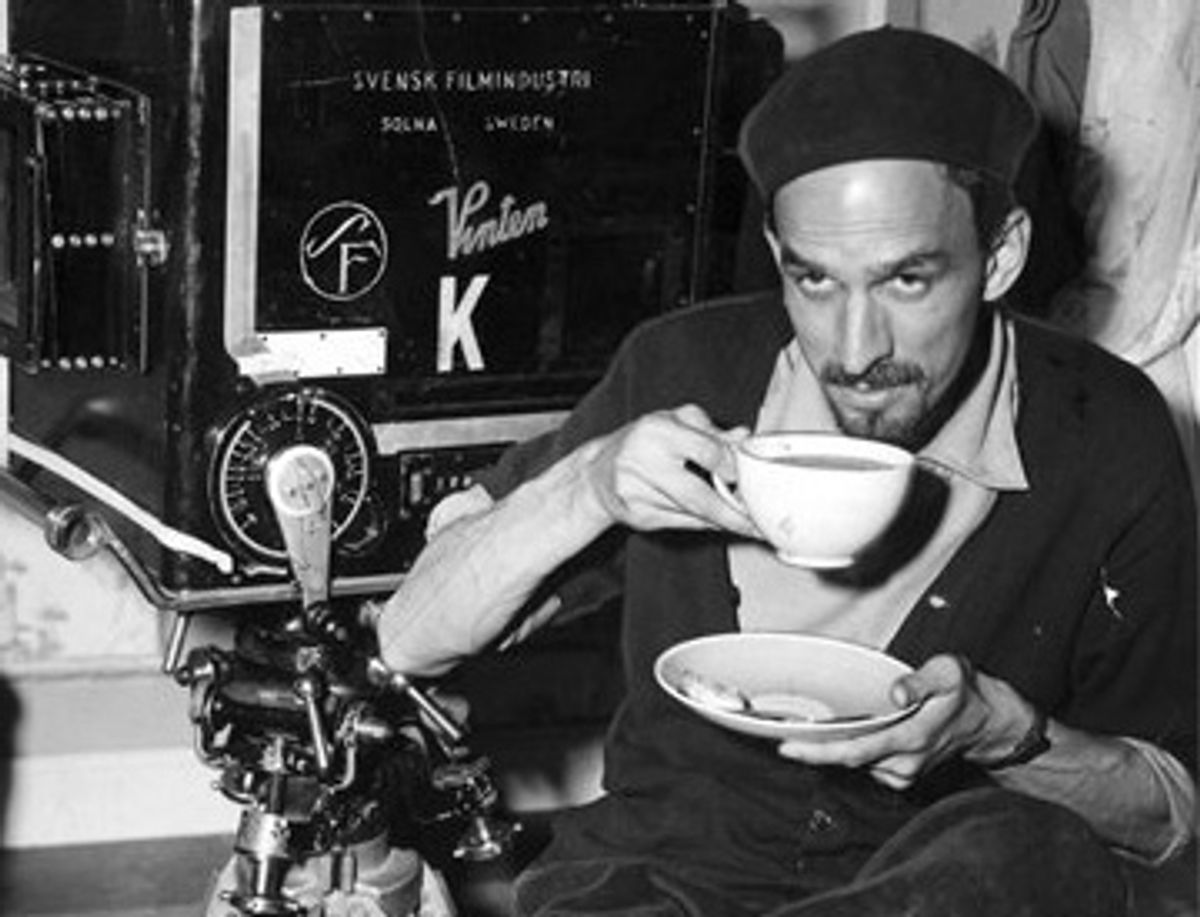
Sometime in the fall of 1980, I went to see Ingmar Bergman's film "Persona." I can literally say that it changed my life. I had seen other so-called art films, and even other Bergman films, but nothing quite like that ambiguous black-and-white masterpiece from 1966, a critical point of contact between regular narrative filmmaking and the parallel tradition of experimental film.
If you haven't seen the film, it begins as an acutely observed, relatively straightforward story about the tense relationship between two women. One, played by Bergman's former wife Liv Ullmann, is a famous actress who has suddenly fallen mute, apparently in the grip of a psychological or spiritual crisis. The other, played by Bibi Andersson, is the chatty, overly confessional nurse assigned to care for the actress while she heads to the seaside for some rest and relaxation. At a certain point in the story, an act of cruelty ruptures the superficial friendship, and literally seems to destroy the film. The film appears to stick in the projector and burn from the heat of the bulb, and all sorts of fragmentary, unexplained images (many of them snippets of silent movies) erupt onto the screen. "Reality" is eventually restored, but the rest of "Persona" has a troubled, dreamlike quality, as if we're now in a world where old-fashioned narrative clarity is no longer available.
I remember sitting up nearly all night in my dorm room digesting what I had seen, and then going back to see it again the following night. A year or so later, one of my friends who had bought a 16mm projector at a flea market checked out a print of "Persona" from the Baltimore public library. We hung a bedsheet on the wall of his apartment and watched the movie perhaps eight times in two weeks, with various constellations of bored or enthralled or bewildered acquaintances. Wherever those people are today, I know what memories were called up for them by reading of Bergman's death on Monday, at age 89, on Faro, the remote Swedish island where he lived and had set several films.
Those bedsheet screenings exemplified the kind of devotion Ingmar Bergman's movies demanded from their adherents, and against which his detractors rebelled. For better and for worse, Bergman was the high priest of a certain vision of cinema, one that essentially vanished long ago. He made only a handful of films after his official retirement with the Oscar-winning "Fanny and Alexander" in 1983, but his death is still a landmark moment. Bergman was the last survivor among the foursome of legendary directors whose work created and defined the art-film market in the years after World War II, the others being Federico Fellini, Akira Kurosawa and François Truffaut.
It's misleading and overly narrow, however, to suggest that Bergman or the other art-house lions belonged entirely to the tradition of high art. His films encompass the carnival as well as the cathedral; they include comedies, romances and family melodramas as well as fables of the dark night of the soul. Only a few of them are as self-consciously confrontational as "Persona," and in the 1960s and '70s you could certainly find film buffs -- followers of Jean-Luc Godard, for instance -- who found Bergman to be conservative and conventional. (Compared to the work of his Russian disciple Andrei Tarkovsky, most of Bergman's pictures feel like crackerjack entertainment.)
It's nonetheless accurate to say that Bergman understood himself first and foremost as an artist who belonged to a European tradition stretching back to the Middle Ages, which he evoked so memorably in his first big international success, "The Seventh Seal" (1957). Most obviously, his work borrowed from the Scandinavian theatrical tradition of Ibsen and Strindberg, from various northern European strains of painting and sculpture, from Freudian psychology and severe Lutheran theology and the tormented philosophy of Nietzsche and Schopenhauer. On the other hand, Bergman was certainly not immune to popular culture; his sense of craft was shaped by the classic Hollywood films of his youth, especially those of George Cukor, a personal favorite. (One can certainly see, in several early Bergman pictures, the influence of Cukor films like "Dinner at Eight," "The Women" or "The Philadelphia Story.")
In an interview published in 1972, the critic John Simon said to Bergman, "It must be a great responsibility, I was thinking, just to be you; because film is probably the most important art today and I think you're the most important filmmaker in the world. To be the most important man in the most important art is a terrible responsibility." Simon is a contentious and disagreeable fellow, and no doubt the remark struck some people as fatuous even then. But it was not inherently ridiculous to suggest, 35 or 40 years ago, that the director of "Persona," "Smiles of a Summer Night," "The Seventh Seal," "Wild Strawberries," "The Virgin Spring" and "Cries and Whispers" might be the most important artist in the world.
Bergman struggled to combine the various intellectual and psychological currents that shaped him against a particular context, that of the postwar West traumatized by Auschwitz and the Bomb, in which belief in God was fading but, as Bergman would often observe, fear of God was not. For an entire generation of the European and American intelligentsia (which included my parents), Bergman's wrestling matches with existential doubt and religious guilt, with fractured family relationships and what seemed a civilization in disrepair, came to stand for its own. Max von Sydow's medieval knight playing chess with Death in the plague Europe of "The Seventh Seal" seemed to symbolize mankind on the brink of nuclear annihilation, and the aging professor facing his own death in "Wild Strawberries" (played so marvelously by Victor Sjöström) captured the anxiety of a culture that believed itself crippled by an inability to express or fulfill its emotional needs.
Some of those concerns now seem remote and old-fashioned to us, just as the boundary-smashing impact of the "interrupted" film in "Persona" looks like nothing special to a viewer acclimated to 20 years of music videos and increasingly sophisticated digital editing techniques. The conception that there could be a "most important" artist, or even a most important art, seems alien to the fragmented, niche-marketed, endlessly commodified spirit of the 21st century. Pop culture has become a self-propelling engine that endlessly consumes and recycles its own waste products, increasingly unconscious of anything that predates its own predominance.
Although Bergman remains the subject of sporadic repertory revivals and university film courses, his movies have lost most of their once-mystical aura. After an onslaught of recent DVD releases, most of his important pictures are now readily available (exceptions include "Sawdust and Tinsel," "Dreams" and "The Magician"), but they too are just cultural commodities from the past, and must fend for themselves on the virtual or actual shelves alongside Antonioni and Godard films and "Spartacus" and "Attack of the 50 Foot Woman."
That's probably for the best. By focusing on Bergman as a great artist and deep thinker who grappled with God and existentialism and boiled the soul of the post-Holocaust world in his crucible, critics like Simon have done much to drive audiences away from his work, and have distorted Bergman's own conception of his art. Entirely too much emphasis has been placed on the ideas that allegedly lie behind Bergman's movies; those who haven't seen them are often startled to discover that those ideas are delivered as memorably intimate images and as affecting human stories. Bergman never conceived of his "art" as distinct from cinematic and dramatic craftsmanship, and his very best films, like the battle-of-the-sexes comedy "Smiles of a Summer Night" or the magical family chronicle "Fanny and Alexander," are never reducible to theses or pronouncements.
"I am a man making things for use, and highly esteemed as a professional," Bergman told Simon. "I am proud of my knowing how to make those things." In another interview, with Andrew Sarris, Bergman famously compared himself to the thousands of anonymous stone carvers who worked together to build medieval cathedrals. "Whether I am a believer or an unbeliever, Christian or pagan," he said, "I work with all the world to build a cathedral because I am artist and artisan, and because I have learned to draw faces, limbs, and bodies out of stone."
As every obituary of Bergman will note, he grew up in Uppsala, the ecclesiastical and academic capital of Sweden, as the son of a strict Lutheran preacher and a mother he adored but who sometimes treated him coldly. (This family dynamic is presented vividly in "Fanny and Alexander," which, at least in emotional terms, is highly autobiographical.) In some respects, that's all you need to know about his background; the passionate blend of love, hatred and fear with which Bergman viewed women, God, spirituality and death, and family life in general is all present in his childhood.
He began working in the theater as a teenager, and continued directing plays throughout his life, serving as director in residence at the Royal National Theatre of Stockholm long after his semi-retirement from filmmaking in 1983. This sometimes leads to the misconception that Bergman saw film essentially as a "larger theater" (to use the phrase of Joseph L. Mankiewicz), when in fact he saw theater and film as drastically different media. What is startling about Bergman's movies (at least after his first few apprentice efforts), and what will ensure their survival, is not their philosophical concerns but their intense attention to cinematic craft.
Bergman's films are economical and intimate, and legendarily focused on the human face. (The split-screen optical merging of Ullmann's and Andersson's faces, at the climactic moment of "Persona," both epitomizes this tendency and simultaneously undermines or renounces it.) Working with cinematographer Sven Nykvist from about 1960 onward, Bergman constructed an expressive visual vocabulary that was both naturalistic and symbolic, in which the human face, considered in loving or excruciating detail, becomes an architectural element, and houses and buildings become characters with moods and temperaments of their own. (Nykvist gets plenty of credit for the "Bergman feeling," and he should. But he did not shoot "Smiles of a Summer Night," "The Seventh Seal" or Bergman's other great 1950s films.)
One thing Bergman brought from the theater was the idea of a revolving repertory company, an idea borrowed or imitated by many subsequent directors, but never to the same effect. Ullmann and von Sydow appeared in nearly a dozen Bergman films each, and Bibi Andersson, Harriet Andersson, Erland Josephson, Gunnar Björnstrand and various other actors kept making return appearances. After a while, seeing another Bergman film felt like a family reunion with people you fundamentally loved and trusted, whatever pain they might inflict on each other and on you. In what turned out to be Bergman's last film, the very fine 2003 "Saraband," Ullmann and Josephson reprised their roles as the warring married couple of "Scenes From a Marriage," made 30 years earlier.
Bergman's movies became the focus of intense intellectual combat: During his period of worldwide fame, he was accused of being a misogynist and a man-hater, of being an apolitical aesthete and a crypto-Marxist nihilist. But the films that occasioned the most controversy in days of yore, and that seem the most implicated in philosophical or psychological heavy lifting -- say, "The Silence" and "Cries and Whispers" and "Shame" and "The Virgin Spring" (and "Persona" too, much as I still love it) -- strike me more as intellectual curiosities today, not necessarily his best work. It's his more "realistic" -- or at least less transparently allegorical -- works about the wounded human quest for love that form the basis of a monumental legacy.
Everywhere I go and as long as I live, I'll carry with me images from Bergman's movies: the beautiful Eva Dahlbeck, weaving her spidery lover's schemes in "Smiles of a Summer Night"; Harriet Andersson and Lars Passgard, as the brother and sister performing a midsummer play for their father in "Through a Glass Darkly"; Bergman and Ullmann's daughter, glimpsed in the audience for his marvelous adaptation of Mozart's "Magic Flute"; Ingrid Bergman, so unforgettable in "Autumn Sonata" (the only time she ever worked with her namesake, to whom she was not related); young Alexander (Bertil Guve) nestled in the lap of his grandmother (the marvelous Gunn Wallgren) in "Fanny and Alexander," a film that captures the joys, terrors and enchantments of childhood better than any I've ever seen.
Bergman's fame may have faded to a ghostly shade of its former self, which he probably didn't mind, and at the moment he's not exactly fashionable outside film-buff circles. ("Saraband" did relatively poor business in its 2005 American release.) His influence is so widespread among younger filmmakers, both in Europe and in American independent cinema, as to be almost invisible. Anyone who makes emotional dramas or what might be called "serious" comedies about parents and children, men and women, is operating on Bergman's turf. Anyone who photographs a door opening in an empty house, a clock ticking on a mantelpiece, or someone reading a letter addressed to somebody else (bad mistake!) is borrowing his vocabulary, consciously or not.
If Ingmar Bergman was the most important man in the most important art form in 1972, his cultural significance on his death in 2007 seems much less clear. No single artist can stand for all the traditions of film (and film itself plays a more limited and ambiguous role in the media economy than it used to), and Bergman was undeniably a middle-class white European from an affluent, highly homogeneous society. Maybe we can agree that Bergman was the greatest of the 20th-century artists who tried to adapt the traditional craftsmanship of European theater to a new cultural form. Maybe we can agree that he believed in art as a redemptive, spiritual, even magical force, and did much to carry that ancient view of art into the movie theater.
Bergman lived a long life full of movies, plays and tumultuous marriages, and by all accounts left it behind with few regrets. He had the life, and the death, we would want for ourselves and those we love. I'm still grieving today because I know that, finally, there will be no more Bergman films. (His recurrent promises to quit making them had become almost comical.) If you've got a bedsheet and a projector, I'm coming over.
Shares