If journalists were forced to observe the commandment that doctors swear to follow -- first, do no harm -- it's not clear whether our profession would exist at all. Doctors do harm all the time, of course, because they are human beings who make mistakes and whose judgment and knowledge are imperfect. They may just be bad doctors. But even good journalists are likely to cause harm (albeit non-lethal harm, most of the time) to the people they cover, without a whisper of conscience and generally in service to high-minded abstractions like "the truth" or "the reader" or "the public's right to know."
As New Yorker reporter Janet Malcolm, the patron saint of journalistic self-flagellation, has put it, what those noble phrases really boil down to -- and the impulse that journalism really serves -- is "society's fundamental and incorrigible nosiness." In the most famous sentences of her career, and perhaps the most famous ever written about the craft, she declares: "Every journalist who is not too stupid or too full of himself to know what is going on knows that what he does is morally indefensible. He is a kind of confidence man, preying on people's vanity, ignorance or loneliness, gaining their trust and betraying them without remorse."
Amir Bar-Lev did not have any of these dark thoughts in his head when he went to Binghamton, N.Y., about three years ago to meet Mark and Laura Olmstead and their 4-year-old daughter, Marla. He didn't know he would wind up making a movie, "My Kid Could Paint That," whose "primary inspiration," as he tells me over lunch, was Malcolm's bitter and brilliant investigative work "The Journalist and the Murderer," which begins with the sentences quoted above. He didn't know he would find himself on the horns of a painful ethical dilemma, torn between treating his subjects humanely and seeking the truth. He didn't know he was going to make an existentially tinged mystery story that would verge on self-regarding meta-documentary and that called attention to its own artifices and tricks, that would engage, as he says now, in "public hand-wringing" about its own morality. (Listen to a podcast of my interview with Bar-Lev here.)
He was a little-known documentary filmmaker in his early 30s who thought that the Olmsteads might make an interesting subject. Beginning in 2004, Marla had attracted global attention for her splashy, colorful abstract paintings, which had miscellaneously been compared to the work of modernist legends like Pollock, Miró, Klee and Kandinsky and had sold for first hundreds and then thousands of dollars.
In the most frequently told version of this junior expressionist's emergence, Mark Olmstead explained that he had plopped diaper-clad Marla on the kitchen table with some paint and paper when she was 2, mainly to get her out of his way. (He was an amateur painter himself.) She started splodging paint around with fingers, brushes, spatulas and other tools, and the rest was history. A friend of theirs hung some of Marla's pictures in his coffee shop, partly as a gag, and then they started to sell. Mark and Laura insisted they had done nothing beyond providing Marla with materials. She was the sole creator of the works and she decided when they were finished.
When Bar-Lev showed up, Marla had just had a solo show at the Binghamton gallery of dealer and artist Anthony Brunelli, an old friend of Mark Olmstead's, and TV crews and newspaper reporters from all over the world had shown up. Reasonably enough, the Olmsteads wondered why they should allow a filmmaker into their lives for months at a time when they already had more publicity than they could handle. As Bar-Lev recalls it, he told them, "Well, maybe my film will get a deeper truth than these news crews that just breezed in and out of here have missed, and maybe that truth is something that you'll be happy to have for your kids in the future." The Olmsteads said yes right away.
They had made a bargain with the devil, even if the devil didn't know it yet (and didn't even know he was the devil). Bar-Lev's "deeper truth" turned into something murky and unknowable, and his relationship with the Olmsteads culminated with a tense and painful three-hour standoff in their living room, which left everybody feeling crappy. As Laura Olmstead observes bitterly before stripping off her mike and leaving the room, the final confrontation of this fascinating and frustrating film is "documentary gold."
Bar-Lev thought his movie would be about an appealing American family thrust, partly by choice and partly by accident, into the eye of a media hurricane. It might also be about the widespread public incomprehension of and hostility toward modernist art. As New York Times art critic Michael Kimmelman discusses in the film, Marla's story appealed to two contradictory popular prejudices. First of these is the idea of prodigal artistic talent as a lottery prize handed out to random toddlers by God. Second is the notion that modern art (at least in its abstract or nonfigurative guises) is a pseudo-intellectual con game that has no standards and conveys no meaning, so the apparent success of a 4-year-old debunks the whole enterprise.
Bar-Lev even thought his movie might be about Marla Olmstead, a strikingly beautiful, standoffish child who seemed to possess an unusual talent. Skipping over the comparisons to various dead European males whose work mystifies the museum-going public on several continents, Marla's big and colorful canvases suggested the verve and openness of childhood, alongside a singularity of purpose and an attention to compositional detail almost unimaginable in someone her age.
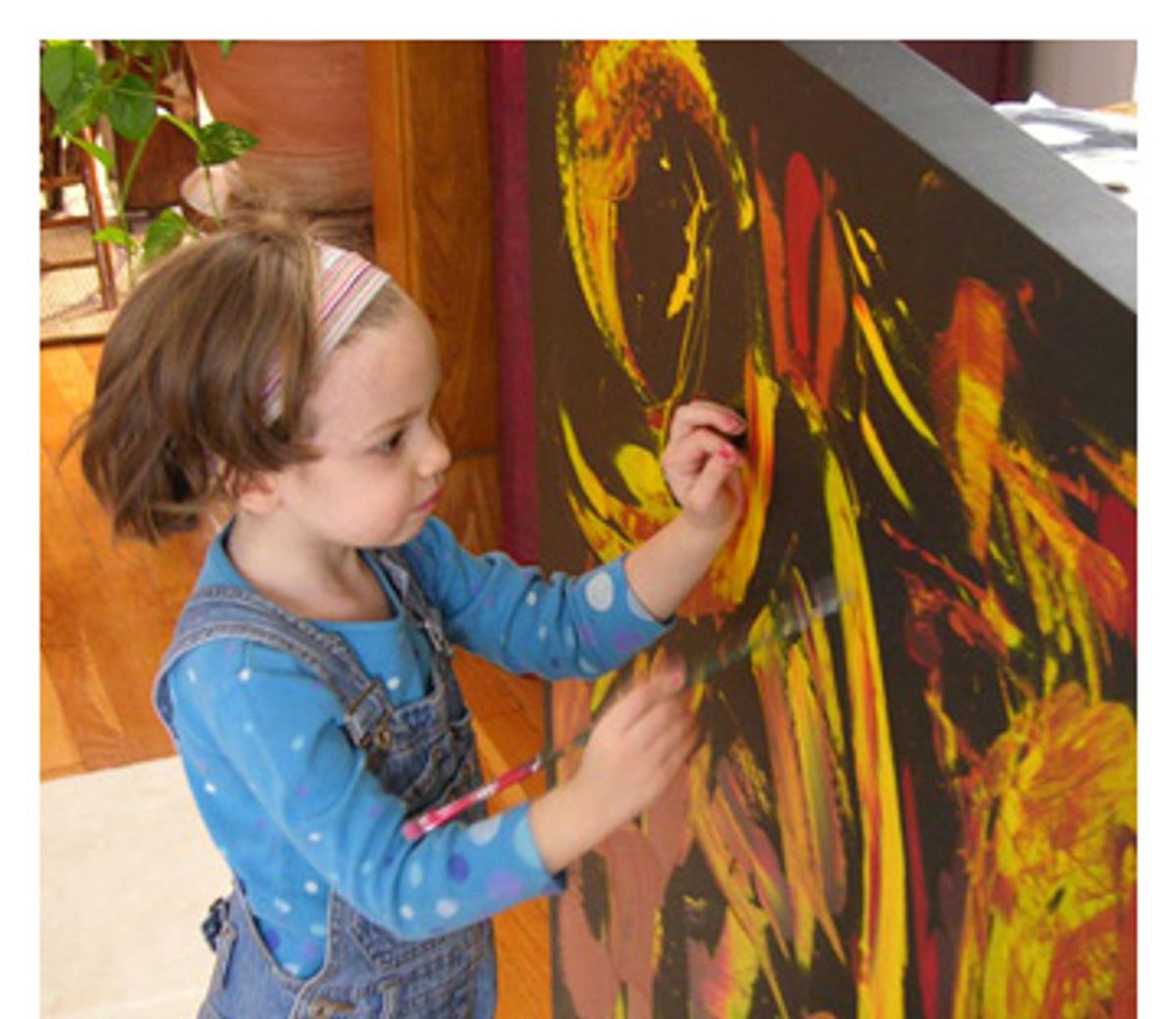
In fact, "My Kid Could Paint That," which premiered at Sundance last winter and opens this week in New York and Los Angeles (along with the Olmsteads' hometown of Binghamton) before a wide national release, is barely about Marla at all. She haunts the picture like an adorable ghostie in OshKosh overalls, taking everything in with her sly, distracted expression and muttering things the grown-ups don't catch (or pretend not to). She is often described by journalists as being oblivious to her fame and the ensuing controversy, which, as any parent of small children can tell you, is a purely ridiculous notion. She even does a little painting in the film. But not much.
In February 2005, about six months after Bar-Lev had begun shooting his film, a bomb dropped on the Olmstead household. "60 Minutes II" ran a lengthy segment about Marla, hosted by Charlie Rose. The Olmsteads had allowed CBS producers and cameras extensive access to their home, and a hidden camera had been set up in the basement to capture Marla at work. But the painting she very slowly created beneath that camera, with whispered and specific exhortation from her father, was a splotchy and uneven color field that didn't look much like her other work.
"I saw her making very ordinary kinds of marks, no different from what a typical 3- or 4-year-old would make," psychologist Ellen Winner, who has worked with child prodigies, told Rose in the segment. Marla appeared to lack the drive, intensity and excitement seen in other advanced child artists, Winner said, adding that for a child to paint competent abstract works is virtually unknown. (At age 9, Pablo Picasso was still struggling to draw realistic figures.) She concluded: "I saw a normal, charming, adorable child, painting the way preschool children paint, except that she had a coach that kept her going."
It was high-minded journalistic betrayal at its finest. Charlie Rose had spent hours doing warm-and-fuzzy interviews with the Olmsteads, posed with them for family snapshots, and then gone on national TV to declare them perpetrators of a scam. It was sleazy, but the allegations it raised were not easy to dismiss, and have haunted Marla's public narrative ever since. The Olmsteads have repeatedly and categorically denied that Mark paints Marla's pictures or collaborates with her or even coaches her; his whispered urgings captured on tape are described as lapses in judgment, the product of anxiety. Bar-Lev knew them better than Rose did, and initially chose to believe them.
"Sometimes people see the film and say 'How could you not have been swayed by "60 Minutes"? How could you not have decided at that moment that they were lying?'" Bar-Lev says. "And the answer is that I asked myself, 'Why the fuck would these people have invited me into their home, and invited "60 Minutes" into their home, if there was some big secret they were hiding?'" This question is never answered, and is one of the principal reasons that the Olmstead conundrum, at least as presented in the film, is so difficult to plumb.
Besides, Bar-Lev reflected at the time, he already had footage of Marla painting. Didn't he? All you ever see in "My Kid Could Paint That," in fact, is either Marla pushing paint around on a completed canvas or working haphazardly on paintings she doesn't "finish," at least in her father's judgment. In one scene, Mark becomes visibly exasperated when Marla sloshes a lot of extra paint on a partially covered canvas and squishes it around with her hands. She clearly relishes the tactile and visual experience, but Mark dismisses the resulting brown glop as "mud."
"When that first happened, I totally thought, OK, my camera crew has interrupted this genius," Bar-Lev says. "She's 4 years old and she's only met us once before. It's a plausible explanation, and Mark led me to that conclusion. He said, 'You guys are killing me.'" (That's only one of Mark's ambiguous and possibly self-revealing comments in the film.) "After '60 Minutes,' when I revisited that material, I started to have questions about it, but they weren't conclusions. Ultimately, when I look at that scene, what strikes me most about it is its brutality. She's painting the way she wants to paint!
"To see Marla as he puts down her painting is -- he's saying, 'Most likely she'll go over it and make it nice.' Well, that is what she thinks is nice! That's why I wanted to put that at the end of the film. I wanted to remind people of the joy she felt in making that 'mud.' She's enjoying the hell out of herself, and at a certain point her father says, 'Oh, she's making a mess.' That, to me, is brutal."
To counter charges of fraud, the Olmsteads have produced and distributed a DVD of Marla painting a work called "Ocean." She appears to be a joyous, happy, creative child, basking in the loving attention of her parents and making a big, blotchy canvas covered with blobs of paint and decorated with teddy-bear heads (or possibly Mickey Mouse ears). She clearly created "Ocean" herself from start to finish, with encouragement and support from her audience, but very little coaching. It's a darn good painting for a little kid, but it exhibits almost none of the concentration or technical proficiency of the work that made her famous.
As Bar-Lev began to notice more and more peculiarities and inconsistencies about the Olmstead family and Marla's art, he found himself becoming the "confidence man" Janet Malcolm describes, slipping more and more into the territory of Charlie Rose-style journalistic deceit. In one scene, he turns the camera on himself to discuss his misgivings: He's begun to feel profound doubts that Marla is really the sole creator of her paintings, yet the Olmsteads still expect him to make a film that will exonerate them.
Any viewer is likely to share Bar-Lev's mixed feelings about this family. If Mark Olmstead sometimes seems like a slippery figure, several degrees too eager to push his daughter before the cameras and drive up her gallery prices, his affection for her is obvious. Laura is a lovely, warm and well-grounded woman, an adoring and protective mom who frequently tells Bar-Lev that she'd be happier if the art collectors and reporters would go away and Marla's paintings could go back on the fridge. If there is some deep and unacknowledged pathology in the relationship between Mark, Laura and Marla -- which is the conclusion I feel myself inexorably drawn toward -- then the real tragedy in their story lies in Laura's failure to obey her own best instincts.
As Malcolm frequently observes in her writing on journalism, the subjects of journalistic betrayal, however they may be shocked by the revelation that the reporter is not their friend, are not quite innocent. "Every hoodwinked widow, every deceived lover, every betrayed friend, every subject of writing knows on some level what is in store for him," she writes, "and remains in the relationship anyway, impelled by something stronger than his reason."
Bar-Lev virtually echoes this when I ask him to explain what in hell the Olmsteads could have been thinking in allowing their 4-year-old daughter to be turned into a celebrity. Didn't they know that could not end well? "When you first have the world knocking on your door and saying, 'Hey, we want to make you internationally famous,' it must appear to be a great thing," he replies. "Especially when people are heaping attention and praise on what you're doing. The Olmsteads, I think, didn't realize that when you become celebrities you completely give up control of your story. Every single person who writes about you, or produces a TV segment about you, or makes a documentary about you, is really telling the story they want to tell. It may work for you for a while, and then it may stop working, because somebody may want to tell a story that is much different than how you wish to be represented."
He is of course describing his own film here, and the story that it tells is about a family where Mark pretends not to hear Marla telling him that a painting being sold as hers was actually painted by her 2-year-old brother, Zane. ("I didn't paint any part of it," she protests ruefully.) It's a story about a little girl being coached on how to play to the video cameras ("That's a camera! Say hello, camera! You'd better get used to that!"). It's a story about a small-town art dealer, the aforementioned Tony Brunelli, who personally embodies the contradictory attitudes about modernism I mentioned above. In several scenes he proclaims Marla an authentic genius and discusses her technique in glowing detail; after the "60 Minutes" segment, he bitterly tells Bar-Lev that he dislikes and mistrusts the entire Manhattan-centric fortress of postmodern art, and conceived of Marla's career as an assault on its snootified battlements.
Is it also a story about a hoax? That's not entirely clear, because the buildup of damning evidence in "My Kid Could Paint That" is both circumstantial and enigmatic. Speaking specifically about Mark Olmstead's questionable behavior in the "mud" scene, Bar-Lev says, "I don't think he was doing that with an eye on his pocketbook. I don't think this whole thing was some way of making money for them. By the time that scene was shot, there was a runaway train that had left the station, and that was a myth about Marla Olmstead that made it seem that if a camera crew was to film her, they would see somebody wildly throwing paint around, of single purpose, with this idea in her head, swigging bourbon and chain-smoking cigarettes like Jackson Pollock. That train had left the station, and he was panicking because he knew that was not what we were getting."
If you abstract that comment to a more general level, I suspect it represents Bar-Lev's best guess about what's going on in that family: Marla showed some talent and imagination, and painted a few paintings. Once the story had gotten launched -- either the story that she was a great painter, or the story that art-world phonies couldn't tell the difference between a 4-year-old and Jackson Pollock, or both -- the paintings had to keep coming, somehow or other. Bar-Lev does not speculate about exactly how Marla's "masterpieces," the paintings no one outside her family has seen done, were created, and I won't either. The evidence is simply not sufficient. As to the question recently raised by L.A. Weekly art critic Doug Harvey -- if Marla's paintings are any good, aren't they still good if someone else painted them, or helped her paint them? -- that never even comes up here.
After interviewing a feminist academic in her meta-biography about Sylvia Plath and Ted Hughes, "The Silent Woman," Janet Malcolm wrote, "On a scale of how people should conduct themselves with journalists I would give her a score of 99." Amir Bar-Lev gets a similar score from me. He flattered my intelligence frequently and was charmingly self-deprecating, all while admitting that the whole thing was in service of publicizing his film, one that has made its subjects very unhappy. We're both fans of Malcolm's work and, as it happens, we grew up in the same town and attended the same high school, some years apart. We didn't literally end the interview with a manly but affectionate hug out of a Coors Light commercial, but it was pretty close.
Nonetheless, in the interest of asserting my own journalistic independence I should report that Bar-Lev artfully ducks and dodges the question of what he actually thinks, both in his highly intelligent film and in person. This is no doubt principled; he doesn't want to paint the Olmsteads or Tony Brunelli as either evildoers or innocents, and wants to leave the interpretive field open for viewers. Even after you see the film, it remains just barely possible that Marla Olmstead is an artistic genius of a heretofore unobserved type. But "My Kid Could Paint That" will also frustrate and bewilder some viewers, which may be the inevitable result of its self-consciousness and fitful attacks of conscience. When I offer him my hypothesis that the paintings emerge from a relationship between Marla and Mark that Laura has chosen not to know about, here is his response:
"It's a really delicate situation, and because this family's reputation -- there's a couple of things I can say. One is, there is no one conclusion or scenario that makes sense. I don't know when you saw the film, but you've been thinking about it for a matter of weeks and I've been thinking about it for a couple of years, and I still change my mind about it a little bit. You never get to a place -- even what you just said, there are some things that don't add up about it."
Does he mean, I ask him, that my suggestion is psychoanalytic bullshit?
"That's not the problem with it," he says. "If you were just doing the investigation, like a cop, there are certain things that don't fit that scenario. I just prefer to let people add things up themselves, and I don't want to insinuate things I don't know, when the stakes are this high. I'm not trying to pretend I don't have an opinion. I've put my doubts and my guesses in the film, and that's about all I can say about it."
Shares