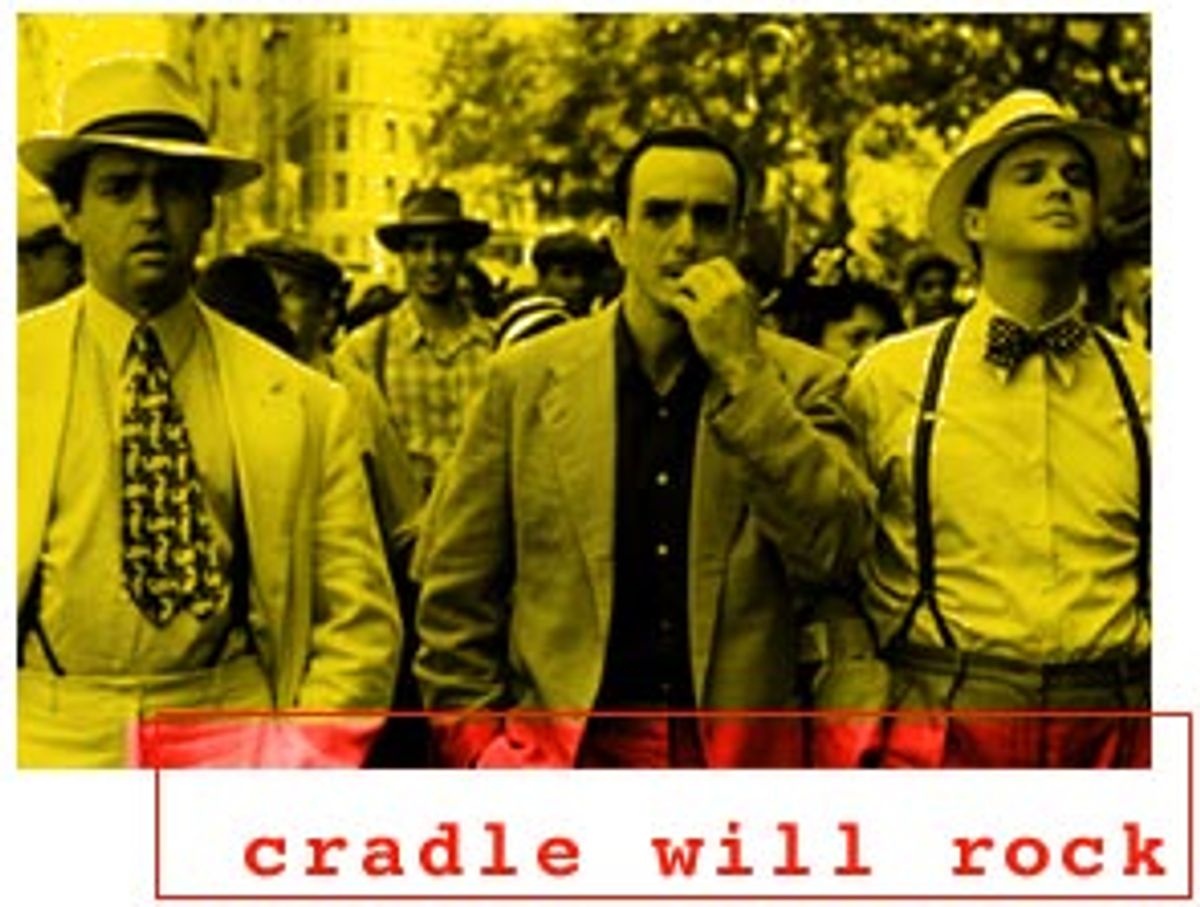
Is there anyone in the movies whose talent is more screwed up by his politics than Tim Robbins? As an actor, Robbins has brought subtlety and nuance to characters as disparate as the student civil-rights volunteer in "Five Corners," the addled Southern poet in "Miss Firecracker," the horny, hotshot pitcher in "Bull Durham" and the slimy young studio exec in "The Player."
But given a character who stands for something that goes against his politics, like the L.A. cop in "Short Cuts," Robbins resorts to crude caricature, to telling us exactly what we should think of whomever he's playing.
The frustrating thing about Robbins' new film "Cradle Will Rock," his third as writer and director, is that both impulses are up there on the screen. Sequences that delight you with their invention and wit bump up against ones of such didactic condescension that it feels as if someone is shoving a pamphlet into your hand.
Tenderness for his invented characters shares screen time with what amounts to the character assassination of real people. "Cradle Will Rock" may be the most ambitious American movie of the year; at times it's one of the most entertaining, and in many ways, it's the most appalling.
At the center of Robbins' panorama of the '30s is the story of the Federal Theatre Project's 1937 production of the Marc Blitzstein operetta "The Cradle Will Rock." An offshoot of FDR's Works Projects Administration, the FTP was intended to put theater professionals to work. Headed by Hallie Flanagan, the FTP staged numerous productions around the country, many of them with socially relevant content. None proved as explosive as "Cradle."
With Roosevelt's New Deal programs running into funding troubles in Congress and rumblings beginning about communist infiltration of the FTP, the decision by Orson Welles and John Houseman to stage Blitzstein's unabashedly pro-union musical was bound to cause a stir.
Just before the production was about to open, Congress announced budget cuts that cost thousands of FTP jobs and suspended any further productions from opening. Turning up at the theater on the day the show was scheduled to open, the cast and crew found themselves barred by federal troops from entering.
In a legendary event of modern theater, the company greeted the opening-night audience assembled outside and together they marched to a new theater that had been secured. There, barred by their unions from setting foot onstage, the cast and musicians performed from their seats in the audience, accompanied by the lone onstage figure of Blitzstein at the piano.
Obviously influenced by the style of Robert Altman's multi-character extravaganzas, Robbins has seized on this incident as the centerpiece in a carnival about the conflicts among art, politics and commerce. Fiddling with the time frame of actual events, he's made Hallie Flanagan's appearance before Rep. Martin Dies' House Un-American Activities Committee coincide with the opening of "Cradle" (it actually took place a year later).
And he's relocated from 1933 to 1937 the conflict between Diego Rivera (Ruben Blades) and Nelson Rockefeller (John Cusack), who commissioned the Mexican artist to paint a mural for Rockefeller Center, only to order it destroyed because of its depiction of Vladimir Lenin, among other things. (Cusack, tentatively sticking one toe in the pond of modern art, and Blades, wild-eyed and obstinate, are a pretty funny team.)
Other characters, real and imagined, swirl around the action. In the realm of the fictional, there's Bill Murray as a ventriloquist on his last professional legs, who gets involved with Joan Cusack as an FTP worker determined to bring the communist infiltration of the project to public awareness. And Vanessa Redgrave plays a ditzy patron of the arts whose rich husband (Philip Baker Hall) tolerates her passion but is more interested in business.
On the real side, there are the movers behind "The Cradle Will Rock," Orson Welles (Angus MacFayden), John Houseman (Cary Elwes) and Blitzstein (Hank Azaria). Emily Watson plays Olive Stanton, the aspiring actress cast in the lead of Blitzstein's operetta who, unbidden, was the first actor to rise from her seat and begin performing on the musical's opening night. And Susan Sarandon plays Margherita Sarfatti, Mussolini's mistress, who also wrote some pro-Duce pieces for the newspapers of William Randolph Hearst (who appears as a minor character, played by John Carpenter, in some scenes).
Robbins doesn't have the skill or the distinction to keep this circus-like atmosphere from tumbling into broadness, and when that happens all you can see is how clumsy the film is next to the screwball comedies it wants to emulate. What the film has going for it is the often ticklish silliness of all these disparate people rubbing up against one another.
In one scene Nelson Rockefeller goes to visit Diego Rivera's shabby studio-cum-apartment and finds the artist with a bevy of naked models. A few hours later, drunk on wine, Rocky's cutting the rug with them to the tune of "What a Little Moonlight Can Do."
One of the wittiest things about "Cradle Will Rock" is the way Robbins tries to blend the conventions of '30s movies into the story he's telling. Redgrave's Countess La Grange has been given a freeloading, no-talent protigi named Carlo (played by Paul Giamatti in a silly little waxed moustache) in homage to the freeloading protigi of the same name played by Mischa Auer in "My Man Godfrey." When Olive Stanton goes to apply for an FTP job but admits to having no previous theater experience, she's told this isn't a Busby Berkeley fantasy where she'll become a star -- yet she winds up starring in the production.
But Robbins doesn't pay attention to what those scenes are telling him. He appears to think that screwball comedies and musicals are entertaining enough but not very significant next to Blitzstein's operetta. He'd like us to believe that "The Cradle Will Rock" is a great work, conveniently forgotten because of its radicalism. But when we see the work performed, it's clear both why it thrilled audiences and why it hasn't survived.
To theatergoers dealing with unemployment and breadlines, keenly aware both of FDR's progressive policies and of the politicians who opposed them, seeing the forces of labor go up against the forces of capitalism in Blitzstein's operetta must have been electrifying. Part of what Robbins is responding to here is that confluence of events, performers and audiences. From his end-of-the-20th-century perspective, when politicians are still trying to shut down art they don't like, an era when the government, however briefly, actually funded political theater for an audience eager to receive its message must seem like a golden time.
As a director, Robbins has never been so openly emotional as he is in the staging of the premiere of "Cradle."
When I saw Emily Watson's Olive Stanton stand from her seat in the audience to sing her first line, I was overwhelmed not just by Watson's touching guilelessness in the role, but by the knowledge of just how much Olive is risking, and the glory that the company conferred on itself by following her brave lead.
This is far from the smug, self-satisfied "Bob Roberts" and the rather underhanded "Dead Man Walking," in which Robbins affected even-handedness while slyly playing one side of the capital-punishment debate off against the other. Robbins' political passions find an outlet in Blitzstein's operetta in the love Robbins lavishes on the actors and musicians.
But he's not a political thinker. What Robbins can't see is that a work like "The Cradle Will Rock" ages faster than any other. Would Blitzstein's operetta be known at all today if not for the unusual circumstances of its premiere?
Doesn't it signal something to Robbins that he can tell the story of Olive Stanton in the manner of "42nd Street," the backstage girl who gets her big break, and we know immediately what he's talking about? The "art" of the '30s, of the movies in general, has more to do with the genres Robbins regards as trifles than with all the socially committed work that was done. There is more of the essence of the '30s in the scene in "Gold Diggers of 1933" where the chorus girls swipe their neighbors' milk, or in offhand details here like Emily Watson washing up using a trickling fire hydrant.
In his autobiography "Front and Center," John Houseman writes that Blitzstein frankly acknowledged "The Cradle Will Rock" as a hodgepodge into which he threw anything that would get his message across. (He also writes that Blitzstein's unresolved conflict between writing politically and writing commercially divided and bedeviled his later work.)
Robbins firmly believes that art and politics are inseparable. The naiveti of that position aside (Robbins isn't a man I'd want to discuss "Birth of a Nation" with), it makes for scenes that are at best conflicted and at worst unreadable.
When Sarandon's Margherita Sarfatti tells Blades' Diego Rivera that she supports his art but that doesn't mean she has to support his revolution, the way the scene is played and shot (and the fact that Robbins has those lines delivered by his offscreen partner Sarandon) makes it appear that Robbins agrees with her. But the import of the movie suggests the opposite.
And when Bill Murray's ventriloquist decides to go onstage and do the old communist-inspired routine he used to do (complete with his dummy singing the "Internationale"), Robbins appears to regard it as a triumph of conscience. But the act is terrible; Robbins refuses to even consider that the people walking out of the theater might well be leaving for reasons other than not liking the politics on display.
It's the scenes with Watson and with John Turturro, in a lovely performance as an actor whose dedication to his art and providing for his family leads him to some very lean circumstances, in which Robbins acknowledges the difficulties that can lie in honoring your principles.
Robbins has made the classic mistake of thinking that art that's persecuted for its political ideals must be good art. (And he's made the kind of movie that, if you don't go for it, always gets you accused of being an impediment to progressive thought.)
That Nelson Rockefeller destroyed a Diego Rivera mural is awful; but the re-creation we see doesn't make the mural look very good to begin with. By the time the workmen bring out the sledgehammers, they might as well be knocking us over the head. Robbins cuts back to show us the only remaining element of the mural, a syphilis cell hovering over the ruling classes, nine separate times.
And he can't resist symbolism that should be outgrown by your junior year in college, like intercutting the performance of Blitzstein's operetta with the rich dressed up as French aristocrats at a costume ball.
Robbins is the kind of liberal who thinks that "the masses" need to be educated by having everything insultingly laid out for them (as opposed to the conservatives who think we're too stupid to understand anything in the first place). That kind of thinking is harder to get by with in a movie season featuring two American political films as complex as "Three Kings" and "The Insider."
And you can attribute nearly all of Robbins' sins here to his simplistic thinking, except for one: the outright viciousness of his treatment of Orson Welles and John Houseman. I don't know what these men ever did to arouse the bile directed toward them here, but the portrayals of them are a disgrace.
Every account I've been able to dig up of the staging of "The Cradle Will Rock" describes it as a collaborative process. Welles' elaborate staging plans, scrapped when the company was locked out of the theater, did make the rehearsal process difficult. But it was his and Houseman's enthusiasm, championing what they knew would be a risk for the beleaguered FTP, that helped get the show cleared for production in the first place.
Why, then, is John Houseman played as a prissy stuffed shirt? Why does Robbins, for the sake of a very unfunny bitchy remark, out him? And consider Orson Welles' career: the triumphant FTP production of an all-black "Macbeth," the staging of Julius Caesar set in Fascist Italy, "Citizen Kane," "The Magnificent Ambersons," "Othello," "Touch of Evil," "Chimes at Midnight" and his performances in movies like "The Long Hot Summer" and "Moby Dick." What in all that supports Robbins' depiction, and Angus MacFayden's horrendous performance, of Welles as a drunken blowhard leeching off the talents of others?
It's not possible to deal with Welles without allowing for the elements of egomania and showmanship. Liev Schrieber's portrayal of Welles in "RKO 281," the recent -- and not very good -- HBO movie on the making of "Citizen Kane," seemed to get it right, allowing for the genius and the egomania. This was a guy who tried to steal credit for Herman Mankiewicz's screenplay but who also directed that film.
Robbins, with his black-and-white way of looking at things, makes no such allowances, and you have to ask, who does he think he is? Tim Robbins is not an untalented man, but next to Orson Welles he's a pisher.
Robbins' treatment seems even more appalling considering that among the people who tried to bring this movie to the screen was Welles himself. In the early '80s, Welles wrote a screenplay and even cast Rupert Everett as himself. But, as frequently happened with Welles, he couldn't get funding.
Robbins shows no sense of how lucky he is to be the one to tell this story, and no sense that without the men he's slandering, there wouldn't have been a story to tell. Couldn't he have at least shown a little gratitude?
Shares