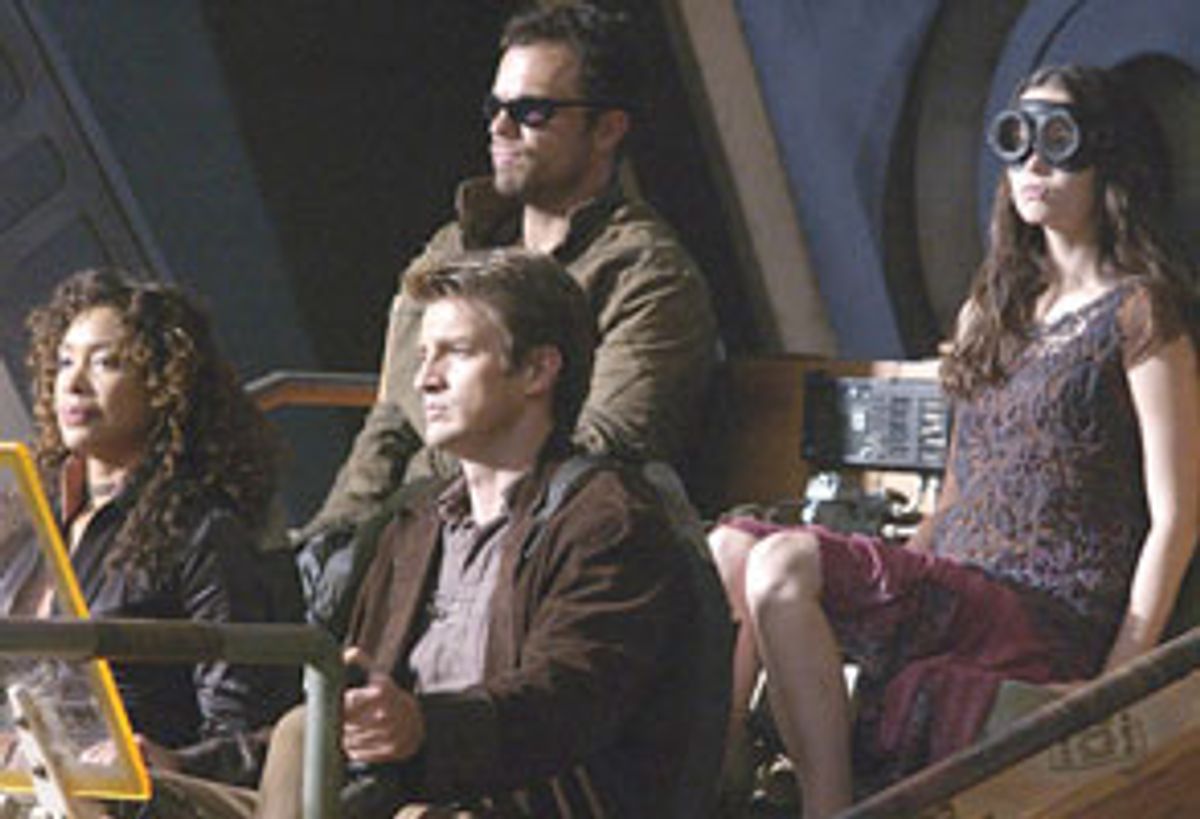
Joss Whedon's feature-film debut, the science-fiction western "Serenity," is beautifully made, written with more wit and intelligence than we get from most contemporary movies of any genre, and features an ensemble of actors whose rhythms are almost supernaturally in tune. There's only one problem with "Serenity": It's not "Firefly," the TV show that first gave these characters, and this story, life in autumn 2002 on the Fox network.
Both "Firefly" (which is available on DVD) and this new movie incarnation of it detail the adventures and tribulations of a loner-rebel named Malcolm Reynolds (Nathan Fillion) and the ragtag crew of his space vessel, Serenity. Their story unfolds in a future world -- the 26th century, to be exact -- in which humans have left an uninhabitable earth to populate a new-old, way-out-there solar system. More Sam Peckinpah than "Star Trek," this isn't a shiny, sleek vision of the future: For one thing, the various planets in this new world have been recently divided by a brutal civil war, and the winning side -- the Alliance -- is now trying to gather all the outlying hoi polloi planets under its rule. Many of these planets are hardscrabble frontiers whose citizens still ride horses, use old-time firearms, and even, occasionally, wear sunbonnets. The idea isn't just that civilization as we know it has largely disappeared, but that people have been so buffeted by hardship that they've had to start practically from scratch.
The "Firefly" episodes burn slowly at first, but their emotional heat intensifies as you learn to live, and breathe, with the show's characters. That's an ancient narrative strategy, and one that Whedon had clearly mastered with his earlier series, the magnificent "Buffy the Vampire Slayer" and its less resonant but still deeply enjoyable spinoff, "Angel." But apparently, this newfangled mode of storytelling intimidated Fox executives. They pulled the plug on "Firefly" after airing only 10 of the 14 episodes Whedon and his cast had completed -- and broadcasting them out of sequence. "Firefly" was seen by almost no one when it aired, partly because even those who desperately wanted to watch it -- namely, the many fans Whedon had earned with his previous series -- couldn't even find it when they turned on their TVs at the appointed time: The episodes were shown in fits and starts, several of them having been preempted by the World Series.
That's probably the worst thing you could do to a Whedon show, considering that he builds his narratives with the dramatic precision of 19th century novels. They don't always grab you with the first episode -- they're not made that way. Whedon prefers to reel us in gently, first setting the scene and then, week by week, drawing us into a web of complex character relationships that become a kind of home for us. Fans of Whedon's shows are the modern-day equivalents of those readers who so long ago got hooked on Dickens, people who would wait on American docks for the next installments of his newspaper serials to arrive on these Godforsaken shores. (Dickens biographer Edgar Johnson recounts how "waiting crowds at a New York pier shouted to an incoming vessel, 'Is Little Nell dead?'")
That's how it should have worked with "Firefly." The show finally did find its audience when it was released on DVD in late 2003, and Whedon, who had never given up on the show and its extraordinarily well-matched cast, sought ways to spin its posthumous success into another project. And almost against all odds, a major movie studio, Universal, put its money (perhaps not a whole lot, but enough) on a show that had earned lots of love but not a whole lot of cash.
"Serenity" -- which Whedon wrote as well as directed -- is both a primer on "Firefly" and an extension of it, a picture carefully calibrated to satisfy fans without leaving newcomers stranded. Whedon sets up the back story neatly at the beginning, introducing all of his characters in a few fleet scenes. Their dialogue comes off as casual, but it's really tightly scripted, a compressed guidebook to who these people are and how they relate to one another: Mal, a veteran army captain from the losing side of that devastating civil war, now roams the postwar universe in an old jalopy of an interplanetary craft he bought, refurbished and peopled with a loyal crew.
Serenity is a transport ship, a flying crate loaded with nooks and crannies, the better to hide the smuggled, and sometimes stolen, goods from which Mal and crew make their money; she's fast and scrappy, but not exactly state-of-the-art -- there are always bits falling off her, or engine parts that wear out and need replacing. But for Mal and his core crew -- including country-girl mechanic Kaylee (Jewel Staite), who understands that machines have souls; weapons expert Jayne (Adam Baldwin), a gun for hire whose brawn sometimes crowds out his brain; a pilot, the good-natured, Hawaiian-shirt-wearing Wash (Alan Tudyk); and Mal's second in command, Zoe (the extraordinary Gina Torres), a curvaceous warrior who redefines womanliness as if it were a newly discovered muscle -- Serenity represents freedom, a place where there's no authority to answer to as long as this bunch can keep those pesky Alliance ships off their tails.
Mal and his crew roam the universe -- they call it "the 'verse" for short -- in search of odd jobs and easy money, bending the rules when necessary but, in best outlaw tradition, always hewing to a code of honor. And along the way they pick up various travelers who also become part of the ship's life: Shepherd Book (Ron Glass), a man of the cloth with a shadowy past; the regal Inara (Morena Baccarin), who plies her trade as a "companion," essentially a cultured and highly respected futuristic courtesan, from a Serenity shuttle she rents from Mal; and Simon (Sean Maher), a young doctor who has smuggled his even younger sister, River (Summer Glau), aboard Serenity, after having rescued her from unscrupulous Alliance authorities.
Summer is a weirdo teen in wispy dresses, both a fragile presence and a strong one. She's also, unfortunately, a schizophrenic mess: Through a series of horrible experiments, the Alliance has been exploiting her extraordinary intelligence and psychic abilities for their own nefarious purposes, and they're desperate to get her back.
"Serenity" introduces two characters who didn't appear on the show: The first is a creepily dignified Alliance zealot known only as "the Operative" (played, with Shakespearean elegance, by Chiwetel Ejiofor), who has taken it as his personal mandate to find and kill River. The second is an interplanetary media geek who goes by the humble nickname Mr. Universe (the expressively eyebrowed David Krumholtz), who plays an instrumental role in the increasingly weighty mission that the Serenity crew undertakes.
Anyone even vaguely familiar with Whedon's means and methods knows that "Serenity" is only partly about a bunch of colorful characters flying around and exploring new worlds. "Serenity," like "Firefly" (and like "Buffy" and "Angel" before it), is an exploration of the meaning of community, maybe even the meaning of democracy. (Is Serenity a metaphor for our own country -- a falling-apart vehicle that we love to bits and steer as well as we can, desperately trying to protect it from the creeps who don't even understand how to drive it, much less understand how it actually works?) And there are spiritual quests in "Serenity" that go much deeper, and are far more unsettling, than the mere question of whether or not God exists. There are moments in which good men do unspeakable things, and malevolent men do noble things. And characters we care very much about are allowed to die.
"Serenity" has everything going for it: Whedon has a cinematic eye, and to help make his vision work on the big screen he's enlisted frequent Clint Eastwood collaborator Jack Green as his cinematographer. Even though this is a space-adventure story, the most intense action takes place within the deep space of the Serenity itself, and Whedon and Green capture both the coziness and the unknowability of the ship -- this is a place where something can always go wrong, and yet the haven of its common area is a constant: It's a nook furnished, like a student apartment, with 20th century castoffs like patterned shag rugs and tacky mustard-leather couches. The big screen also reveals details of Serenity that aren't so apparent on the small one: We see how the whole thing is jury-rigged with old cables and bits of tubing, held together with soldered globs of metal and, possibly, duct tape; the stenciled words "Resealable container, do not destroy" are clearly readable on a big metal canister.
"Serenity" is a trim little picture of epic proportions. The combat sequences are brutal and ingenious, and many of them feature River, who, it turns out, possesses special skills beyond her psychic ability: She's a balletic nymphowarrior capable of taking on the most ruthless inhabitants of the 'verse, a tribe of cannibal-rapists known as the Reavers. (The movie's climax includes an unforgettable image of this petite powerhouse silhouetted in a doorway, wielding a giant blade in each hand; it's a noble image in itself and also a nod to Whedon's first great heroine, Buffy Summers.)
Violence isn't an abstraction for Whedon. But even though his characters, male and female, get tossed around -- a lot -- he never presents violence for our delectation. When the Operative hurls Inara, a seemingly delicate creature who's actually capable of matching wits with generals, against a wall, we feel it in our own bones. This isn't violence against women presented for kicks. It serves a purpose beyond the moment, and it also sets up a spectacular rejoinder, a way for Inara to assert her dignity over any pathetic creep who would dare assault her.
So if "Serenity" is this good -- and as a piece of filmmaking, I'm hard-pressed to find much fault with it -- why am I still feeling the strong pull of those "Firefly" episodes? Whedon knows what he's doing here: When he puts lines like "I got no rudder. Wind blows northerly, I go north" in Mal's mouth, he does so for a reason. Everything in "Serenity," including the delicate shorthand used to delineate the relationship between Wash and Zoe, who are husband and wife, is part of a meticulously worked-out plan, a way of cluing us in to the hearts and minds of these characters, fast.
But some "Firefly" characters, most notably Shepherd Book, are accounted for but get lost by the wayside. And when certain characters die, those deaths are likely to hit "Firefly" fans much harder than they do "Firefly" novices.
That's understandable, but I still feel some anxiety that "Serenity" will be viewed by audiences unfamiliar with Whedon's work as just another sci-fi-geek enthusiasm. My problem, I think, is that "Serenity" dredges up some of the same feelings I have when a movie adaptation of a book I love just doesn't measure up. I'm so used to "reading" Whedon in the long form -- so used to riding the rhythms of his television series, rhythms he sustains beautifully week after week, season after season -- that "Serenity," as carefully worked out as it is, feels a bit too compact, truncated. That's less a failing on Whedon's part than a recognition of the way TV, done right, can re-create for us the luxury of sinking into a good, long novel. I hope Whedon makes many more movies (and there's the enticing possibility that "Serenity," if it does well, will be the beginning of a franchise). Faced with a big screen, Whedon knows exactly what to do with it. But the small one needs him, too. Of all the pleasures TV watching has to offer, he has perhaps tapped the greatest one: that of waiting on the docks, anxious to find out what happens next.
Shares