
Salon Member log in | Help
Benefits of membership

"United 93"

Pages 1 2 3

Greengrass has a feel for the way the mundane so readily gives way to the tragic. We see the passengers and crew getting ready to board the doomed flight, doing all the things most of us do as we hang around in airports: Some slouch in their chairs, reading books or newspapers or fiddling with their bags; others make last-minute work or personal phone calls, possibly more out of boredom than out of necessity. The pilots (played by J.J. Johnson and Gary Commock, pilots in real life) chat idly about the recent ups and downs of the weather as they make their way toward the plane. Onboard, the attendants call to one another from across the cabin ("Do you have sugars up there?") or wish out loud that they could be at home with their babies instead of working.

These early moments give the movie a portentously chilling shape and texture: Sometimes it seems as if 99 percent of our conversation is just boring work talk, and yet even our boring work talk is a way of defining our lives. Later, when the passengers and attendants realize what's happening and begin to make anxious calls to their loved ones, the movie veers into a sharper dramatic pitch -- and yet I'm not sure those final phone calls are necessarily more moving than the unassuming casualness of those earlier conversations. (Greengrass needs to dramatize those fervent phone calls, and yet he does dance a bit too closely to milking them for dramatic value -- it's an insoluble problem for any filmmaker.)

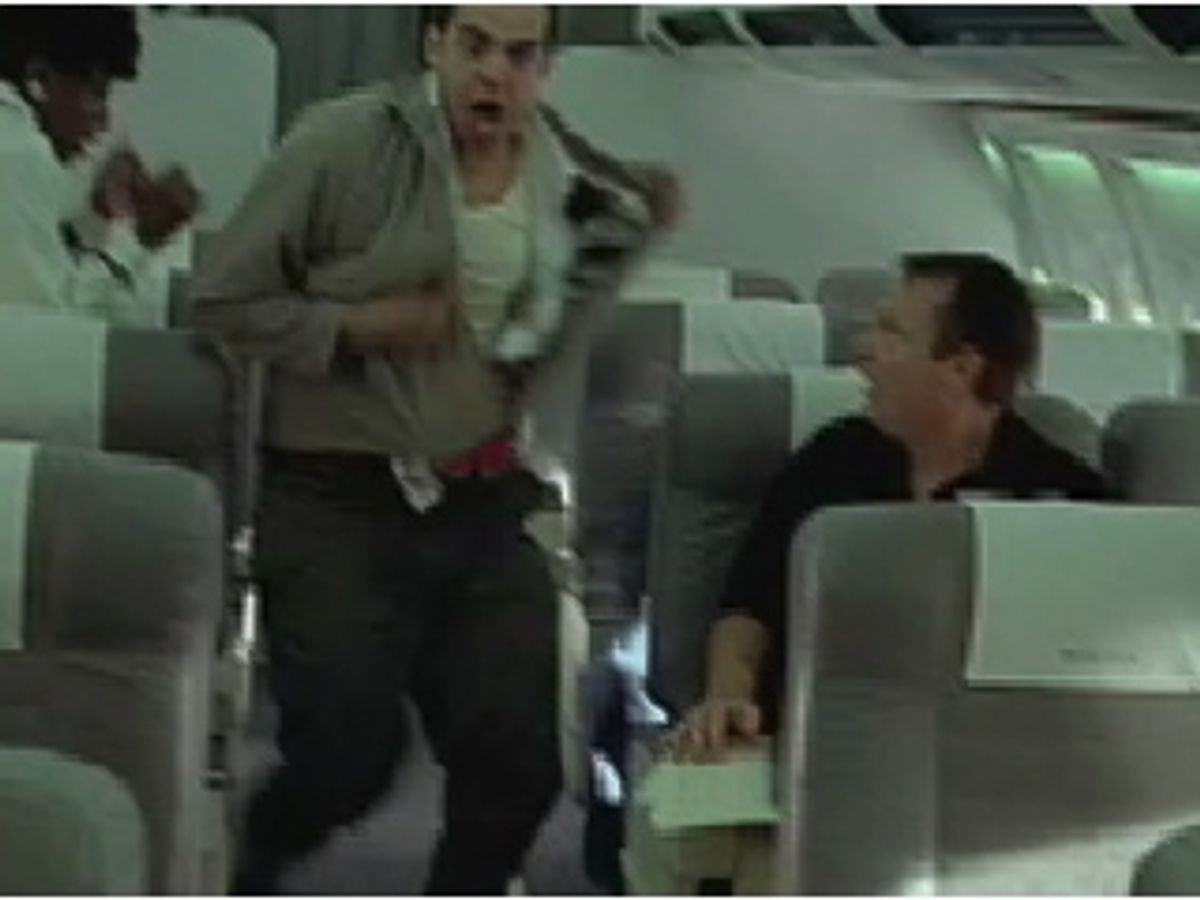
The action in "United 93" cuts between the plane cabin, a thin shell of isolation and vulnerability, and various sites on the ground: Those include the FAA's Herndon command center and a military command center in upstate New York, as well as air-traffic-control centers in Boston and New York and the control tower at Newark International Airport. (In one moment that's startling even though we're set up for it, the Newark controllers glance across the river and see fat plumes of smoke billowing from the World Trade Center. We see it from the same distance they do, an emblem of both Greengrass' fidelity to the characters' point of view and his tact.) The sequences set in the cabin -- even before the hijackers spring into action -- are so tense they're nearly unbearable to watch. Whenever Greengrass cuts back to the safety of the ground -- even as the air-traffic controllers and military personnel slowly come to realize that two earlier flights have been hijacked -- the movie relaxes slightly, and we do too. We know the worst is yet to come, and we know exactly what the worst consists of. So we grasp at every reprieve from it.

Greengrass doesn't portray the four hijackers (they're played by Khalid Abdalla, Lewis Alsamari, Omar Berdouni and Jamie Harding) as monsters, but as human beings who have chosen to act like monsters. The picture opens with two of them praying in their hotel room, a faceless, neutral space whose very beigeness seems unwelcoming to anyone's God; still, their prayers have the rhythm of habit and conviction -- although that comforting rhythm may also suggest the utter absence of thought.

But the hijackers -- even the tall, handsome one, who betrays a flicker of recognizably human apprehension in the early moments of the flight -- are very much "the other" in "United 93." None of the other passengers pay these men a bit of attention, but we're hyper-aware of their presence, simply because we know what's coming. Greengrass, to his credit, doesn't do any fancy two-step around the fact that these men committed murder in the name of Islam. He's unafraid to make the link between the terrorists' religion and the barbarism they carried out for its sake. "In the name of God," one of the hijackers says flatly as he slits the throat of a flight attendant.

Next page: Are artfulness and conscientiousness enough?

Pages 1 2 3

Related Stories

"I never want to forget 9/11"
Alice Hoglan's son Mark Bingham died on Flight 93, in a final struggle captured on cockpit tapes heard only by family members. With pride, grief and anger, she tells what happened.
By Kevin Berger
07/23/04

"The Bourne Supremacy"
Remember him? Matt Damon is back as everyone's favorite amnesiac former CIA assassin in one of the summer's best films.
By Charles Taylor
07/23/04

"Fahrenheit 9/11": Nay!
Moore's latest has some powerful images that are invariably overwhelmed by his jokey, faux-populist self-righteousness.
By Stephanie Zacharek
06/23/04