

I'm young and I love to be young
I'm free and I love to be free
To live my life the way I want,
To say and do whatever I please.
-- Lesley Gore, "You Don't Own Me"
Now it's dark and I'm alone
But I won't be afraid
In my room.
-- Brian Wilson, "In My Room"
No one-time teenager has suffered more from the cruelty of history's gossip mill than Marie Antoinette. When she was told the peasants were starving for lack of bread, the Marie Antoinette of lore shot back, "Let them eat cake!" -- a great line, straight out of "Mean Girls," except that the real Marie Antoinette never said it. Imported to France from her native Austria at age 14, she was the brokered bride of a future king, a bargaining chip with a womb. Her purpose was to cement peace between, and solidify the power of, the two nations. Marie Antoinette landed in a country, and a court, that eyed her with suspicion and contempt: She was a callow, uneducated foreigner, barely worth the disdain of oh-so-civilized France, and the fact that she couldn't immediately produce an heir didn't help. But because she was a future queen, she had access to -- and availed herself of -- the grand and costly buffet of opulence that had been the norm in Versailles long before she arrived. To paraphrase a lyric from another Lesley Gore song: You would shop, too, if it happened to you.
There is shopping in Sofia Coppola's buoyant, passionately sympathetic dream-bio "Marie Antoinette" (which plays the New York Film Festival Friday night, and opens in New York and other cities on Oct. 20). But this is not -- as you might have believed if you trusted the reviews out of Cannes, scrawled by critics from the garretlike confines of their hotel rooms as they clutched their Mao jackets tighter to protect themselves from the threat of beauty, pleasure and decadence -- a movie about shopping. Nor is it a straightforward biopic or a history of the French Revolution (it never purports to be either of those things).
"Marie Antoinette" is Coppola's silk-embroidered fantasy sampler of the inner life of a queen we can never really know: It's a humanist comedy-drama decked out not in sackcloth but in ribbons -- instead of flattering our ideas of our own virtuousness, it asks our sympathy for this doomed queen even as we can't help envying her privilege.
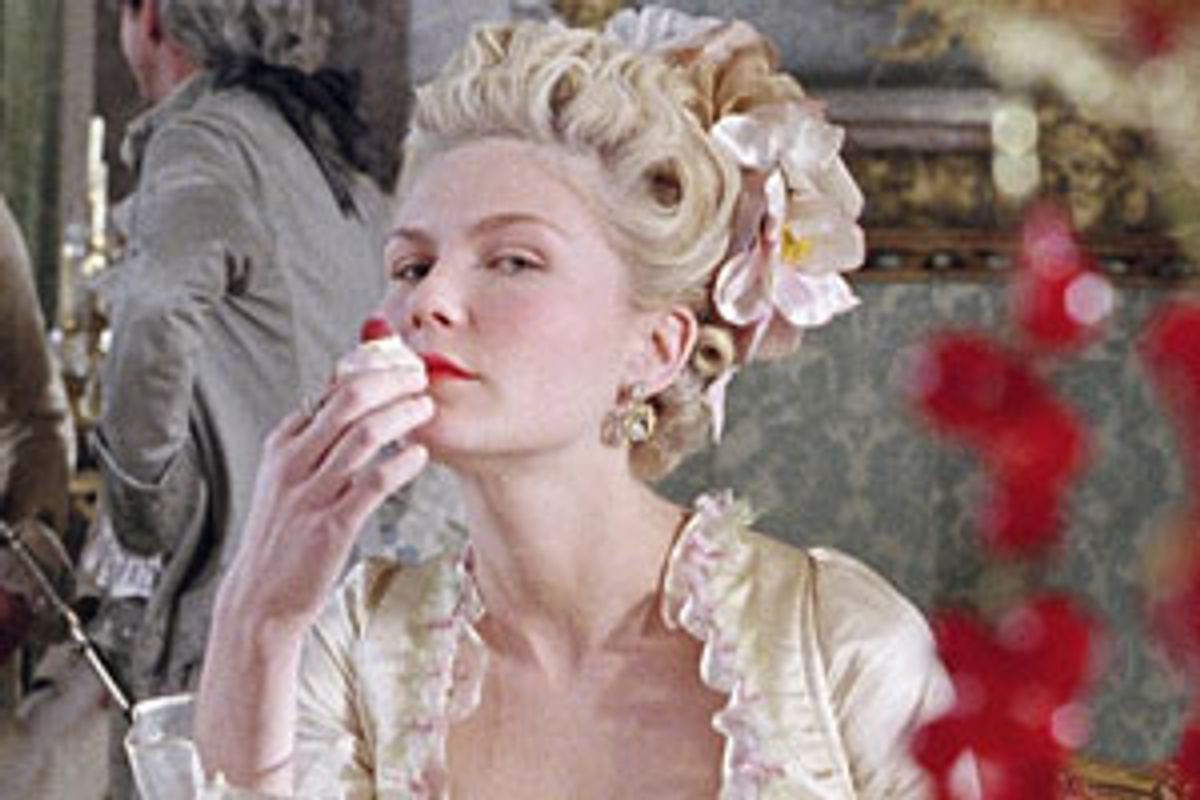
And that, right there, is the challenge of "Marie Antoinette." There's no doubt the woman is a divisive figure, which at least partly explains the mixed-to-negative reaction Coppola's picture received at Cannes. Even with the appearance of biographies like Antonia Fraser's 2001 "Marie Antoinette: The Journey" (which Coppola used as inspiration for the film, and which manages to be both empathetic and keenly judged), there's still a pervasive sense that feeling something for Marie Antoinette means being against the starving masses -- and none of us wants that on our résumé. Writing her off as a bitch is so much neater than considering her as a person, which may be why Coppola opens her picture with a pipe-dream tableau that invites us to shine up those cherished assumptions: We see Coppola's star, Kirsten Dunst, as the frivolous, uninterested queen of legend if not of fact, draped in satin and lounging on a chaise as a lady-in-waiting tends to her toenails. The queen exerts herself only enough to scoop a fingerful of whipped cream from one of the confections laid out before her. She's lost in an erotic stupor, high not just on white sugar but on her own sugar. Against this vision of useless luxury, we hear Gang of Four's "Natural's Not in It," a song that seems to be made up not so much of notes as shards of broken mirror. "Dream of the perfect life/ This heaven gives me migraine": Too much sugar, too much self -- either one will do you in.
That opening is a tease, a sly visual joke with some truth in it, but it's not the whole of the truth. And from there, "Marie Antoinette" takes off at a sidesaddle gallop. This is Coppola's third movie, her most ambitious in terms of structure and lavish detail, although it skims themes she's explored before. Her adaptation of Jeffrey Eugenides' "The Virgin Suicides" is like a Pre-Raphaelite painter's vision of '70s suburbia: Telling the story of the mysterious Lisbon sisters and the neighborhood boys who adore them, Coppola maps, with tenderness and clarity, the incongruity between the dreamy mantle of idealization the boys drape around the young women, and the isolation and depression those women suffer in secret. And in the elegiac "Lost in Translation," a young woman rattles about in a marriage that she's unwilling to identify as unhappy: Marriage is supposed to confer a sense of belonging, and yet she belongs nowhere.
"Marie Antoinette" is an expansion on the idea of "belonging nowhere," a blending of imagination and history that may fit less comfortably in the genre of costume pictures than in that of teenage drama -- a genre that was born with "Rebel Without a Cause" and took root in the culture with movies like "Splendor in the Grass" and, much later, "Fast Times at Ridgemont High." More recently, the genre has thrived on television in shows like "Buffy the Vampire Slayer," "Veronica Mars" and "The O.C." -- shows that are watched as much by adults who lived through teenage insecurity but will never be able to shake its phantom as they are by actual teenagers.
Marie Antoinette -- who became queen at 19 and was beheaded at 37 -- isn't a teenager through the whole film. But Dunst plays her as a youthful spirit, at times a careless one and at times serious in the way only young people can be. At the beginning of the picture, the very young "Antoine" -- as her mother, Empress Marie-Therese (played by a regal Marianne Faithfull), calls her -- is whisked away from Austria in a golden fairy-tale carriage to the French border, where she's met by a stern handler, the Comtesse de Noailles, played by Judy Davis. She's told she must leave all her Austrian friends behind, including the kindly ambassador who's been assigned to help her (played with canny warmth by Steve Coogan). Even her clothes have to go: "It's the custom that the bride retain nothing belonging to a foreign court," the Comtesse informs her in icicle tones, as a gaggle of maids strip her down to her beribboned thigh-highs. Even her beloved pug is snatched away from her: The crestfallen look on the princess-to-be's face says, "Childhood stops here." And in her new clothes, she suddenly looks like an adult, as if she'd added 10 years in the time it takes to be laced into a corset.
She meets her future husband, the doughy Dauphin (Jason Schwartzman), and the two are married before they even have any idea what to say to each other: "So -- I've heard you make keys as a hobby?" she offers, with the eager-to-please brightness of a coed, to which the young Louis, between bites of food, replies bluntly, "Yes." Dunst has very few lines for the first third of "Marie Antoinette": Coppola shows her watching and observing, and we see this strange French planet through her eyes. The dicor at Versailles, all gold leaf and creamy blues, looks brittle to the touch, compared with the mellow opulence of Vienna. She has inherited two sour French aunties (played by Shirley Henderson and Molly Shannon) who observe her every move. All the ladies of the court whisper as she passes, their comments ranging from the patronizing ("She looks like a piece of cake!") to the cruel ("I wonder how long she'll last"). Their feigned smiles are like daggers; they can't wait to see her fall. And when she fails to become pregnant, they speculate loudly about what is (or, more accurately, isn't) going on in her bedroom. Her life is no longer her business; she belongs to the court.
Coppola traces the life of the young queen in sequences connected by dotted trails of ellipses. She has a gift for making pictures of incredible lightness, to the point where her movies are often falsely accused of having no depth. (Her critics should read Kundera.) But her lightness of touch is deceptive: The complexity of her movies is embedded within their simplicity. Coppola is essentially a linear storyteller, although her pictures move the way vines and tendrils grow, crisscrossing and winding, art nouveau-style. In the space of a few seconds, Coppola tells us that Marie Antoinette gave birth to a child (her third) and lost him in infancy by showing us a mock-up of the Vigée-Lebrun painting portraying the mother and children: Dauphin Louis Joseph points to an empty bassinet. And even within the movie's bubble of lavishness -- it contains many vibrant, seductive sequences of gambling, partying, dancing and, yes, shopping -- Coppola spends far more time peering into the interior lives of her characters: Louis begins as a plump dullard but gradually turns into an affectionate companion (Schwartzman's performance has sly, padding charm); Marie Antoinette, though she's not above having an affair (her paramour, Axel von Fersen, appears only briefly and is played by Jamie Dornan), returns his regard. The warmth between them is the best-case scenario in a royal arranged wedding, and a teenage one, at that: As Chuck Berry once sang, "It goes to show you never can tell."
Coppola's picture is unabashedly luxurious to look at: It was filmed on location at Versailles (Coppola is the first filmmaker to have been granted that privilege), in a palette of cupcake-fondant colors and patina'ed gold. (Her cinematographer is Lance Acord, who also shot "Lost in Translation.") Dunst herself could have been whisked off a Limoges teacup: Her beauty is so youthfully vital that it's almost spectral, as if she were a dream of beauty rather than its fact. Her performance is at once weightless and deeply touching.
One of the most distressing things about the negative reaction to "Marie Antoinette" -- a reaction that, incidentally, has hardly been universal -- is that Coppola has detractors gunning for her no matter what she does, simply because she's the daughter of a very famous director and therefore has advantages that aren't open to most filmmakers. The unrepentant visual sumptuousness of "Marie Antoinette" makes her an easy target: Coppola likes fashion, has money, and is friends with Marc Jacobs -- therefore, she must be shallow, and this very fancy-looking movie proves it.
But there's another possible explanation for Coppola's attraction to beauty and splendor, as we see it in "Marie Antoinette": Maybe it stems less from a girly love of glamour than a Catholic taste for pageantry and excess -- a taste that her father and his fellow Italian-American filmmaking contemporaries, Martin Scorsese and Brian De Palma, have all shown in their movies. The lush draperies and ornaments of Versailles are baldly ecclesiastical, perfectly fitting for rulers who were supposed to be guided by God. Why wouldn't Coppola be attracted to that setting?
Coppola wants us to enjoy all of that grandeur without guilt. Even so, she never denies the toxicity of the pleasure and decadence that Marie Antoinette took part in. Her movie doesn't dramatize the revolution from the people's point of view -- it's not their movie, after all. But Coppola captures the luxe insularity of Marie Antoinette's world in a way that leaves no doubt why the revolution had to happen. The picture's final image is a moment of devastating stillness that wouldn't be out of place in Luchino Visconti's end-of-an-era masterpiece "The Leopard."
History is filled with personal sadness, the result of mistakes made or warnings ignored, or sometimes just of circumstance: Even though we human beings like to believe we have the power to shape the course of events, whole kingdoms have been lost by men and women who have had the dazzling misfortune of being in the wrong place at the wrong time.
The Marie Antoinette of Coppola's movie is neither a victim nor a villain, and there's no doubt she was guilty of carelessness, extravagance and poor judgment. But the intentionally anachronistic "Marie Antoinette" asks us to walk in her dainty satin slippers, just for a few hours. Eighteenth-century teenagers were, of course, "older" than contemporary ones, partly because the human life span was so much shorter. Even so, Louis XVI and Marie Antoinette were essentially kids -- both were 19 -- when they were put in charge of the future of France. And what teenager, of any era, would want that headache? After the death of his grandfather, Louis XV (played by a randy Rip Torn), Schwartzman's Dauphin turns to his young wife and says, with a trembling, heart-rending gravity, "God help us, we're too young to reign."
The selfishness of being a teenager is one of the things that makes those years so vital, and it's part of what gives rock 'n' roll -- including the post-punk soundtrack Coppola uses here, featuring music by the likes of Bow Wow Wow, the Cure and New Order -- its kick. The youthful cry of rock 'n' roll, one that each successive generation has reinvented for itself, is "The world is ours!"
Then, on further reflection, we realize with horror, "My God -- the grown-ups before us have totally fucked it up!" Louis XVI and Marie Antoinette inherited a world they didn't -- maybe couldn't -- fix. But with her movie, Coppola at least restores some of their youth. Maybe this is the only chance the teenage Marie Antoinette will ever have to say to the world, as she can say only in fiction, "You don't own me." Shake it up, baby. Twist 'n' shout.
Shares