

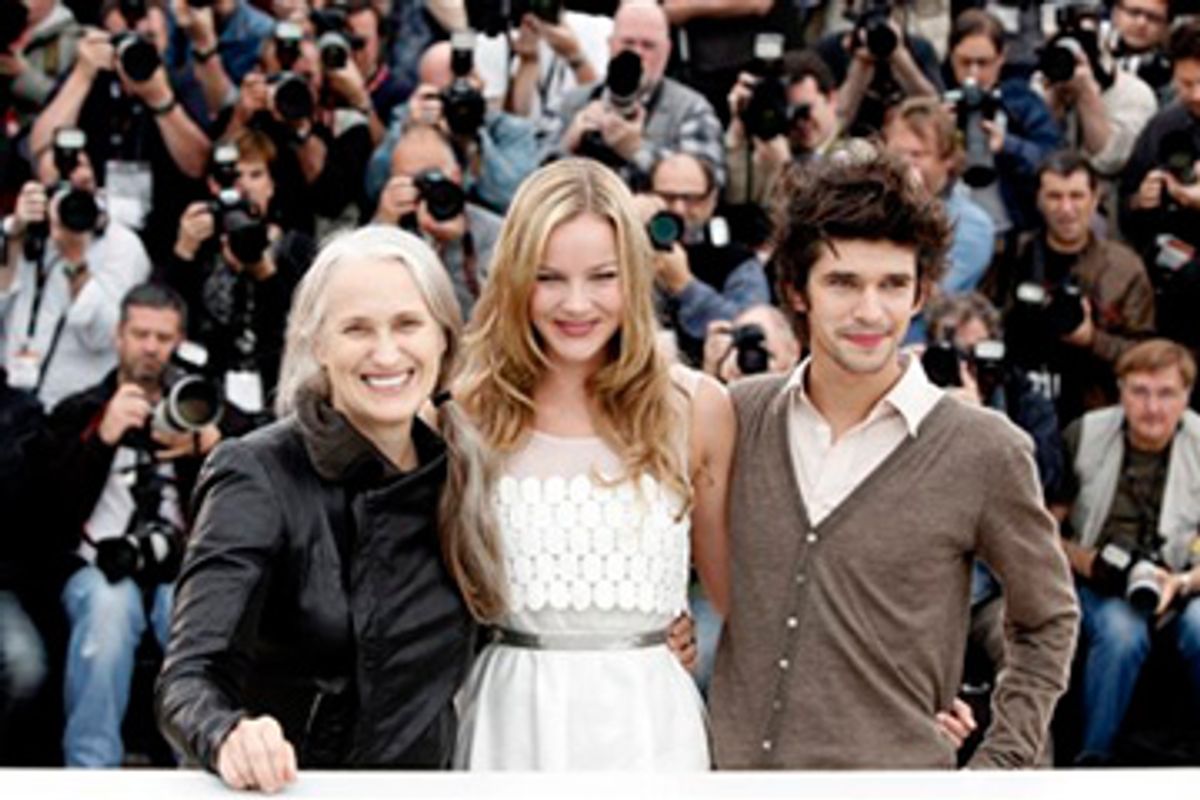
The opening film is meant to set the tone of the festival -- or at least that's what the big names in Cannes would like to think. And the movie that kicked off the world's most important film festival, taking pride of place on the giant screen at the Festival Palace this week, is called "Up."
The message of the film is one of enlightenment, revolution even. It's the first animated film ever to make the esteemed gala slot on the festival's first evening. So coming almost six-and-a-half decades after "Bambi," it is a courageous move for the festival, which was created in 1939, as well as a sign of respect for animated films. It's also about the cineastes in Cannes trying to make a fresh impression. For decades, film buffs have looked down their noses at the animation genre -- they saw it as artistically inferior. Until 2001, that is, when "Shrek" was accepted at Cannes. This week's message: no hard feelings!
In fact, "Up" was perfect for Cannes' opening night because the story it tells also has considerable symbolic value. The movie, produced by U.S. entertainment factory Disney/Pixar, is about an imaginative but ornery old man who barricades himself into his house. As a result, none of his dreams have ever come true -- until the old man and his crooked house miraculously take off heavenward, and onto a series of fantastic adventures.
The festival in the small French city on the Mediterranean could use a similar kind of magic. Demonstrating an unusually united front, and in perhaps the gloomiest mood ever, filmmakers, investors and even festival organizers are painting an epic picture of crisis in the film industry.
"Where will the Festival de Cannes be in five years' time?" Gilles Jacob, the festival's 78-year-old president, asked anxiously at the press conference held last month to announce the official selections. He noted that the future of independent cinema and the future of the world's larger film festivals is "essentially one and the same" and that he has serious concerns for both. "The last we heard," Jacob said, "the type of cinema that we like -- upright, original, unique cinema, the cinema of byways -- has been declared extinct by the thought police."
And at the introduction for this year's artists, Cannes festival director Thierry Frémaux, 48, felt the need to declare that he did not believe "that young cinema is dead." Partially this was because there is no fresh, young talent among the films currently in the official selection. Indeed, the lineup of stars and filmmakers who will present their work in Cannes this year gives one the impression that the organizers have hedged their bets. Some of the most seasoned champions of art cinema are here: New Zealander Jane Campion, 55, Danish director Lars von Trier, 53 and British filmmaker Ken Loach, 72, as well as Austrian director Michael Haneke, 67, and Spanish director Pedro Almodóvar, 57. British newspapers are already scoffing at the assembly, noting that the champagne has been locked away this year and that it's time for "the heroes of festival days gone by to show up and save the party."
The concerns of Cannes godfather, Jacob, are completely justified. Auteur cinema, which -- thanks partly to his festival -- has been considered visionary and demanding by artists and intellectuals the world over, does appear to be threatened with extinction. Of course, auteur films are still being made today and a handful of young directors are certainly emulating the old masters. But hardly anyone is interested anymore.
For years, clever, culture-savvy sophisticates had two responses to the films screened in Cannes -- and that includes everything from Jean-Luc Godard's "Sauve qui peu" ("Every Man for Himself," 1980) to David Lynch's "Wild at Heart" (1990). They either loved them or hated them. Unfortunately today, many cinephiles couldn't care less. The days when curious young film buffs treated the films of François Truffaut, Martin Scorsese, Wim Wenders and Lars von Trier like mysterious messages from the avant-garde and analyzed them down to the last detail, are gone -- and probably for good.
Auteur cinema has had its day in the cultural sunshine and now it's just another niche genre in filmmaking. As the fate of recent Cannes selections demonstrates. After the festival ends, many routinely sink into almost total obscurity. Many never even make it into movie theaters, going straight to DVD instead. Of course, there have always been films with artistic merit that the general public has spurned -- including Cannes winners like Luis Buñuel's "Viridiana" (1961), Andrzej Wajda's "Man of Iron" (1981) or Abbas Kiarostami's "Taste of Cherry" (1997). But then there were also films that did well at Cannes and drew larger audiences -- Martin Scorsese's "Taxi Driver" (1976), Volker Schlöndorff's "The Tin Drum" (1979) and Quentin Tarantino's "Pulp Fiction" (1994) among them.
However, in recent years it hasn't been just the winners of Cannes' top prize, the Palme D'Or, that need to worry about turning toxic at the box office. A disturbingly large percentage of the selections at film festivals everywhere have not made any money. And that's whether the films were directed by indie-film superstars like Ken Loach, the Dardenne brothers or Gus Van Sant, or not. American distributors note that one movie in the "Star Wars" series attracted more viewers into movie theaters than the last 10 years' worth of winners at the Cannes and Venice film festivals combined.
Another option is to make the films available for download on movie-buff Web sites. But that has yet to become profitable. One example is the much-discussed, California Internet start-up with a somewhat ironic name, theauteurs.com, which purports to provide an "online film festival."
The slow decline in the importance of auteur cinema at Cannes has been somewhat hidden by the glamorous hustle and bustle along the city's beachside Boulevard de la Croisette. But with the current economic crisis, the glitzy parties and big-deal-making of days gone by have become fodder for nostalgia. Glamour is conspicuously absent this year. The owners of luxury rental yachts bobbing up and down in the harbor and the owners of the party villas in the hills above Cannes are reporting sharp declines in revenue, a reflection of the general mood of frugality. And hotel owners are annoyed by obstinate guests refusing to rent rooms for the entire festival at the standard-for-the-week, absurdly high prices. And without all that glitter, it is suddenly very obvious how arty cinema in competition at Cannes is now just a sideshow.
The film industry itself is expecting economic carnage this year. And the moviemakers' year begins in Cannes, where lawyers and agents bargain at what is the world's most important convention for film sales. As in previous years, more than 900 films will be shown at the convention -- an enormous selection when compared to the few dozen films actually on the official festival program. Those films will be offered for sale in more than 1,400 screenings. But the mood this year is predominantly gloomy. According to U.S. film industry publication Variety, most film industry insiders were already anxious as they packed their bags for Cannes this year. They were thinking to themselves, "It can't get even worse -- or can it?" Variety reported.
In recent months, film brokers have been battered with more bad news than ever before. Aside from problems posed by the general financial crisis, movies are not doing too badly at the box office where ticket sales remain moderate. However, worldwide sales of DVDs and revenues from television have dropped dramatically. For many years the red carpet, where celebrities pose for the photographers in Cannes, was where the film industry was able to show off to the world, a spotlit runway for the stars and their wares while the real business was being done on the sidelines. But this year the scene behind the runway looks more like some massive clearance sale -- which isn't exactly sexy.
And Hollywood, at any rate, is more or less giving Cannes the cold shoulder this year. The relationship between the American dream factory and the European festival has had the "history of a love-hate relationship," Swiss film scholar and critic Christian Jungen writes in his new book "Hollywood in Cannes," which describes the nearly endless dispute over promotional appearances for American blockbusters in Cannes. It's been going on ever since Alfred Hitchcock, director of "The Birds," was spectacularly attacked by a pigeon in Cannes and a muscle-bound Arnold Schwarzenegger paraded almost naked across the beach. But it seems that this love-hate relationship ended in 2009. Even the Americans seem to have lost their interest in Cannes.
In a last-ditch effort, festival organizers managed to entice a few directors important to the U.S. -- such as Taiwan-born virtuoso Ang Lee, and magnificent misfit Quentin Tarantino -- to the gathering. Tarantino wants to prove that he can follow up on his Cannes triumph, "Pulp Fiction," which premiered there 15 years ago. In his new work, "Inglorious Basterds," an elite force of Jewish-American soldiers slaughters scores of Nazi troops. And at least Tarantino's film promises to deliver a dose of action to the festival, as does Lars von Trier's work "Antichrist."
That's a welcome departure from the Cannes tradition of presenting hard-to-sit-through, minimalist epics with as little action as dialogue and calling it the only true "auteur cinema" -- even though the auteur's signature is scarcely discernible with this kind of cinema. The dull aesthetics of films that pay homage to art-cinema deities like Michelangelo Antonioni have simply become annoying for a large number of those reporting and reviewing at Cannes. And one wonders whether festival director Jacob is doing the festival any good by describing these mutinous critics as "thought police."
It is true that for years the festival, to which the art of cinema admittedly owes a great debt, has favored a monoculture. But the vapidity of that monoculture becomes painfully obvious to viewers when a film demonstrates a sense of humor and a real fighting spirit, as Matteo Garrone's "Gomorra," a movie about a settling of accounts with the Mafia, did last year. So what will it look like at Cannes in five years' time -- and at the world's two other major film festivals, Venice and Berlin?
The publishers of "Schnitt" (Cut), a Cologne, Germany-based film magazine, recently devoted an entire issue to "The Future of the Film Festival." The issue served as a wakeup call to various festival directors, encouraging them to carefully contemplate the future of their business.
There's been a lot of discussion around the notion that festivals should act as some sort of temporary museum for red-hot but hard-to-sell cinematic art -- because, after the Internet, festivals could be the most important way for independent filmmakers to get their work to an audience. In the magazine, Lars Henrik Gass, director of the Oberhausen Short Film Festival, proposes an even more radical argument. As the movie business shifts to DVD and digital channels, films are making less and less money in theaters. Which is why "film as a product no longer needs festivals, and maybe not even theatres," Gass argues. But this need not spell the end of film festivals, he continues. Rather it creates "an historic opportunity to show better films."
Back in Cannes, it seems unlikely that Gilles Jacob and Thierry Frémaux will go that far. Even though Jacob has now discovered the Internet and introduced an earth-shattering innovation: Every filmmaker on the Cannes program may present the first five minutes of his or her film on the festival Web site. "Instead of the usual trailer, which extinguishes all desire to go to the movies," Jacob hopes the samples will make the films more appealing "especially to a young audience."
"Was it Altman or Renoir -- I forget -- who said that the great artists are at their best in the first and last reel?" Jacob said at last month's press conference. "Let's hope so!" He has a point -- a little hope is never wrong.
Translated from the German by Christopher Sultan.
This article has been provided by Der Spiegel through a special arrangement with Salon. For more from Europe's most-read newsmagazine, visit Spiegel Online or subscribe to the daily newsletter.
Shares