

Late in the summer, editors at all sorts of publications (this one included) were looking ahead to the fall's releases and taking note of the numerous fictional movies that were either about the Iraq war specifically, or about the United States' tangled, contentious involvement in the Middle East in general. Week by week those movies -- "In the Valley of Elah," "Rendition," "The Kingdom," "Lions for Lambs" -- some of them lousy and some of them at least honorable and thoughtful, have come and gone. These days all movies are disposable -- even a heavily hyped blockbuster like "American Gangster" has a short shelf life. But the Iraq war movies of this recent autumn have churned through theaters so quickly they've barely left a footprint. As my colleague Andrew O'Hehir has noted, no one wants to see these pictures. When I talk to my friends about it, it's clear they're staying away not out of apathy but out of helplessness and fatigue. At this point, can any movie about Iraq make us think or feel any differently?
Despite -- or perhaps because of -- everything that's already been written about it, not many people will likely want to see Brian De Palma's "Redacted," either. But of all the war-themed pictures that have been released so far this fall, it stands apart, and it stands alone: "Redacted" is confrontational, rough, immediate and confounding. In places, it's nearly impossible to watch, or perhaps it just seems like too much for any filmmaker to ask us to watch. But I've seen no other picture like it, certainly not this fall and perhaps ever. "Redacted" is a fictional story based on real events -- most significantly the rape and murder of 14-year-old Abeer Qasim Hamza al-Janabi, in Mahmudiya, Iraq, in March 2006 by American troops -- and it's a blunt, flawed picture, flagrant in the way it defies the degree of finesse and meticulous emotional orchestration we expect in a movie. But the nakedness of its anger, of De Palma's anger, is its very strength. Debating its numerous problems -- the weakness of some of the acting (De Palma uses a group of relatively unknown actors here), or the effusiveness of the music over the final, devastating set of images -- is like critiquing an open sore. This is one of those rare pictures that's more significant for what it asks of us than for what it is.
De Palma found all the material for "Redacted" -- its title a reference to the act of alteration, of editing or removing sensitive or confidential information -- by digging around on the Internet: He collected the pieces of his story from news reports, from pictures, videos and journal entries made by soldiers, from snuff videos posted on Islamic fundamentalist Web sites. From the Web he also collected photographs of Iraq war victims -- many of them children -- that would never show up in the mainstream press: These are the pictures that close the movie, a set of images of the wounded and the dead that will linger with you -- as they did with me -- long after you've left the theater. I doubt I'll ever forget them. (The eyes of these people have been blacked out. Eamonn Bowles, president of Magnolia Pictures, the studio behind "Redacted," has claimed the alterations were necessary for legal reasons, because the subjects had not signed releases. De Palma has decried the alteration of the pictures in interviews and at the movie's New York Film Festival press conference in October. As he has said, his movie is itself redacted.)
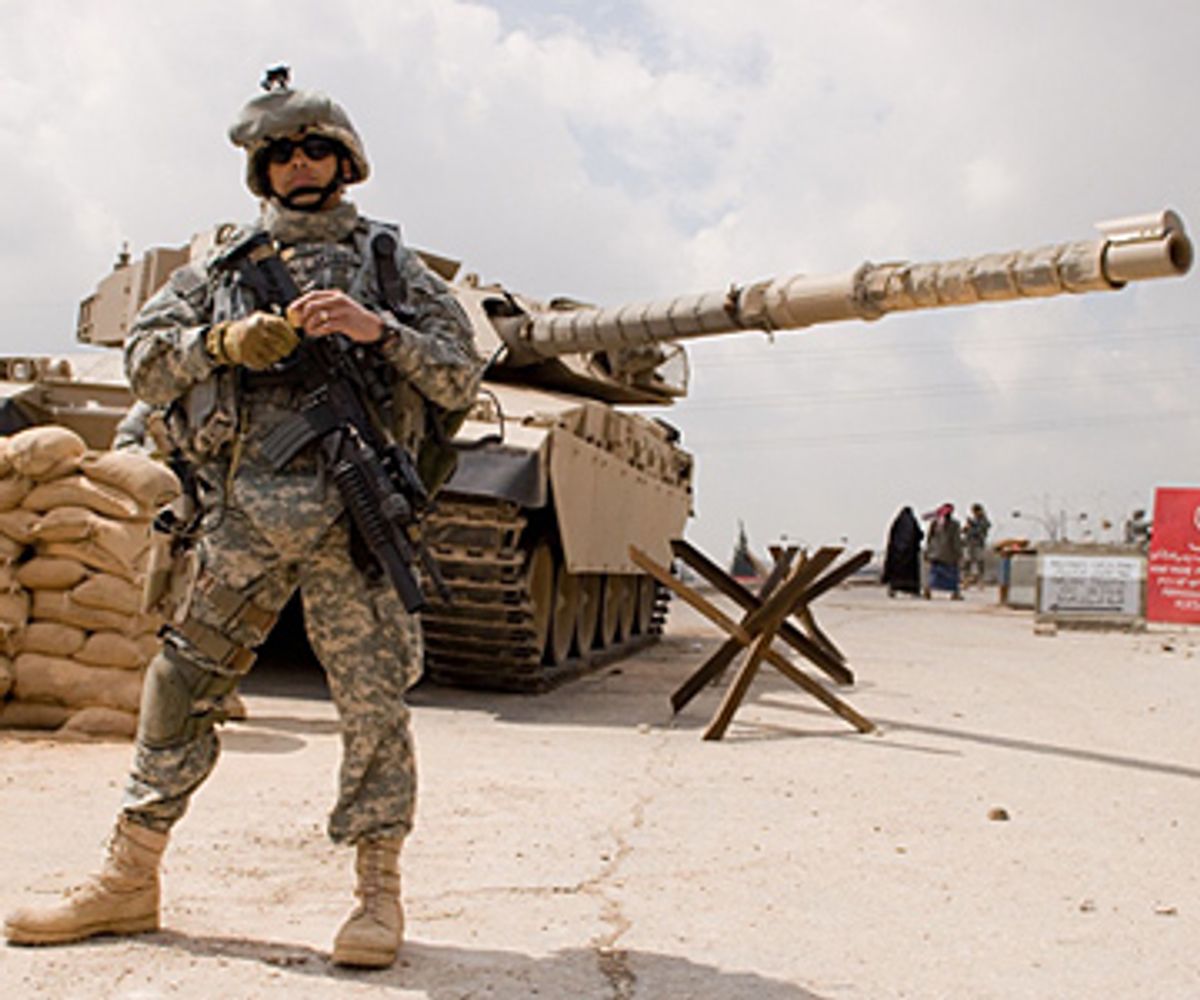
"Redacted" consists largely of re-creations of the images, videos, testimonies and blog entries De Palma found on the Web, a fictional collage (shot in high-definition video) that works as a jagged, reflective mosaic of reality. The central figures in the story are a group of U.S. soldiers stationed at a checkpoint in Samarra. One of them, Salazar (Izzy Diaz), has a video camera, and he's decided he's going to capture the "real" experience of a soldier in Iraq; he also hopes the movie he'll ultimately make will get him into film school. So he records his buddies doing the things they do every day: He questions Blix (Kel O'Neil) about the book he's reading, or attempting to read, John O'Hara's "Appointment in Samarra"; he captures the repartee of two other guys, close buddies, Rush and Flake (Daniel Stewart Sherman and Patrick Carroll), as they trade crude, brain-dead remarks; and here and there another soldier, McCoy (Rob Devaney), weighs in on the proceedings like an observant, but reticent, Greek chorus -- he's hip to the fact that some of his comrades are numbskulls, but he's smart enough to know that he shouldn't advertise it.
Salazar's camera captures both the tedium and the edgy anticipation of the soldiers' daily lives, much of which seems spent waiting for something -- an inevitable, horrible something -- to happen. Salazar's footage, from the soldier's perspective, is intercut with a professionally made French documentary (faux, of course) that shows the soldiers waiting, hour by hour, day in, day out, at the checkpoint. As this fake doc shows, their jobs are tedious, but not innocuous, and they make fatal errors in judgment: When a car refuses to stop (it later becomes clear the driver doesn't understand what's being asked of him), the soldiers shoot a pregnant Iraqi woman, who later dies.
The soldiers, in their recklessness, inflict damage, but they suffer it too, when their commanding officer, Sgt. Sweet (Ty Jones), is killed. The soldiers, listless in their anger, sit down for a game of cards; they get drunk. Two of them, Flake and Rush, decide to stage a raid on a nearby home, as a pretext for raping the 15-year-old girl they know lives there. Blix and McCoy try to dissuade them, but not hard enough; Salazar goes along with his camera, and it's through his lens that we see what happens next.
In "Redacted," events unfold in ways that are sometimes confusing, contradictory, not immediately readable; the movie's structure alone is a metaphor for the struggle to make sense out of chaos. As in any De Palma movie, we're reminded we can't always trust what we see -- we need to be sure we're reading what we see as well. De Palma has said that he was moved to make "Redacted" over his anger at how the Iraq war has been underreported by the media, and I believe him when he says he wants to bring events and images that have been hidden from us out into the open so American citizens will be driven to take action. But I think "Redacted" is a personal movie more than a political one: If it were merely political, a topical response to current events, it wouldn't be nearly as effective.
"Redacted" revisits the themes of De Palma's greatest picture (and possibly the greatest film of the '80s), the 1989 "Casualties of War" -- also based on a true story -- in which Michael J. Fox plays a Vietnam War soldier who tries to prevent the rape and murder of a Vietnamese girl, and whose ineffectuality haunts him, we can be certain, for the rest of his life. (The girl is played by an actress named Thuy Thu Le; it's the only performance she has ever given, but it's so potent, so devastating, that it constitutes a career by itself.) "Redacted" isn't the supreme blend of emotion and artistry that "Casualties" is. "Casualties" is opera, while "Redacted" is only operatic. But both movies mark De Palma as a filmmaker who's deeply, almost painfully attuned to human suffering. If Hitchcock is the filmmaker De Palma is most often linked with (ad nauseam, though for some good reasons), in "Casualties" it's also possible to draw threads from the work of Satyajit Ray, Renoir and De Sica, even though, stylistically, he has little in common with any of those filmmakers.
"Redacted" doesn't have the grace, the lacerating beauty, of "Casualties." And perhaps the movie is least effective when De Palma is working hardest to evoke the dehumanizing aspect of war: The faces of the movie's coldest characters, Rush and especially Flake, are hard blanks, impossible to read -- maybe their emptiness is what allows them to rape and murder (they also kill the girl's family), but their coldness would be even more chilling if De Palma had humanized them just a little bit, instead of allowing them to be monsters with unholy appetites.
But the movie's failings don't dilute De Palma's intent: This is a picture that's electric and alive, and the fact that it's so loaded with feeling is part of what makes it so difficult to watch. The movie has provoked a certain amount of outrage, both among those who haven't seen it (like Bill O'Reilly, who has denounced it as anti-American) and those who have. It has certainly gotten under the skin of New Yorker journalist George Packer, the author of "The Assassins' Gate: America in Iraq." In a New Yorker blog entry in October, Packer questioned, and denounced, De Palma's motives: "And what is the point? That we're all the same, Zarqawi, Lynndie England, the rapists in Mahmudiyah, CNN, Ashley Gilbertson, the readers of the Times, yours truly -- we're all accomplices in the great act of violation that is the Iraq war."
Packer, a terrific journalist and one of many voices of reason heard in the superb Iraq war documentary "No End in Sight," clearly feels that De Palma has personally insulted him and his ilk, and while I understand his hurt feelings, I think he's missing the point even though he's put his finger right on it. De Palma has always explored feelings of guilt and complicity. When I wrote about "Redacted" briefly from Toronto in September -- that tongue-tied brevity was all I could manage in the hours after I first saw it -- I said that I thought what De Palma was trying to do was to sharpen our collective guilt over this current war into something more personal, more cutting. And he wants us to face the specifics of this war squarely, not recoil from them.
Packer, of course, has spent time in Iraq -- he certainly isn't guilty of recoiling. But then, his specific experience means that in the context of "Redacted," he's not the average American moviegoer, either. Nor is he a critic: It's telling that he begins his entry by noting that De Palma's "other films include 'Dressed to Kill' and 'Scarface.'" He fixates on two of De Palma's most sensationalistic pictures, with no mention of "Casualties" or even of the overtly political "Blow Out."
The rape scene in "Redacted" is extremely difficult to watch; our impulse is to look away, as if doing so would somehow preserve some sense of decency in ourselves. De Palma doesn't dilute the horror of the rape by shaping it into something comfortably cinematic, something we can deal with as "art." De Palma has always been interested in collapsing the distance between viewer and subject (for all his love of stylization, he's a hot director, not a cool one), and "Redacted" shrinks that distance to a degree that's bound -- no, designed -- to distress viewers.
But for De Palma, portraying an act of rape in a way that doesn't horrify us would constitute a betrayal of the act's magnitude. He needs to personalize it, to hit us where we live and not just in the place where we think, analyze, rationalize. That's the De Palma way: No wonder he infuriates some people and inspires devotion in others. "Redacted" isn't great De Palma -- it may not even be good De Palma -- but it's pure De Palma. We're separated from this girl in the movie not by thousands of miles, or even by the space between her and the camera lens, but by a membrane, a millimeter's breadth of life, and that millimeter of life is everything.
Shares