

Those of us who live in big cities, who never see bears rummaging through our garbage or find wildcat prints in the snow, often think we're protected from nature. But even when we think we've built the most sophisticated fortresses against it -- office buildings that require three forms of ID for entry; apartment complexes with astute doormen who will let no raccoon pass unannounced -- nature always finds a way to come charging back. In her 2001 book "Wild Nights," a study of the way the creatures of the natural world find ways to assert themselves into the urban landscape, Anne Matthews writes, "More and more scholars now suggest that even a megacity is part of a larger land-use story, in which cities are as vulnerable to nature and fortune as any other life-form; some endure, some thrive, some shrink." And sure enough, coyotes now trek from God knows where to take up residence in Central Park; battle-scarred pigeons, missing eyes, toes and even parts of wings, roam the streets with a survivor's cockiness; certain weeds and even trees can, and will, grow anywhere; and we all know what they say about cockroaches and nuclear war.
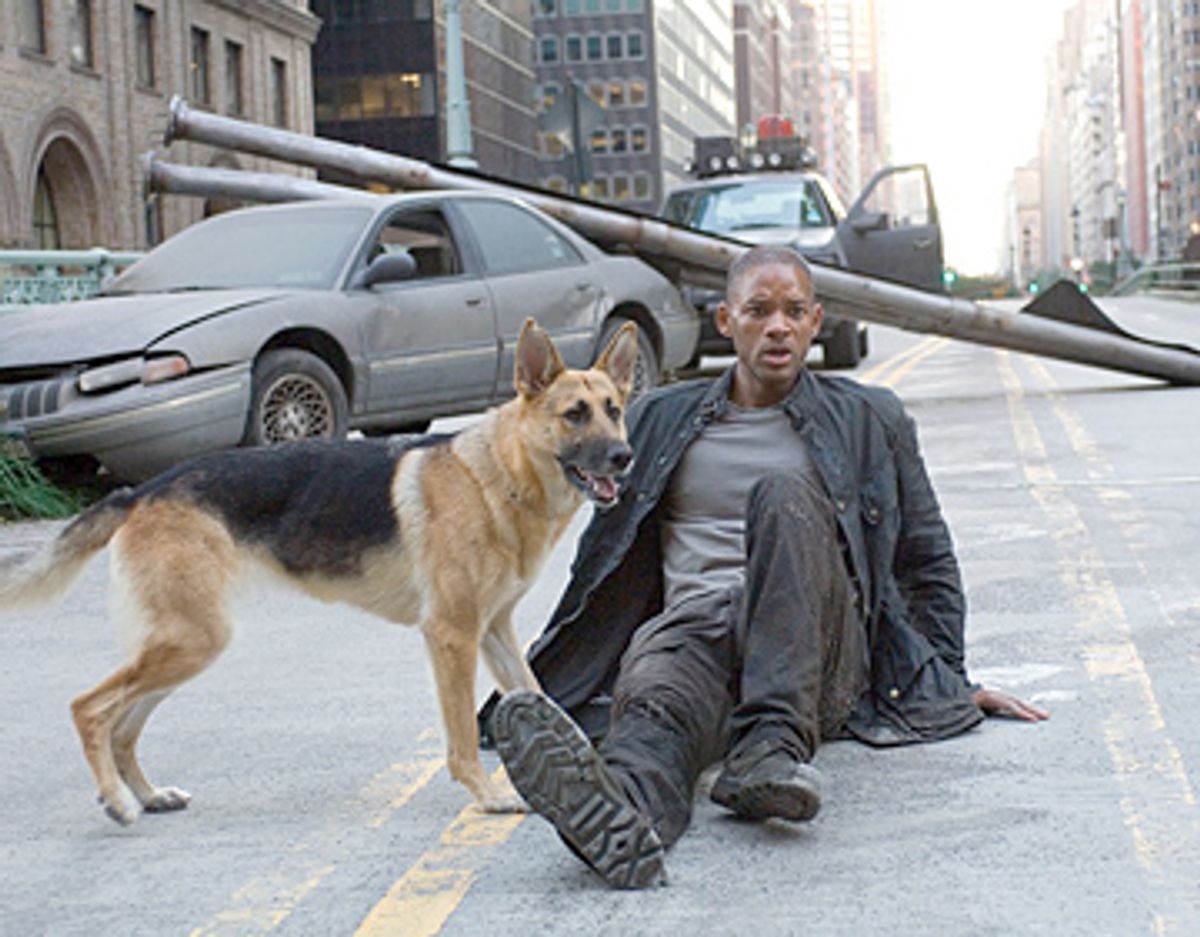
In the opening sequence of "I Am Legend," Will Smith, as the last person alive in 2012 New York, navigates the deserted streets in a chick-magnet sports car. But in this solemn landscape, three years after a virus has wiped out most of the global population and turned others into bloodthirsty vampire zombies, there are no chicks to magnetize -- nature has taken its course, but that course is out of the question. There are cars in the streets, but they're not moving: Long abandoned, they snooze at intersections, while odd little plants push up through the pavement around them. There are no traffic sounds, only the singing of birds. And as Smith's character -- his name is Robert Neville -- trolls around in that sports car (he's looking for something, but we don't know what it is yet), his dog, a German shepherd named Sam, pricks up her ears. Before long, we know what she's on to. We hear a dull, clattering tattoo, a sound that seems to be traveling beneath the pavement, and then we see its source: a herd of deer running through the streets of Manhattan, past once tony, now useless Madison Avenue stores, past a Staples filled with office supplies that no one needs, past any number of empty, permanently decaffeinated Starbucks. The sound of their hooves is a drumbeat of fear and freedom. In a world turned upside down, they've gone wild in the streets.
"I Am Legend" is supposedly an adaptation of Richard Matheson's much loved 1954 science fiction novella about the last man alive in a world populated by vampires. Fans of Matheson's stark, unsettling and eerily beautiful book may be outraged by this version, which was directed by Francis Lawrence (who made the 2005 comic adaptation "Constantine"). The details of Matheson's story -- which has been adapted for the screen twice before, most recently as "The Omega Man," with Charlton Heston, in 1971 -- have been either submerged, changed beyond recognition or deleted entirely. The setting has been switched from California to New York. Here, the virus-infected mutant creatures that surround Neville aren't really vampires, but skinless, seemingly mindless zombies motivated only by their own bloodthirst.
"I Am Legend" is really two movies seamed together, à la Frankenstein: The last half-hour seems to have been grabbed from some other, very different movie. It's as if, two-thirds of the way through, Lawrence realized that after spending this kind of money (reportedly, the movie cost some $200 million to make), he'd better deliver the zombie-filled special-effects dazzler the audience -- or, perhaps more significantly, the studio holding the wallet, Warner Bros. -- would be expecting.
But in the first hour of "I Am Legend," Lawrence captures the essence of Matheson's story, its mood of creeping despair, its vision of a man trying not to fall apart within a world that's already broken into pieces. And he adds something else: a sense of wonder mingled with dread, suggesting that even this nightmare-future world can hold its own kind of rough, wily beauty. Lawrence shot the picture on location in New York, and even though it's heavily enhanced with CGI, to anyone who knows the city even from casual visits, the settings are unnervingly recognizable. (His production designer is Naomi Shohan, and the cinematographer is Andrew Lesnie, who previously made plenty of people believe that Middle-earth was an actual shooting location.)
The industrial-chic trendiness of Tribeca becomes a foreboding canyon of damp, deteriorating squats, hiding places for any number of unseen, inhuman creatures waiting to strike. Most remarkable of all is Times Square, here seen only in daylight: Neville and Sam hit the streets by day, looking for food, supplies and possible survivors, and wiping out as many zombie vampires as they can find, but they must be back to their Washington Square home before nightfall, when the creatures -- who can't tolerate sunlight -- are free to roam and maraud. So in the daytime, they're tourists in a city that used to belong to them: The Times Square in which they find themselves has already forgotten its many recent pasts (from lively hub to tawdry playground to family-friendly entertainment mecca) and is slowly transforming itself into a primeval forest, stretching back toward a past no human can remember. Small trees have popped up wherever they can find a place to do so -- mostly between those endless rows of stalled cars -- and lowlier types of vegetation thrive too, as if they've won a battle against humankind that they didn't even know they were fighting. In the movie's opening sequence, Neville and Sam corner one of those deer in the middle of Times Square, only to lose their prey to a lioness who, they quickly realize, is trying to feed her cub. The image is one of life trying to rejuvenate itself in the face of despair.
I'm wondering whether, for that first hour at least, "I Am Legend" isn't the most meditative blockbuster ever made. Although there's some action in that first hour -- Neville and Sam hunt vampire zombies by day, tracking them, setting traps for them and, when necessary, outrunning them within the large, empty buildings they've requisitioned for themselves -- the picture is disquietingly quiet. (The movie's sound design is marvelous, especially for the way it makes the singing of urban birds seem both ominous and hopeful.) There's no heavy metal on the soundtrack, no fast cutting. The goal isn't to pump up the audience but to get it to lean in close enough to be drawn into the story.
In short, until the movie's false and flashy faux-religious climax, "I Am Legend" barely seems like an action movie at all. And though it has its flaws, including numerous cracks in its logic, I've never seen a blockbuster quite like it. Lawrence has pulled off what Steven Spielberg failed to do in "War of the Worlds": He gives us an apocalyptic vision in which enforced loneliness and isolation almost become a state of grace. This is big-budget filmmaking that shows a human touch, and for that reason alone, I fear for its box-office potential. Even though Lawrence pulls off some grand spectacles -- including one involving the Brooklyn Bridge -- I wonder if his picture isn't too intimate, and too upsetting, to work as a crowd pleaser.
Possibly, though, it will please many crowds of just one, finding its audience inch by inch instead of all at once. The zombies are supposedly the biggest special effect here, and they're reasonably creepy, with their moist-looking, hairless bodies. But "I Am Legend" -- its script is by Mark Protosevich and Akiva Goldsman -- is only ostensibly about monsters; it's really about loneliness. Neville, a scientist who for some inexplicable reason is immune to the virus, has spent his three years of near-isolation trying to reverse its effects on others -- he hopes to be able to cure them. He and Sam spend part of each day at South Street Seaport: Hoping to find other survivors, Neville has announced, via radio, that he'll be waiting there, when the sun is highest, each day. In the remaining daylight hours he and Sam explore the city. The virus hit the city right around Christmastime, so when Neville breaks into one building, he finds a forlorn decorated tree standing in the living room -- and a tented bed behind a bedroom door with a biohazard sign plastered on it. (The door next to that one opens into a child's room, which is also, of course, empty -- as if Neville needed to be reminded that he's lost family of his own.)
Neville has tried to populate his corner of the city to the best of his ability, even dressing up dummies and posing them around his local DVD-rental store. He talks to these mannequins as if they were alive, but what's even more touching is the way he preserves the routine of returning the DVDs he's already watched before choosing new ones.
Although several other, non-mannequin actors appear in "I Am Legend" (among them Alice Braga and young Willow Smith, Will's real-life daughter), Smith carries the picture -- but he doesn't do so alone. Most of his lines are delivered to his only companion, a dog: Sam is played, mostly, by a 3-year-old German shepherd named Abbey, whose responsiveness and expressiveness account for much of the movie's humanity. Sam's not human, but if her job is to please her master, she's going to do her damnedest to understand every word he says to her.
Animal lovers should know (and here comes a big spoiler) that Sam doesn't survive the movie. But even though Lawrence protracts the events leading up to her death a bit too much, this isn't a case where an animal is killed off to goose the audience in a cheap way. Lawrence treats the dog's death seriously: He knows that when Sam dies, some of the movie's life will be snuffed out, too.
I've heard some critics sniping about how silly it is that Smith spends most of the movie talking to a dog. But to me, this performance shows perfectly how Smith has built something out of his extreme likability instead of merely coasting on it. I've always liked Smith, and after his remarkable performance in last year's "The Pursuit of Happyness," I gave up apologizing for it: He's still a sunny, cheerful presence, but as he's gotten older, he's also become adept at suggesting the flip side of sunlight -- that there's always the possibility that something, or someone, who matters to us can be lost.
If there were only one man left in New York, you'd want it to be Smith: His Neville is affable, a people person, the sort of guy who'd surely look out for his neighbors, if only he had any. And here, Smith extends his generosity as an actor to a scene-stealing dog. In an early sequence, he bathes Sam in a big bathtub as late-afternoon sunlight streams into the once luxurious West Village apartment, now a cozy, cluttered bunker, they call home. He massages her soapy ears as he sings to her -- the tune is Bob Marley's "Three Little Birds," with its chorus of "Every little thing's gonna be alright." In this world gone wild, he's reclaiming one of the more soothing rituals of civilization.
Neville speaks, and sings, to Sam, never doubting that she understands every word. He can't afford that doubt, nor can he afford to let go of two of the most marvelous creations of man, language and music. And so by allowing Neville to preserve those two small things, Sam has become the keeper of his humanity. That's a lot of weight for a dog to carry, and a lot of power for an actor to cede to his costar. But then, "I Am Legend" is a blockbuster like no other, one that finds its grandness in modesty. It's a star vehicle with a star who knows his place in the universe.
Shares