

What kind of year was it for independent film? To paraphrase the well-known husband of our prospective first female president, it depends what the meaning of "was" is. And also the meaning of "independent" and "film." New York publicist Jeremy Walker, who helped nurse John Turturro's eccentric musical "Romance & Cigarettes" from the edge of the straight-to-video graveyard and turned it into a modest sleeper hit, approaches the question cagily (as publicists will). "I've been encouraged by the audiences, as distinct from the films," he says, "and the films, as distinct from their delivery systems."
Jonathan Sehring, the indie pioneer who helped launch the Independent Film Channel in 1994 and is now president of IFC Entertainment, says roughly the same thing, in less coded language. "It was not a great year," he tells me. "A lot of it has to do with how fast this industry is changing." In the midst of tremendous confusion over "what's independent and what isn't," he goes on, films not produced or distributed by the major studios' specialty divisions -- meaning Fox Searchlight, Warner Independent, Focus Features, Sony Pictures Classics and so on -- "are barely getting any distribution at all."
Another veteran of the indie battlefield, producer Christine Vachon, whose recent projects include Todd Haynes' acclaimed Dylanology experiment, "I'm Not There," and Tom Kalin's forthcoming tale of sexual depravity, "Savage Grace," sees a rosier if still complicated picture. "It's been a notoriously intense fall, and there's a lot dividing moviegoers' attention," she says. "But actually, I feel like this has been a pretty impressive year for movies."
Vachon declines to be drawn into the what's-independent-and-what-isn't debate. "It's so hard to quantify exactly, and it feels so reductive," she says. She even rejects the standard industry definition of the term, which means following a film's financing back to its original source. "For me, ultimately you divorce it from the question of financing," she says. "Being independent is about the integrity of the vision. If a movie's great, I don't think it matters whether it was produced by 20th Century Fox or by Fox Searchlight, or was a film-festival acquisition."
Hardly anyone would disagree with that on a philosophical level. But over the three years I've been conducting a year-end survey of the indie biz, one grand theme has emerged. You could almost call it a gigantic free-floating anxiety, rather than a theme: Nobody has a clue how audiences will be watching adventurous, modestly scaled, sub-Hollywood films in five or eight or 12 years, but everybody's pretty sure they won't be watching them the way they are right now.
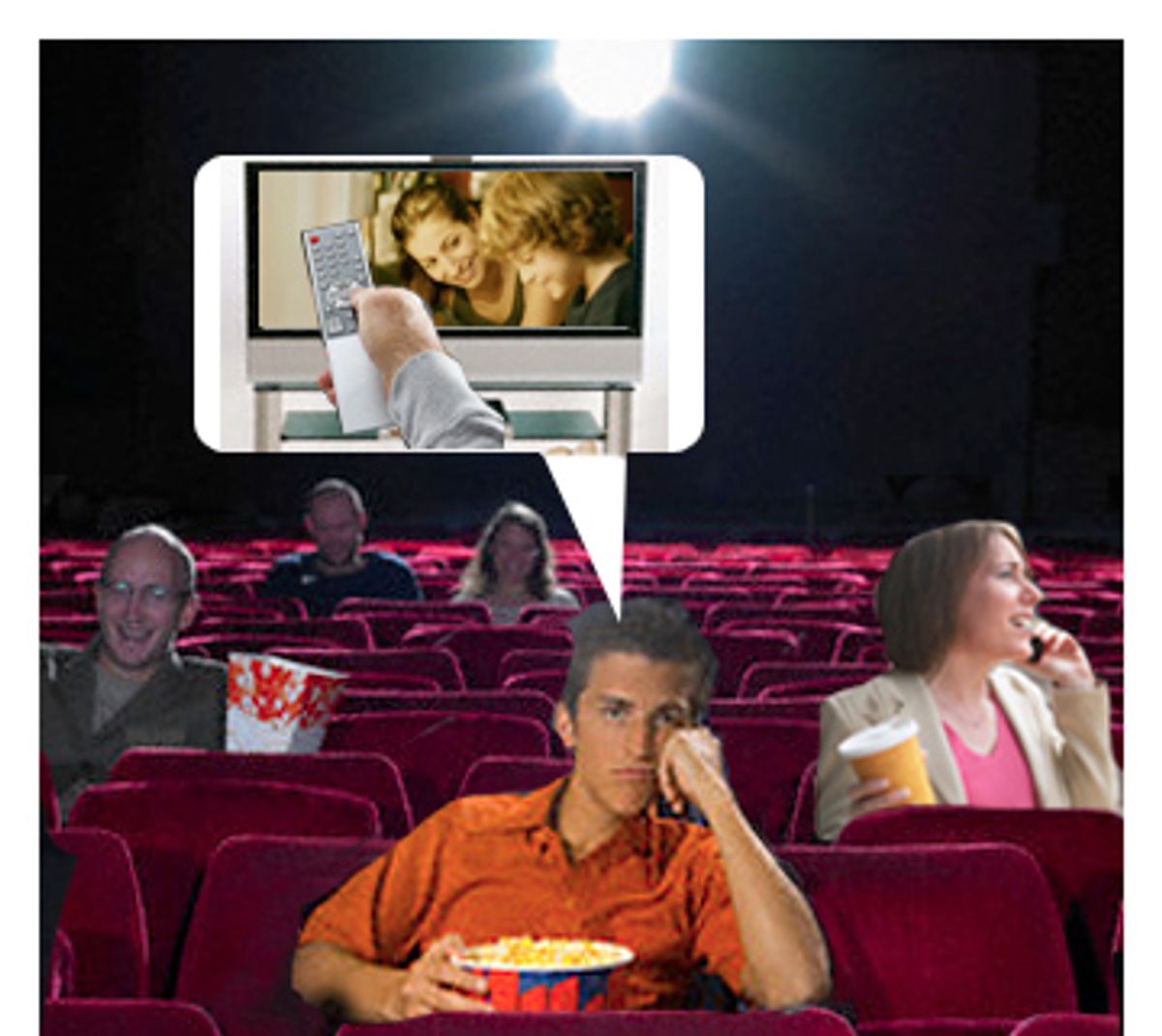
What Walker calls the "hardtop experience" -- using the ultimate business insider's term for, you know, paying your money and going into a dark room that smells like popcorn to watch images projected on the wall -- is not dead or dying or on life support, or subject to any other medical clichés you can come up with. As Walker says, "The 90-minute to two-hour moving picture still seems to be a standard cultural entity."
Yes, moviegoing is still here and still the centerpiece of the business, although everyone in Indiewood talks about it the way you'd talk about an aging relative who's bound to buy the farm sooner rather than later. Maybe it's not dying, but it's being closely monitored by the doctors for signs of a fast-spreading tumor or a compromised immune system.
There were the customary out-of-nowhere hits in the indie economy this year: Adrienne Shelly's "Waitress" is the clear winner of 2007's Napoleon Sunshine award, piling up almost $20 million as a feel-good hit despite the not-so-feel-good fact that its director was unavailable to charm journalists with stories of the little film that could (because she had been murdered in her New York office in November 2006, shortly after "Waitress" was accepted at Sundance). Far more surprisingly, John Carney's winsome Irish musical "Once," another Sundance talking point, made more than $9 million, which comes under the heading of Touched by a Showbiz Angel.
Olivier Dahan's Edith Piaf biopic "La Vie en Rose," with its Oscar-plausible star turn from Marion Cotillard, grossed more than $10 million, an outstanding number for a foreign-language film about a cultural figure with little American profile. Julie Delpy's Woody Allen-esque comedy "2 Days in Paris" made a highly respectable $4.4 million, and another Oscar hopeful, Charles Ferguson's "No End in Sight," grossed $1.4 million, which is a "Star Wars"-scale number for a serious documentary about recent history in that country that starts with "I" and ends with "q." I'm still startled by the fact that "Into Great Silence," a nearly wordless three-hour documentary shot at the Grande Chartreuse monastery in the French Alps, made $800,000. Monk movies! I'm tellin' you, they're hot, hot, hot! Harvey and Quentin are getting one cranked up right now!
Then there are the kinda-sorta-independent major fall releases that have been carefully nurtured and packaged for the awards season, most of which are doing just fine. On one end of the spectrum you have "No Country for Old Men," clearly an indie by the industry's prevailing definition, but also a massively hyped motion-picture experience cum cultural moment that's bound for Oscar glory and a domestic box office somewhere north of $60 million. (Those are predictions, not facts.) Jason Reitman's pregnant-teen comedy, "Juno," looks like the winter's irrepressible breakout hit; Julian Schnabel's "The Diving Bell and the Butterfly" and Tamara Jenkins' "The Savages" are being caressed along carefully in limited release, en route to multiple Oscar nominations and the ensuing payoff.
That doesn't sound much like a dying business model, does it? Well, no, and also yes. You see, almost all the movies I've just mentioned -- and all of them with actual or likely box-office returns above $5 million -- fall on one side of the great indie-film caste divide mentioned above by Jonathan Sehring. Nobody disputes that the Hollywood studios' boutique wings produce, acquire and distribute lots of worthwhile films, but they're simply not playing in the same stadium as genuine independents like IFC or Magnolia or THINKFilm or Samuel Goldwyn, not to mention the many smaller companies clinging to the fringe of the business. As First Run Features vice president Marc Mauceri told me last year, the mini-majors and their upscale, awards-ready product should be understood as "a side strategy of the Hollywood conglomerates."
Milos Stehlik, director of the Chicago-based video distributor and art-house proprietor Facets Multi-Media (which occasionally dabbles in theatrical distribution as well), has been observing the transformation of the indie-film niche for many years. The studio specialty divisions, he says, "release a lot of good movies, and that's terrific. But they are the big gorillas in this little pond, and the way they can play the economics is very different. If something doesn't work, they can absorb the loss. When something does work, they can maximize it and reap the payoff. Their business model is very different from anything a true independent with meager resources can muster."
So the mini-major studios are implacably shoving the genuine indie distributors out of the marketplace they created; isn't that just capitalism at work? Beyond empathizing with a few people's bruised egos and disordered career paths, why should you care about this? That's an open question, but my own hunch is that, "Into Great Silence" aside, certain kinds of unconventional and demanding films, the ones the specialty divisions don't know how to package and present as spiritually beneficial holiday fare, will get driven even further under the radar than they are already. In my conversation with Stehlik, we began wondering whether filmmakers like Andrei Tarkovsky and Krzysztof Kieslowski (not that they were ever so wildly popular) would even get noticed if they were working today.
"When you see exciting and terrific films that come with all this festival imprimatur, with rave reviews from all the critics, and they become barely a blink on the box-office scene, it's depressing," says Stehlik. "It's probably a harbinger of very bad things to come." (He's specifically talking about "The Death of Mr. Lazarescu," one of the best-reviewed films of 2006, which made less than $80,000 in U.S. release.) But Stehlik's answer to Lenin's perennial question for would-be revolutionaries ("What Is to Be Done?") is pretty much the same as everyone else's in the business: Like it or not, sooner or later we've got to leave the damn movie theaters behind.
Facets has moved almost entirely away from theatrical release, and Stehlik notes that the old-school art-film audience has already retreated to their home entertainment systems. "In a very small way, DVD is keeping that art-house scene alive. I almost feel like independent film is going back underground, like it was in the 1950s and '60s. I mean, the cultural landscape is very different, and the technology is very different. I'm not sure the fundamental economics are very different." (His company's all-time best-selling DVD set, for example, is Kieslowski's 10-part series "The Decalogue.")
Sehring's company, IFC, is also gradually decoupling itself from the hazards of theatrical release, but in a different direction. Over the past year or so, IFC has committed to a refined version of the controversial "day-and-date" release strategy, whereby films are released in a handful of theaters and simultaneously become available via video-on-demand (VOD), or pay-per-view, to cable TV customers. This has yet to produce a breakthrough hit, but Sehring says that Ken Loach's Palme d'Or winner "The Wind That Shakes the Barley" and Shane Meadows' acclaimed skinhead saga "This Is England" both did about as well on TV as they did in theaters, and that Jeff Garlin's low-key comedy "I Want Someone to Eat Cheese With," while almost unnoticed on the big screen, did "unbelievable business" in VOD.
IFC's new model will get an even more interesting test in 2008, since the company has abruptly become the go-to U.S. distributor for almost every festival-certified art film. Sehring's upcoming slate includes Hou Hsiao-hsien's "Flight of the Red Balloon," Catherine Breillat's "The Last Mistress," Gus Van Sant's "Paranoid Park," Jacques Rivette's "The Duchess of Langeais," Guy Maddin's "My Winnipeg" and many more.
"Right now, the VOD platform is the best one out there for this kind of film," Sehring says. "I know I'd much rather watch a movie on my home entertainment system than on a computer screen. I disagree with the common wisdom that the marketplace is overcrowded. I think there are a lot of great movies that have to find their audience, and that audience can be found all over the country. New York and Los Angeles will always be unique as venues for moviegoing, but those are not the only places where film lovers live."
As far as what we'll be doing five years from now, I wish I knew," Sehring continues. "If people are buying brand names, we think the IFC brand is a very strong one for people who want to see good movies. Speaking frankly, I'm not necessarily saying that this model is going to work a year or two from now. But I do know that the traditional model for specialty distribution is broken."
Christine Vachon says she appreciates the necessity of distributing and marketing art-house movies in an entirely new way, but wonders whether IFC's day-and-date releases generate too low a media profile and disappear from public consciousness too rapidly. "I couldn't believe how good 'This Is England' was, from beginning to end," she says, "and it got universally terrific reviews -- and then got completely overlooked at award season."
Still, Vachon adds that her production company, Killer Films, is becoming less focused on making films exclusively for theatrical release. "We're trying to shift with the times," she says. "We had a great experience making 'Mrs. Harris,' which was a movie for HBO. You have to look at how our consumption of media is changing: I watch TV shows on my iPod Nano now, and then there's the YouTube universe and the whole notion of making things for cellphones. It's not up to us to decide what a movie is or how people watch it." For an entire generation of younger viewers, she adds, watching movies on some version of the small screen has long been the primary mode, and going to a movie theater is a rare and special event.
Predicting the end of moviegoing is like predicting the end of the oil business -- people keep doing it, and they keep on being wrong. So I'm not predicting any such thing, and I'm not even saying that strange and adventurous little movies won't keep playing in theaters into the indefinite future. But this time, cinephiles, the writing is on the wall. If 2006 was the year when the indie-film marketplace decisively split into the haves and the have-nots, 2007 looks to me like the year when the artier and more ambitious fringes of that marketplace began to visibly evaporate.
Joel Bachar founded Microcinema International, his small San Francisco distribution company, in the mid-'90s on the premise of screening experimental films, documentaries and cutting-edge animation -- material no mainstream distributor would touch -- for live audiences in nontraditional venues. He still holds those screenings, but says, "We've definitely seen a downturn, both in my film series in San Francisco and all across the country. It's getting harder and harder to convince people to come out."
Microcinema is essentially a home-video distributor now; you might even say Bachar's concept has abandoned the public sphere and moved to the high-end HD monitors in people's living rooms. (One of Microcinema's niches, actually, is ambient video for plasma screens, intended as background visuals or a "video fireplace.") Bachar's next move, he says, will be nailing down a channel for the digital distribution of his videos, perhaps through a social-networking site. "We know we can't stick with DVD distribution forever; the point is to stay open to all possibilities." Whether online distribution actually creates a new audience for challenging material, however, remains anybody's guess.
He concludes: "You know what? The theatrical experience? Usually it's crappy anyway, because people are talking around you and it's uncomfortable or whatever. And I just don't think people care about it anymore. I think we have a new audience and their attention span is different. It might be a cliché, but I really think it's true. There's this social-networking mentality; they're Twittering, they're blogging. There's more commitment to, you know, the experiential moment, and not much commitment to longer moments."
Shares