

The Berlinale is the crocus of the big international film festivals: Midwinter in Berlin may not be as warm or as sunny as spring in Cannes, but there's something optimistic about the way the Berlinale -- now 58 years old -- flourishes in the cold (or, in these days of global warming, semi-cold) for some 10 days each February.
With more than 200 films being screened, including some 20 pictures in competition, this is a fairly sprawling festival, and yet it still manages to come off as intimate and friendly. The surroundings aren't necessarily the big draw: Most of the screenings and events take place in a complex of reasonably attractive but unmemorable buildings around the Potsdamer Platz, some of which have been built expressly to accommodate the festival. The Berlinale Palast is the most gallant structure in the complex, and the one where most of the big red-carpet events take place. Even though those events are never my thing, standing on those steps one afternoon I did happen to catch a few moments of a press conference with Indian superstar Shah Rukh Khan (here with his '70s-Bollywood spoof "Om Shanti Om") televised on a giant screen: While I would have loved to see Khan in person, his goofy expressiveness is no less charming even when his face is broken into a bunch of little dots.
Then there's the Sony Center, a circular arrangement of buildings that, viewed from the courtyard inside (which is covered by a dome resembling an Origami flower), looks both sleepy and forward-looking, as if it had decided to nap until the future arrives. (A Berlin acquaintance tells me that most of the office space facing this courtyard languishes unoccupied, since most professionals would much rather overlook the greenery of Tiergarten, the park nearby, than be locked in an anonymous-looking futuristic nest.) But the Center does house a film school, several theaters, and a film museum with an excellent shop, stocked with an intriguing assortment of film books (most of which are, unfortunately for me, in German) and postcards. There I saw a hot-water bottle with an image of the German poster for "Streetcar Named Desire" printed on it. It's nearly 20 euros, but I'm afraid that if I leave Berlin without it, I'll someday think I only dreamed it.
Near the Berlinale Palast is an undistinguished shopping mall, not much different from the type you might see in any U.S. city: This is where the locals queue up to buy their festival tickets, since one of the purposes of festivals like these -- lest we critics should forget -- is to bring movies to real, live moviegoers. But of course, most of the people I see wandering around during the day aren't real, live moviegoers at all, but festival schmoes like me, wandering around with our various assortments of passes dangling from our necks. As efficient as the festival complex is, it has a not-quite-real quality -- it's a kind of Eurodisney for film geeks. Still, this is an extremely well-organized and welcoming festival, as I learned when I got shut out of the only press screening of the Madonna movie, "Filth and Wisdom," on Wednesday: I waited among a group of about 100 who hadn't gotten into the theater, as a festival person tried to see if another screening could be arranged. It couldn't, but at least someone bothered to make it appear as if she'd made an effort to accommodate us. (When this sort of thing happens in Toronto, the general response of festival staff is "Tough luck.")
Because we are here, after all, to see movies. I've been in Berlin for a week, not strictly to cover the festival, but to participate in the Berlinale Talent Campus, a program of lectures, workshops and panels for filmmakers, composers, screenwriters and even critics: The Berlinale has brought me here as a mentor in the Talent Press program, in which eight young critics from around the world -- most from countries in which English is not the primary language -- are invited to attend the festival and, under the guidance of four "older" mentors (this is where I come in) file one review or article per day. The participants come from countries including Peru, Nigeria, Poland and Turkey (you can read their work here), and in six days of talking with them and reading their pieces, I've learned more from them than they probably even know.
So for that reason alone, the 2008 Berlinale has meant more to me than just the usual assortment of festival movies. The consensus among my colleagues -- both those that I've spoken with and those whose reports I've read in the press -- is that this Berlinale hasn't been particularly impressive. One of the movies in competition is Paul Thomas Anderson's "There Will Be Blood," and despite the fact that most American critics love it (note my foxy use of the word "most"), it's old news to those of us who wrote about it in December. But you can't walk away from a festival of this size without having seen something that excites you, or at least intrigues you. Following are a few highlights -- and some lowlights.
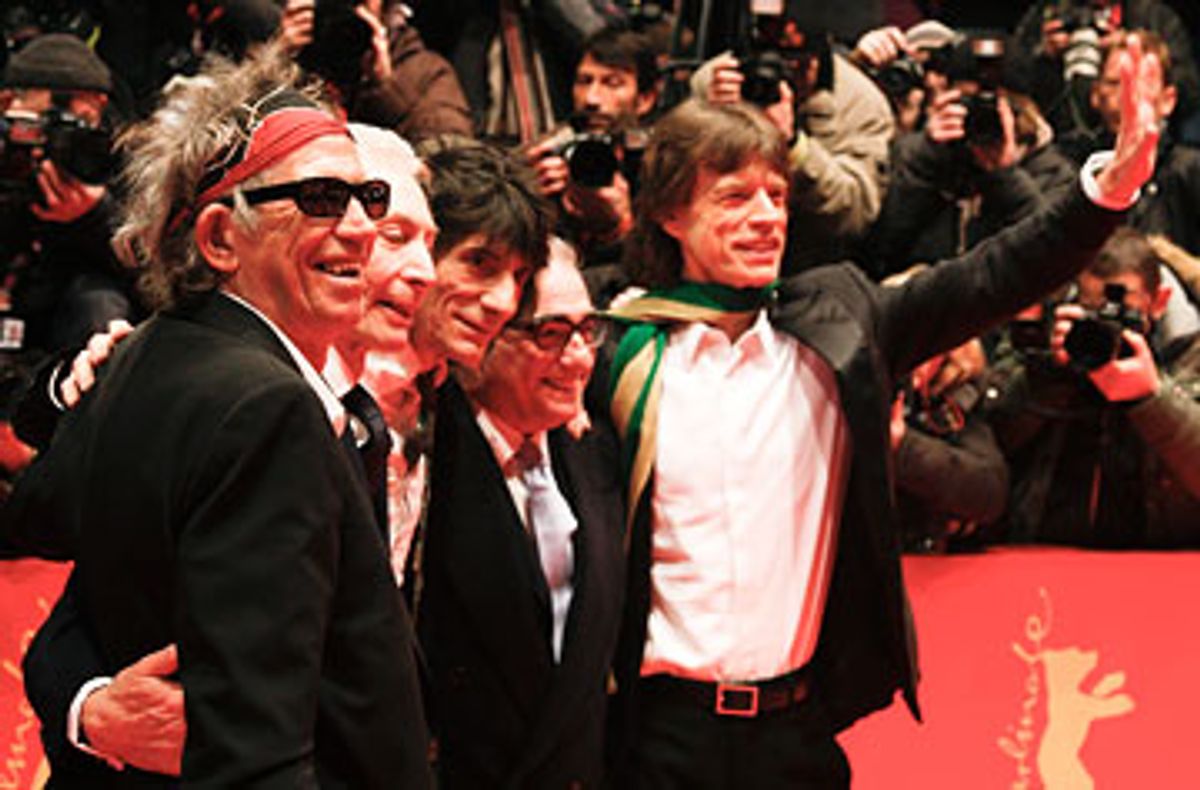
Martin Scorsese's documentary about the Rolling Stones, "Shine a Light," opened the festival on Feb. 7, and while the picture's glamour quotient may be high -- these are the Rolling Stones we're talking about -- the movie itself is self-serving and mechanical. Scorsese filmed the Stones over two nights of live performances in 2006 at the Beacon Theater, the rock-'n'-rollers' old folks' home on New York's Upper West Side. (Hoping to catch that "Ten Years After" reunion tour? This is the place.) Actually, I have a soft spot for the Beacon, and for old rock-'n'-rollers: Not even Elvis could stay young forever, and it's a challenge for any of us to not fade away.
But while I'm glad Mick Jagger is healthy and seemingly happy, I'm not sure I want to watch two hours' worth of his leaping and twisting through songs that I actually love for their, oh, emotional content? Structure? Pure animal expressiveness? I've never seen the Stones live, but friends who have always come back with glowing reports of how much energy Jagger still has. That's clearly what Scorsese seeks to capture here. Working with an A-team of cinematographers (including Robert Elswit and Ellen Kuras), with documentary-god Albert Maysles lending a hand as well, Scorsese seems preoccupied with celebrating the wishful thinking of his (and, increasingly, even my) generation. Every frame of "Shine a Light" is an exhausting shout: "Look at how old these guys are! And yet they're not really old!" Scorsese also rustled around in the attic and found some old interview footage of the young Jagger responding to bland questions about how long he'll go on doing this rock 'n' roll thing, to which he responds, honestly if with a bit of feyness, that he'll go well into old age.
That's all well and good, but Jagger's leaping and prancing comes off as a kind of "Red Shoes"-style obsessiveness, and Scorsese treats that as a good thing -- with this movie he has bottled it for the ages, an elixir from which we all want to drink. But no one wants to think about how all that jumping around affects Jagger's phrasing. As I listened to him recite his way through "As Tears Go By," like a schoolboy proud that he has memorized all the words, I felt as if he were reading the text from the side of a box of bran cereal. The song's poetry seems to mean nothing to him. And sue me: While I love Keith Richards enough to listen to him sing (as he does here, though thankfully just one number), I still wanted more of Ronnie Wood and Charlie Watts, who don't move around so much but who always captivate me regardless. There's lots of running and jumping in "Shine a Light." Just not enough standing still.
Errol Morris' "Standard Operating Procedure" is a detailed -- though, in the end, somewhat limited -- examination of the Abu Ghraib scandal told largely in the voices of the soldiers who took, and appeared in, those haunting and horrifying photographs. As a document if not as a movie, "Standard Operating Procedure" is useful and edifying for the way it pulls together a timeline of what happened at Abu Ghraib (the film provides an overview that's impossible to grasp by looking at the pictures alone) and for the way it confirms that the members of the military who were punished for the scandal, the underlings, couldn't have been the only ones involved: They were participants in the prisoners' torture and humiliation, but they weren't the architects of it. If nothing else, Morris' picture raises the question of who those architects might be -- a question he can't and doesn't attempt to answer, although he at least opens the door to it.
Yet I can't help being appalled at the way Morris applies such relentlessly tasteful filmmaking to such a horrific subject. He turns his camera on many of the principals involved in the scandal: the baby-faced Sabrina Harman; the inscrutable Megan Ambuhl, who comes off as simultaneously bland and calculating; and Lynndie England, who, after serving a portion of her three-year sentence (she's now out on parole), betrays so little about what's going on in her heart and in her brain that she barely registers as a human presence. (Charles Graner, the ringleader of this not-so-merry band, is still serving his 10-year sentence; the military wouldn't allow Morris to interview him.)
Plenty of people respect Morris' tactic of turning the camera on his subjects and letting them talk, largely unfettered by the presence of an interviewer. (Morris does interject in a few key places here.) But the result is a kind of faux objectivity, a disingenuous, who-me? statement from a guy who wants us to believe he has done nothing more to shape this material than just turn the camera on. Morris does believe he's giving these players a fair shake -- he said as much in a press conference here: "These guys are not the culprit and these photographs are not the entire story of what happened there," he said. "We are looking at a very dark and disturbing chapter of American history and something that does reflect deeply on my entire country."
But if Morris really feels that way -- and I'm not even questioning his sentiments -- then what's wrong with a little subjectivity? Why should he -- or we, for that matter -- feel we have to be objective about England, as we gaze into her flat, dead eyes and listen to her flat, dead voice? Perhaps Morris believes he's letting some of his interviewees hang themselves, but it's his very lens that hands them the rope. The gist of their explanations for their behavior basically amounts to "Um, well, we kind of knew it was wrong, but we did it anyway. And now we see how bad it was." It may be edifying, but it's not vindicating.
I'm not crazy about Morris' penchant for fictional re-creation of events (a tactic he uses frequently here). But I have much more difficulty with his arty visual interjections. A soldier describes appearing on the scene as one of the Abu Ghraib prisoners is dying. The soldier says a drop of blood fell on his uniform -- and I'll be damned if Morris doesn't show us a beautifully lit, semitranslucent droplet of blood, magnified a bajillion times, falling in slo-mo on a crosshatching of uniform cloth. (When you're Errol Morris, this is what you keep a great cinematographer -- in this case, Robert Richardson -- around for.)
What on earth is that heavily art-directed droplet (and the movie includes plenty of other similar visual touches) doing in a documentary about such a horrific crime against humanity? The most effective and chilling elements of "Standard Operating Procedure" are the Abu Ghraib pictures themselves. No matter how many times we've seen them, they retain their power. Against those, Morris' photography-exhibit blood droplets mean nothing. A picture is worth 1,000 words -- but it all depends on the picture.
Before I get to my favorite movies of the Berlinale so far -- the festival continues for three more days, although today is my last day covering it -- I need to send up a giant red flag to everyone who loved French filmmaker Erick Zonca's 1998 debut "The Dreamlife of Angels": His new film, "Julia" (his first in English), a sort of remake of John Cassavetes' "Gloria," stars Tilda Swinton as an alcoholic kidnapper who finds redemption -- and it's insufferable. Many of my colleagues have noted that while they dislike the movie, they think Swinton is terrific. It is the sort of performance that people look at and marvel, "She can do anything!" when in fact it's simply a role that's all wrong for her. Cast as a woman who's blowsy, selfish and usually sozzled, Swinton plays down to her character, which isn't nearly the same as playing it. If Satan appeared at the door of my hotel room and offered me, for some outlandish price, the two hours of breathing time "Julia" took from me, I might be tempted to take it.
Then again, even though Blanche DuBois wasn't the type to hang around film festivals, she did inadvertently coin the festival slogger's motto: Sometimes there's God so suddenly. I found him, first, in Mexican filmmaker Fernando Eimbcke's "Lake Tahoe," one of those quietly miraculous little pictures that manage to be both minimalist and rich at the same time. At the beginning of "Lake Tahoe," a young man named Juan (played by Diego Catano) crashes his car somewhere on the outskirts of a Mexican town. He then sets off on an odyssey to find the single part that will get the car going again, in which he meets a grizzled old mechanic whose only companion is a sweet-tempered bruiser of a dog (who goes by the name "Sica," perhaps a reference to the great Italian neorealist filmmaker, or perhaps just a name); a young woman who's far more interested in punk music than in car parts; and a young man who can actually fix the car, but who would rather spend his afternoon in the dark watching a Bruce Lee picture. He invites Juan to join him, one of those simple gestures that represent a tiny yet immense act of kindness, something we don't realize until we learn that Juan is trying to deal with -- and seems to be buckling under -- enormous grief.
Eimbcke -- who made his debut in 2005 with the lovely "Duck Season" -- tells his story with a series of still shots. Characters move into and out of the frame, going about their business as if unwatched. Eimbcke's camera doesn't track; it only captures, keeping so still that it seems to be listening as well as watching. This is the kind of modest, unassuming filmmaking that doesn't win giant prizes. But it's the sort that can keep you going to the movies, and in the current climate -- one in which big Hollywood pictures, in particular, are becoming so increasingly and desperately facile -- that's more valuable than ever.
Even though no one actually sings in Johnnie To's "Sparrow," it's more a musical than an action movie, borrowing the mood, color and vitality of pictures like "Singin' in the Rain" and "The Band Wagon" and "An American in Paris" -- and maybe even "The Young Girls of Rochefort." In "Sparrow," a group of rapscallion pickpockets led by Kei (Simon Yam), a smoothie who dresses like an old-Hollywood matinee idol, make their way through Hong Kong. With moves that might have been choreographed by Michael Kidd, they lift the wallets of unsuspecting passersby, but these are principled petty criminals: After removing the cash, they conscientiously drop the wallets into a mail slot. (At one point Kei removes the bills and then replaces the wallet in the victim's back pocket, all in one smooth move.)
These guys take great pleasure in their craft; for them, stealing is artistry, as well as a way to make a living. And then a knockout femme fatale, Chun Lei (Kelly Lin, who appears in Olivier Assayas' "Boarding Gate"), infiltrates their circle and upsets their routine. The picture's beautifully orchestrated finale -- one that harnesses all the visual poetry of twirling umbrellas and rain-slicked streets -- is, again, more a dance routine than an action sequence. "Sparrow" is lighter, more buoyant, than To's last feature, the extraordinary (and moving) "Exiled." But it may be the better film: To uses plenty of standard film references here, and still, what he has come up with is quite unlike anything I've seen before. "Sparrow" is so pleasurable that I can't wait to see it again.
Face it: The idea of crossing an ocean to look at movies for six or eight or 10 days isn't just luxurious; it's absurd. Even so, a purely enjoyable picture like "Sparrow" can make you feel you've crossed that ocean for good reason. And it reminds you that Blanche DuBois was right.
Shares