

Aren't you psyched about the yearlong presidential campaign, which cannot, God help us, be ignored even through heroic absorption in the minutiae of the independent-film world? Boy, I sure am. In the same spirit of sincerity that infuses national politics, I hereby offer my solemn campaign pledges to readers. While I offer no clear distinction between waterboarding and torture (or between waterboarding and water-skiing, for that matter), and I intend to obscure any thoughts I may have on the Iraq war beneath a thicket of non-navigable rhetoric, let me make one thing clear: I will no longer tolerate or accept gratuitous references to "Little Miss Sunshine" or "Pan's Labyrinth"!
Unless, that is, circumstances should arise that cannot be predicted and over which neither I nor anyone else can exercise control. Such as when some new movie vaguely reminds me of one of them and I have nothing else to say. Furthermore, I declare unambiguously that I today reject the first use of $5 adjectives, or FDAs, as a way of avoiding actual description or discussion of motion pictures. I say this, my fellow Americans, in full cognizance of the fact that we live in a complex and multivalent cinema universe, overloaded with works whose ontological status and epistemological significance is often paradoxical, elegant, eloquent, sophisticated, absorbing, contradictory, troubling, schizophrenic, graceful, ill-tempered, puckish, vainglorious, fanciful, phantasmagorical, acidic, acerbic, profoundly ironical, dark-hearted and sure-to-be-controversial.
Speaking of meaningless promises, people in the film business keep assuring us that the post-Michael Moore tidal wave of documentaries is sure to ebb, any day now. Since very few of the non-Moore docs are making any money whatever, the thinking goes, basic laws of supply and demand are sure to kick in. Most of the real Indiewood success stories in the last couple of years have been narrative films, like "Waitress" and "Once" and "La Vie en Rose" and, you know, some others I could name. But won't! Well, to Adam Smith and to supposed economic logic I say whatever. I count 11 noteworthy new documentaries opening between now and the end of November, on top of several terrific ones already in release. (And no doubt I'm missing something.)
I'm not complaining about quality -- there are some wonderful films in the bunch -- but this is just nuts. How are terrific movies like "Jimmy Carter Man From Plains" or "Joe Strummer: The Future Is Unwritten," which have both opened strongly, going to find the slow, steady national build that documentaries require? How are intimate little niche-market pictures about love in the concentration camps, or Indian immigration to Britain, or how Steinway pianos are made (all covered below), going to find any audience at all? Film execs talk cheerfully about "the ancillaries" -- in English, that's the DVD release -- but too many damn documentaries, in my view, means not enough ancillaries to go around. After the coming docu-crash, I'm afraid we may go from a market where everybody's documentary gets released to a market where nobody's does.
With such an embarrassment of docu-riches this week, I'm ditching the usual column format for a user's guide to this week's releases, which also include a lo-fi film about the still-obscure jazz legend Albert Ayler and "War/Dance," a good-news-from-bad-places saga that looks like one of the season's potential hits. Wonderful to tell, we've even got a couple of narrative films! One of them, mind you, is more than 40 years old and in Italian, while the other -- Steve Barron's likable New York indie "Choking Man" -- has been shuffling homelessly through the film-festival circuit for two years.
This week also brings us Joel and Ethan Coen's "No Country for Old Men," by all accounts one of the year's leading award contenders. (My colleague Stephanie Zacharek has already reviewed it.) I was underwhelmed when I saw the film at Cannes; it struck me as handsome, well-crafted and self-consciously grim, without much of the verve or entertainment quotient I associate with the Coens. Still, I'm definitely planning to catch it again, and the same goes for Richard Kelly's long, long, long-awaited "Southland Tales," which finally reaches theaters next week, a year and a half after the debacle of its 2006 Cannes premiere. In other notes, New York moviegoers can catch a brief rerelease of Ingmar Bergman's formerly scandalous 1953 "Monika," featuring a 21-year-old skinny-dipping Harriet Andersson, and the American premiere of "Glass Lips," a new experimental feature from Polish artist, author, composer, director and all-around avant-garde Renaissance man Lech Majewski.
"War/Dance" This crowd-rouser, which won a Sundance directing prize for the husband-wife team of Sean Fine and Andrea Nix Fine, combines a veritable perfect storm of allergy-producing documentary elements. It's not just about kids; it's about kids from a war zone (in this case, northern Uganda), most of them with horrific personal histories to recount. It's not just about a talent competition; it's about a talent competition pitting war-zone-kids-with-terrible-stories against kids who are better off and grew up in more normal circumstances. It doesn't just feature music and dance numbers; it's got romping, stomping, blow-the-doors-off, celebration-of-life music and dance numbers. Furthermore, the Fines rely on a host of techniques that could be considered hackneyed or dubious or both: It depends on a tiny handful of individuals to tell a much larger story; it shows children declaiming their own experiences, in suspiciously articulate and reflective language, in extreme close-up or in murmured voice-over; it uses the stark beauty of the African grasslands, and the seemingly innocent games of children, as contrasts to the grim stories being told; it explains nothing about the political, social or cultural background of the Ugandan civil war.
While that last factor still bugs me, you can't say that "War/Dance" is irresistible despite all these clichés. In fact, it's the film's reassuring, almost hypnotic visual rhythms, along with its Hollywood-like narrative structure -- which is closer to "Drumline" or "Bring It On" than to most documentaries -- that make it bearable. At least two of the abandoned children the Fines profile in the Patongo refugee camp, members of a rural tribe victimized by rebel militiamen, have personal histories so hideous you couldn't stand to hear them without some sugarcoating. But we already know that these kids are part of the Patongo school's improbable success in Uganda's national song-and-dance competition for schoolchildren, so what they have endured becomes the back story to a narrative of triumph.
Does the Patongo kids' dynamite ensemble version of the Bwola, an ancestral dance of the Acholi people, somehow make it OK that a girl named Rose had to watch her parents beheaded, or that a boy named Dominic was abducted as a child soldier and forced to kill innocent strangers? Probably not, but I don't think the Fines are making an argument that specious. It's more like: Rose and Dominic's lives are not over, despite the unbelievably bad stuff that has happened to them. They're not just victims, but remain the agents of their own lives: Rose quietly believes she's the best dancer in the troupe, and I defy you to refrain from blubbering when Dominic brags that he wants the world to know he's the best xylophone player in northern Uganda. Now we know it, kid. (Opens Nov. 9 in New York, Los Angeles and other major cities, with wider national release to follow.)
"Note by Note: The Making of Steinway L1037" Luring non-piano-buff viewers to see this "process" documentary about the making of the ultimate high-culture artifact -- the Steinway concert grand piano, with a retail price of roughly $100,000 -- might pose a marketing challenge. I dragged my heels on seeing "Note by Note" myself, but I'm here to report that Ben Niles' picture is a fascinating and delightful thing. If anything, it glorifies the working-class craftsmen at the legendary Steinway factory in Astoria, N.Y. (a district of Queens), as the heirs to a nearly dead 19th-century piano-making tradition, rather than the concert pianists who depend on their work.
Mind you, music fans will get plenty for their money here: We hear jazz pianists Kenny Barron, Bill Charlap and Harry Connick Jr. demonstrate what they want in a piano, and observe concert impresarios Pierre-Laurent Aimard, Lang Lang and Hélène Grimaud trying them out, with the critical air you or I might assume while assessing dishwashers at Home Depot. (Lang is hilarious, Aimard comes off like a pompous ass and Grimaud's playing is positively magical.) But "Note by Note" is more than anything a social and cultural portrait, capturing the lonely pride of the 450 Steinway workers who take nearly a year to render raw sheets of timber, piece by piece and step by step, into the most elaborate and precise handcrafted machine made anywhere in the world. (Now playing at Film Forum in New York; other cities may follow.)
"Steal a Pencil for Me" There have been dozens of Holocaust documentaries, and one could well argue that the world doesn't need another. But Michèle Ohayon's "Steal a Pencil for Me" offers a simple human story of dignity, levity and romance -- both unlikely qualities in the chaos and terror of Nazi-era Europe -- and exerts its own special charm. Jakob Polak was a struggling young Amsterdam accountant, in love with a girl named Ina Soep, the beautiful heiress to a diamond-manufacturing family. Ina loved him too, but Jakob was too poor for her family and already married to a jealous woman he no longer loved. Add this domestic soap opera to its setting -- 1943, under Nazi occupation -- and the fact that all three participants in this love triangle were Jewish, and it begins to sound like a pulp novel.
Unlikely as it seems, Jakob, his wife and Ina all wound up in the same concentration camp -- and, luckily for them, that camp was Westerbork, a showcase set up by the Nazis to demonstrate that incarcerated Jews were being treated well. (As Jack Polak quips, Borscht Belt-style, in later life: "I'm a very special Holocaust survivor. I was in the camps with my wife and my girlfriend, and it wasn't easy.") That's only the first in a set of remarkably fortunate occurrences in "Steal a Pencil for Me"; while more than 90 percent of Holland's deported Jews died in the camps, all three of these people, along with their heated little romantic drama, survived the war. It would be idiotic to claim that love saved their lives; plenty of people who loved each other wound up in the crematoria. But somebody had to get lucky, I guess. When you meet Jack and Ina today -- a cultured elderly couple in suburban New York, their European manner and obvious mutual adoration undimmed by time -- and hear them reflect on their history of dignified concentration-camp adultery, you can only be grateful for small mercies. (Opens Nov. 9 at the Quad Cinema in New York and the Laemmle Music Hall in Los Angeles, with more cities to follow.)
"I for India" Here's a documentary maxim I halfway believe: From the most modest materials come some of the best films. If "Steal a Pencil for Me" is a case in point, Sandhya Suri's modest family memoir "I for India" is an even better one. Composed mostly of the home movies Suri's immigrant father shot in Britain over 40 years, and the home movies family members back in India sent in exchange, "I for India" assembles an epic history of assimilation, betrayal, racism, failed homecoming and dispersal out of the most minimal ingredients. The only character we come to know is Yash Pal Suri himself, a doctor who dreamed of returning from British training to become a great man in his hometown, but eventually and seemingly inescapably morphed into a suburban Englishman, who chats over the back fence with the lady next door about how the roses are coming along. His audiovisual letters home slip more and more into English; at one point, while struggling to remember the Hindi equivalent for something, he stops to ask himself, "What is the Hindi word for 'equivalent'?" Suri's film is a loving tribute to her family that never feels like an invasion of their privacy, and a potent, heartfelt meditation on time, home and identity. (Opens Nov. 14 at the Pioneer Theater in New York; other cities may follow.)
"My Name Is Albert Ayler" Even to aficionados of the 1960s and '70s avant-garde music known as "free jazz," tenor saxophonist Albert Ayler remains an enigmatic figure. Unlike John Coltrane, Ornette Coleman, Cecil Taylor and other musicians of the period, Ayler charted his path largely alone. He emerged from the expatriate American jazz scene of Stockholm in 1962 and died in New York in 1970, apparently after jumping into the East River. While he was briefly a well-known figure on the Manhattan nightclub scene, his music was strident and anarchic even by the period's standards, and he never sold many records or made a consistent living. Kasper Collin's film portrays a confident but troubled man, who never doubted that posterity would discover him, and consoled himself that prominent American composer Charles Ives had to work a day job. Nearly 40 years later, Ayler's music remains little-known outside a coterie of admirers, but it remains remarkable that, hampered as he was by poverty, drug problems and probably by mental illness, he accomplished as much as he did. (Now playing at the Anthology Film Archives in New York.)
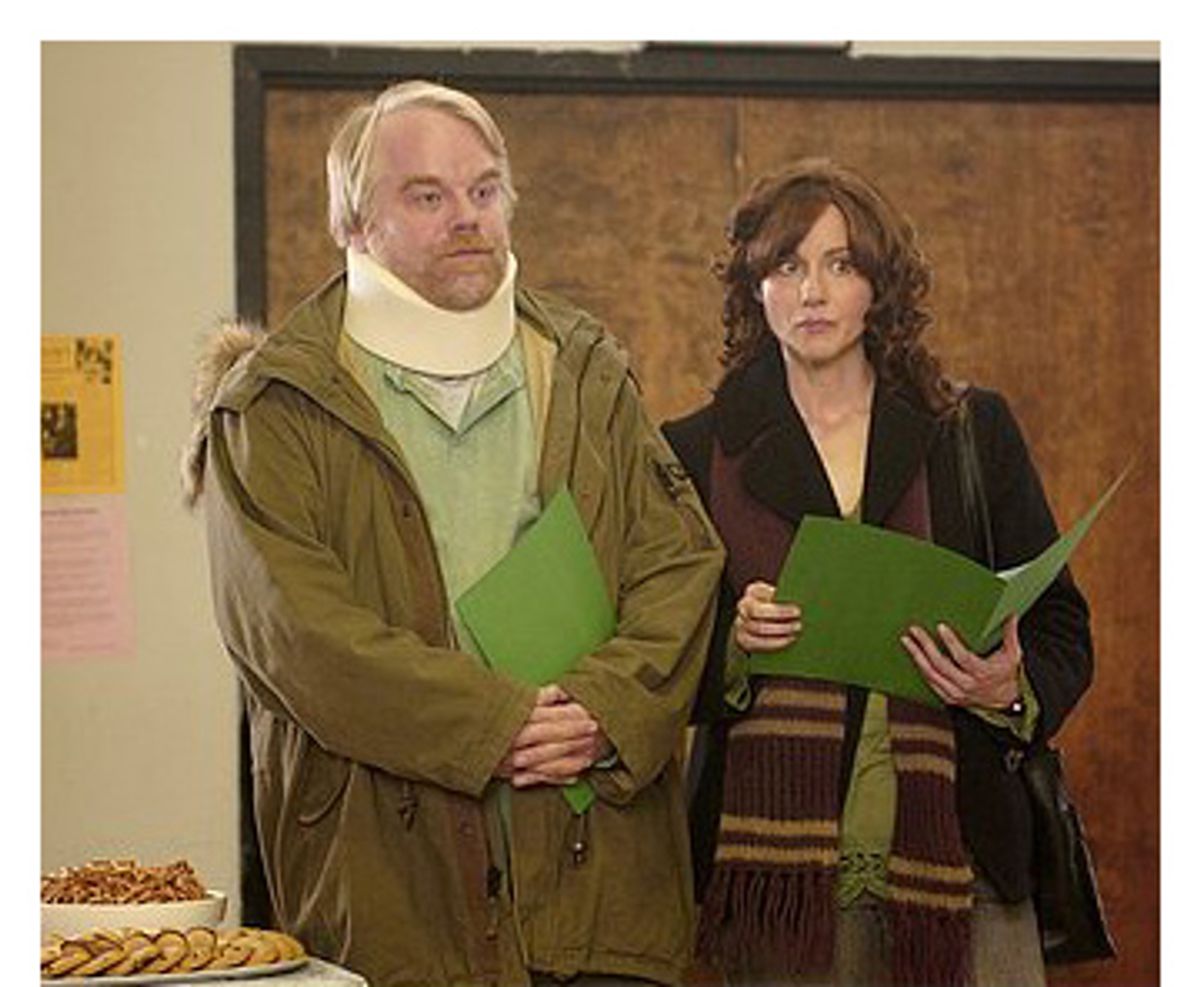
"Choking Man" I can think of no earthly reason why this well-made and thoroughly charming New York indie drama from writer-director Steve Barron (director of music videos by Michael Jackson, David Bowie, ZZ Top, Culture Club, etc.) has been languishing in limbo for two years. Well, besides the fact that the film economy is completely screwed up, I mean. An intimately observed picture with a strong commitment to realism, a slightly sinister undertone and a sweet aftertaste just doesn't compute these days -- not without a wacky premise or a superstar (and not always with those things). "Choking Man" is set in and around the Queens, N.Y., diner where Jorge (Octavio Gómez Berríos), an awkward and shy Ecuadorian immigrant, washes dishes. Jorge is besotted with Asian-American waitress Amy (Eugenia Yuan), who may fall first for Jerry (Aaron Paul), a rakish Irish-American from da nay-buh-hood. Mandy Patinkin brings a little star power in a nice turn as the inevitable Greek proprietor, and Barron adds a winsome note of magical realism with his odd, lo-fi animations, and even a live-action magic carpet. (Opens Nov. 9 at Cinema Village in New York and Laemmle's Sunset 5 in Los Angeles and Nov. 23 in Chicago, with more cities to follow.)
"Divorce, Italian Style" This bitter, dry and devotedly immoral marital comedy, featuring Marcello Mastroianni in one of his greatest roles, is the centerpiece of a retrospective on the underappreciated Italian director Pietro Germi. Although it was a huge hit on international release in 1961, "Divorce, Italian Style" hasn't been seen much in recent decades, partly because it shamelessly traffics in the kind of Sicilian stereotype that became seen as reprehensible. Sleepy-eyed, shallow and supercilious, Mastroianni's Ferdinando, a decayed Sicilian aristocrat, is out only for himself, and of course seals his own doom with a crackpot scheme to find a lover for his overly lustful wife (Daniela Rocca), kill her off in revenge and then marry his comely cousin (Stefania Sandrelli). If it's true that Germi and his writers first conceived of the story as intense drama, that's because it partakes of all the classic clichés about men, women and sex retailed in melodramatic Italian opera, ratcheted just far enough to become absurd. I'm sure some viewers will still find "Divorce, Italian Style" an unappealing and misogynistic spectacle. But none of its vain and deluded women are as thoroughly reprehensible as Mastroianni's Ferdinando -- he's like Buster Keaton, possessed by the devil -- and Germi's cynical portrayal of Sicilian society was (like that of Alfredo Lattuada's strikingly similar "Mafioso") years ahead of its time. (Opens Nov. 9 at Film Forum in New York, with more cities to follow.)
Shares