

Five Spot -- a club that opened in Philadelphia at the height of the mid-'90s swing revival but has since had to pollute its retro identity with nu-soul, alt-rock and, most embarrassingly, bad house music on the weekends. We are packed in this club, like the Beastie Boys once said, like sardines in a tin.
And the couch we're sitting on is a gold mine of irony and voyeuristic thrills. Me and my friends -- a writer from Nylon, another guy from Magnet, a producer from NPR's "Fresh Air" -- are perched just outside the VIP Room, separated by just the flimsiest curtain of minuscule ball bearings from the party's guests of honor: the Strokes.
On our side of the velvet rope there is the usual shop talk, grousing, gossip and drinking. On the Strokes' side there is the music and the spirit and the life of youth, spurred on by a brand of rock 'n' roll -- obscenely lifted from the Velvet Underground and Television -- that stumps all of us when the question of its actual worth comes up. One thing is for sure in this foggy haze: There are girls literally lined up, literally begging to make out with any of the Strokes, a New York band of fashionable pretty boys who supposedly signify the return of everything that's supposed to be cool about rock.
Being children of the '90s, in the days before the rock pornography series "Backstage Sluts," back when musicians were ostensibly having the same girl problems as their fans, none of us have ever seen anything quite like it. Julian -- the one whose daddy owns the modeling agency -- has his tongue in some guy's ear; Fabrizzio (my favorite, and to prove this, I am drunkenly shouting his name in my thickest Dago accent: "heyyyyyyyy fab-REETZ-EE-o!") is nodding vacantly and staring into space as no less than five women talk to him at once; and the vaguely Swedish-looking one is sitting at his banquette, also -- you guessed it! -- staring into space.
Around them, hormones are raging, cellphones are exploding -- "Janet! I touched his ass! You have to get down here!" -- and we are all green-eyed, doing everything we can to stave off what will surely be our virulent hatred of the Strokes, due the second each of us catches himself in the bathroom mirror the next morning and realizes that -- fuck! shit! -- we are not them.
This was the color and shape of music hype in 2001: beer-bottle green and in the form of a heart-shaped box of chocolates, delivered by a lover who knows he doesn't stand a ghost of a chance.
But it's just that kind of hype -- desperate, sweaty and loaded with lies -- that was the order of the day in the music biz, 2001. And depending where you're sitting, its unmitigated failure was either a triumph or a tragedy.
Worse still, the year was hallmarked by an ennui that was, in most ways, not genre-specific. Even before Sept. 11, there were signs that nü metal was finally waning; after the tragedy, many pundits put forth that the music -- with all of its unjustified anger, put-upon sense of entitlement and willful self-obsession -- was rendered obsolete by noon on that fateful day.
Electronic music -- dance and otherwise -- continued on with a fantastic flaccidness. Daft Punk's long-awaited sophomore album came out, and even had a few great ahead-of-the-curve synth-revival tracks, but it was ultimately crushed under the weight of its own self-conscious over-ness. (That is, the state of feeling like their whole deal -- the funny French disco fills, the vocoded vocals, the fetishy sneakers, the Spike Jonze videos -- was just so 1998, so Internet boom-years, so ... over.) English house gods Basement Jaxx put out a fantastic flop in an even more extreme manner -- most people didn't even know the record came out. To the delight of about 137 people, out-sound experimentalists like Matmos plugged onward with the burgeoning form of clip-hop -- a hookless, beatless hybrid of musique concrete and the fast-forward button on your CD player -- and old heads like Stereolab managed to put out a serviceable album of "songs" that you could "hum" to. Even the best-selling, worst-sounding music under the electronica umbrella -- that brand of soul-sucking formulaic techno known as trance -- just staggered on, with Paul Oakenfold appearing every weekend at a club near you, a booking delighting no one but people two weeks away from rehab (or graduation). If I could draw the year in techno with emoticons, I think it'd look something like this: \/. (For all of you reading this on your cell phones, that's an arrow pointing downward.)
The blizzard of teen pop melted into a sweaty, nervous rain in much the same way. With Britney Spears angling for a Shania Twain-like adulthood that finally put fathers and their right hands at ease, and 'N Sync going all whiny and high-concept with "Pop" -- well, high-concept for "Total Request Live" viewers, at any rate -- teen pop heaved a heavy sigh that was the musical equivalent of the Freshman 15. And while the genre still proved that you can't kill off Swedes and marketing departments with just marriage and sex -- after all, who doesn't wanna bone the trashy one in Dream? -- the bubble unquestionably burst this year, the second Staind and Cold initiated the 20-years-too-soon revival of grunge.
And with it came Weezer, who always probably fancied themselves the poppy vaccine of the grunge era in the first place. After a year of touring and reintroducing themselves to the disenchanted 14-year-olds of the world, the band was cresting atop a wave of the best kind of publicity: the word of mouth of those self-same teens. And then they released the worst record of their career, their cute new bass player left and suddenly, it seemed like people weren't so crazy about Weezer anymore.
That was a shame, because in 2001, you didn't hear many songs on the radio that were filled with as much brutal angsty honesty ("Hash Pipe") or hope against hope ("Island in the Sun"). Hell, if you lived in a town dominated by megawatt radio and concert dillweeds Clear Channel, chances are, you probably didn't hear many songs at all. In the days after Sept. 11, some of the company's programmers issued a now-famous bonehead list of songs not to play -- including such disturbing numbers as John Lennon's "Imagine" -- for fear of letting music do the one thing that is still free: mean something.
Clearly, the music-consuming public was increasingly sick of something, and that something was the goddamned record industry. It was that sort of revolt -- to make music mean something to people again -- that led to some of the year's most thrilling upsets. After all, who (other than fans) would have predicted that in the wake of Napster's shutdown that CD sales would actually drop? And who else (other than anyone with a brain) could have predicted Michael Jackson's unmitigated flop of a comeback? And whether you like their brand of Moby-era Pink Floydisms or not, who in their right mind would have ever predicted that Radiohead would have entered the charts at No. 1 with an album of difficult neo-prog-rock? In the parlance (and on behalf) of snickering high school boys everywhere, that shit was priceless!
On the other hand, I don't know. Maybe I'm reading an entire sea change into a few blips on the musical radar; there was just as much business-as-usual bullshit every time you turned on the MTV. There was Mariah Carey's perfectly timed meltdown-with-a-popsicle in front of Carson Daly on "Total Request Live"; there was heretofore white-gal-Eminem contender Pink turning herself into a much skankier version of No Doubt's Gwen Stefani (upon which Gwen morphed into a less skanky version of Pink); and there was all that Macy Gray silliness all over again, still stoned, still essentially hitless.
Oh yeah: Lenny Kravitz had some kind of album out -- with songs on it, I guess -- and he even played on the Mick Jagger album that had, like, no songs on it (but still got five stars in Rolling Stone). Somewhere in here, I think a rapper might have gotten arrested, too. I hope it wasn't Redman. I like Redman.
But back at the Five Spot, where the lager is flowing and the bathrooms are strangely crowded again with men and women -- drugs are back! -- this is not really what is on the minds of my sniveling cabal of rock critic friends. What we are thinking about, if only to drown out the sounds of our own asses getting fatter and more irrelevant with each passing Son Volt record, is what all this will mean for the music, man.
There is, after all, a reason we're here, at party after party like this -- well, not exactly like this (it's usually a steak-and-greet with some loser like Tal Bachman), but still. And that reason is music. Just like all the sad fuckers who have to pay for their own records, we actually have an emotional investment in this stuff. For seven years now -- after the last post-Nirvana indie boom that gave us such now-negligible names as John Spencer and Superchunk and, oh man, do you remember Ben Lee? -- we've been straining our tired eyes to see an ass crack's worth of light at the end of the tunnel. And we're trying desperately to weave it into a story. Or at least, I am.
Which is precisely why this year's crop of nu-soul felt so mixed-up and fallen-off. Sunshine Anderson had one of the catchiest singles of the year with "Heard It All Before," and India Arie's "Video" followed likewise. But then Alicia Keyes started with all that "I am a Serious Musician and look how I can modulate notes like a coffeehouse Mariah" crap and I just got turned off. Similarly, Jill Scott took the nu-soul formula -- which is a good one, borne of street-savvy, ambitious arrangements and low, low pretense -- and devolved the form into something so close to smooth jazz that, as a hometown writer, I just felt bad for her. This was the future of soul? Bummer.
But whatever. (How '90s to say so!) You take the good, you take the bad, you take them both and there you have ... the facts of life. And the facts were, that in the most awful first few moments in the New Kind of War (That Will Probably Last The Rest of Our Lives), the people populating our current pop landscape had it together enough to do something for the relief effort that was patently not embarrassing -- namely, "America: A Tribute to Heroes." In fact, from the moment Bruce Springsteen stepped out into a silent, lonely spotlight to play "My City of Ruins," a moment of sheer intellectual whiplash went through almost everybody within viewing range: This was what music could do. This was how music could move and heal and embolden the tattered soul. There was even a chance that, if the music so moved you to call in and donate money, Benecio Del Toro might be on the other side of the line.
That's a strange kind of comfort, to be sure, but even before the tragedy, there were plenty of spaces to let a joy, however temporary, creep in -- you just had to know where to look for them. Like the White Stripes wreaking havoc on industry weasels (by flatly refusing to sign to a major since their record was plastered all over the place to begin with) and the press (by saying that they were brother and sister when in fact they were lovestruck divorcees) while endearing themselves to audiences everywhere by simply entertaining in the rawest, most primitive fashion they could muster. Like seeing Wilco, just days after the tragedy, play that new song that says "I salute the ashes of American flags" to a packed house, stunned and moved. Like seeing Bob Dylan at 60, at the peak of his powers, at all.
That's a highly subjective survey of joy in music -- as well as one that leaves out tons -- and I recognize that. But you like what you like, and being Americans -- and perhaps even more than that, searchers on an expedition for the redemptive powers that it seems like only music has -- this is hardly a time to be an apologist. If I had a chance, you can bet your ass I would have made out with one of the Strokes, too.
What follows, then, are those other glorious stolen moments. I hope you got as lucky as I did.
Best Use of Vincent Price's Moustache on a Record Cover: Bob Dylan, "Love and Theft" (Columbia)
And that wasn't even the half of it. "Love and Theft" was Dylan in an increasingly gleeful dirty-old-man guise, loose with craggy wisdom and saltier than a truckful of fishheads. "Love and Theft" rocked, rolled and swung like a drunken divorce: At its heart, it ached, sure, but mostly it wanted to just keep moving. And so it did.
Best Record Available Only on Quicktime: Wilco, "Yankee Foxtrot Hotel"
The rumor goes that when Wilco found out that a rep from its record company stole the "Yankee Foxtrot Hotel" tapes in an effort to remix it and get the hit that had always eluded the band -- despite a standing status as the foremost of American rock bands fighting the good fight, despite the fact that their previous effort, "Summer Teeth," had become a sort of bona fide, cross-cutting classic of the kind that is simply not made anymore -- the band went apeshit. And rightly so. Having found a loophole in their contract that prohibited such antiquated (or at least we like to think so) music-biz shenanigans, the band walked out on their label, record completed, in debt to no one. So they did what any smart band would do: Until they found a new label, they'd stream it off their Web site. The story is great -- Rock Band Emboldened by Art and Truth Tells Major Label to Stick It! -- but the killer is that "Yankee Foxtrot Hotel" is an absolute fucking monster of a record. Sad and psychedelic, jazzy and poetic, breezy and weary, the record is loaded with all the clammy portent of the human experience. It begins with the lines, "I'm an American aquarium drinker/I assassin down the avenue," and just gets even braver from there. Now if somebody could just convince them to take on Clear Channel.
The Michael Penn Award for an Artist I Liked for Five Minutes and Then Changed My Mind About Completely: India Arie
"Video" -- the debut single from India Arie, a nu soul empress who, ideally, should take us all straight back to the heady days of Arrested Development and the first season of "A Different World" -- strummed its way into heavy rotation during the summer. And with its vocal hook -- "I'm not the average girl in a video/I don't have the weight of a supermodel" -- it was easy to love. But by the time Christmas rolled around, something in India -- in fact, maybe in all of nu soul as it was seen on TV -- had turned. There she was on the Gap's "Give a Little Bit of Your Love to Me" ads, emoting like crazy, pointing her fingers at all the crazy wavering notes she was hitting, like a professor at the Mary J. Blige School of Humorless Histrionics. Tragic, that.
Best Badly Drawn Boy Side Project: Gorodisch, "Thurn & Taxis" (Leaf UK)
In which Stephen Cracknell -- sometime Badly Drawn Boy guitarist and apparently a young genius himself -- makes a mini-album driven entirely by his own whimsical pairing of John Fahey/Leo Kottke-esque acoustic guitar figures propped up against scratchy rare grooves, feathery bossa nova rhythms and long, loping cello arcs. The result is not, as it would be easy to categorize, two-years-too-late trip-hop, but rather, something bold and new in instrumental music. But something happens, and the world yawns, failing to notice its raw enchantment and melancholy spark. It makes me crazy when this happens.
Best Homemade Elliott Smith-ish CD-R Album: Bill Ricchini, "Ordinary Time"
CD-Rs have become the cassette of the ought years, and as such, they've also become in most music quarters, an object of pure dread, often containing some of the worst music you've ever heard. That's the taint in the DIY world that no one ever wants to talk about, but it is as certain as the rain. So when one gets passed your way that is as much a homespun work of quiet beauty and low-key charm as Bill Ricchini's "Ordinary Time" is, it's something to talk about. Billy Ricchini is an unassuming South Philly boy with a genuine knack for the kind of hushed pop that made Elliott Smith's first few acoustic albums one of the defining artistic statements of '90s and Belle and Sebastian a cottage industry. After getting the ol' dot-com heave-ho -- who knows how much of the art of the next decade will result almost directly from the dot-com fallout? -- Ricchini sat up in his room for a year making "Ordinary Time," and then sent off a copy to everyone he could think of who might possibly like it. Within weeks, he was a touring member of the indie pop group Mazarin, "Ordinary Time" was one of the biggest selling CD-Rs ever to grace the indie shops of Philadelphia and he was mulling over which local label was finally gonna put it out, you know, like, for real. Long story short, the record is due out in the spring on the Red Square label, but if you can't wait until then, make Billy's day and order one from wr43@hotmail.com. I love it when technology is not used for evil.
Best Ryan Adams Album: Whiskeytown, "Pneumonia" (Lost Highway)
Because, really, there were three to choose from: Adams' solo debut, "Heartbreaker" (Bloodshot), which came out at the end of last year; this one, the vaunted (and apparently, much-MP3'ed) swan song from Adams' old band Whiskeytown; and "Gold," his bid for major label son-of-a-gun status. Given that Adams is, by anyone's count, a talented and prolific (perhaps too much so) songwriter with an entire palate of classicist rock, pop and soul motifs at his disposal, the breakdown of product went thusly for his solo efforts: "Heartbreaker" was sheer, wired genius, raw and hillbilly with just the right touches of "Highway 61 Revisited"-style sneer thrown in, and "Gold" -- damn you, Elton John! -- was pure schlock that even Hootie would have deemed perhaps a bit facile. But it was "Pneumonia" -- the record that Adams almost seemed to want to suppress -- that showcased Adams, with the aid of Mike Daly and Caitlin Cary, at the peak of his songwriting powers. The record played havoc with American musical theater, Laurel Canyon-ified big FM pop and even the much-worn alt-country formula of sad eyes, boozy breath and a suitcase full of regret. "Pneumonia" was a big production, to be sure, but something about Whiskeytown made it stately and grand in a way that neither of Adams' solo albums managed to be. Doing press for "Pneumonia," Adams joked that the band was trying to make the last alt-country album ever. That remains to be seen -- in fact, it is completely unlikely -- but that doesn't take anything away from "Pneumonia's" random-access, broad-minded glory. It was probably the best record I heard all year.
Best Reissue of 13-Year-Old Girls Doing Stoner Samba: Wendy & Bonnie, Genesis (Sundazed)
The only album ever recorded by San Francisco's Wendy and Bonnie Flower was a masterpiece of jazzy flutes, high harmonies and odd meshings of personal and political lyrics. Wendy was 17, Bonnie was 13 and this record they made in 1969 intuited stacks and stacks of minor musical movements to come (twee pop, post-Riot Grrl softness, the E-Z listening revival) as well as all the ones going on while it was made. The perfect symbiosis between the Mamas and the Papas, Astrud Gilberto and the Shaggs.
Best Indicator That We Have Lost Michael Stipe Forever: "What's Going On"
This thing was a travesty, from start to finish, even before they made that awful, presumptuous video that, thankfully, Stipe had the good sense to not show up for. (Witness Fred Durst whining, "I can't be watching people die!" thereby translating the tragedy of human suffering into something the dudes who date-rape to "Break Stuff" can get behind.) But there was something in that vocal line, that wavering, quivering sincerity while behind him, Marvin Gaye was propped up and reshaped and molded like a Silly Putty of mixed intentions, that all but shouted that Stipe had, perhaps not for the first time, lapsed into cluelessness. This was the Michael Stipe who wears funny T-shirts, hangs out with Jane Pratt and spends lots of time mulling over Bumble and Bumble products. What I wouldn't give to have the old one back. Oh, wait, that is the old one. Shit.
Best Example of the More Things Are Changing, the More They Are Staying Exactly the Same: The "Now That's What I Call Music!" Phenomenon
Something about these CDs -- which compile in a bustle all the hits of the current day the moment they are not mega-huge anymore -- takes me straight back to the days of Tiffany and outlet shopping. And I suppose that thing might be a recession-borne sense of getting musical hand-me-downs, just slightly out of fashion and going for the low, low price of almost free. That makes the "Now That's What I Call Music!" CDs somewhat sad, but it also helps us to understand a little better the battered English pop psyche -- after all, their charts are even stranger, and they've had these things for years.
Biggest Beatle Bummer Almost Above and Beyond the Death of George: "Freedom," Paul McCartney
Apparently written in five minutes and recorded in possibly even less time to meet the release date for Paul's new album, "Freedom" was barely a song, which contained barely an idea. It went something like this: "Why would anyone do this? They envy us our freedom! Why? 'Cause freedom is great! Yay, freedom! FREE-DOM! Freedom is great!"
Most Unintentionally Hilarious Rapper: Ja Rule
He's like the kid in 8th grade who uses the scary death metal voice, like, all year long.
The Good, Bad and the Ugly Award: Missy Elliott
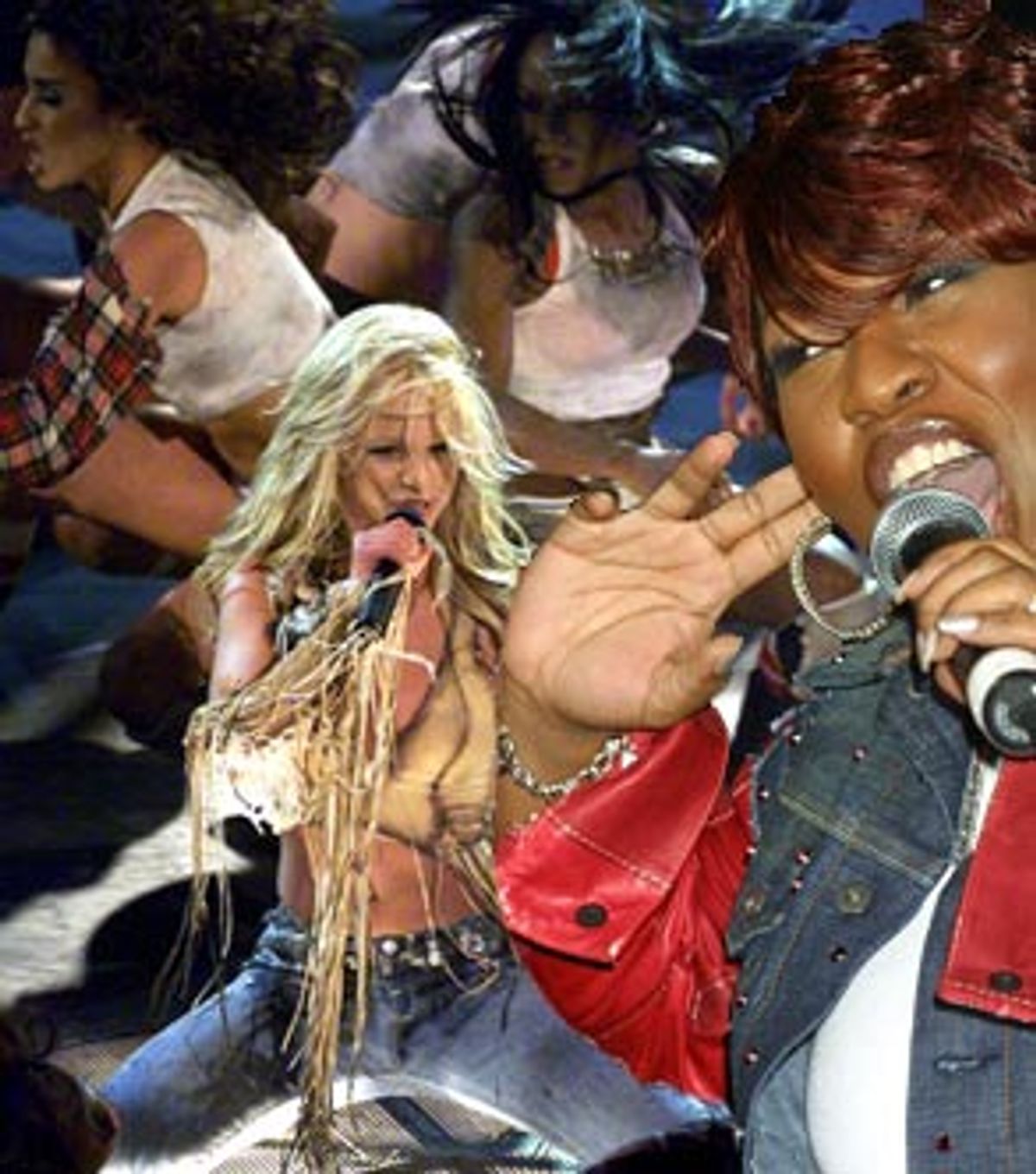
Elliott dropped what was easily the best hip-hop record of the year. "... So Addictive" was adventurous in scope -- it played with hip-hop's new digitality in a way no other mainstream rapper has to date -- and hilarious in execution. After all, how could she make such an obvious put-down song like "One Minute Man" sound so seductive and blithe without secretly having a wicked sense of humor? Coupled with her other megahit on the album -- "Get UR Freak On," soon to be heard at a football game near you -- "... So Addictive" rattled and rolled the way everybody always knew Elliott could, since the day that "I Can't Stand the Rain" track came out. So that was good. What was bad -- and I mean, patently bad, totally without merit -- was the Reebok commercial she did later this year, in which she rapped about a woman's world and in just 30 seconds seemed to reduce all feminist theory that had gone before to some kind of you-go-girl sound bite. It was painful to watch, and not only because you knew Elliott knew better: The raps were wicked stale. Oh yeah, and then she was in that "Ugly" video for no-neck white boy hick rapper Bubba Sparxx, riding a tractor as Bubba sampled her. That was kind of lame.
The 15th Minute Award: Uncle Kracker Sir, I have the list in my hand and I see no "U. Kracker" on this list. I'm sorry, sir. You might want to try the club down the street ...
The Chicago Award for the Most Unbearable and Most Ubiquitous Artist: Creed
Everything they do hurts my feelings.
The Mike Watt Award For Tireless Road-Dog-ism: Clem Snide
From spring 'till fall, Clem Snide were everywhere this year, doing it the old-fashioned way: earning it. The Brooklyn nerd-rock outfit probably played every beery bunghole in these United States this year -- and even a few of the ones they have over in Europe, that is, before all hell broke loose -- in support of their most recent record, "The Ghost of Fashion" (SpinART). That record -- and more immediately, the live shows that supported it -- got to the heart of why Clem Snide have become the world's favorite pet band: They're smart, they're funny, they're sincere, they rock and they can even write songs about Chinese babies and Corey Feldman without sounding like Cake or some other joke-rock band. In their hands, a song like that even sounds tender. When they weren't playing these songs, they were either doing the new theme song for the TV show "Ed," dedicating a cover of "I Don't Want to Set the World on Fire" to Osama bin Laden or sleeping in the van. But apparently, not much.
Best Album to Feature Buddy Rich Samples: Solex, "Low Kick and Hard Bop" (Matador)
Those decrying the early and unfortunate death of electronica need look no further than Solex -- aka Dutch record geek Elizabeth Esselink -- to find everything necessary to carry the genre on, and notice everything it was missing up until her. Noticeably, that amounted to a sense of humor, which "Low Kick and Hard Bop" has in spades -- big-band drum rolls and Ramsey Lewis overbite grooves mesh into song after song of delirious white-girl musings (delivered in a Liz Phair-y singsong rap style) that can only make you smile. Rich would have been pissed, but he secretly would have loved it. How could you not? The gal's got moxie.
Best Sideways Cleavage: Nikka Costa, "Like a Feather," from "Everybody Got Their Something"
This was the best sideways cleavage to be seen anywhere this year. Ms. Costa is not here this evening to accept this award, so I will gladly accept it for her, taking special care to honor her requests that I thank God Almighty, her fans and the makers of Scotch tape.
Best Symbiosis Between Nick Drake and an Actual Volkswagen: Maximilian Hecker, "Infinite Love Songs" (Kitty-Yo)
Maximilian Hecker is a male model -- quite popular, apparently, with the same Berlin-at-night scene that produced shock feminist Peaches and her own brand of bloody Salt-n-Pepa tributes -- who at heart is but a softy of English folk proportions. His overlooked debut album referenced Drake so heavily -- as well as Cat Power, Jeff Buckley, Radiohead and all the other great mopes of our time -- that it felt like a deliberate attempt to squeeze the singer's sensibilities into a modern context. It was shockingly, blissfully successful. Give it a crack and you won't believe you missed it.
Best Reissue of a Record From the Immediate Past: Pedro the Lion, "The Only Reason I Feel Secure/It's Hard to Find a Friend" (Jade Tree)
Sure, it's easy to grouse about Pedro the Lion muddying the waters of punk rock -- more specifically, post-emo -- with all that icky spirituality and highfalutin straight-edge judgment calls. But this reissue proved that Pedro -- mostly the work of one David Bazan, wearer of a young man's beard and seemingly an honest-to-goodness nice guy -- has become Bono for guys who still wear dickeys and gas-station attendant jackets. Bazan's guitars are pristine, his voice is affable and honest without ever resorting to indie faux-coyness and the production on his records -- which he does mostly by himself -- is crystalline and, at times, oddly joyous, never steering away from a big pop payoff. That his vision was this clear this early on -- way back in the late '90s! -- only proves how many more great records the guy has in him.
Best Foreign-Language Frug Freakout to Appear on a Movie Soundtrack: Mohammed Rafi, "Jaan Pehechaan Ho" from the "Ghost World" soundtrack (Shanachie)
"Jaan Pehechaan Ho" plays during the opening credits of "Ghost World" -- a wondrous (if flawed) film adaptation of the Daniel Clowes comic -- as the camera pans from one blue-television-lighted suburban window to another, looking desperately for signs of life. As the camera finally happens upon the window of the film's protagonist Enid (played masterfully by Thora Birch), we realize that it's "Jaan Pehechaan Ho" that's blaring out of her bedroom TV in an absolutely raucous '60s Bollywood sequence. That sense of otherness -- and the sly charm of it -- goes on to inform the whole movie, but it never hits this early apex again. "Jan Pehechaan Ho" is Enid's freak flag brought to speaker-bursting life.
The "20: That's a Nice Age" Award: Britney Spears
Well, you knew it was inevitable that Spears would grow up -- I mean, the signs were everywhere. Ahem. But it took her enlisting Jon Voight on her HBO "Live in Las Vegas" special -- wherein the actor debased himself in a bit of fatherly playacting that went beyond camp and into sheer (but cruelly hilarious) vulgarity -- to realize how much her love had matured, and in turn, just how cold and calculated it had become. Spears' maturation-in-public might have gotten a lot of sweaty dads off the hook, but its handling was so hammy and preapproved that you couldn't help but feeling something very essential about what we loved about Spears was lost in the process. And the overarching message of Spears-as-young-adult wasn't very comforting, either -- that she would survive, not because she's got chops or great looks, but simply because she is now an enormous personality-driven corporate entertainment presence. That, oddly, puts her now in the same boat as Martha Stewart.
Best Comeback When You Could Have Just as Easily Assumed All Was Hopelessly Lost, Consigned to a Different Age: New Order, "Get Ready" (Warner/Reprise)
"Get Ready" perfected the poncy jock-rock formula New Order had been working on since the late 1980s. That it came without warning -- just as I finally joined a gym -- made it even more of a delight. All the pieces were in place: Bernard Sumner's deadpan winsome vocals, Peter Hook's octave-favoring bass runs and no end of post-Manchester disco groove. I thank you, everyone waiting for a new Morrissey album thanks you -- after all, this was the next best thing -- and eventually, my cholesterol count will thank you, too.
Shares