

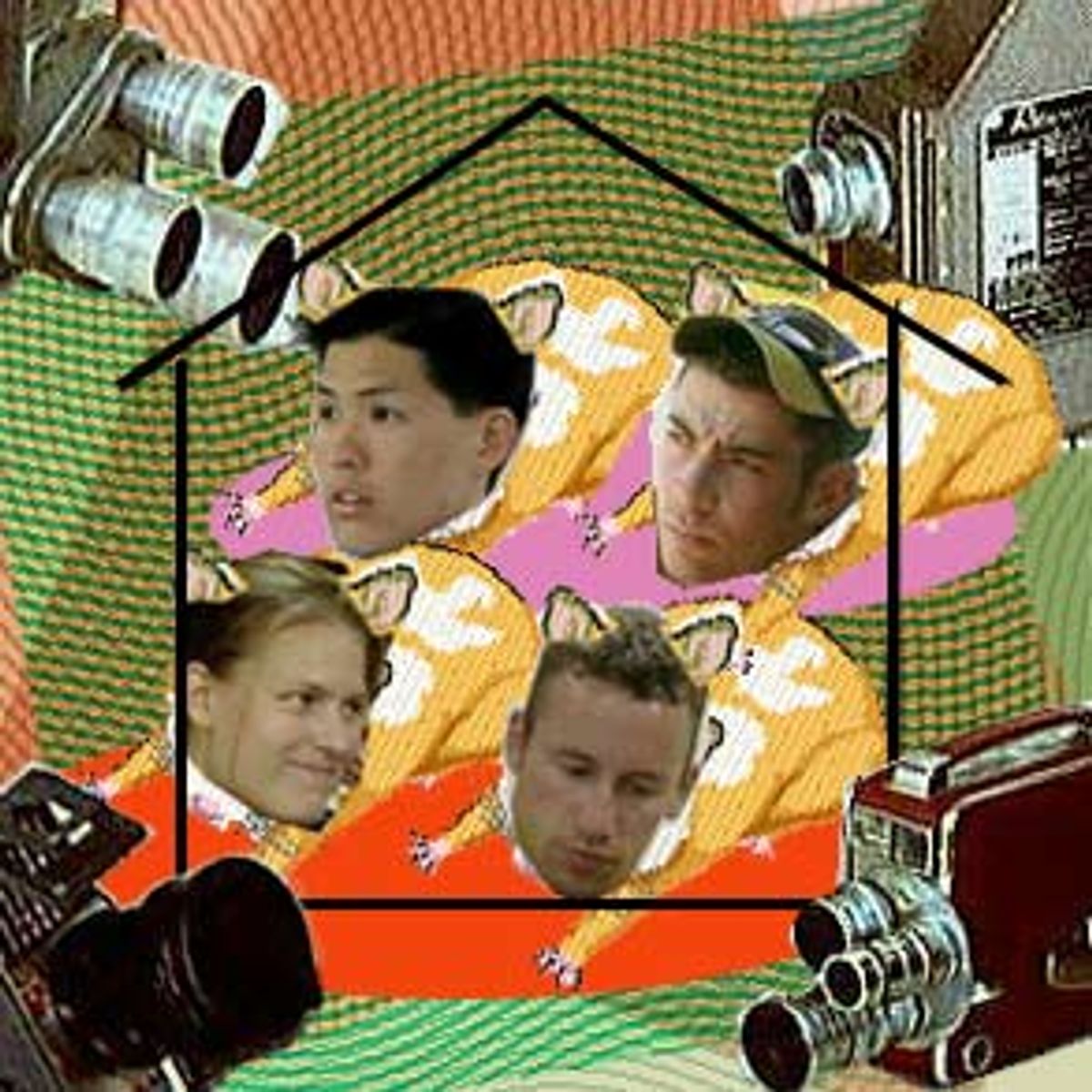
"Big Brother" could have changed everything. We're inured to the idea of reality TV at this point, and we know that "Big Brother" has now become a punch line. But we have to remember what a far-out, original, sick concept it is: Lock 10 people up in a house. Remove virtually all forms of distraction: TV, newspapers, radio, computers, music. Let the mess steep and see what happens.
Would the residents bond, talk, fall in love, have sex? Lose their humanity? Turn on each other?
Reality is interesting. The static documentaries of Frederick Wiseman ("High School") and the cinima viriti masterpieces of D.A. Pennebaker and the Maysles brothers ("Dont Look Back" and "Gimme Shelter") demonstrated that some piercing truths can be found in an unblinking, (somewhat) unnoticed camera eye.
There is something terrifying about reality. Why can't we face its implications? Consider "The Truman Show," the movie that critics oddly hailed for 10 minutes a couple of years ago and then promptly forgot about. The trouble with "The Truman Show" was that it wasn't a movie -- it was an idea for a movie. The script never confronted the implications of its lancing high concept: What if you discovered your life was a TV show?
Truman, played by Jim Carrey, lives a perfect life in an entirely created world with a camera under virtually every bush and behind every wall. He discovers what's going on, and walks out. End of film.
The writers couldn't deal with the fact -- or were afraid to deal with the fact -- that "The Truman Show" is about the audience, not the subject. The film tried to make the viewers misty-eyed and human, when in fact they were monsters, ready to sacrifice someone's life and humanity for their entertainment.
The movie needed to begin with Truman going back out into society. Perhaps he'd find he could not blend in -- and eventually opt to go back to his perfect wife and calm life inside a gilded cage. And perhaps then his fans, seeing that their subject was in on the game and quickly tiring of his self-consciousness, might reject him.
His life might, in fact, be canceled.
Or perhaps he'd lose his mind, a mild child raised domestically and released, unequipped, to fight for life in a harsh world.
The audience could then have faced the consequences of its unthinking use of a man's life for its amusement. Encoded in the failure of "The Truman Show" is that very syndrome: For our amusement, the filmmakers crafted a movie that touched on the implications of decadence, but didn't confront them. In this way is a tragedy of pop art writ large on our psyche.
- - - - - - - - - - - -
The sad thing about "Big Brother" is that it was handled so incompetently.
Virtually nothing on the show worked. The idea, as you may know, was to lock 10 strangers, whom we know only by their first names, in a small house for about three months. (The show ends Friday.) There is no phone, no TV, no computer, no radio, no dishwasher or washing machine. The residents slept five to a room, men and women divided.
Cameras monitored their every movement -- in the kitchen, backyard, common areas, bedrooms and bathroom. Even in the shower and toilet, cameras ascertained that the residents were alone before turning demurely to the wall. Every two weeks, the residents nominated two other residents for banishment. Whom they voted for was kept secret.
Then the audience voted, via a 99-cent phone call, to kick one of the nominees out. (Sometimes, ties put three or more people up for banishment.) The last resident standing wins $500,000. The two runners-up get $100,000 and $50,000.
That was the setup. But things soon changed. The isolation of the "Big Brother" house was overstated from the start. The houseguests were interviewed about their thoughts and actions alone each day in the so-called Red Room. In other areas of the house the "Big Brother" announcer spoke to them through a P.A. system. There were first one, and then two, live shows a week, hosted by a chirpy CBS factotum, Julie Chen.
Also, the producers spent their time crafting "challenges" for the houseguests. These were designed both to pass the time and create stress lines in the group.
None of it worked.
For the first, the casting was abysmal. The "Survivor" producers had the casting gene. There were one or two faceless refugees on the island, but most had surprisingly complex and memorable personalities. For "Big Brother," bad luck had to enter into the equation: Ten people randomly taken off the street would have been more interesting.
Plainly, a few of the residents were picked for easy outrage -- a fiery black, William, who was nicknamed "Mega," and a former stripper named Jordan. But the producers' plan backfired. Those were the first two voted out of the house.
The pair were banished because CBS never thought out how its voting system would work. The audience didn't like tension, didn't like conflict. Instead of cheering on the bloody battles like a Roman crowd at a gladiator fight, the audience was like a nanny, feeling a need to calm the children's fears and oust anyone who caused trouble.
This was exacerbated by the fact that in order to vote for someone, you had to vote against someone else. Viewers seemed motivated only by negative forces. You'd expect, for example, that Jordan, a self-described "exotic dancer" who displayed the charms of a master flirt and loudly speculated about her lesbian tendencies, would be a dream of a sitcom star for any self-respecting couch potato.
But this required an extra step of reasoning that it might have been overoptimistic to expect from a mass viewing audience.
In the event, Jordan was nominated for banishment the first two rounds, and was thrown out in a massive landslide the second time. The cast and audience efficiently targeted first the disruptive people (Mega the radical, Jordan the flirt, Karen the emotionally unstable mom) and then anyone else who caught their attention (the madcap Brittany).
Only after removing virtually everyone distinctive in the house did the audience get around to ousting a quiet resident -- Cassandra, who happened to be black. The last three residents -- the ones who will share the cash prizes -- are by anyone's standards among the house's four most conventional and homogenous residents.
It's not clear why the show needed the oustings. It would be a much purer and truly voyeuristic experience just to watch a group operate in something as close as possible to a vacuum. Why not stick them in the house with no outside contact at all? Deliver food silently, and convey any needed messages on paper. Give the players no sense of the passage of time or the world outside. Seal them up for a six-month or yearlong period and tell them that, short of a nuclear war, no one's going to be letting them in on any outside news.
Let them stew in their own juices for three months, and then start broadcasting. That might make for some amazing television.
Even if some sort of winnowing process is deemed necessary, the producers should have stuck to their isolation precepts and kept all the decisions in the house. Make the residents deal with the consequences of their votes. Let the nominations be a primary, and then have the whole group vote someone out each week publicly. Or let them live together for six months and then vote among themselves to award the prizes.
If the residents had been left to vote each other out, it would have directed their attentions inward, and turned the house into a cauldron of intrigue, just as Palau Tiga, the "Survivor" island, became. Instead, the group bonded and spent its time trying to look good for the audience.
Which brings us to another central screw-up. The "Big Brother" producers did everything they could to remind the group that it was on camera all the time. Two-way mirrors lined the rooms. Noisy, rotating cameras were mounted from the ceiling and on posts in the backyard. The residents could hear them zoom and pan on their every move.
The noisy cameras should have increased paranoia, but that was another miscalculation. Instead, they just continually reminded people that they were on TV.
The residents found their dreams come true and then adapted to the spotlight. Some, like Brittany and Mega, became colossal bores, loving the idea that people were finally actually paying attention to them. Others, most notoriously Jamie, the beauty queen, squirmed and calculated how not to give the cameras a "story" to relate. Jamie and banishees like Jordan and Karen fretted that "editing" would make them look bad.
The residents quickly learned to conform. After the first few weeks, virtually nothing interesting happened.
That may sound like a hyperbolic statement. How boring could it be? Consider that one recent action highlight included George, the tubby dad from small-town Illinois, misspelling a two-letter word on a makeshift tattoo on his biceps.
Desperate producers tarted up the live shows as a direct consequence. The residents, buffeted but mystified, couldn't complain, because it was something to look forward to outside of the quotidian boredom of life inside the house.
The residents took increasing interest in the prizes the "Big Brother" producers offered. They really did come to look like hamsters, as we Salon episode recappers called them. Find the hidden prize! Crawl through the mud! Learn the United States highway system!
The producers compounded the problem by plainly having no overarching plan. Brittany, a zany young woman in her 20s who dyed her hair in electric colors, was able to talk with one of the remaining internees and blurt out some misinformation. It was kind of interesting to watch how the bits of outside info poisoned the atmosphere inside the house.
But even this seemed haphazard. If that was the plan, the producers should have tied the misinformation theme up with bows: The president's been shot! Your mother died!
The producers seemed to be making things up week by week. There would be a wild veer into tastelessness, like a comedy roast with risqui scripted jokes. Then a zoom back into pointlessness, like the jumping-rope contest. The residents were given French berets, then formal wear, then camouflage outfits, then cowboy hats.
Sometimes the challenges were so bad the residents didn't even try. The group was given a "Big Brother" jigsaw puzzle, which they largely ignored. They were forced to square dance, and wrestle in big vinyl sumo outfits. The backyard had a pool, which was the site of some of the more open early discussions. But then the producers introduced a dog into the house, which promptly fell into the pool. A new fence built closely around the pool made it impossible for the residents to relax around it as they did originally.
As on "Survivor," there was no way of enforcing or even encouraging chores, smart decision-making or even personal hygiene. (Eddie, the one-legged athlete from Long Island, was often referred to as being "smelly." Eddie accepted the description graciously, and so passive were the hamsters that no one suggested he do something about it.) On "Survivor," the castaways couldn't consistently catch fish, and ate only white rice for the last weeks. It was pathetic, but the setting made their fecklessness seem a little understandable.
On "Big Brother," the group couldn't keep enough toilet paper in the house.
This is not the stuff of dramatic tension. The pallid group, we noticed, was devoid of leaders. No one made the decision not to buy enough toilet paper, and no one could be blamed. Viewers were left with a picture of indistinct haplessness. There is nothing on earth less compelling to watch.
The overall tone and direction and art direction of the show was cheesy. The weekly live shows were studies in cluelessness -- a stream of AOL apparatchiks, specious polls, network spin, misrepresentations and incomplete information.
Chen, the vacuous host, planted a story in the New York Times saying she was allegedly fighting against the cheesiness of the show; there was never any evidence on the air that such concerns were a part of her personal makeup. The overall tenor of the live shows -- a mechanically applauding infomercial-like studio audience, the grinning, moronic host -- made "America's Funniest Home Videos" look like "Firing Line." Chen was incapable of asking an original question, flummoxed by unexpected developments and seemingly unable to talk like a human being. "This is my favorite part of this segment," she gushed to an AOL flunky at one point -- this to the news that an Internet viewer had written a song about George to the tune of "Old McDonald."
Getting desperate, the producers had no backups. They started violating the house's insularity. Jamie, the impassive beauty queen, got to talk with a casting agent. Curtis was taken out of the house to a bash -- and not just any bash, but the Emmys, Judgment Day for TV shows. Brittany, banished, got to shout misinformation to Josh. At one point, the producers offered $50,000 to anyone who would leave the house so that they could replace one of their boring casting decisions with a fiery, comely young woman. This all heightened the group's nerve endings but froze their initiative. They just sat around nervously waiting for the next thing to happen to them.
The net effect was akin to watching a dentist's waiting room.
What do we want from a reality show? Is it voyeurism, really? Some innate urge to see what people do when they're alone, when they think we're not watching? Voyeurism is a good and healthy fetish; exhibitionism and the desire to be on TV are much less attractive.
I think we don't know what we want. I think we think there's a secret we can discover, a revelation we can see, some knowledge we can glean, from watching someone.
"Big Brother" was such a failure that it's difficult to draw a lesson from it. But I think the failure may not entirely be CBS's fault. Maybe the fault lay with the residents -- and not even them personally, but perhaps their species, at least the American version of it. At this point we are a nation of watchers, entranced with an implacable entertainment industry designed specifically to take us away from reality. Maybe reality TV is an oxymoron. Maybe humans aren't set up, at this point in their development, to be watched.
The nadir of the show came a few weeks ago, when George, the regular-Joe roofer, concocted a somewhat deranged plan to have the remaining cast walk off the show en masse. His reasoning was a bit crazy: He argued that this was the secret way to win the game -- that they were supposed to rise up and lose their chains, though of course he didn't put it that way.
The plot came just at a time when viewers, too, were exasperated with the show. Somehow, beyond George's raving, the other residents could sense something was wrong.
George the ringleader and his followers were patently inspired by received behavior patterns from movies, notably "The Great Escape" and "Chicken Run." But they also seemed to be motivated by a dimly remembered, almost prelapsarian instinct toward rebellion and against dehumanizing treatment. They discussed the plan, built up their courage and staged a flamboyant clasping of hands to seal the mutinous agreement.
The pact lasted barely a day and was a memory by the time a gleeful CBS began airing footage of it. Had the group stuck to their bargain they would have truly made history -- had an entire cast ever walked off a TV show before? It would have given us a taste of what happened after the end of "The Truman Show." The hamsters -- I'm sorry, the humans -- might have become the standard bearers for a nation of Trumans. We don't want to be watched, they could have said. We don't want to be passive. We're a society of couch potatoes reduced to watching a houseful of other couch potatoes in search of something human.
But the plan dissolved. George ended up trying to save his place in the house. (He was bounced soon after.) And the others appealed to the viewers at home to let them live inside their specially created biosphere until the end. Only one of them, Eddie, even admitted that he was interested in the prize money. The rest said they were there for "the experience." They couldn't step out of their roles. It was nice inside the house, they told themselves. They'd made an agreement, they rationalized. There was a game to play, they said, and money was on the line.
George's plan wasn't so crazy, really. But, like many visionaries who are given a sudden piercing insight into reality, he was unable to make it real in the minds of his fellows, and was martyred as a result -- nominated by his onetime acolytes, and then banished by his audience.
There will be more reality TV shows, but they will be ever more baroque, like "Survivor," in order to disguise the fact that they're not about reality at all. "Big Brother" will be remembered as the show that reminded a nation of watchers, suddenly, of what reality, at this point, is about: stasis, boredom, timidity, passivity. We took a look, and changed the channel.
Shares