

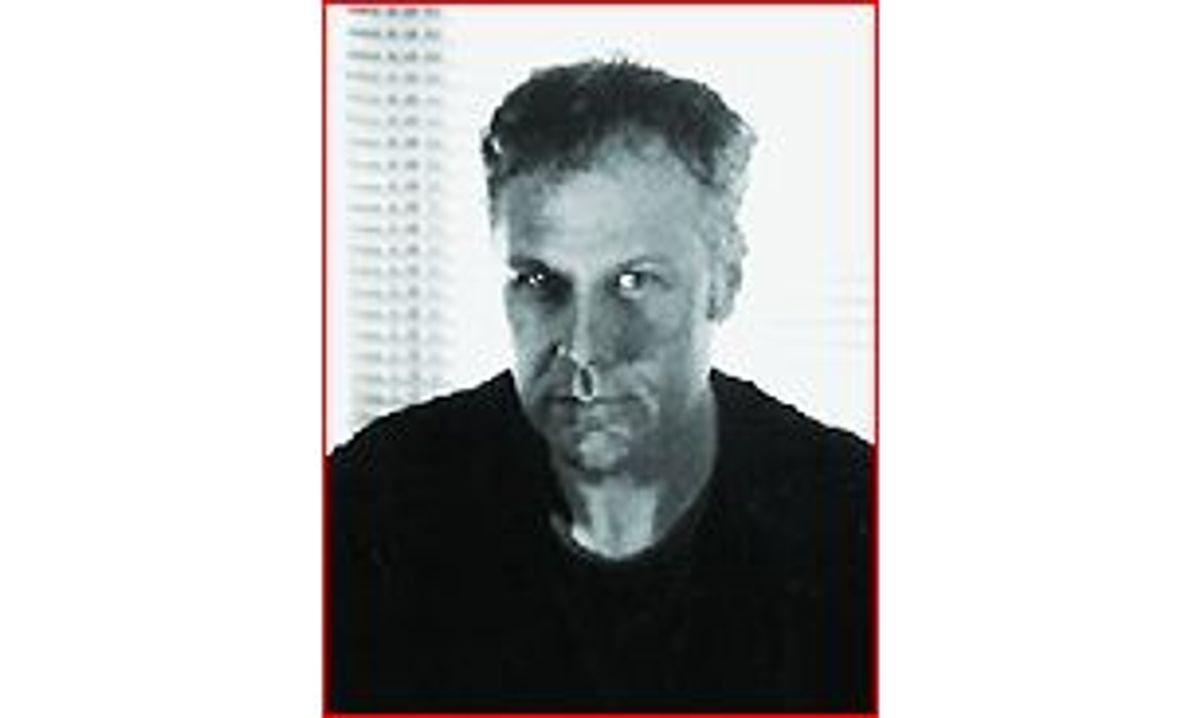
"Dennis Cooper, God help him, is a born writer," William Burroughs wrote about the man who has, more than anybody else, come to inherit the subversive tradition most exemplified by the Great Outlaw of American letters. Burroughs gave his cautionary praise based on reading "Frisk," Cooper's most infamous and signature work; "God help him" was an eerily prescient choice of words. Burroughs may have been an outlaw, but in truth he may have had it easier than Cooper, who has not blinked through this most nauseating era of political correctness and radical gay self-righteousness. And Big Bad Bill never had a death threat made against him. Dennis Cooper has.
The death threat isn't that surprising. Cooper is a dangerous writer, both for the pedestrian reader unable to get beyond surface, and for those who like their homosexual literary aesthetics cozily free of anything resembling depth or complexity. Cooper is anything but cozy. Prolific but terse, simultaneously poetic and laconic, he is a profoundly original American visionary, the most important transgressive literary artist since Burroughs. America being America, transgressive literary artists are not a highly appreciated commodity. Not surprisingly, particularly for a writer who has been influenced by European literary traditions, Cooper is more respected in Europe and even the Middle East; his books have been translated into 12 languages, including Hebrew. In England, his books are bestsellers.
All this is not to say that he isn't appreciated here -- in spite of what one might think reading the occasional Ameri-phobic European literary critic, who often feels the need to tell us what he thinks we don't know about our own. The truth is that Dennis Cooper is an American master, and his great subject is American youth culture. George Bataille has certainly had his influence, and Cooper also summons to mind Genet, Baudelaire and Rimbaud, but he is, in the end, himself. He stands alone.
His vision is excoriating, hallucinatory, viciously funny. As with the work of the painter Francis Bacon, to really appreciate the effects Cooper creates, you have to be willing to look beyond the immediate "horror hospital" (to borrow a title from Cooper), to what Bacon once referred to as "sensation without the boredom of its conveyance." There you will reach the pure, undistilled essence of Cooper's achievement, which is rigorously literate, multilayered, brimming with intellect. He is a lover of language, and he uses it with the precision of a sculptor using a drill. Sentence for sentence, there are very few writers as perversely pitch-perfect.
The overriding obsession of anyone in a Dennis Cooper novel might best be summed up in his first, "Closer": "He couldn't decide if he wanted to draw David, fuck him, beat him up, or fall in love with him." Add "or kill him," and this would be a synthesis of everything Cooper has been working toward, unceasingly, since. Far from being a narrow vision, this accommodates everything there is: art, sex, the violence of life and the finality of death.
Probably the most subversive and delicious thing about Cooper is his genius at working humor into the most outlandish scenarios. Ziggy, the zoned-out teenage hero of "Try," screams at his ass-hungry lech of a foster father, "If you loved me you wouldn't rim me while I'm crying." Watching a porn-movie sex scene between adolescent Chris and Don Haggarty, a resentful adult dwarf, the narrator of "Guide" has this observation: "The porn had this strange, silly, magical ... I don't know, charm. I guess it was mostly the fact that I was watching a dwarf, with all his fairy-tale baggage." And what could be a more succinct description of oral sex than this? "The sensation's indescribable, like however the opposite of being tortured to death might feel."
- - - - - - - - - - - - - - - - - - - - -
I had the opportunity to meet and talk with Cooper when he was recently in New York to attend a two-day symposium on his work at New York University. He is someone who seems to inspire devotion. "Beautiful: The Writing of Dennis Cooper," an exhibit of his manuscripts, scrapbooks, first editions, photographs and letters in NYU's Fales Library, features countless letters written to him, including those from writers such as Edmund White, Allen Ginsberg, Kathy Acker, all professing their awe. (There are a few naked Polaroids from gushing boy fans as well.)
In person he is tall, slim, still boyish and strikingly handsome, looking 10 years younger than his 47 years. While everyone seems to have a preconceived notion of what Cooper must be like based on his books, he is actually rather lovely -- unassuming, polite, self-effacing and utterly candid.
The facts of Cooper are these: He was born in Pasadena, Calif., in 1953, and grew up wealthy as the son of Clifford Cooper, who owned a company that built missiles for NASA. (One of Cooper's memories of adolescence was his parents' having their good friends Dick and Pat Nixon over to the house.) His family life was a deeply alienating experience. "I had severe problems with my parents. They divorced when I was quite young, and the divorce proceedings took forever, and my parents did not behave well during that period. The fact that parents barely exist in the books is probably because I escaped mine as completely as I could beginning in my teenaged years. I crashed at friends' houses a lot, and tried to distance myself from the hell going on in my family home, and, ever since, I've had a very distanced relationship to my family."
Considering that the 1960s were his formative years, I asked Cooper why his work reflects virtually no aspect of this time. "Hippiedom held little appeal for me, though the freedom it celebrated certainly appealed to me, and the fact that drugs were seen as tools of enlightenment certainly influenced me, and I took advantage of the plethora of drugs that were around. And rock culture was my culture, though I don't know if that's specific to the period -- maybe psychedelic music influenced my thinking about form, since my writing has a kind of psychedelic feel, maybe."
But it was punk that took hold of Cooper. "That was the most important, the first culture I felt aligned with without reservation. Disco, of course, I despised, and its grip on gay culture of the '70s and onward undoubtedly helped create the deep alienation I feel and have always felt from gay-centric culture."
He attended Pasadena City College and Pitzer College of Claremont Colleges, lived as an expatriate in London and followed a boyfriend to Amsterdam. Then he lived for a while in New York, before relocating permanently to Los Angeles. In the '70s he founded the influential Little Caesar magazine, later to become Little Caesar Press, and published more than two dozen chapbooks of his poetry, as well as the work of, among others, Bob Flanagan, Tim Dlugos and David Trinidad.
His early short fiction has been collected in "Wrong," but it is in "Closer," his first novel, that Cooper began to explore in earnest the true nature of his obsessions, in the form of a walking enigma named George Miles. George Miles was his teenage infatuation -- a kid three years younger, with extreme psychological problems, who became Cooper's closest friend, and the inspiration for his five-novel cycle. Briefly, they were lovers. Even when Cooper lost touch with Miles, and Miles had disappeared, his emotional hold over Cooper was profound. In "Closer," he is the victim of a violent mutilation, which he survives, only to vanish from the other books -- until the last.
In "Period," published this year and the last novel of the cycle, Miles' memory lingers. "Period" is an elegy to the nature of obsessive love, the need to feel. It is also a memoriam: Before embarking on the writing of "Period," Cooper discovered that the real George Miles had killed himself years before. In the history of great artistic inspiration there is another muse named George -- George Dyer, the model-lover of Francis Bacon, whose genius, like Miles', lay in being the object of passions both physical and aesthetic. It was George Dyer who haunted Bacon long after Dyer's own suicide; likewise it is George Miles who is the locus of Cooper's genius.
In "Period," there is a character named Walker Crane, author of a book called "Period," described by one of the characters as "a messed-up human being ... not cool and evil like you'd think." Later, he's described as "an evil man. He made George get completely dependent on him, and then he dumped him, and exploited him for that novel, the fucking psychopath." I asked Cooper about this. "I was poking fun at my reputation" -- the idea that Cooper himself is not nearly as evil or cool as his image might suggest. (In fact, "Dennis" is described in "Guide" as being "sort of a wuss.")
But perhaps, insofar as Miles is concerned, there is also an element of guilt involved: Cooper used Miles' passivity and psychological traumas as stimulation. At the same time, he had taken care of Miles, before he disappeared for good, leaving Cooper with this need to reinvent Miles in fiction. "I couldn't remember who the real George was. The real George got lost."
Then came "Frisk." It was the publication of this second novel in 1991 that led to the death threat. As death threats go, it was a fairly ludicrous one -- more a piece of guerrilla theater from a half-baked queer splinter group. Cooper was due to give a reading from "Frisk" at San Francisco's A Different Light Bookstore when he was handed a leaflet -- a group calling itself the "Hookers Undivided Liberation Army" proclaimed that "Dennis Cooper Must Die! Must Die! Must Die!" (The flier is on view in the "Beautiful" exhibit at NYU.) His crime? Murdering young men, and glorifying his activities in a novel called "Frisk."
I said I thought the death threat was more a stunt for attention -- a mock fatwa -- than a real threat, and Cooper concurred. "Of course it was. I realized it once I spoke to the guy responsible. When 'Frisk' came out, it was the heat of the moment -- ACT UP had kind of become Queer Nation, Jeffrey Dahmer had just gotten arrested, 'American Psycho' had just come out. There was a lot of hatred directed at me."
No doubt, it is his use of real names -- specifically his own in "Frisk," as a character who commits savage murders in his head -- that has allowed those prone to outrage to indict him for crimes he never committed, beyond the crime of creative license. Did he mean it as a deliberate provocation, a kind of self-indictment?
"Using mine was both a provocation and a self-indictment. It was also a way to introduce the idea that authorship is an issue in the work, suggesting parallels between myself and the fictional Dennis, and emphasizing and blurring the distinction between fiction and the truth, fantasy and reality in 'Frisk' and 'Guide,' both of which play with the idea of what is 'true' and 'confessional' and what is 'made up' and 'manipulative.' As for using the other real names, it depends on the situation. Sometimes I used real names for the above reason, and sometimes I used them to ground the work in the real world of the readers in order to give it a sanity, and sometimes I used the names as an homage to the real people I referenced, and sometimes they were all of these things at once."
A film of "Frisk," released in 1995, only added to the misunderstanding. By the end of the book, it is clear that the grotesque, cartoonlike butchery is a fiction. In the movie, this element was deliberately blurred. When the film was shown for the first time in San Francisco, a furor erupted -- people yelled at the screen, there were walkouts and indignant press write-ups, with accusations such as "virulently anti-gay" and "internalized homophobia" being leveled. What might have made the difference -- at least to Cooper -- was a statement he prepared to demonstrate his displeasure at the director's decision to depart from Cooper's original intentions.
"The novel is about the difference between what is possible in one's fantasy life, and what is possible in one's real life," Cooper wrote. "It tries, in various ways, to seduce the readers into believing a series of murders are real, then announces itself as a fiction, hopefully leaving readers responsible for whatever pleasure they took in believing the murders were real ... I question very strongly the decision in the film to leave the question of whether the murders were real or not up in the air. Murder is only erotic in the imagination, if at all. ... By choosing to represent only the surface of my novel, by using my novel to eroticize sadistic sexual acts against innocent people in an uncomplex way, the film perpetuates a common, simplistic reading of my work, and this concerns me." Though the filmmakers promised to read Cooper's statement after the film's screening in San Francisco, they reneged; he has since disavowed it.
Other offers have come Cooper's way to turn his books into movies, but he has resisted them, partly because he likes the fact that books are books, with an integrity of their own. The art of fiction is one that Cooper believes in, and one that he fearlessly pursues, sticking to the same subject matter and themes that have made his reputation. Now, with "Period," the George Miles cycle -- five short, dense novels -- is complete, and taken as one long book, it is as significant a contribution to American literature as "Naked Lunch." As such, the publication of the last book in this cycle is a watershed moment. But Cooper himself is ready to move on, planning a book based on Kip Kinkel, the 15-year-old Oregon teenager who opened fire at high school after shooting his parents to death in their home. The book represents a departure for him. "I'm not going to access my psychosis. There will be no sexuality at all, no abuse beyond what every teenager goes through."
Provocation in one form or another defines Cooper's work, but it does not necessarily define him. He has a "ton of straight friends," including teenagers who find him through his books -- "then their parents find my books, and all hell breaks loose." He has friends over for a weekly "Buffy the Vampire Slayer" viewing. And then there's his 9-year-old nephew Cody, with whom he shares a mutual admiration society. "He's extremely attached to me because I play Nintendo with him all the time. I really love him."
Shares