

If you're an oversexed teen, a harried parent or a frustrated office worker, you are well represented on prime-time television. But if you're a 20-something, like me, you are out of luck. For some reason, the networks just aren't scripting shows about us -- which seems strange, given that networks live and die by their success with the 18-to-34 demographic.
Of course, people my age are all over that questionably named genre "reality TV." We compete for love, money, stardom and success; we submit to radical makeovers in front of millions; and, for some unknown reason, we allow cameras to follow us as we get wasted, start fistfights and fall into bed with strangers (and that's all on just one episode of "The Real World"). This is all well and good for those blessed with strong singing voices or cursed with a penchant for binge drinking and exhibitionism, but what about the rest of us?
Not surprisingly, some of the best representations of post-college, pre-marriage existence can be found on the Internet -- the same realm where we forge our careers, look for dates and communicate with friends. One of the best examples is Joe Swanberg's online series "Young American Bodies," now in its third season, which chronicles the romantic tribulations of young people in Chicago. The 26-year-old director of independent movies like "Hannah Takes the Stairs," "LOL" and "Kissing on the Mouth," Swanberg belongs to what film critics call the "mumblecore" movement, a loose cadre of lo-fi, low-budget filmmakers whose movies contain unflinchingly realistic, dialogue-heavy depictions of post-adolescent life.
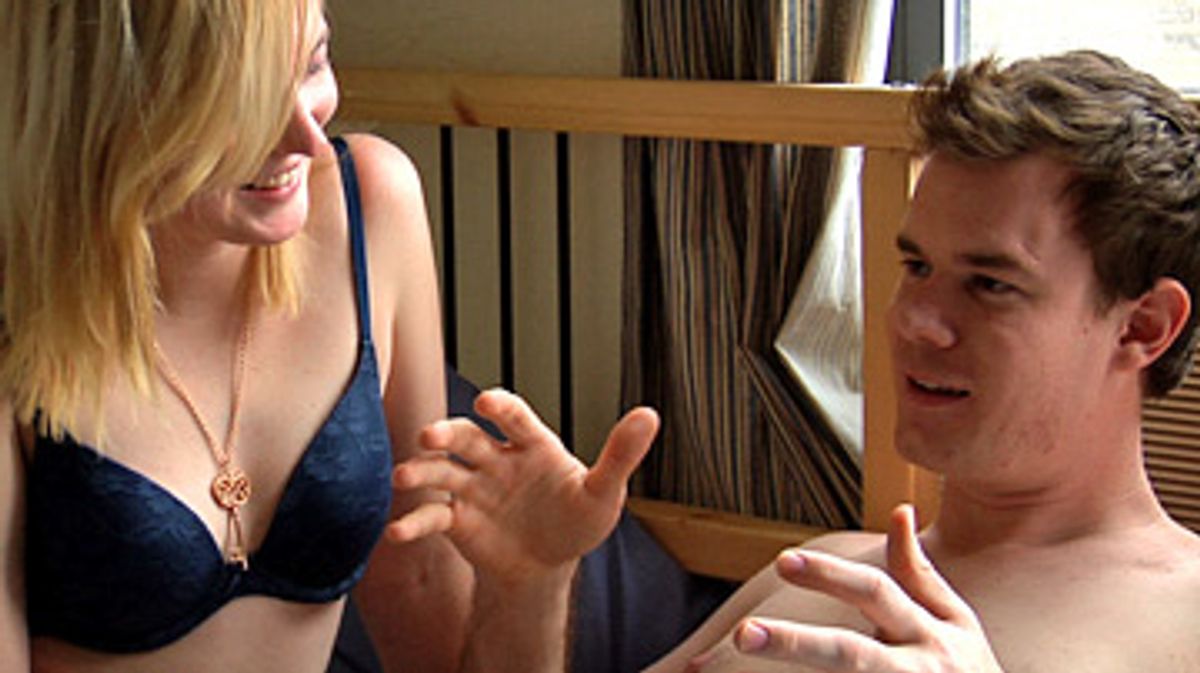
In "Young American Bodies," Swanberg, who often acts in his own projects, stars as awkward, self-sabotaging Ben, who carries a torch for his neighbor Maggie (Mollie Leibovitz), going so far as to run out on a girl he's about to sleep with when she calls. But rather than devolve into the tired boy-meets-girl, boy-loses-girl, boy-gets-girl-back story line that plagues most romantic comedies, Ben's long-standing crush fades into the background as he and Maggie both pursue a handful of unsatisfying relationships and halfhearted hookups.
Originally launched by Nerve, "Young American Bodies" lives up to its title. The short, roughly seven-minute long, episodes have always been packed with full-frontal, coed nudity, and that hasn't changed now that the series has moved to IFC.com for its third season, which began last month, with a new episode premiering each weekday for a total of 12. (All three seasons are archived online.) This isn't porn, though, not by a long shot, and the bodies, while attractive, don't aim for the kind of airbrushed fantasia you might find on late-night Cinemax. A scene from the first season shows Ben, naked and scowling, on a bathroom scale.
Ben and Maggie's friends Dia (Swanberg's wife, co-producer Kris Williams) and Kelly (Frank V. Ross) are a couple negotiating between the freedom of youth and the confines of a committed relationship. Though she loves her boyfriend, Dia is conflicted about moving in with him, becoming engaged and embarking on a lifetime of monogamy. The rest of the rotating cast runs the gamut of post-collegiate relationship angst: When Noah (Nathan Adloff) proposes to Casey (Eve Rounds), she surprises him -- and herself -- by refusing; then after disappearing for an entire season, Noah returns, with a surprise in store.
While some movie critics appreciate Swanberg's unadorned style, recognizing in it the cinéma vérité influence of John Cassavetes and Dogme 95, others find it chatty, boring and narcissistic. It's true that Swanberg's plots aren't thrilling, but they also aren't the point. He has set out to document the lives of people like him and his friends, and at that he is wildly successful. The dialogue is so realistic that, for days after watching an episode of "Young American Bodies," I often find myself musing that I've just had a very "Joe Swanberg" conversation. In an episode from Season 2, Ben and Casey are chewing on pieces of candy, and he asks her what she thinks of it. Instead of replying, she says, "Where's Maggie?" Ben doesn't answer her question either. "The cup's warm because I just washed it," he tells Casey, handing her a glass. "Do you ever have that, where you have a warm cup and cold water?" They go on to discuss, at length, the price of some fancy chocolate that Ben offers her. Swanberg is just as interested in the way characters spend idle moments and handle awkward situations as he is in how they deal with major decisions and life-shaking change.
A number of other online series by and about 20-somethings -- such as "We Need Girlfriends," a comedy about three guys who've recently graduated from college and been dumped by their longtime significant others, and "Clark and Michael," which stars "Superbad's" Michael Cera and follows two friends struggling to succeed in Hollywood -- also opt for speech that sounds improvised, complete with hesitation, stammering and, yes, even mumbling. This isn't just because young people's speech abounds with such verbal tics as "like," "um" and "you know"; the blogs we read, e-mails we send and reality television we watch have made us hyperaware of the stiff, rehearsed dialogue that still pervades most scripted programming. When the repartee starts to feel a bit too witty, or a character's monologue sounds too articulate or practiced, we have trouble suspending our disbelief.
While Swanberg and his actors make naturalistic dialogue seem effortless, other, failed attempts at realism show that it's harder than it looks. The project of two co-workers at the sophomoric site CollegeHumor, "Jake and Amir's" sloppily cut two-minute skits exhibit a sense of humor that favors awkwardness, homoeroticism and bodily fluids. Set among the workstations of Jake and Amir's open-plan office, the action often consists solely of a conversation between the two main characters, who are supposedly exaggerated versions of the real Jake Hurwitz and Amir Blumenfeld, as they sit at their computers. Amir is arrogant, abrasive and obsessed with straight-man Jake in what's often portrayed as a more-than-just-friends way. In an episode called "Jake's Computer," Amir takes over his desk-mate's computer, and Jake returns to find that Amir has been visiting Web sites with names like "whereexactlydoesjakelive.com" and "wheredoesjakehangoutafterwork.com." As with most of the "Jake and Amir" videos, there is no clear punch line. We're left with two guys bullshitting at their desks, repeating words like "chill" ad nauseam.
"Jake and Amir" falls prey to the potentially paralyzing sense of self-awareness that plagues the so-called MySpace generation. Their interests, behavior and even language are all insincere jokes meant to obscure any potential point of vulnerability. Because we constantly submit ourselves for the approval of anyone who cares to look up our Facebook profile, browse our Last.fm account, or glance at our GoogleChat away message, we obsessively curate our public personae. In an episode of "We Need Girlfriends," one character looks up his ex's new boyfriend on MySpace and is disgusted to find that his favorite movie is "Boondock Saints."
Instead of ignoring young people's image consciousness and self-protective irony, Swanberg intuitively builds these elements into his characters. Maggie and Ben, implicitly aware of the power well-constructed artifice can have, invent a band called the Blue Dress. Rather than writing any music, they just take photos of themselves in odd sunglasses and post them on their fake band's MySpace page. Throughout "Young American Bodies," speakers revise what they're saying midsentence, making sure they don't misrepresent themselves or disclose too much.
It isn't that these characters are cold or apathetic or desensitized: "Young American Bodies" contains moments of genuine intimacy, as well as moments of utter sadness. In a quiet scene from the current season, the tenderness between Dia and Kelly is palpable as he gives her a relaxing breast massage and they chatter aimlessly. While Swanberg's characters are upbeat and measured with casual acquaintances and in large groups, they let down their guard when left alone or with a trusted friend or significant other.
These scenes create the kind of emotional realism that many online series lack. Cult favorite "The Burg" (now on indefinite hiatus because of lack of funding) lampoons the hypocrisy and superficiality of a clique living in one of America's trendiest neighborhoods, Williamsburg, Brooklyn. While satire by necessity relies on caricature more than fleshed-out character, "The Burg's" one-dimensional hipsters are so consumed with getting into the right parties, wearing the right clothes and knowing the right people that we could predict their behavior in advance. In their newest online series, "The All-for-Nots," "The Burg" creators Kathleen Grace and Thom Woodley seem to have learned that multifaceted creations are more exciting to watch than stereotypes. Though it is also satire, this time of a touring rock band, its distinct band members face real problems and feel genuine emotions.
Swanberg has always been especially adept at illustrating the way technology mediates our relationships. His 2006 film "LOL" is entirely devoted to the topic. ("Young American Bodies" takes its somewhat tongue-in-cheek name from the porn site that a character in "LOL" frequents.) But, ever the documentarian, Swanberg refrains from passing judgment on his characters or scolding them for existing in a largely virtual world. In the second season of "Young American Bodies," Maggie posts revealing photos of herself on the Internet and begins video-chatting with a guy who lives in California. Within a few episodes, she has moved there to be with him. Rather than call attention to what a crazy idea this is, or overplay the harm it causes Maggie, Swanberg simply has her return to Chicago early the next season, happy to be back, but not noticeably damaged by the ordeal.
This preoccupation with technology's influence on our personal lives abounds in online series, with varying degrees of verisimilitude. "Quarterlife" -- a show about a fictional social-networking site that has now, in a dizzyingly "meta" move, actually spawned its own, real social-networking site -- asks viewers to believe that it's possible for a young woman to film her friends for days at a time without their realizing it. The same supposedly intelligent character, Dylan Krieger (Bitsie Tulloch), gossips snarkily about her friends on her video blog and then seems shocked when they confront her, angry that she has aired their dirty laundry in such a public forum.
More than any other online series, Craig DiFolco's "iChannel" grapples with the way the Internet is changing personal relationships and individual lives. Surprisingly high-concept for an Internet series, "iChannel" follows a teaching assistant and student of philosophy (Michael Izquierdo), referred to only as "I," who gradually realizes that his life has been turned into a 24/7 video blog run by a mysterious entity that communicates with him solely via a PDA left at his door. Also constantly atwitter with viewer input, the device becomes a running commentary on his career, love life and daily routine. When the vlog begins to track I's love interest (Kristen Connolly), commenters taunt her incessantly, prodding her to do something more interesting. "You want me to put on 'Fergalicious' and dance around in boy shorts. Sorry, ain't gonna happen," she retorts, calling out the voyeurism inherent in sites like YouTube.
As the series' creators continue to add interactive elements -- blog comments quoted on the show now come directly from viewers of "iChannel," fans are invited to shoot "video responses" to each episode, and aspiring actors can audition for a part by submitting footage of themselves -- their critique of online life becomes ever more trenchant. We are those faceless watchers who can't pry ourselves away from the quotidian adventures of "I" and his associates, those greedy masses who feel entitled to be entertained by the real lives of other people.
While, of course, I would love to see "Young American Bodies," or "iChannel," or "The All-for-Nots" on network television, I understand why they've been relegated to an online existence. Swanberg's series is less glamorous than reality TV, with its dashing but dim bachelors and the promise of instant pop stardom. "Quarterlife," created by the team behind "My So-Called Life" and perhaps the glossiest of all online shows, fared so poorly when NBC slotted it in as a midseason replacement that it was canceled after only one episode. But as big producers, famous directors and movie stars begin to explore the possibilities of the Web ("The All-for-Nots" is backed by Michael Eisner, "Spider-Man's" Sam Raimi is working on a number of projects with the horror site "Fearnet," and NBC recently bought an online sci-fi series featuring Rosario Dawson), I worry the audience for Internet series will grow so large that my demographic will once again become marginalized, all of the funding diverted to shows about spoiled teens and suburban families.
Thankfully, unlike prime-time television, there's no limit to the programming the Web can support. The beauty of "Young American Bodies" is that it doesn't need a seven-figure budget or an eight-figure viewership to survive. And for those of us to whom "The Real World" kids seem like beer-guzzling monsters from the planet Meathead, it's a godsend.
Shares