Having wrapped the final season of their critically acclaimed HBO series "The Wire" this spring, you'd think that David Simon and Ed Burns would spend at least a few months sipping on cocktails by the ocean somewhere, toasting each other on creating what many have proclaimed the best show in TV history.
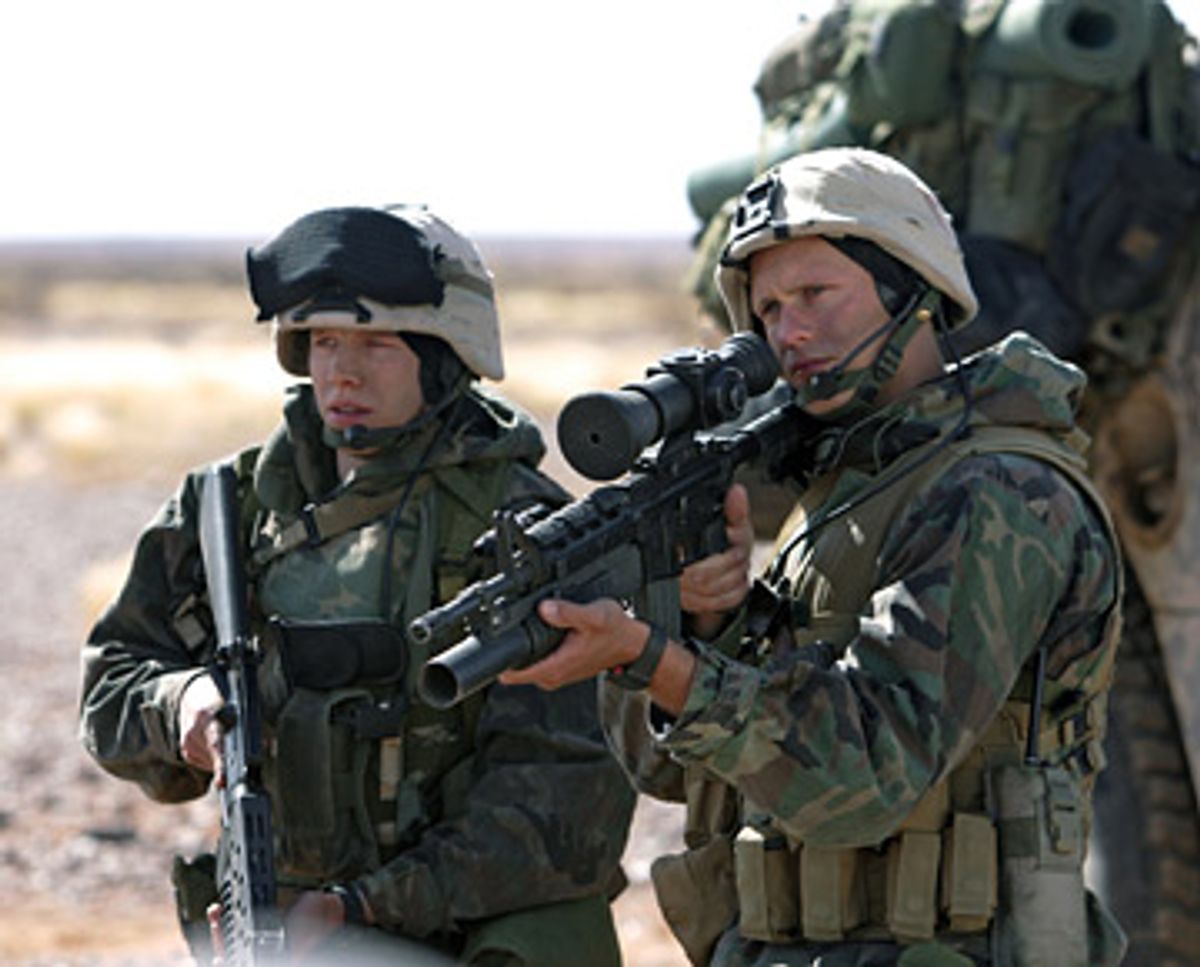
Instead, Simon and Burns shifted their focus from the drug kingpins of Baltimore to the 1st Reconnaissance Marines of the Iraq war. Based on the bestselling book "Generation Kill" by Rolling Stone reporter Evan Wright, who was embedded with the 1st Recon Marines spearheading the Iraqi invasion in 2003, HBO's seven-part miniseries depicts the early days of the war with all the sharp, clever dialogue and painfully vivid scenes of destruction that you'd expect from the team behind "The Wire." When one enlisted officer says to another, "We need to make sure the stupidity in this company doesn't roll down too hard on our guys," you can practically see McNulty grumbling over a beer with Bunk about the incompetence in the Baltimore P.D.
But incredibly enough, most of the dialogue of "Generation Kill" (premieres 9 p.m. Sunday, July 13) is real, lifted from a combination of Wright's book and his notes. (Wright collaborated with Simon and Burns on the script.) When Marines trade insults or a soldier with a camcorder quips, "CNN would definitely pay for drama like that, bro. That shit was extreme!" we're offered a glimpse of the surreal experience of modern warfare that's very different from either romanticized, heroic war movies like "Saving Private Ryan" or nightmare scenarios like "The Thin Red Line" or "Platoon." Unlike the nervous, reluctant rookie soldiers we've been introduced to so many times before, the 1st Recon Marines remain unnaturally calm in the most harrowing encounters along the long and winding road to Baghdad, reflecting both their close ties to one another and their intense training and preparation for the frightening realities of guerrilla warfare.
The real focus here is less on the war than on the Marines themselves. Like the corner drug dealers of Baltimore, the 1st Recon Marines form a culture that possesses its own structure and language. Crude exchanges, racist jokes, pop-cultural references, sparring, insults, impromptu singing of Nelly's "Hot in Herre" -- these are all a part of the bonding between the Marines of Bravo Company. Although their banter ranges from incomprehensible to off-putting at first, by the time they roll up on an unoccupied airstrip, it makes perfect sense when, instead of expressing relief or disappointment, Cpl. Ray Person proclaims, "As the great warrior poet Ice Cube once said, 'If a day does not require my AK, it is good.'"
Speaking to Salon over the phone from his home in West Virginia, Ed Burns, a former cop, teacher and Vietnam vet, explained the process of dramatizing Wright's story and expressed his admiration for the Marines who led the charge into a war he nonetheless calls "a tragedy."
How did you make decisions about where to stray from writer Evan Wright's story and where to stick to it?
Well, we try to stay as much as possible with the story. A lot of times we didn't stray so much as we got into Evan's notes -- Evan was right there. We just squeezed his brain like a sponge and he either went to his notes or remembered or went to his tapes, and we found a way to begin a scene or end a scene with dialogue there.
The dialogue among the Marines is so full of quips and barbs, similar to "The Wire," that I was surprised at how often the quotes in Wright's book were exactly the same as the dialogue in the miniseries. I assumed a lot of that was invented by you and David Simon.
We thought that Evan's work was phenomenal, and that the best we could do was just to stick with the book.
The themes of "Generation Kill" are closely in line with the themes of "The Wire," too. Were you amazed that you found the same sorts of dynamics among the men that you found among the police officers of Baltimore, or did you expect it?
I think [the dynamics are] pretty much the same, particularly when you're looking at institutions. Because of the different tiers, everybody has a different viewpoint. And the higher up you go, the guys down on the bottom are going to think that you're nuts, because they don't see the issues that you're dealing with. So from [Lt. Col. Stephen] Ferrando's point of view, the violence of warfare makes a lot of sense. To the Marines [under him], it's "He's trying to kill us!"
What is the advantage of sending Humvees and other light vehicles into these towns in Iraq first, instead of tanks? Is it the speed?
Oh, it completely unbalances the opponent. When you blow past him, he can't react to it, and now you're cutting off his supply lines. So the enemy is on his own little island all of a sudden. He doesn't want to be there. So he's going to start pulling back, he's going to start doing things that give the attacker the advantage. If he had to come out from his defensive positions, then he's going to get swacked by the Air Force. So this blitzkrieg, this lightning warfare, whatever they call it, gives you an incredible advantage if you can pull it off.
So why not just roll a tank in there? It just takes too long?
Well, you saw what happened when they went to Nasiriyah and they tried rolling tanks in there and preparing for battle. This kind of warfare is not about battle; this is about positioning. It's like a chess game where the threat of a move is much more powerful than the move itself. So you're always worried about the threat, and the opponent doesn't let you off the hook by making that move. He can do other things that can complicate your life. So the straight-out Stalin-type attack on Germany, where they leveled everything in front of them by artillery, they don't do that anymore.
In Afghanistan what they did was they sent in teams of Special Forces and recon guys, and gave them sat phones; and Special Forces has tons and tons of money. They just bought the Northern Alliance, put that together, and very quickly turned the country over.
So I guess it's clear why these guys from 1st Recon preferred Afghanistan -- that was their kind of war.
Right. [Maj. Gen. James] Mattis had a particular purpose for them. He knew that they were the best in his Marine Corps. So he felt very comfortable sticking them in Humvees, because that was the tip of the spear. They didn't feel very comfortable at all, but as Ferrando says, "I can't tell the general we don't do windows." Mattis is a very, very smart general. He's probably one of our best. So he understood what he needed to do. There was no need for recon in the sense of putting them out behind enemy lines and letting them watch for a couple of days. He saw a war that was moving much too swiftly for that.
The men involved certainly had a right to feel vulnerable, given their exposure to gunfire during their missions. It seemed miraculous that they came out of some of these ambush situations alive.
Exactly, but the first thing is the mission. The second thing is human life. These guys have volunteered for this, they are warriors, they want to go into battle, they want to test their mettle and that's what they're prepared to do. Ferrando, who understands what the general wants, is giving them the type of battle that they aren't familiar with. So obviously there's going to be that kind of "He's trying to kill us" attitude, which after Al Gharraf in Episode 2, it very much seems that way.
They got out [survived] because they were extremely good, extremely well trained and extremely lucky.
It's fascinating to see a depiction of troops who stay completely calm and are prepared, since most of us are used to seeing war movies like "Saving Private Ryan," where all the soldiers are shaking and freaking out. Did you think about those movies at all and consciously try to create a different picture?
Well, we saw the Recon Marines, and we got to know them, and we understood both from Evan [Wright] and from them the nature of their training. They train 10 or 15 times harder than what combat would be. What they believe is that when you go into combat, you rely on your muscle memory. When they go into combat, because their training is so intense, instead of getting that tunnel vision where everything shrinks down -- I've seen guys try to put the clip of an M-16 into their weapon upside-down in combat, because the muscle memory wasn't there -- instead, everything opens up, which gives them something that the enemy doesn't have. At this time, most of the guys they were running up against, the fedayeen, they sort of believed that Allah would take care of the bullets once they came out of the barrel of the gun. So in Episode 2, when you saw them in Al Gharraf, the way they were firing the weapons? Very imprecise, more like they were warding off the evil spirits.
Yeah, the enemy looked like a bunch of Storm Troopers.
Yeah, whereas the Marines: Tap, tap. Two in the chest. Tap, tap. Very precise. So you're much more deadly when you're calm.
Did you try to avoid the most common depictions of war?
We were lucky. There's a myth that nobody cussed in World War II. You know that's not true. And there's a myth that these guys are all terribly focused and driven by patriotism, or they're stereotypes and they just have to kill the gooks and the Nazis and stuff like that. But that's not the way it is. They're just human beings put in a very, very difficult situation, but they're prepared for that situation. And they create this subculture. You know when you look at "The Wire" and you look on the corners, that's a culture that you're looking at. You're privileged to see another way of being. And if you're interested in that, you have a dire obligation to make that as real as possible and to give the details for viewers to begin to see how this is shaped, why it's shaped that way, why people act the way they do.
Did you worry about moments that might prejudice viewers against the Marines in the story? There's a lot of talk about race. There are tasteless jokes. It's a very strange moral universe that these guys exist in. How did you approach that and what were the challenges of that?
First of all, I think you have to understand that you've got 24 guys who are all alpha males. These guys spend a lot of time in the bowels of a boat, waiting to deploy, year after year. They're constantly attacking each other, they're constantly challenging each other, they're constantly looking for weaknesses. Because there's great humor when you can destroy a guy. It's not that they're racist. It's not that they're bigots. It's the humor they find. If they found out that your weakness was your sister, God help you.
The masculine side of the male doesn't come out in warfare. That's sort of always out. What comes out is the feminine side. That's where the real tight bonding is. We don't bond the way women do; we don't hug each other. We sort of keep each other at a distance with humor, sarcasm. And what you see in Episode 2 when they get out of Al Gharraf, there's that moment when they're just hugging each other, thankful to be alive. And that's the camaraderie that puts a lie to a lot of the stuff that comes out of their mouths. These guys are extremely tight.
Every time Eric Kocher, our military advisor, calls someone up and needs something, any Recon Marine will immediately jump to. This is just the way they are. A lot of them have been out for several years, but that's how tight they are.
At first when I watched the series, I thought the cleverness might be overdone. But then there are other characters who I thought could never be that stupid.
Remember, a lot of the jokes that were thrown at us, when we first come to Mathilda, the actual Marines have been doing this for years. Guys like [Cpl. Gabe] Garza who sort of hide behind the "Oh yeah, let's go shoot wetbacks" -- being a Mexican himself -- that's just his way of matching up. Whereas somebody like Person, you wouldn't want to get in the verbal fisticuffs with him because he'd cut you down. And the king of the hill is [Sgt. Brad] Colbert; nobody will match up with Colbert when it comes to trading barbs.
They do seem to have a lot of time on their hands to trade witty banter.
Right. Everything you're hearing, he's probably said 50 times in 50 different situations. He's honed it. This is his act.
It reminds me of the firemen you run into at coffee joints who know how to flirt really well. These guys spend half their time showing up at nonemergency locations and flirting with random women. That's part of their job.
Right, you get good at it! Another thing they do that's amazing is that they learn large chunks of dialogue from certain movies that they love, and they'll just go into it. Not for a minute, not for two minutes -- they can do 10, 15 minutes, full scenes from like "Heat" and all this kind of stuff, and you're just going, "Wow, you guys have a lot of free time."
The dialogue from "Heat"? That was legendarily bad dialogue.
"Heat" is one of them. Again, this is from being on a boat with nothing to do.
If you leave men alone together for too long, bizarre things happen.
Absolutely. Civilization is a woman's thing. We're raised by our mothers to a certain point and then our wives take over. If you can get us to a certain position, we're fine, we're human beings, but if you don't get us to that position ...
You never quite get there, let's face it. That's why you need women.
That's true. But if we never get any of that, we're dangerous.
A lot of stuff in the background is just guys from Bravo Two getting it together in the sound mix, adding layer upon layer. You put five or six Marines in a room, you've got a movie. You just pick a topic and they go off. They go, they feed off of each other.
We made the movie for them. The scariest showing we had was in front of them. When they thought it was what their world was, we were very pleased; we knew we had done what we were supposed to do. And a lot of them helped out [with the movie].
Did any of them have a problem with the way that they were portrayed?
No. You know, if you had one of them alone, he might say, "I'm not like that!" But if he's around his buddies who know exactly what he's like, it's like, "The fuck you're not!" and then they'll go off on him. Person [kept saying], "I said that? Damn, you put that down too? I said that?" But he's quite a character.
How did they maintain such a tight bond when their lives sometimes depend on the intelligence or stupidity of those around them?
Well, that intensifies the us-them situation [between officers and enlisted guys]. Those who are not in the Humvees [the officers] are part of the Other, and we [the enlisted guys] have to be that much more together to survive.
The only guy who consistently freaks out under pressure is [platoon leader] Captain America. Is that the "Other" you're talking about?
Yeah. Captain America was very well respected before they jumped off. A lot of guys who are officers grow up in a much more refined world than the enlisted men. They don't have fights in high school, they don't have run-ins with the police, and their training doesn't even begin to come close to the enlisted men. So when they step into combat, they're not as prepared. So you can see a lot more breakdown with the officers. Those officers who are good, it says an awful lot about them, because again, they don't have the totality of training that the enlisted men have. Captain America actually failed out of the basic recon school. He's very smart; he's just not cut out for combat.
How much did you struggle with how many dead bodies to show, and how much to show these guys wrestling with the serious, moral questions that they were forced to confront?
We tried to stay in the heads of the guys in the Humvees. To me it was amazing how they anguished over the rules of engagement, and how Colbert wanted to have a pristine war where only the armed enemy was engaged, and how that was all taken away, step by step, because of the imprecision of war and how that starts to register on these guys. The [number] of civilian casualties that these guys [caused] was enormous. That's [a result of] the kinds of weapons they have. That very first sequence in Episode 1 where you see them rolling through the desert shooting things up? We're trying to give you an idea of how the firepower has changed since Vietnam. When they're hitting Nasiriyah, every time one of those shells lands, as [Sgt. Tony] Espera says, you strike off a couple of more people. And the bushmasters, when they were chopping them up outside of Nasiriyah, those bullets don't distinguish civilian from enemy.
There are obviously some cases in the series where an overly aggressive attitude is involved in civilian deaths.
Well, these guys are trained to be overly aggressive. These are not policemen. That's what makes what happened after those 21 days so much more of a bloodbath, because these guys can't transition into being cops. They're taught to kill, and they're taught to deal death. You take the roadblocks. Even though, to their credit, they try to figure out ways of not blowing up these cars, the officers weren't happy with that, because all it takes is one car with a suicide bomber and you've got yourself a bunch of American casualties. So they were between a rock and a hard place.
You served in Vietnam. Did this project make you anxious in any way?
No, I just felt very old. I'm just incredibly impressed with these guys that I've met. They might be the cream of the cream, but they're just fantastic individuals. They're very, very caring; they're very soft underneath all of that armament. They want to do the right thing, they're incredibly well trained, they're tough, they have a great work ethic. When I was in Fort Dix, N.J., in basic training, I shoveled snow to get ready for Vietnam. We were just a drafted Army. The training was horrible. The equipment was OK, but it's nothing [compared with today]. What's happened even in Iraq in the last five years, it's astounding what they can do now.
If this miniseries followed regular enlisted guys in the Army serving in Iraq, would the picture be different?
Yeah, I think if you looked at any grunts, either Marine grunts or Army grunts, they're going to be rawer, younger, less disciplined. And these guys, remember, they've got their fingers on a lot of triggers. You saw the first five episodes, so you didn't see when Delta Company came in during Episode 6. Delta Company is the reservists. They hook up with Recon when they're going north to Baquba. When there's a night firefight, these guys just dump everything. That's the difference in training. When you listen to [military advisor] Eric Kocher, he believes that the people in the battlefield should be in their 30s, not in their 20s or their teens, because then you'd have guys who are smart, are highly trained and could wait that half-second and make decisions, rather than just pull triggers.
How did working on this series affect your perspective on the war?
It didn't. I still hate it. It just makes it more of a tragedy to know that we sent these guys into combat in the wrong war, on a make-up war. We wasted such talent on a lie. I know from Vietnam, when these guys are injured -- guys who are really injured, the guy who steps on a mine or gets hit with an IED [improvised explosive device] -- you know, he wants to believe that he gave it for the right cause. And you know, as time wears on, it'll become more evident, just like it was in Vietnam, that it wasn't the right cause. Yet that doesn't bring his foot back or his arms back.
From my point of view, we should try those people responsible for putting us to war. Put them in a courtroom, because what they did was a crime.
So you take these honorable men, and send them into a dishonorable situation.
Right. First of all, they're volunteers, so they're going to go where they're told to go, and it's up to the American people to be very cognizant of that decision. I don't think Bush has any idea of the suffering he's caused. In fact, E.L. Doctorow wrote an Op-Ed piece about that. We don't see the coffins coming home. We're disconnected from the war. And that's wrong -- we should all be in it together. If we're going to be in it, we should all be in it together, and we're not. And I think that in a larger sense, we're ashamed that we're not involved. At some level we know that it's wrong to have done this.
Do you think that this series highlights the arbitrary nature of the whole conflict? Because I think people will have trouble understanding the job of killing, the notion that that individual could be a good person who's been sent into the wrong situation.
I don't know if it's that kind of a vehicle. I think it's more of a vehicle that lets you see into this world. We don't know these people. Particularly the upper middle class, we don't know these people. These are the working-class guys who're doing this. The disconnect is profound. I just read that Congress passed another bill for the Iraq war, and it doubled the amount of money for college. That's great, but a lot of these guys don't go to college; that's not who they are. The guys who passed the law, that's who they are. They think they're doing a wonderful thing but they don't know these guys. These are the guys who are carpenters, or electricians, or cops, or paramedics. They're the backbone of our country, but most of them don't want to sit in the classroom. If that's what you're offering, you don't understand them.
I think that by looking at these guys, you get an understanding that there are a lot of good guys out there. And this is their world.
Shares