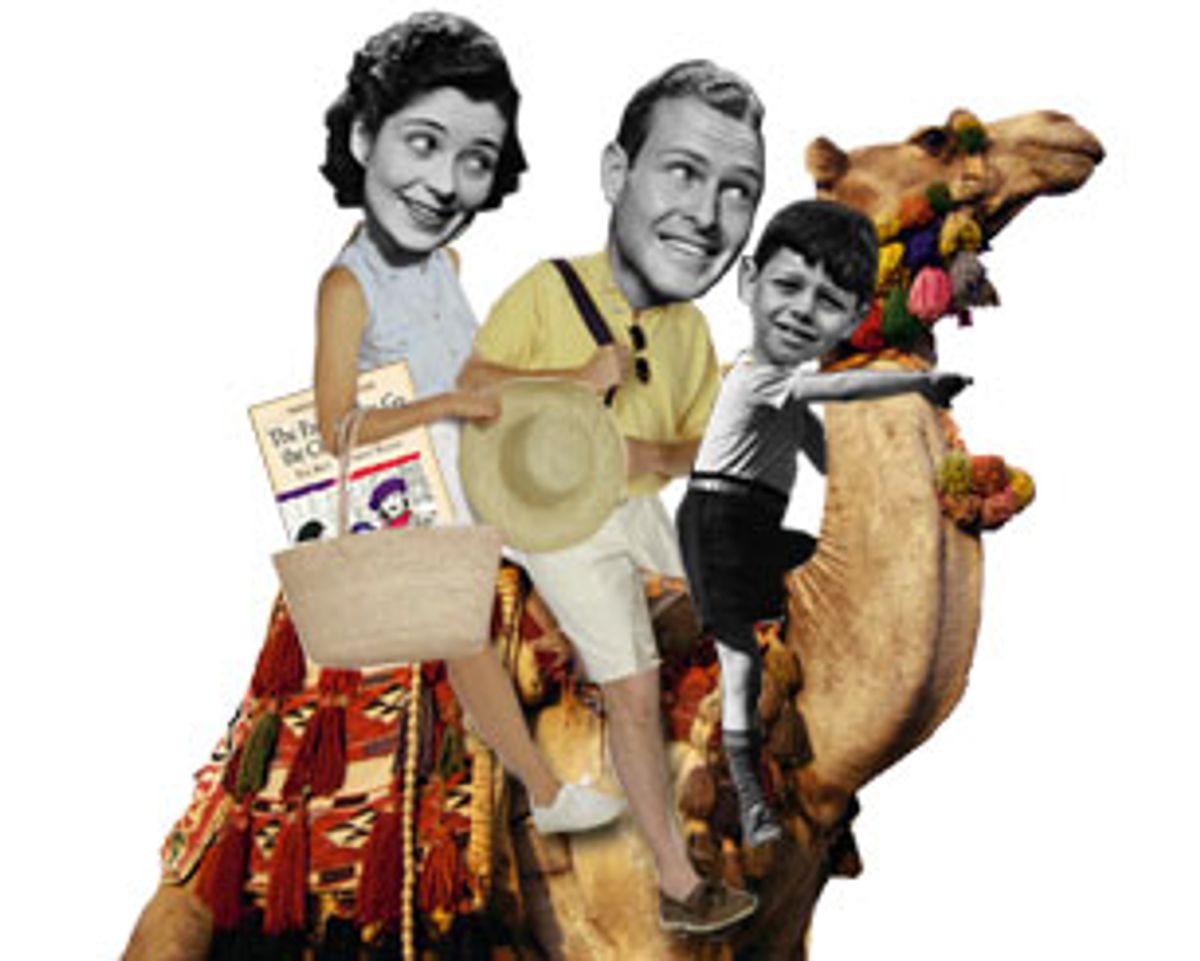
Family trips do not normally lend themselves to great travel literature. The kind of attention and reflection that travel writing demands are antithetical to the whole family travel experience. It's hard to lose yourself in a cathedral revelation or museum epiphany when your daughter is screaming to have her diaper changed, or your son is telling you for the 20th time that he's hungry and wants to go back to the hotel now.
When you travel alone, you're free to wander at whim, to spend hours in front of that one Monet painting if you want to, to read, sip and scribble an afternoon away in a sidewalk cafe, to spontaneously hop on the slow boat to Lindos or the horse cart to Bukittinggi. And as a solo traveler you're befriended by English-practicers at every turn; opportunities for serendipitous encounters and detours abound.
When you travel with your family, on the other hand, you're about as approachable and flexible as an expeditionary force. It takes hours just to get from your hotel room to the beach outside your window. When your children are young, you need Sherpas to carry all the accouterments you require; when they're older, you need security guards. Spontaneity doesn't often happen -- and when it does, it necessitates profuse apologies and large sums of cash.
"Family vacation" is an oxymoron. And yet, somehow, more and more families are traveling more and more places than ever before.
Actually, my family is a happy example: Our first child was born 13 Augusts ago, and a couple of months later, I was named travel editor of a major metropolitan newspaper. At that time I decided the universe was issuing me a challenge: Here are your wings, and here are your roots. Marry them.
And we did. Before my daughter had started preschool, we had visited Japan, Australia, Mexico and Hawaii. When our son was born four years after her, we kept going: Hong Kong, Greece, France, Fiji, plus more Japan, Mexico and Hawaii. We'd adapted our traveling ways, but we hadn't curtailed them.
And everywhere we went, we met other families who were similarly staking their claim in this brave new world. People who had explored Asia and Europe in the 1960s and '70s weren't going to let a child or two get in the way of their global explorations; travel was stitched into the very fabric of their lives.
This phenomenon is the unspoken raison d'être of a new anthology in the Travelers' Tales series, "Family Travel: The Farther You Go, the Closer You Get."
Much as I admire the Travelers' Tales books, I must admit that I approached this one with trepidation. In my experience as a writer and editor, compelling articles about family travels are as rare as Buddha-babies on transatlantic flights. At times -- usually when I am on deadline, contemplating a blank screen with increasing desperation -- it has seemed to me that family travel and good travel writing are simply incompatible. And yet, as many of the offerings in this surprisingly enjoyable anthology show, children can be extraordinary travel companions, who deepen and enrich our understanding of the world. You just have to learn to read a different map.
This theme runs throughout the volume, beginning with the introduction by editor Laura Manske, who writes: "My eleven-year-old son, Max, and my seven-year-old daughter, Natasha, ask 'Why?' when I otherwise would have moved on. I would have missed so much if I hadn't had these little magnifying-glass people with me. They give me balance. They give me roots. They give me stronger wings. They encourage me to look under the leaves in the proverbial forest. So I explain and explain again, and consider my children's innocent and often insightful queries as precious gifts that open doors."
Or as Mary Morris writes in the anthology's first piece, "Blessed": "What you get is this: You get to see a child's eyes the first time she sees an ocean or an elephant, smells a pine forest or gazes at the ongoing narrative told from the window of a train. You experience the world as the child experiences it, for the first time, all over again."
Of course, family travel encompasses generations preceding as well as succeeding, and some of these stories deal with adult children traveling with elderly parents. Others expand the concept of family even further: An exchange student finds a second family in Italy, an American visits the family of his foster child in the Philippines, a miscarriage on the road forges a culture-bridging bond, travelers look for ancestral roots or for vestiges of their own childhoods.
While many of the pieces are not especially satisfying tales in a dramatic
or literary way, nearly all have a pertinent and penetrating point to make.
I will never forget, for example, this lovely sentence from James
O'Reilly's "Road Scholars": "It occurred to me like a bell struck in the
night that the only legacy worth having is one of kindness."
Or this sentence from Jane Myers' "Past Imperfect, Future Not So Tense,"
the remarkable story of a family that, at the request of their children, reunited
years after their parents' divorce for one last family vacation:
If, as the writer Pat Conroy observed when his own marriage fell apart, "Each
divorce is the death of a small civilization," then perhaps our days together
can best be understood as the reconstruction, if only temporarily, of a small
civilization, a civilization more filled with splendor, more intriguing to
the children who were part of it than Pompeii or Troy or King Tut's tomb
could ever be.
I read these words, and I think again about how fragile family ties are,
and how precious -- how, when all is said and done, there is nothing more
important to me in the universe.
And this, I realize, explains some of the life-choices I have made: We sacrifice some things to gain others. I travel with the kids, and I curtail my days to spend time with the kids at home too. Life is short, time is fleeting, and I do not want to look back with regret someday and think, "Where was I when the children were growing up?"
Of all the fine lessons in this volume, the one that really stays in my
heart is Chelsea Cain's "A Room in Oaxaca." Cain's story centers on her mother, who, after being diagnosed with cancer, decided to travel throughout Mexico on her own for the last years of her life, then finally settled in Oaxaca. In the piece Cain has journeyed to
Oaxaca to see the room in which her mother chose to spend her dying
months. She wants to find what her mother found there, Cain
says. Then, near the end of her essay, she writes:
My mother said that cancer is like one long existential moment. Because when
you are dying, everything is different. Everything looks different.
Everything feels different. Because you are different. All at once you are
stripped down to what you really are: mortal. And one of the first things you
realize is that everyone is dying.Your parents are dying. Your children are dying. And the really amazing thing
is that none of them seem to know. They are all so concerned with your wellbeing because you might die that night or in a year or two, when they are all
in the same imminent danger. And you want to scream at them: Don't you see?
Your house could burn down tonight. You could fall down the stairs and snap
your spine. A small plane could crash on the freeway, taking your Volvo with
it in a hail of fire. Your cells are, at this very moment, breaking down and
disintegrating and aging one by one. You're sick. You need to take stock of
your life. You need to follow your bliss. You need to save your soul.That's when you catch yourself, and slowly you begin to realize that you are
completely on your own.
I read these words, and I think about my parents. I think about my children. I
think about the parents of my children's friends, how they look older every school year; I look at myself in the
mirror. We are all dying. Today is the first day of the rest of your death.
But if this is true, then its converse is true as well: We are all being
born anew, over and over, each and every day. Every day we grow, every day we learn, every day brings new marvels and miracles. Children know this, but we have to re-learn it -- day by day.
Travel innocently and wholeheartedly embodies this. When we travel, we are constantly nourished by new things -- places and people, history, culture and creation, sights and tastes, textures and scents. We grow like vines -- and when we travel with loved ones, we twist around them, all green and full of sap, stretching toward the sky.
I owe my love of travel to my parents, who used to bundle
my brother and me into our car and set off on a road trip every
summer -- sometimes to North Carolina, sometimes to Nova Scotia, sometimes to
upstate New York. Where we went didn't matter so much as the fact of our
going. I will never forget the sensation of watching the world pass by the car window -- and the wonder of arriving in a new world with new people, new restaurants, new beaches and swimming places and woods for long walks. Every place taught me things -- not just about that world, but about my parents, my brother, myself.
More than anything, I think now, I want to share this with my children: I want them to glory in the planet's ever-changing wonders, to sink deep roots in the soil of our travels, to stretch their wings in our wanderings.
These days my parents visit us at least once a year. Whenever they come, I reflect on what a miracle it is to watch my father walk along a beach holding my daughter's hand, or to see my mother and my son squeal together in glee at the antics of a monkey in the local zoo. Small things. Precious things. Vines that leap and shine.
Children and parents teach us how short life is -- and how long. Journeys teach us how large the world is -- and how small. Marry them -- family, travel -- and they offer lessons that intertwine: about connection and continuity, about the boundaries that constrain us and the bonds that, transcending them, abide.
Shares