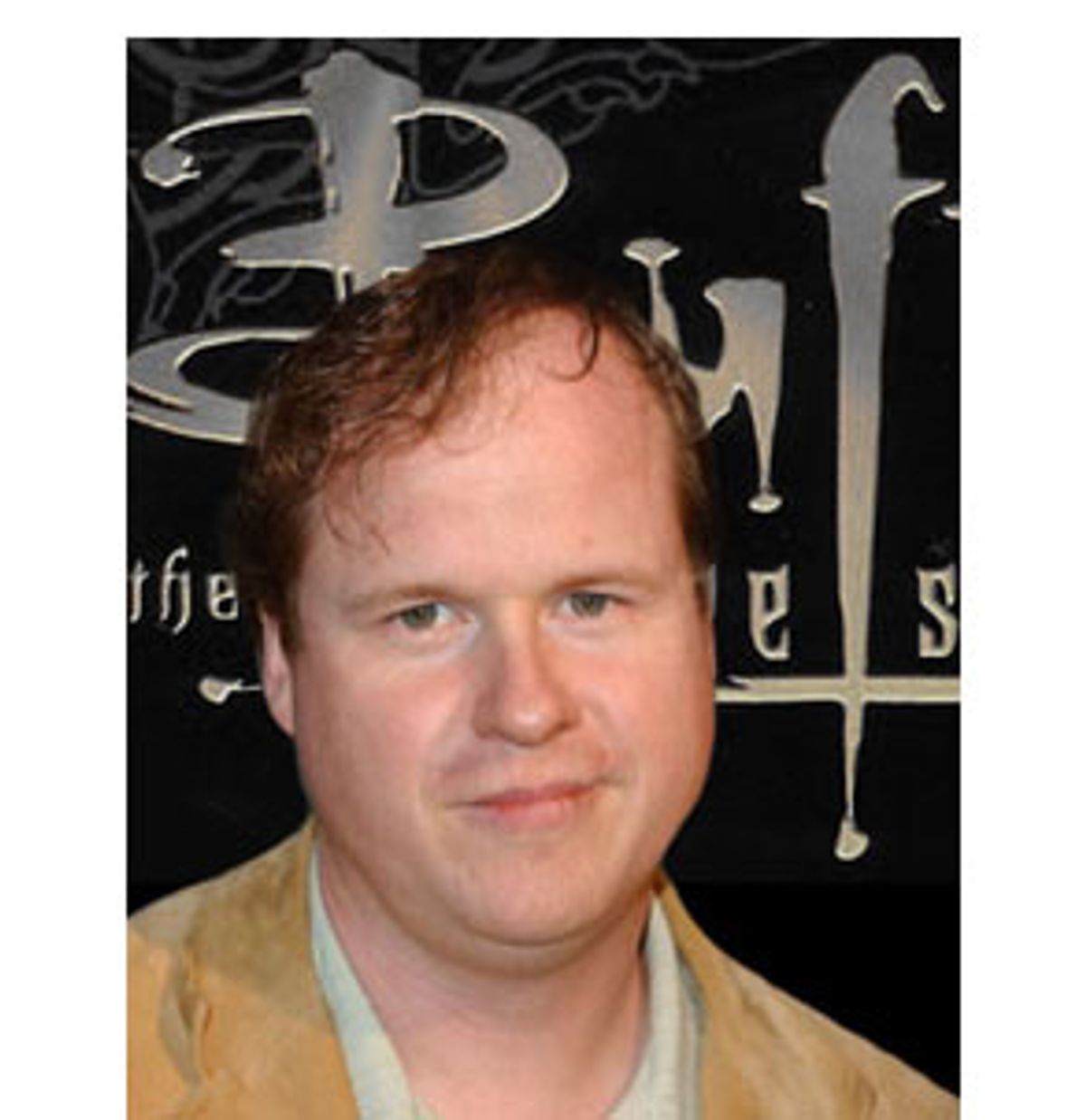
Not many people can create a cult phenomenon, and few of those set out to do it from the start, so fans of Joss Whedon's "Buffy the Vampire Slayer" may be forgiven for suspecting the writer/director of possessing superpowers rivaling those of his famous heroine. It would be exaggerating to say that his statements are studied like the utterances of the Oracle of Delphi, but let's just say that after seven years as the genius behind the Buffy universe, Whedon has learned to measure his words carefully.
Salon reached Whedon at his office in Los Angeles a few days before the May 20 broadcast of the final "Buffy" episode. We wanted him to answer a few of our own lingering questions about "Buffy" and perhaps to spill a few hints about the future -- for the "Buffy" characters and for Whedon himself.
How do you think longtime fans of the show will feel about the final episode on May 20?
It will make some people happy, it will make some of them angry, and if people aren't crying at least a couple of times during it, we won't have done our job.
Buffy started out seven years ago as a new kind of hero, one that broke the traditional masculine mold. Instead of deciding that her destiny sets her apart from regular people even though she devotes herself to protecting them, she was always determined to have a life. But lately, she's been acting a lot more like an old-fashioned male hero.
This last season has been about that, taking the idea of how the Slayer is different from other people and really exploring it. The last episode is in fact about that very issue. Part of that has to do with where we want to go with the message of the season, which is really contained in the last episode, deal with the idea of separateness. And honestly, some of that comes from the actors. Ultimately there always had been some separation between the star and the ensemble. You find that bleeds into your storytelling. The way that Giles got hipper and Willow got sexier. Because that's who [the actors] were. You live with these people and interact with them for the past seven years and that starts to creep in. The whole "I'm a stalwart hero who does the job" sort of came from Sarah [Michelle Gellar] a bit.
It also came from "I've come back from the dead!" This is no small thing, no coming out of the shower. You don't buy that back cheaply. Whereas last year Buffy went to a place of dark questioning, which is very much not Sarah, this year was about "OK, I have this power that sort of separates me from the rest of the world," which in a weird way is the life of a star.
She's also dealing with authority, too, how hard it is to be in charge.
That's just me. Everybody has been in a similar position in one way or another, but a lot of that [groaning] "Hey, being in charge is really hard!" is me, whingeing.
Was being in charge harder than you thought it was going to be back when, as a screenwriter and script doctor working on movies like "Speed" and "Toy Story," you weren't in charge?
No, actually, it was a little easier. When you're in charge you really get to do things your way, and ultimately it's better than the other thing. But having said that, it is not a small amount of responsibility and sometimes the weight of it ... the weight of "I need this to be as good as it can be and I need it to send the message I want to send and serve as what the fans want and need, and I need to do that 22 times a year -- no, wait, 44 times a year." There is a great pressure that nobody else is feeling. At the same time, nobody else is feeling the total grand plan. Everybody sees a portion of it. But ultimately most of it has to be seen by me, the panorama, and that changes your relationships. And that's something we explored with Faith. When Faith became the leader of Buffy's group, she had to become the leader. It's different from, "Hey, I'll just run things for a while."
That said, everything in my power is done to show off other people as much as possible and to share power -- and to get out of things.
You're known for having that master plan, for having mapped out the whole arc of the story, not just within a season, but also from season to season. But there must have been changes to that plan over the years, stuff you couldn't help or that you realized as you went along would be better if you did it another way. What were some of the big changes from your master plan?
The master plan does not have a master plan. Television ultimately finds itself, and after it finds itself, it finds itself changing. I'd have a year plotted out, maybe two years in advance. And I had the major points that I knew I needed to hit and they would serve as anchors and we'd get from one to the next, and that was great. But the rest you deliberately don't have a master plan for, because you don't know what's going to happen. Apparently people seem to be responding to this Boreanaz fellow [David, the actor who plays Angel]. Apparently Seth [Green, who plays Oz] is gone. Apparently this villain isn't working out and this one's popping like crazy. You need to improvise, you always need to.
TV's like whitewater rafting: Without rocks, there wouldn't be rapids, and it wouldn't be as much fun. Rolling with it gave us Tara and Willow coming out. It gave us Spike falling in love with Buffy. Rolling with it found out that Anya and Andrew were comic geniuses. You plan your ideas and themes, and then you let the rest form naturally, and then it feels real. It doesn't feel like you're imposing something on everybody. Ultimately, the staff -- who are the biggest fan-geeks in the world, and I'm including myself -- when they watch an episode have to feel the way the audience does, and more importantly the characters have to feel the way the audience does. If the audience doesn't buy that Buffy's brought back from the dead, then Buffy can't buy it. They've got to go, "I can't believe this has happened. It's horrible." If the audience is feeling the loss of Angel and feeling that she can't have a relationship with Riley, she's got to feel the same way. You feel that out.
But sometimes you push back against some of the things the fan base, which is so possessive, wants.
Sure, yeah. There's obviously the fact that Angel has his own series now, so what are you gonna do? It's not like we're reading the Internet and going, "OK, Ain't It Cool says blah blah blah." We take our fan base's opinions and concerns very seriously, but at the same time we're the storytellers.
In terms of the Angel thing, the truth is that by Year 4 we would have been throwing up our hands going, "How can we possibly make this fresh?"
Often what the fan base wants is for two characters to get together romantically, but that often doesn't leave the narrative with anyplace to go.
It's Sam and Diane [from "Cheers"]. That's why we had Angel go bad when he and Buffy got together. Because -- and I've gotten into so much trouble for this phrase -- what people want is not what they need. In narrative, nobody wants to see fat, married Romeo and Juliet, even if fat, married Romeo and Juliet happen to be [Dashiell Hammett's detective couple] Nick and Nora Charles and they're really cool and having a great time in their lovely relationship and really care about each other and have nice, well-adjusted children. Guess what? People don't want to see it.
That was the problem we ran into with Riley. We said, "Let's give Buffy a healthy relationship," and people didn't want it. They did some great work together. But at the same time, when they were happy, it made people crazy. We found this with Willow and Tara, we found it with Gunn and Fred [from "Angel"]. It's fine for a while, but ultimately the course of true love is not allowed to run smooth.
Were there things you planned to do that you had to abandon? In particular, I know a lot of people who speculate that Buffy and Xander were once intended to get together.
That was fluid. The concept was in the air and they both sort of got pulled in different directions storywise and we didn't feel like there was some big point we weren't paying off, so we ended up not doing it. We liked him with Anya, and she had a lot going on, and it didn't really seem to be the thing. The concept was out there, but it was never a mission statement. A lot of concepts were out there, then you sort of wait and see. Besides, Xander got so much goddamn tail. I'm sorry -- that's a nerd? He went out with Cordelia, he had an affair with Willow, he lost his virginity to Faith. He nearly married Anya. The guy's James fucking Bond over here. It's a lie! It's a lie!
Anything else?
I had a huge arc planned for Oz.
That was a heartbreaker.
It was, and so Willow got her heart broken. I took what we were feeling and put it on-screen, so everybody would be on the same page.
What was your idea for Oz?
I mean the thing with him and Veruca, the female werewolf, and that triangle. That was going to run through a good portion of that season. I really wanted to see where we could go with that. Paige Moss was really cool, she did a great job. But she only did it for a couple of episodes because we lost the boy. But then four episodes later I got to meet Amber Benson [who plays Tara]. So, like I said, you gotta have the rocks.
Sometimes we had guest-star issues. Quite frankly, I had planned to see Tara again later this year and Amber decided against it. I'm not unhappy because we got to make the statement with [Willow's new girlfriend] Kennedy that you can move on and you can live. It's scary, and we've played a couple of episodes about how frightening it was for Willow to enter into another relationship, how it felt like a betrayal -- because it felt like that to the audience. That was an interesting place to go. You know what they say, every time a door shuts ...
Would Willow have become gay if Oz hadn't left?
It's very possible. The idea of exploring somebody's sexuality and that it would probably be Willow was out there. Then Oz left. And we thought, how do you follow Oz? People loved the shit out of him, though they hated him when he first arrived. The one romance that we could give her that would really affect people in a new way would be with a woman. We didn't know how far we were going to go with it.
In the same way, Dawn was the next Riley. When we did Dawn, part of the mission statement was, let's have a really important, intense emotional relationship for Buffy that is not a boyfriend. Because let's not have her be defined by her boyfriend every time out of the bat. So, Season 5, she's as intense as she was in Season 2 with Angelus, but it's about her sister. To me that was really beautiful.
With Willow, we'd talked about the idea [of her becoming gay] and the opportunity was dropped in our lap, so we said, Let's do it as a sort of metaphor with this other witch. It's very physical, it's very romantic, it's very private. Then, we'll see where it takes us, and where it took us was to something more specific. We were pretty much accused of being coy and we had a lot of fun making metaphorical jokes. But we decided, yeah, these two have real chemistry and this is clearly a romantic relationship and there's no reason not to physicalize it because it means we will get a lot of really funny hate e-mail.
What, you were bored? You weren't getting enough as it was?
We weren't getting a lot of hate mail. I kept thinking we were going to [for earlier aspects of the show]. We were shooting one scene in the very first episode, and [executive producer] David Greenwalt was standing next to me saying, "You're going to be murdered." And I'm like, "What?" But ultimately people accepted what we were doing until Willow came out, and then not so much.
But we don't really think about that, any more than we were thinking about the people it would help. Then people came to us and said, "I was able to come out because of your show," and we were like, "Whoa! Well, we meant to do that." We're very conscious of our responsibility, but you can't make stories based on it, because stories are by their nature irresponsible. It's gratifying that we got to do something that really mattered to people. That wasn't why we did it, but it sure was cool.
This season you've had to come up with the ultimate villain, and the First, being disembodied, presents some challenges. Now you have introduced an evil priest as its main henchman, and I think he could be the scariest bad guy so far.
He's pretty creepy, isn't he? I love Nathan [Fillion]. He's an extraordinary actor who would not have been available had a certain door not shut, however temporarily [a reference to Whedon's series "Firefly," starring Fillion, which was canceled last year]. I want to come down against the patriarchy and there was simply no more potent image. At the same time, I'm not coming down against priests. This guy clearly is not one. He's very bad at it.
His denomination is kind of unclear.
Yeah well, again, it's the image of the thing. I believe that religion has contained within it an enormous amount of misogyny, and that cannot be denied. That's something that I will always bridle against and that image [a priest] is potent because of that. However, I have nothing against religion as a concept, or as people practice it. Religious institutions on the other hand, I believe cause people to fly planes into buildings. It's very dangerous. I do think that he is the creepiest priest. He is the most bald-faced misogynist we've had since, well, since last year, with Warren.
You've created a world where religion isn't to be trusted but some conventional religious items do have power in it. Crucifixes and holy water are still harmful to vampires.
Ultimately, I'm dealing with a vampire myth. It's not any huge secret that I'm an atheist. For me, the most radical thing I ever did was have Riley go to church. I thought that was really cool. It makes him really different from the people in my universe, and somebody who is new to me. I've never met a well-adjusted person. It's weird.
So I am an atheist, but I'm telling a vampire story and everyone knows that vampire stories involve crosses. You haven't seen many of them and we haven't done much with holy water, though we've used it on occasion. We pretty much stick to stakes. That iconography is not something I want to explore. However, I do use Christian mythology. Buffy, resurrected much? She pretty much died for all of us by spreading her arms wide and ... well, I won't go into it. That's what I was raised with. As much as I learned Greek myths and as much as I read Marvel Comics and watched "The Prisoner," I grew up around Christianity and Judaism and those are the prevalent myths and mythic structures of my brain.
Every vampire fiction reinvents vampires to its own needs. You take what you want. I took that they have to be invited into the house, which a lot of people apparently didn't know about. I had always grown up thinking this.
They're sometimes said to not be able to cross running water.
Yeah, I didn't use that one, although I've never had anyone jump over a stream. The idea of them looking like monsters and then looking like people, that was in "Lost Boys," and that was very useful for us. You could have somebody fool you, or someone like Angel seem like he's not a vampire and then he is one. You make up rules that you need and jettison the ones you don't. I had to jettison one of the rules from the movie, which was that Buffy had sort of a cramping every time she was around a vampire. In a series I didn't want her to always know when she was around a vampire. And that's too bad in a way because it was a very primal, feminist concept that she literally feels it in her womb, as it were. But I had seven years and she needed to be surprised.
Were there any other final notes you wanted to strike before the conclusion and couldn't, besides having Tara come back?
We also talked about bringing Oz back, and quite frankly we didn't have the money. We had a whole cool idea and we just didn't have a dime.
What's next on the agenda for you? You made an allusion to the demise of "Firefly" being only temporary.
I have hopes that there may be another venue for "Firefly," although I don't have any proof yet. But I've been fighting to find a place to do a version of that because I like the story so well and the actors so well.
Was that a big change to do a show that was centered on a grown man instead of a young woman?
It's so funny, because I have a lot of movie ideas and they all tend to revolve around young adolescent female superheroes. But not "Firefly." This one is about Joe Schmo, everyday life, and then of course I introduce River, the young female superhero. Let's face it, I'm just addicted. But it was nice to have a show that was about different perspectives and to really get to explore all of them. I was excited that I was going to have a happily married couple that was not boring. Because that's just so rare in fiction and it's such an important thing in life. And yet apart from [Dashiell Hammett's] Thin Man series, I think it's never really been adequately represented. And I had a preacher on board, to explore the concept of faith, people who don't have it and people who do. And of course the captain was the me figure because he's very tall and handsome, but cranky and also slim.
Are there going to be any all-new projects?
Yes, I think there are. What they are I can't say, obviously. I still have a deal with Fox, and I'll be running "Angel" and I believe there will be some development down the line. I definitely want to make a movie of some kind in the next couple of years. I have a number of ideas that are vying for my attention, sort of like a horse race. They're all at the starting gate and it'll be interesting to see which pulls ahead.
Both TV and movies?
Yeah, but I'm letting it be a void right now because I'm so fucking exhausted. It doesn't hit you until you let it. I used to get sick every season at the end of the season. My body said, OK, can I? After seven years I have to admit I'm kind of reeling. Now, I also have a 4-month-old child, so: double reel.
Is it going to be hard not to have "Buffy the Vampire Slayer" in your life? After all, that's what you've been doing for seven years.
You know, no. Because it really was time to stop. Like, I loved going to college, but I was happy to graduate. It was an extraordinary thing and there will never be anything like it again. Ultimately, I wasn't going on set as much, wasn't directing as many episodes. I was still very much involved, but the physicality of being there was less. The people on the show that I'm pals with I see anyway. I had a great crew, and hopefully I'll get to work with them again. I'll miss them, but I won't miss having to turn out 22 stories about Buffy in a year. I feel like we did the best we could for a long damn time and it's time to tell the next story. Even if it's about Willow.
Is that a hint?
No. If there turns out to be a spinoff with any of the characters, I'll be interested. It'll happen because we have something to say and not because we have an actor ready. But we won't have anything to say until we catch our breath.
A last question: Can you tell us about some of your favorite Buffy moments or stories from the past seven years?
Here are a few of my favorite things that also represent larger things. The scene where Angel has become Angelus but is pretending he's not and that he's just had a one-night stand with Buffy and that destroys her. When he came to her and said, "Why are you making a big thing out of it?" When he acted like a guy. I wrote that scene and thought, "I might be a worse person than I ever imagined because I am able to write this scene. I think I just tapped into somebody really horrible and it came rather easily." Ugh.
I would have to say the moment Amber and Tony started singing together [in the musical episode "Once More With Feeling."] That made my hair stand on end. That makes me so happy. First of all, it was the first counterpoint I've ever written. It was beautiful voices raised in song about really depressing emotions. My two favorite things put together.
Off the top of my head, Willow licking Willow. Just having double Willows, just the absurdity. That whole thing was such a romp. As a director, I didn't do too many of the romps. It was always, [in an agonized voice] "Oh, Angel, we can't ever be together!" Ally [Hannigan, who plays Willow] was like, "Your shows are always about Buffy," so I said, "I'll write one for you. In fact, there'll be two of you, what do you think about that?" God, some of the funniest stuff we ever did was in that episode, but also the scene where they find out that Willow is alive and everybody, everybody, is so goddamn funny. It's Giles, Xander, Willow and Buffy, the fearsome foursome.
Shares